



Finance teams across the UAE are rethinking how employees pay for fuel. Traditional reimbursement systems—collecting receipts, verifying claims, and reconciling them manually—consume hours each week and often leave gaps in VAT documentation. Small inconsistencies, such as missing supplier TRNs or faded receipts, can result in rejected VAT claims and incomplete expense records.
In today’s fast-moving operations, where sales teams, logistics staff, and field technicians are constantly on the move, these inefficiencies add up. Fuel represents a recurring, high-frequency cost that needs the same level of visibility as payroll or vendor payments. Yet, most organisations still rely on delayed reimbursements or petty cash systems that provide no real-time view of what is being spent, where, or by whom.
A gas card for employees directly addresses this challenge. Instead of waiting for expense claims, companies can issue controlled payment cards linked to approved budgets. Employees pay for fuel instantly, while finance teams view every transaction as it happens. The result is less time spent on reconciliation, improved cash management, and a stronger audit trail for compliance.
A recent EY benchmarking study found that manual expense management tasks cost an average of US$4.51 per data-entry item when processed without automation—costs that compound significantly for recurring categories, such as fuel. For UAE-based businesses subject to VAT, adopting automated expense solutions is not just operationally efficient but strategically essential.
Key Takeaways
- Manual reimbursements and paper receipts make fuel expense tracking slow, error-prone, and non-compliant in the UAE.
- Companies now prefer gas cards that give employees controlled spending access while giving finance teams real-time visibility.
- Options include station-issued cards, open-network fleet cards, and modern corporate cards with fuel-only controls.
- Choosing the right model helps finance leaders maintain control, recover VAT correctly, and simplify month-end reporting.
Understanding the Concept of Employee Fuel Cards
At its core, a gas card (also known as a fleet or fuel card) is a payment instrument issued by a company to authorised employees for fuel purchases. It’s typically pre-funded or linked to a corporate account and restricted to fuel-related merchants. Each transaction is automatically recorded, categorised, and visible to the finance department.
These cards are fundamentally different from regular debit or credit cards. Unlike general-purpose cards, fuel cards can be limited by merchant category codes (MCCs), ensuring they work only at petrol stations or service centres. Administrators can also set limits—daily spend caps, litres per transaction, or even time-of-day restrictions.
In the UAE, fuel cards serve another important function: VAT compliance. Every purchase generates a digital trail and, when combined with AI-backed receipt capture, ensures that invoices meet Federal Tax Authority (FTA) requirements. This means every litre purchased has a valid, reclaimable VAT record.
For finance teams, that translates into fewer errors, faster closings, and stronger control over how company funds are used. For employees, it removes the friction of paying out-of-pocket and waiting for reimbursements.
→ Also read: Fleet fuel cards for small businesses in the UAE
Exploring the Main Types of Fuel Cards in the UAE

Different types of fuel cards cater to different operational needs. Broadly, UAE companies can choose from three categories: station-issued cards, network fleet cards, and corporate cards with built-in fuel controls.
1. Station-Issued Fleet Cards
These are offered by major fuel providers such as ENOC, Emarat, and ADNOC. They operate on closed networks—usable only within their branded service stations. Each card can be assigned to a vehicle or driver and often requires a PIN for every purchase, making it suitable for large fleets that refuel in predictable routes.
However, while they simplify control within one fuel brand, they can be restrictive for businesses whose teams operate across emirates or regions where station availability varies. In addition, integration with accounting systems or expense management tools is limited, requiring manual reconciliation or exports from vendor portals.
For organisations that refuel consistently at a single network—say, a logistics company operating within Dubai or Abu Dhabi—these cards can still deliver efficiency and tracking benefits.
Also read: Corporate card reconciliation guide
2. Network Fleet Cards
Network or open-loop fleet cards function on Visa or Mastercard infrastructure, allowing use across multiple petrol station brands nationwide. These cards often include detailed reporting, fuel-type restrictions, and control settings based on merchant categories.
Because they connect to wider payment rails, finance teams get consolidated statements covering all transactions—fuel, oil, and service centre purchases—across brands and cities. They also allow better visibility into consumption trends and are especially useful for distributed or cross-emirate operations.
However, network cards can come with higher service fees or minimum volume thresholds for rebates. Some providers also limit access to advanced VAT-ready data, requiring manual invoice uploads.
Also read: Expense management software for business spend tracking
3. Corporate Cards with Fuel Spend Controls
The newest and most flexible option, these cards combine the acceptance of network cards with the precision of modern spend management software. At Alaan, we help finance teams issue corporate cards that can be restricted exclusively to fuel merchants, enforce per-card limits, and capture every receipt automatically.
Transactions appear instantly in dashboards, with AI-powered tools verifying receipts, extracting VAT fields, and matching data to ERP entries. This means no manual reconciliation, no missing tax invoices, and no out-of-pocket spend for employees.
These cards are ideal for companies that want to centralise all spending—including fuel—under one platform without sacrificing control. Finance teams can fund, freeze, or adjust limits instantly while maintaining complete compliance.
Also read: Corporate cards for startups
Selecting the Right Fuel Card for Your Organisation
Choosing the right model depends on how your business operates and the kind of control your finance team needs.
The three fuel card categories—station-issued, network-based, and corporate cards with fuel spend controls—serve different priorities: coverage, compliance, or integration.
Below is a practical comparison for UAE finance leaders evaluating their options.
Finance leaders managing diverse teams—sales, operations, logistics, or field support—often find that corporate cards with fuel controls deliver the best balance of flexibility and governance.
They consolidate all expenses, automate tax compliance, and provide granular visibility without the administrative weight of running separate systems.
→ Also read: VAT compliance health check for UAE businesses
Managing VAT Compliance for Employee Fuel Transactions
Fuel expenses are VAT-eligible in the UAE, provided the business holds valid FTA-compliant tax invoices.
This is where finance teams often face challenges—handwritten receipts, missing TRNs, or duplicate invoices can make input VAT claims invalid.
To remain compliant, every fuel transaction must have an invoice containing:
- Supplier name and address
- TRN (Tax Registration Number)
- Date and tax invoice number
- Fuel amount and total VAT charged
- Business name of the purchaser (when applicable)
For companies handling dozens of fuel receipts daily, this verification process can become unmanageable without automation.
Modern expense management platforms now use OCR and AI tools to read receipts, extract VAT data, and flag errors instantly.
At Alaan, we’ve designed our platform to check every uploaded fuel receipt for FTA-compliant fields and alert finance teams to missing information before submission. This ensures no reclaimable VAT is lost due to avoidable documentation gaps.
→ Also read: Manage VAT in QuickBooks UAE and KSA
Establishing Effective Spend Controls

Fuel is one of the easiest expense categories to misuse when governance is weak.
Effective spend controls don’t just block unauthorised purchases—they also drive accountability and prevent leakage.
Here’s how leading finance teams in the UAE are tightening oversight:
- Transaction limits: Set daily or per-refuelling spend caps to prevent over-purchase.
- Merchant restrictions: Allow transactions only at registered fuel vendors
- Location-based control: Limit fuel usage to predefined regions or routes.
- Time-based control: Block purchases outside business hours.
- Real-time alerts: Get instant notifications of off-policy spending.
- Instant freeze/unfreeze: Temporarily disable cards when vehicles are inactive or employees exit.
With these controls, CFOs maintain strong governance without restricting legitimate operational needs.
At Alaan, we give finance teams the ability to adjust all these parameters instantly through a unified dashboard—no calls to banks or manual approvals required.
[cta-5]
→ Also read: Understanding chart of accounts guide
Rolling Out Fuel Cards Across the Organisation
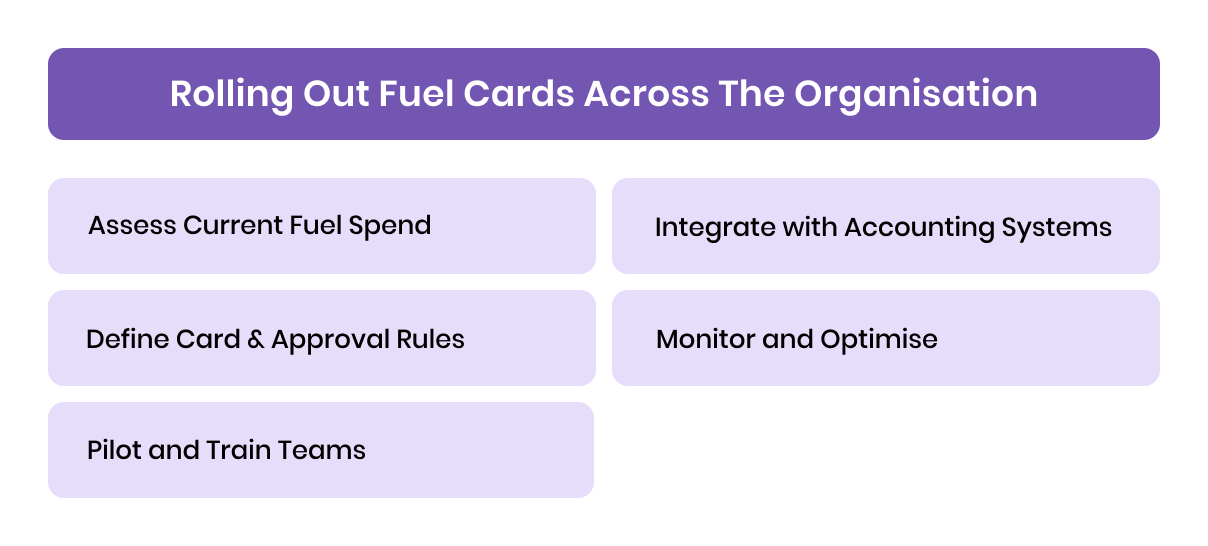
Transitioning to controlled fuel cards doesn’t have to disrupt daily operations.
The most efficient deployments follow a structured rollout plan that builds user confidence and compliance from day one.
1. Assess Current Fuel Spend
Analyse historical expense data—total monthly spend, number of drivers, and reimbursement delays. This helps define realistic card limits.
2. Define Card and Approval Rules
Set category restrictions, spending thresholds, and workflows for exception approvals.
For example, a senior sales manager may have a higher daily limit than a field technician.
3. Pilot and Train Teams
Start with a small group to validate card settings and VAT documentation flows.
Train employees on receipt submission timelines and personal-use restrictions.
4. Integrate with Accounting Systems
Connect the card platform to accounting tools like Xero, QuickBooks, or NetSuite to automate ledger entries and reconciliation.
5. Monitor and Optimise
Use dashboards to monitor real-time spending trends, policy breaches, and VAT claim success rates. Adjust controls as needed.
→ Also read: Cash flow optimisation strategies and techniques
Conclusion
Fuel expenses may look routine, but managing them well determines how efficiently a business controls costs and maintains compliance.
A structured card-based system eliminates manual bottlenecks, ensures every receipt meets VAT standards, and gives finance teams total visibility into spending patterns.
At Alaan, we help finance leaders take control of every dirham spent on fuel. Our AI-powered corporate cards and expense management platform bring automation, accuracy, and real-time insights to your business operations. Learn how Alaan simplifies fuel spend management across teams. Book a free demo today!
Frequently Asked Questions
1. Can corporate fuel cards be restricted strictly to petrol stations?
Yes. By configuring merchant category codes, administrators can ensure that cards function only at registered fuel vendors.
2. What happens if an employee uses the card for non-fuel items?
Such transactions are immediately flagged in the dashboard and can be reversed or deducted during reconciliation.
3. Is VAT reclaim possible without a printed tax invoice?
The FTA requires valid digital or printed tax invoices. AI-based expense systems can validate scanned receipts and preserve compliant digital copies.
4. Do virtual fuel cards work at the pump in the UAE?
Most fuel terminals require physical cards; however, virtual cards can be used for online top-ups or fuel app integrations where supported.
5. What security measures prevent card misuse or fraud?
Two-factor authentication, PIN-based transactions, and instant freeze features significantly reduce misuse risk.



%201.avif)
