



Finance teams across the UAE are navigating an environment where accuracy, speed, and compliance expectations have intensified. VAT regulations demand clean documentation. Multi-entity structures require consistent chart-of-accounts discipline. Digital spending has accelerated. And senior leadership increasingly expects real-time financial visibility rather than retrospective reporting.
Traditional approaches to expense management, collecting receipts at month-end, reconciling transactions manually, and adjusting entries before VAT submissions, no longer hold up under this pressure. They introduce delays, obscure spending patterns, and consume capacity that finance teams cannot afford to lose.
At the same time, companies are operating with more distributed teams, more digital tools, and more vendor transactions. The diversity and velocity of these expenses make manual oversight impractical. When information enters the system late or inconsistently, organisations risk misclassification, inaccurate accruals, and VAT leakage.
This is why streamlined expense management has moved from an operational improvement to a financial imperative. It ensures expenses flow into accounting systems accurately, immediately, and with complete supporting documentation, providing the control and clarity finance teams need without slowing down the business.
In this blog, we’ll explore what streamlined expense management looks like in practice, the operational and behavioural challenges finance teams must address, and how automation reshapes the end-to-end expense lifecycle.
Key Takeaways
- The most efficient UAE finance teams operate with real-time expense capture, policy-driven controls, and VAT-ready documentation from the outset.
- Automation + corporate cards create a workflow where expenses flow into ERPs accurately and predictably, reducing manual work and audit exposure.
- Organisations achieve true efficiency when technology, policies, and team behaviour align, turning expense management into an ongoing financial intelligence layer, not an administrative process.
What Streamlined Expense Management Looks Like in Practice
A streamlined process does not simply digitise expense reports. It reshapes the entire spending workflow so that evidence, policy logic, and accounting alignment are built into each transaction from the moment it occurs.
Real-Time Capture and Verification of Expenses
In efficient organisations, expenses enter the system as soon as payments are made. The supporting documentation, receipts, invoices, and VAT details are captured immediately, either through automated prompts or direct upload. This immediacy eliminates the typical gap between spending and recordkeeping, reducing errors and strengthening audit readiness.
When receipts arrive alongside transactions instead of days or weeks later, finance teams no longer need to chase information. Exceptions become easier to address because they are identified at the point of spend, not during month-end consolidation.
Policy Enforcement Embedded Directly Into Workflows
Streamlined expense management brings governance into the flow of spending rather than applying it after the fact. Card rules, merchant restrictions, project-specific limits, and approval pathways operate in real time, meaning transactions are shaped by policy from the moment they occur. Employees are not required to interpret ambiguous guidelines, and finance teams no longer have to interpret unclear submissions.
This approach removes friction by reducing the need for escalations and retroactive corrections. It also enables departments, sales, operations, and procurement to spend confidently within defined parameters.
Accounting and VAT Information Captured From Day One
In the UAE, the completeness of VAT documentation is as important as the accuracy of spending. Streamlined systems extract VAT amounts, TRN details, invoice numbers, and supplier information at the time of upload. This ensures companies maintain compliant records and avoid disallowed claims or audit exposure.
Equally important is the alignment with accounting systems. When category codes, tax treatments, and cost-centre mappings are applied automatically, entries reach the ERP in a consistent and usable format. Month-end close becomes a confirmation step, not a reconstruction exercise.
The Core Breakdowns That Prevent Expense Processes From Scaling
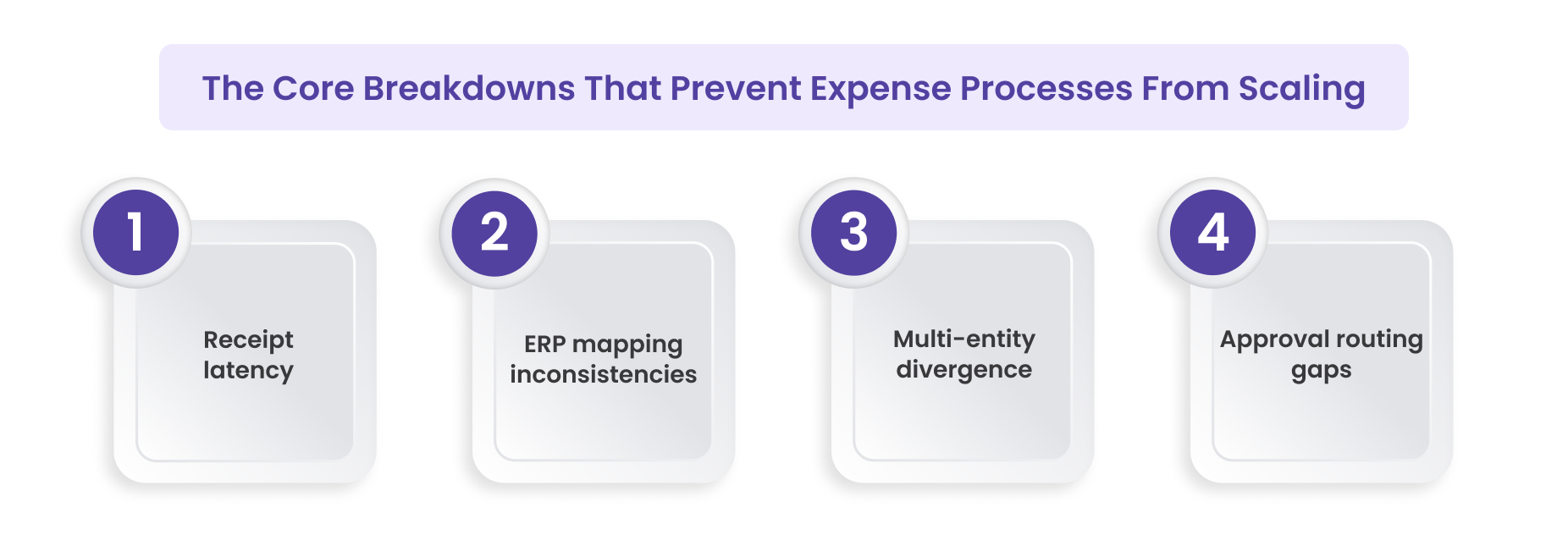
Even companies that adopt digital tools often struggle to achieve process maturity. The barriers are rarely about the software itself. They arise from structural and behavioural patterns within the organisation.
Structural Inefficiencies That Persist Even With Digital Tools
These issues typically appear as companies grow and diversify:
- Receipt latency: Employees submit receipts long after transactions occur, causing mismatches and incomplete VAT documentation.
- ERP mapping inconsistencies: Accounting relies on structured data, but expense submissions vary by employee, function, or entity, creating downstream correction work.
- Multi-entity divergence: Different subsidiaries operate with different approval flows and cost structures, making consolidation more difficult.
- Approval routing gaps: Generic or outdated workflows create bottlenecks, leaving finance teams to manually intervene to keep processes moving.
Each of these friction points has operational, financial, and compliance implications.
Behavioural Patterns That Create Bottlenecks
Digital tools reduce but do not eliminate behavioural dependencies.
Employees delay uploads. Managers approve without reviewing. Teams create workarounds when policies feel misaligned with how the organisation actually operates.
These behaviours accumulate and eventually overwrite any efficiency gained from automation. A streamlined system cannot succeed unless organisational habits support it.
Also Read: Modern Expense Management Guide
How Automation Transforms the Expense Management Lifecycle
Automation reshapes expense management by removing the dependencies that slow finance teams down. It ensures that every part of the lifecycle, from the moment of spend to ERP posting, moves without manual intervention. The focus shifts from gathering information to validating and analysing it.
Automated Evidence Collection and Transaction Matching
Automated systems close the gap between the transaction and its supporting documentation. When receipts are uploaded instantly or extracted through prompts, the platform can match evidence against merchant data, timestamps, and amounts in real time. This prevents the most common sources of inefficiency: missing documentation, incorrect VAT details, and unverified transactions.
Because the validation happens immediately, finance teams no longer need to follow up with employees at month-end or manually search for discrepancies. Exceptions become visible as soon as they occur, giving finance the ability to address issues early rather than retrospectively.
Real-Time Spend Controls Through Corporate Cards
Corporate cards play a central role in truly streamlined expense management. They bring governance closer to the moment of spend. Dynamic limits, merchant acceptance controls, and team-specific permissions ensure that expenses fall within policy before they reach finance.
This reduces escalations and rework. It also gives department leaders clearer visibility into what their teams are spending and why. For UAE businesses that manage distributed operations or large field teams, real-time card controls significantly reduce the risk of overspending or non-compliant submissions.
Virtual cards add further precision. They can be created instantly for a specific vendor, subscription, or project, and disabled when no longer needed. This level of control aligns spending behaviour with budget ownership.
Seamless Integration With ERPs and VAT Frameworks
The advantages of automation become most visible when expense data flows directly into accounting systems in a structured and compliant format. Mapping rules for the chart of accounts, tax codes, and cost centres ensure transactions enter Xero, QuickBooks, NetSuite, or Microsoft Dynamics correctly on the first attempt.
In the UAE, where VAT documentation must meet strict requirements, automation ensures that TRN, VAT amounts, invoice numbers, and supplier details are captured at the outset. This reduces the risk of disallowed VAT claims and strengthens audit readiness.
Finance teams benefit twice: the time spent correcting entries decreases, and the month-end close becomes more predictable and accurate.
[cta-9]
Also read: QuickBooks ERP Integration Guide
How to Build an Expense Management Model That Scales With the Business
Expense management processes often work adequately at a small scale, only to become strained as organisations grow. A scalable model requires more than additional approvals or broader controls; it demands clarity, consistency, and alignment between policy and practice.
Designing Policies That Reflect How Teams Actually Spend
Policies are effective only when they mirror operational reality. Sales, procurement, marketing, and operations incur expenses differently. When a single generic policy applies to all functions, exceptions multiply, and ambiguity grows. Scalable expense management requires policies that take into account how each team spends, what timelines they operate under, and which thresholds make sense for their workflow.
Creating Predictable Approval and Accounting Outcomes
Predictability is a sign of maturity in financial operations. Automated workflows ensure that every expense follows the right path, lands in the right account, and carries the correct VAT treatment. When approvals are routed based on amount, department, vendor type, or project, finance can forecast processing times and maintain a steady flow of validated transactions.
Predictability also supports budgeting. When expenses are consistently coded and posted in real time, leadership gains a clearer view of spend patterns and variances.
Embedding Accountability Across Roles and Functions
Even the most advanced systems rely on people to uphold standards. Employees must submit receipts promptly. Managers must review transactions with context. Finance must define rules that strike the right balance between governance and operational flexibility.
When accountability is embedded as a normal part of daily workflow rather than a compliance burden, exceptions decrease, and the system becomes self-sustaining.
Indicators of a Well-Streamlined Expense Management System
A streamlined system is not defined by the tools used but by the outcomes it produces. Finance teams can recognise maturity when the following indicators are consistently present.
Financial Indicators
- Expenses are captured and posted in near real time, improving cash-flow visibility.
- Budget owners can identify deviations early instead of waiting for month-end reports.
- Month-end close is faster because fewer entries require review or correction.
Compliance Indicators
- VAT documentation is complete and accurate without repeated follow-up.
- Audit trails are automatic, consistent, and easy to retrieve.
- Policy exceptions are rare and well-documented.
Operational Indicators
- Approvals move quickly because routing reflects real workflows.
- Employees understand expectations and meet submission standards without intervention.
- Finance spends more time analysing spend than collecting or validating information.
Also read: Effective Ways to Reduce Operating Expenses
How Alaan Enables a More Streamlined Expense Environment
Alaan is designed around the realities of modern finance operations in the UAE, where VAT requirements, distributed teams, and multi-entity structures create unique challenges. Our approach brings clarity and structure to the entire lifecycle of an expense, ensuring accuracy from the moment of spend.
Continuous Spend Visibility Through Corporate Cards
At Alaan, we enable teams to issue corporate cards instantly with controls that operate at the moment of purchase. Finance teams set merchant restrictions, spending limits, and team-level rules that reduce the likelihood of non-compliant spending. This gives organisations real-time visibility into expenses and eliminates downstream corrections.
Intelligence-Driven Verification and VAT Accuracy
Alaan Intelligence reads receipts, validates supplier information, detects duplicates, and extracts VAT details, including TRN, invoice number, and VAT amount. This ensures that evidence is complete, compliant, and matched to the correct transaction. Finance teams gain confidence that expenses entering the system are ready for approval and accounting.
Reliable Alignment With ERP and Multi-Entity Accounting
Alaan integrates directly with Xero, QuickBooks, NetSuite, and Microsoft Dynamics, ensuring that accounting entries arrive in the correct category, cost centre, and entity. For groups operating across multiple subsidiaries, this consistency reduces consolidation work and improves the accuracy of financial reporting.
By removing friction from each step of the process, Alaan allows finance teams to maintain stronger control without slowing down the organisation.
[cta-10]
Where Expense Management in the UAE Is Headed Next
As companies adopt more automation, the next evolution will focus on intelligence rather than digitisation. Systems will identify anomalies before they impact budgets, anticipate category mapping, and recommend spend adjustments. Vendor-level insights will inform procurement, and real-time dashboards will replace periodic reporting.
For UAE organisations, the emphasis on VAT compliance and audit readiness will continue to shape the direction of technology adoption. The companies that succeed will be those that view expense management not as an administrative function but as a source of financial insight.
Also read: Automation in Finance: Future Trends
Conclusion
A streamlined expense environment gives finance teams the clarity and control they need to operate at speed. When expenses are captured in real time, verified automatically, and aligned with accounting and VAT requirements from the outset, finance shifts away from administrative tasks and applies more of its time to analysis, planning, and decision-support. Compliance becomes easier, month-end becomes faster, and leaders gain a level of visibility they can rely on.
At Alaan, we help finance teams achieve this standard by bringing real-time spend controls, AI-driven verification, and accurate ERP-ready data into one unified platform.
If your organisation is aiming to strengthen financial discipline, reduce manual workload, and build a more predictable expense workflow, you can book a demo to see how Alaan supports a streamlined, compliant model that scales with your business.
Frequently Asked Questions (FAQs)
1. What does “streamlined expense management” actually mean for finance teams?
It refers to a workflow where expenses are captured, verified, and coded automatically in real time, rather than being reconstructed at month-end. The key shift is operational: finance teams spend less time collecting information and more time analysing spend, identifying trends, and improving controls.
2. Why is real-time expense data important for UAE businesses?
In the UAE, VAT documentation must be complete and accurate for each transaction. Real-time data ensures receipts, TRN numbers, VAT amounts, and supplier details are captured immediately. This reduces audit risk, prevents disallowed VAT claims, and strengthens financial reporting.
3. How do corporate cards improve expense control compared to reimbursements?
Corporate cards bring governance closer to the moment of spend. Merchant rules, dynamic limits, and function-specific controls ensure compliance is built into each transaction. With reimbursements, finance can only review and correct after the fact, making inconsistencies and non-compliant submissions more common.
4. What are the biggest signs that an expense process is outdated?
Common signals include late receipts, high exception volumes, manual ERP corrections, unclear approval pathways, and recurring VAT documentation issues. If finance teams spend most of their time following up with employees or reconciling inconsistencies, the process is no longer fit for scale.
5. How does automation reduce errors in expense management?
Automation validates receipts, extracts VAT information, matches evidence to transactions, and applies accounting rules consistently. This removes human variability, reduces duplicate entries, and ensures every expense lands in the ERP with the correct coding and documentation.
6. Does streamlining expense management reduce month-end workload?
Yes. When expenses flow into the system continuously, with correct coding and complete documentation, month-end becomes a confirmation step rather than a reconstruction effort. Finance teams close faster because there are fewer discrepancies, fewer manual adjustments, and minimal missing information.



%201.avif)
