



In 2025, many UAE companies are discovering that unmanaged vendor ecosystems are one of the biggest hidden risks to operational continuity.
A recent global survey found that 73% of organisations oversee more than 300 third-party vendors with only two or fewer full-time staff dedicated to managing that risk. This is a gap that often shows up as delayed approvals, compliance missteps, or surprise costs at month-end.
You know that vendor management is not a theoretical challenge. It is about tightening controls around compliance, payments, and risk while maintaining agility in a fast-moving market. In the UAE, where regulatory standards and cross-border vendor relationships add complexity, these pressures are even more acute.
This article goes beyond basics and explores 10 proven vendor management strategies designed to help you regain control, reduce risk, and streamline supplier performance.
Key Takeaways:
- Vendor Capacity Gap: 73% of organisations manage 300+ vendors with two or fewer staff, increasing the likelihood of compliance lapses and uncontrolled spend.
- Lifecycle Discipline: Treating vendor management as a full lifecycle creates clearer governance across sourcing, onboarding, monitoring, and renewal.
- UAE Compliance Pressure: TRN checks, VAT-ready invoices, and cross-border payments require stricter, system-level controls to prevent non-claimable VAT and delays.
- Operational Controls: Real-time monitoring, category-level budgets, and quarterly vendor reviews help teams detect cost drift and risk patterns early.
- Automation Advantage: Automated spend controls, receipt matching, and live dashboards reduce manual work, with Al Barari saving 200+ hours per month through process automation.
Vendor Management Lifecycle Overview
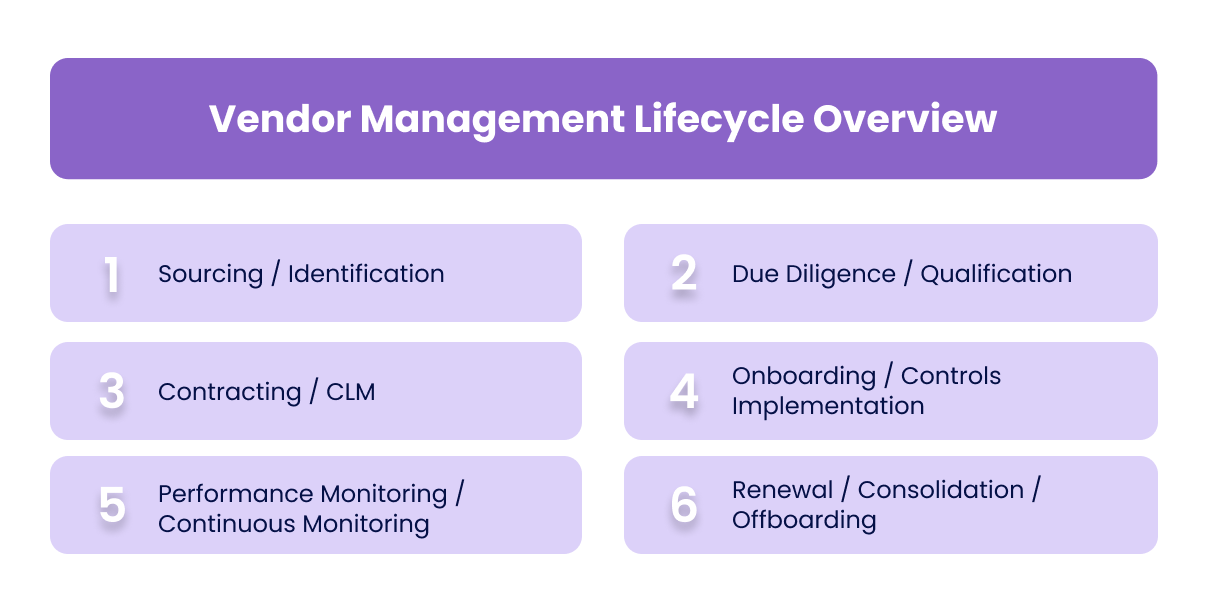
In practice, the lifecycle is where vendor management delivers, or loses, its strategic value. Mature organisations no longer treat suppliers as isolated transactions; they manage them as ongoing relationships that require governance, automation, and measurable controls.
Gartner consistently notes that the biggest third-party risks and value gaps emerge across the lifecycle, not at any single step.
Use this lifecycle as your operational playbook. Each stage should have one clear control, one supporting technology lever, and one governance checkpoint.
- Sourcing / Identification: Select vendors through a structured, criteria-driven process to ensure only qualified suppliers enter your pipeline.
- Due Diligence / Qualification: Validate financial stability, regulatory compliance, and operational risk before onboarding a vendor.
- Contracting / CLM: Formalise SLAs, commercial terms, and obligations using trackable, enforceable contract workflows.
- Onboarding / Controls Implementation: Set up payment methods, documentation, access, and approval workflows to operationalise the contract.
- Performance Monitoring / Continuous Monitoring: Track KPIs, SLA adherence, and risk signals to detect deviations before they escalate.
- Renewal / Consolidation / Offboarding: Make data-driven renewal decisions, consolidate overlapping suppliers, and securely offboard when relationships end.
With the full lifecycle in view, certain patterns start to emerge, and so do the levers that truly shape vendor performance.
10 Proven Vendor Management Strategies
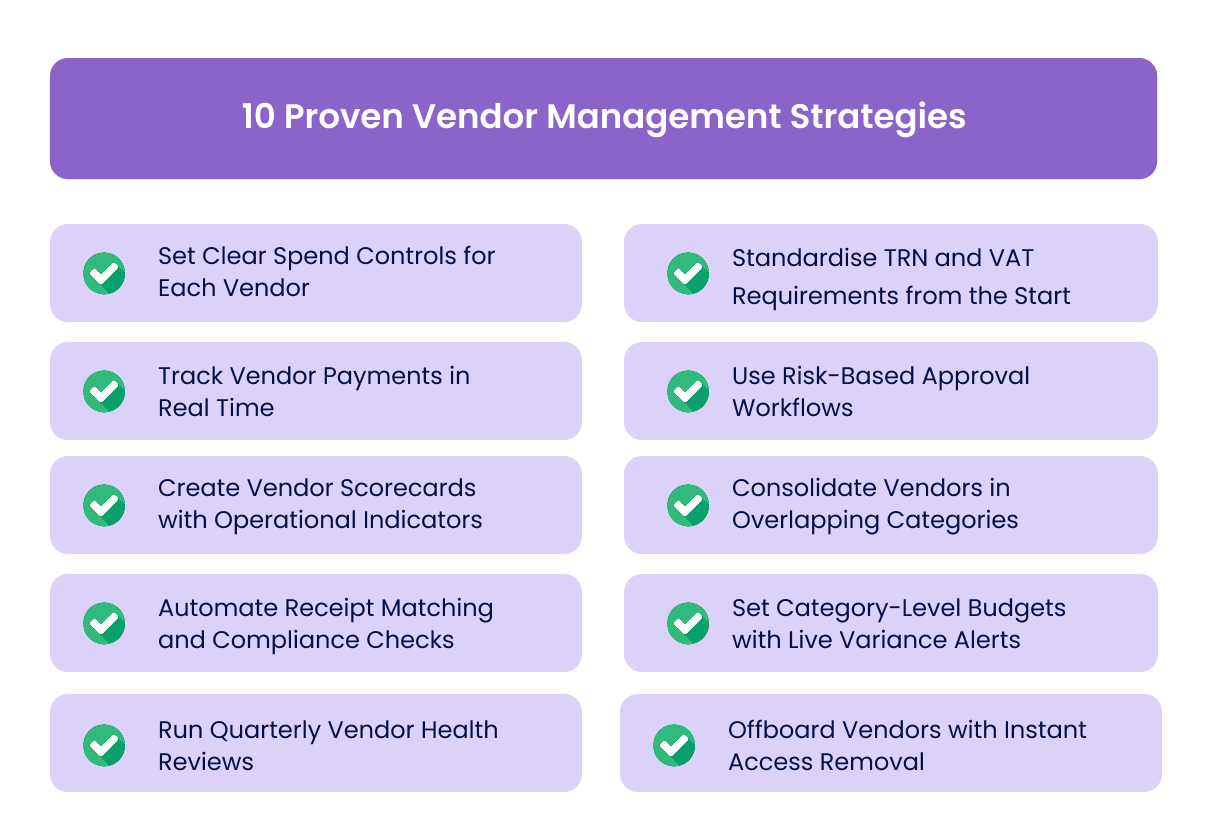
Vendor management in the UAE comes with its own pressures; TRN checks, VAT-ready invoices, and cross-border suppliers that need tighter control than most systems allow.
The strategies below reflect what teams here rely on to stay compliant, avoid delays, and keep vendor spend predictable.
1. Set Clear Spend Controls for Each Vendor
Vendor-level spend controls are essential in the UAE, where project costs, VAT treatment, and cross-border payments can vary widely by supplier. The objective is not to “limit spend,” but to pre-define the exact conditions under which a vendor is allowed to transact.
How to implement it:
- Monthly Caps: Set limits tied to project allocations, not department budgets, to prevent silent overruns.
- Merchant Categories: Restrict spend to approved MCCs, ensuring purchases stay within contracted scope.
- Approval Tiers: Apply thresholds by invoice type, such as higher scrutiny for service or import invoices.
- Variance Alerts: Trigger notifications when spend deviates from historical norms, indicating early risk.
Example:
A maintenance vendor may have an AED 40,000 cap, maintenance-only MCC access, and a second-level approval for any invoice above AED 7,500, controlling spend while keeping audit trails clean.
[cta-4]
2. Standardise TRN and VAT Requirements from the Start
VAT compliance issues in the UAE rarely appear at year-end. They surface at onboarding, when TRN details, invoice formats, and VAT calculations are inconsistent across vendors. Standardising these requirements early ensures every supplier enters the system with clean, claimable, audit-ready documentation.
How to implement it:
- TRN Verification: Validate the supplier’s TRN before activating them, ensuring the number is active and matches legal records.
- Invoice Standards: Mandate VAT-compliant invoice fields, including supplier TRN, VAT amount breakdown, and correct descriptions.
- Document Templates: Issue standard invoice and PO formats, reducing discrepancies that slow down reconciliation.
- Compliance Flags: Set automatic checks for missing TRN or incorrect VAT amounts, preventing non-claimable expenses.
Example:
If a marketing vendor submits invoices without a VAT breakdown, the system flags it immediately, prompting correction before payment. This avoids month-end rework and protects VAT recovery.
Also Read: How to Manage VAT in QuickBooks for UAE and KSA
3. Track Vendor Payments in Real Time
Delayed visibility is one of the main reasons vendor issues in the UAE are discovered too late, especially with cross-border suppliers, fluctuating FX rates, and VAT-sensitive categories. Real-time monitoring ensures every transaction is reviewed as it occurs, rather than weeks later during reconciliation.
How to implement it:
- Instant Posting: Ensure every vendor transaction appears immediately so teams can verify amounts, tax treatment, and documentation on the spot.
- Live Reconciliation: Match payments to POs and receipts as they occur instead of batching them at month-end.
- Exception Alerts: Trigger notifications for duplicate charges, incorrect amounts or unapproved merchant categories.
- Spend Trends: Review rolling daily and weekly spend patterns to catch anomalies before they disrupt budgets.
Example:
If a contractor posts an unexpected AED 12,000 charge mid-cycle, real-time visibility surfaces it instantly, allowing finance to verify scope and approval before it affects project margins.
[cta-4]
4. Use Risk-Based Approval Workflows
Not all vendors pose the same financial, compliance, or operational risk, especially in the UAE, where cross-border suppliers, import services, and regulated activities require additional scrutiny. Risk-based workflows ensure higher-risk vendors receive tighter controls without slowing down low-risk, routine transactions.
How to implement it:
- Vendor Tiering: Classify vendors (e.g., critical, high, medium, low) based on spend exposure, service type, and regulatory requirements.
- Approval Thresholds: Assign multi-level approvals for high-risk categories, such as international services, retainers, or ad-hoc project work.
- Invoice-Type Rules: Require additional checks for service invoices, imports, or items with complex VAT treatment.
- Risk Flags: Trigger escalations for unusual invoice patterns, repeated disputes, or deviations from contracted scope.
Example:
A cross-border technology vendor may require dual approvals for any invoice above AED 5,000. At the same time, a low-risk local supplier might follow a single-step approval, keeping controls tight where it matters most.
Also Read: Smart Strategies to Reduce Operating Expenses in the UAE
5. Create Vendor Scorecards with Operational Indicators
Vendor scorecards turn subjective impressions into objective, measurable performance data; a practice shown to help procurement and finance teams compare suppliers, spot trends, and highlight risk before it escalates. Scorecards consolidate key performance metrics into a single view that supports renewal and negotiation decisions.
How to implement it:
- Compliance Accuracy: Track invoice accuracy, VAT breakdowns, and TRN consistency to ensure audit-ready documentation at all times.
- Delivery Reliability: Measure on-time delivery rates and average delays; late fulfilment often signals deeper performance issues.
- Cost Metrics: Include total cost of ownership and procurement ROI to assess pricing stability and real cost impact.
- Responsiveness: Evaluate speed and quality of responses to issues and disputes as part of operational reliability
Example:
A vendor consistently scoring high on delivery and compliance but low on responsiveness may fulfil contractual obligations but still delay critical approvals; a trend you can address before it affects operations.
Suggested Read: A Guide for VAT Registration in the UAE
6. Consolidate Vendors in Overlapping Categories
Having multiple suppliers providing similar services increases administrative load, complicates VAT and TRN checks, and weakens negotiation leverage. Consolidation helps redirect spend towards a smaller set of reliable vendors, making compliance smoother and performance easier to track.
How to implement it:
- Category Mapping: Identify where several vendors offer the same service, such as logistics, maintenance, or marketing support.
- Spend Analysis: Review 6 to 12 months of spend data to find duplicated costs and low-value activities.
- Performance Comparison: Assess vendors on delivery consistency, documentation accuracy, and issue resolution.
- Rationalisation Plan: Move a greater share of work to the highest performing vendors with clear service expectations.
Example:
A company using three different maintenance vendors for nearby sites may shift to one provider with stronger SLAs and cleaner VAT documentation, reducing cost variance and approval delays.
7. Automate Receipt Matching and Compliance Checks
In the UAE, most reconciliation issues stem from inconsistent invoice formats, missing VAT fields, and TRN discrepancies that are only discovered at month-end. Automating receipt matching ensures that every vendor transaction is validated at the source, removing manual cleanup and reducing the risk of non-claimable VAT.
How to implement it:
- Auto-Matching: Connect each card or system transaction to its receipt on upload so finance can validate value, supplier identity, and tax treatment at the same time.
- VAT Validation: Check that the TRN, VAT rate, VAT amount, and invoice description meet FTA requirements, and quarantine anything that is incomplete.
- Exception Handling: Detect mismatches between receipt amounts and transaction amounts, especially common with deposits, partial invoices, and FX-based services.
- Pattern Monitoring: Identify repeated missing receipts or incorrect VAT entries from the same vendor, signalling a process or compliance issue to address directly.
Example:
A design vendor may submit invoices with correct totals but inconsistent VAT descriptions. Automated checks flag these in near real time, allowing procurement or finance to request a corrected invoice before approval, protecting VAT recovery and keeping audit files clean.
[cta-1]
Also Read: The future of AI in Finance: How is AI reshaping the financial landscape?
8. Set Category-Level Budgets with Live Variance Alerts
Category-level budgeting gives clearer visibility into how spend behaves across similar vendor types, which is particularly important in the UAE, where costs vary by project cycle, FX exposure, and VAT treatment. Live variance alerts help teams address deviations before they become end-of-month issues.
How to implement it:
- Category Allocation: Assign budgets to categories such as logistics, facilities, contractors or marketing, aligned with operational plans.
- Historical Baselines: Use previous cycle data to set realistic thresholds that reflect seasonality and cross-border fees.
- Variance Alerts: Trigger notifications when cumulative spend deviates from expected patterns.
- Cross-Vendor Comparison: Compare category spend across vendors to identify cost drift.
Example:
If the contractor spends for a category that exceeds its expected mid-month level, a variance alert prompts finance to review active POs before further charges are approved.
9. Run Quarterly Vendor Health Reviews
Quarterly reviews convert static scorecards into action. They bring procurement, finance, and operations together to spot trends, validate remediation, and agree on next steps before issues compound; especially vital in the UAE, where cross-border payments and VAT treatment can change vendor risk quickly.
How to implement it:
- Attendees: Include procurement lead, finance manager, ops owner, and a contract owner to ensure decisions are executable.
- Inputs: Use scorecards, spend variances, incident logs, VAT/TRN exception reports, and open disputes.
- Agenda: Review trends, SLA breaches, repeated documentation failures and FX or cross-border friction.
- Outputs: Produce an action log with owners, deadlines, and measurable KPIs for follow-up.
Example:
A review reveals rising dispute frequency for a logistics supplier; the team agrees to renegotiate transit SLAs, tighten invoice evidence requirements, and place two-month holdbacks until compliance improves.
10. Offboard Vendors with Instant Access Removal
Improper offboarding is one of the most common sources of financial leakage and audit exposure in the UAE, especially when vendors retain payment routes, system access, or active POs long after a contract ends. A structured offboarding process ensures obligations are closed cleanly and no residual liabilities remain.
How to implement it:
- Access Removal: Immediately revoke system permissions, payment methods and card access linked to the vendor.
- Final Reconciliation: Settle outstanding invoices, validate VAT and TRN details, and close open POs to avoid accidental charges.
- Asset and Data Checks: Confirm that documents, credentials, or shared files have been returned or revoked.
- Record Archiving: Store contracts, compliance documents, and communication logs for future audits.
Example:
When a facilities vendor is offboarded, finance closes all active POs, removes payment credentials, and archives VAT documentation, eliminating the risk of unintended charges or audit gaps.
With these practices in place, the final step is enabling them consistently at scale, which is where the right tools make a meaningful difference.
How Alaan Supports Better Vendor Management
Vendor management becomes difficult when payments, receipts, and approvals are scattered across teams, making it hard to track spend or maintain clean VAT records.
This was the challenge Al Barari (a renowned, eco-conscious luxury residential community in Dubai) faced across its entities before adopting Alaan. By centralising spend and automating receipt capture, they now save 200 hours every month, with clearer visibility and smoother vendor control.
This impact is driven by a set of tools that bring structure and accuracy to everyday vendor transactions.
- Corporate cards: Issue physical and virtual cards with limits and merchant controls to enforce vendor-level spend policies and reduce unauthorised charges.
- Automated receipt capture & matching: OCR and automatic matching ensure invoices contain VAT/TRN details before payment, protecting VAT recovery and audit trails
- Real-time spend dashboard: Live transaction visibility surfaces anomalies, duplicate charges, and budget drift so finance can act before month-end.
- Configurable approval workflows: Digitised policies and role-based approvals apply stricter checks to higher-risk vendor payments without slowing routine transactions.
- Accounting & ERP integrations: One-click exports, direct connectors, or API syncs push validated vendor transactions and receipts into ledgers, reducing reconciliation time.
If you want a cleaner, faster, and more reliable way to manage vendor spend, schedule a personalised demo with Alaan and experience the difference for yourself.
Conclusion
Vendor management works best when performance, compliance, and spend visibility support each other, not pull teams in different directions. And with vendor networks expanding and UAE regulations getting stricter, the organisations that stay ahead are the ones that keep things clear, consistent, and proactive rather than fixing issues at month-end.
That is why many teams, including Al Barari, turn to Alaan. It gives finance everything in one place, spend controls, real-time visibility, and automated checks; so vendor payments and documentation stay clean without the extra chase-work.
If you want to bring that same clarity to your vendor processes, book a demo with Alaan and see how much easier it is to manage suppliers.
FAQs
1. What makes vendor management more complex in the UAE?
Vendor management in the UAE involves TRN validation, VAT-compliant invoicing, cross-border suppliers, and multiple free-zone regulations, all of which require stricter documentation and clearer spending controls.
2. How often should vendor performance be reviewed?
Quarterly reviews are ideal, as they allow teams to catch trends early, address documentation issues and adjust contracts or expectations before problems escalate.
3. Why are real-time spend controls important?
Real-time visibility helps finance teams identify duplicate charges, incorrect VAT entries or unapproved transactions immediately, preventing errors from reaching month end.
4. What is the biggest risk of manual vendor processes?
Manual processes often lead to missing receipts, inconsistent VAT data and delayed reconciliations, which can affect audit readiness and VAT recovery.
5. How does automation improve vendor compliance?
Automation validates receipts, matches transactions, checks VAT fields and enforces approval workflows, ensuring vendors remain compliant without increasing administrative workload.



%201.avif)
