


Ask any finance leader what drives business success, and the answer rarely starts with revenue. It starts with control, the ability to see how every department spends, plans, and adjusts in real time.
That visibility begins with an operating budget. More than a financial plan, it’s a live reflection of how a business functions day-to-day, from payroll and procurement to travel and taxes. It’s where projections turn into performance, and financial discipline meets operational reality.
In the Middle East, where companies often scale faster than their processes, the operating budget has become both a map and a mirror: it shows where money goes, and how strategy unfolds. The most successful finance teams no longer treat it as a static document; they use it as a dynamic framework to track progress, optimise spend, and align decisions with business goals.
So, what exactly makes up an operating budget, and how can finance teams build one that adapts as quickly as their business does?
Let’s start with clarity.
Key Takeaways
- What an Operating Budget Does: It lays out expected revenue and operating costs for the year, giving finance teams a clear framework to plan, allocate, and monitor spend.
- Why It Matters: Accurate budgeting depends on visibility, real-time data, regular reviews, and clear tracking across departments, not static reports.
- How to Build It Well: Strong budgets rely on clean categorisation of costs, realistic revenue projections, cross-functional input, and built-in flexibility for market changes.
- Where Most Teams Struggle: Delayed data, spreadsheet errors, and fragmented ownership make budgets drift from reality; consistency and shared accountability fix that.
- Role of Automation: Tools like Alaan bring live spend data into the budget, enforce policy automatically, validate VAT, and keep forecasts accurate, turning budgeting into an ongoing control system rather than an annual exercise.
What Is an Operating Budget?
An operating budget is a company’s short-term financial playbook, a detailed outline of how it plans to earn and spend money within a specific period, usually a fiscal year.
It captures the rhythm of daily business life: incoming revenue, recurring costs, and the operational levers that keep everything running. Rather than a static spreadsheet, it’s a living document that evolves as markets shift, teams expand, or objectives change.
A strong operating budget does three things exceptionally well:
- Translates strategy into numbers. It turns business goals into measurable targets, aligning spending with outcomes.
- Keeps teams accountable. Department heads know what they can spend, and finance knows where every dirham goes.
- Bridges planning and performance. It links forecasts to reality, helping leaders make timely, data-led adjustments.
Unlike capital budgets, which focus on long-term investments like infrastructure or product development, an operating budget is concerned with the here and now, the costs and revenues that keep the business moving every day.
Agility in operating budgets has become a competitive advantage. With evolving VAT frameworks and tighter financial scrutiny, businesses need budgets that adapt as fast as they grow, providing a clear line of sight between planning, execution, and results.
Key Components of an Operating Budget
Every business budget has numbers, but what makes an operating budget powerful is structure. It connects revenue, expenses, and performance in a way that reveals whether the company is on track or drifting off course.
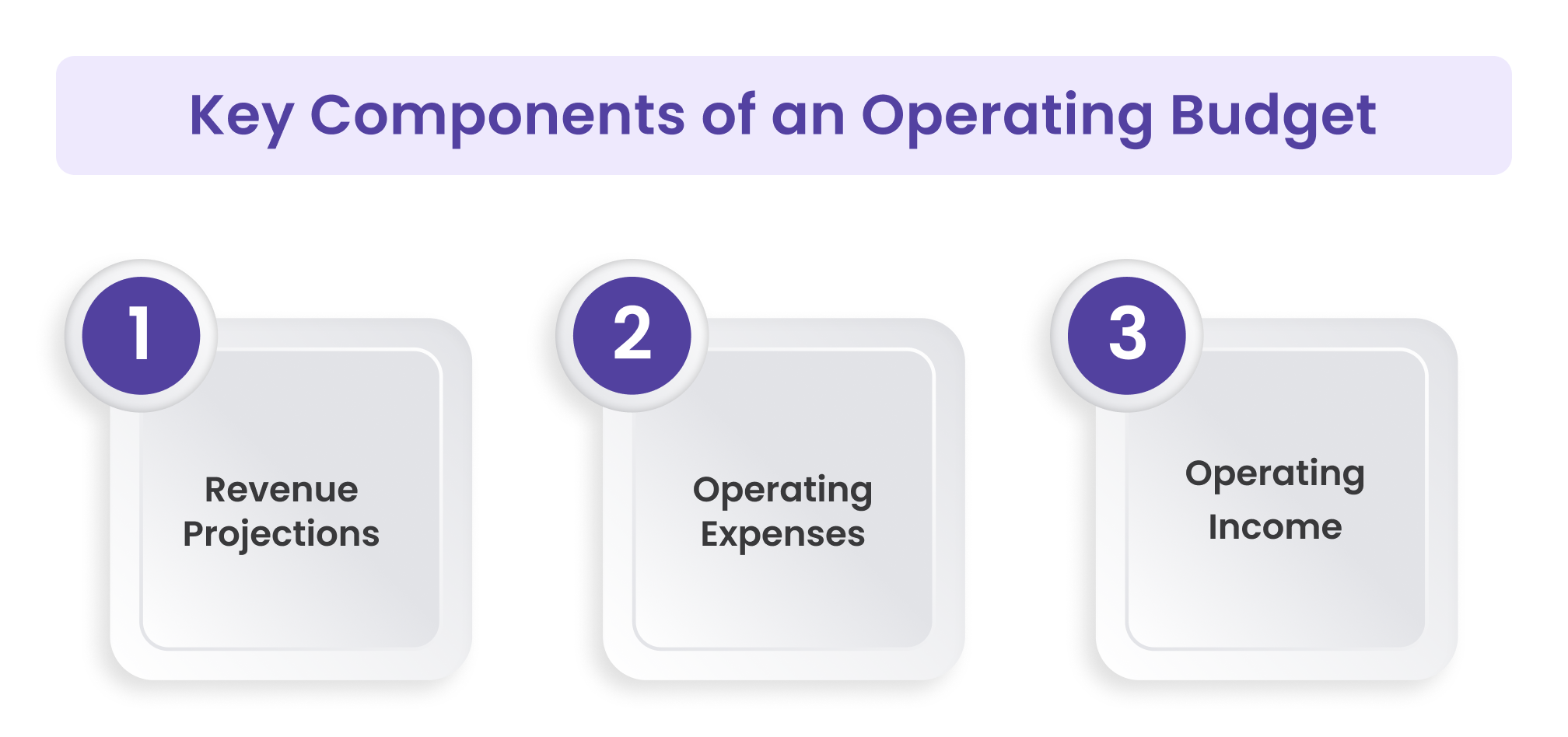
A well-built operating budget typically includes three core elements: projected income, operating expenses, and operating profit. Together, they tell the story of how a company sustains its day-to-day operations while staying aligned with strategic goals.
1. Revenue Projections
This is where the story begins. Revenue projections estimate the income a company expects to earn from its main activities, product sales, service fees, or subscriptions.
For finance teams, this isn’t guesswork. Projections draw on historical performance, market trends, and upcoming contracts. In the Middle East, businesses often consider seasonality, for instance, slower retail months during Ramadan or end-of-year surges in logistics and travel.
2. Operating Expenses
Operating expenses (OPEX) are the costs that keep the business running: salaries, rent, utilities, software, travel, marketing, and maintenance. These expenses are grouped into categories to make monitoring and reporting easier, for example:
- Administrative costs: Office leases, insurance, and compliance.
- Personnel costs: Salaries, benefits, and allowances.
- Selling & marketing: Advertising, promotions, and events.
- Operational costs: IT subscriptions, logistics, or supplies.
A detailed breakdown helps managers see which areas drive growth and which quietly drain resources.
3. Operating Income
Operating income (or operating profit) represents what’s left after subtracting total operating expenses from total revenue. It’s a key performance indicator because it shows how efficiently a company converts its resources into profit before taxes or interest.
Healthy operating income signals that a business is managing its costs well, a sign of operational discipline, not just sales success.
How to Create an Effective Operating Budget (Step-by-Step)
.png)
A solid operating budget reflects how money moves through the business and how each decision contributes to its financial stability.
For finance leaders, the goal is precision: setting realistic targets, allocating resources with intent, and staying agile when conditions change. In markets where growth cycles can shift quickly, that discipline can make the difference between steady performance and reactive management.
Below is a structured approach to building an operating budget that supports both control and flexibility:
Step 1. Define your goals and timeframe
Budgets are only as good as the goals they serve. Decide whether you’re building a monthly, quarterly, or annual operating budget and align it with strategic objectives, growth, cost efficiency, or expansion.
This ensures every projection and cost line has a clear purpose, not just a placeholder.
Step 2. Gather the right data
Start with historical records, sales reports, invoices, payroll data, and supplier costs and layer them with current forecasts.
For UAE-based companies, also factor in VAT obligations, rent adjustments, and region-specific fluctuations like energy or logistics costs.
This creates a realistic baseline rather than an optimistic one.
Step 3. Estimate revenue with context
Project your income based on reliable trends and confirmed deals, not assumptions.
Use past patterns to adjust for seasonal shifts (such as Ramadan slowdowns or Q4 peaks) and account for potential currency changes if operating across GCC markets.
Accurate forecasting at this stage prevents downstream budget distortions later.
Step 4. Identify and categorise expenses
Separate fixed costs (like rent and salaries) from variable costs (marketing, utilities, or travel).
This not only clarifies where money is going but helps leaders make informed trade-offs — cutting variable spend without stalling growth.
In mature teams, expenses are organised by department or function, allowing department heads to manage their own mini-budgets within the larger plan.
Step 5. Build in flexibility
No budget survives contact with real life. Market shifts, regulatory updates, or unexpected expenses are inevitable.
A strong operating budget includes contingency margins, typically 5–10% of total costs, to absorb short-term changes without derailing cash flow.
Step 6. Use automation to stay current
Traditional budgeting relies on static spreadsheets. Modern finance teams use integrated tools to track actual vs. planned performance in real time, update forecasts automatically, and flag anomalies early.
Automation removes the lag between data and decision, letting teams correct course while it still matters.
Step 7. Review, adjust, repeat
An operating budget isn’t a once-a-year exercise. It’s a continuous loop of planning, monitoring, and refining.
Regular reviews (monthly or quarterly) ensure your numbers reflect business reality, not outdated projections.
Smart finance leaders treat their budgets like dashboards, live, transparent, and ready to inform action.
Budgets fail when they’re built in isolation. The most effective ones involve cross-functional input from operations, HR, marketing, and procurement. This collective approach makes the numbers more realistic and builds company-wide accountability. That’s where the capital budget comes in.
Operating Budget vs. Capital Budget
Every business works with more than one type of budget, but two dominate most financial discussions: the operating budget and the capital budget. Both are essential; one keeps the company running, the other keeps it growing.
An operating budget covers the short-term costs of keeping daily operations functional: payroll, rent, marketing, utilities, and other recurring expenses. It focuses on the near term, typically a fiscal year, and provides a benchmark for performance against forecasted revenue.
A capital budget, on the other hand, deals with long-term investments. These include spending on assets such as new offices, machinery, technology infrastructure, or product development. Unlike operational spending, these costs are expected to deliver value over several years.
The key distinctions
In the UAE and Saudi Arabia, many growing businesses now run both budgets in parallel. Operational planning ensures stability, while capital budgets support expansion, opening new branches, adopting new tech, or entering regional markets.
Keeping the two aligned allows finance teams to balance short-term control with long-term vision, ensuring that growth never outpaces financial discipline.
How to Track and Optimise Your Operating Budget
An operating budget earns its worth when it reflects how the business is actually performing. Tracking is part of that discipline. It helps finance leaders stay close to operations, spot early shifts, and make informed decisions before gaps widen.
Optimisation follows naturally. It’s less about fixing numbers and more about maintaining visibility, understanding how activity on the ground aligns with what was planned, and acting quickly when it doesn’t.
Read the story behind the numbers
Data rarely speaks in straight lines. Subtle shifts, a slow climb in travel spend, and a dip in recurring revenue often signal operational changes long before they appear in reports.
Sharp tracking means reading patterns, not just reporting them. It’s about recognising when numbers are hinting at behaviour, whether it’s overspending, delayed receipts, or underperforming projects.
Keep reviews short, sharp, and shared
Budgets lose value when they live in spreadsheets no one revisits. Quick, consistent reviews across finance, operations, and leadership turn tracking into a habit, not a task.
When each department owns its numbers, accountability spreads naturally. The budget becomes a shared conversation instead of a finance-only audit.
Use automation as your early-warning system
Automation isn’t about replacing oversight; it’s about extending it. Real-time data capture and analytics allow finance teams to spot irregularities the moment they appear.
That immediacy changes how decisions are made from reactive to informed. The sooner finance sees the deviation, the smaller the correction needs to be.
[cta-9]
Refine without overcorrecting
The goal of tracking isn’t perfection; it’s clarity. Adjustments should improve visibility, not overcomplicate the model.
Smart finance teams update budgets with the intention to clarify assumptions, adjust forecasts, and strengthen decision-making, not to chase every number that changes.
Common Challenges in Managing Operating Budgets (and How to Solve Them)
.png)
Even the most carefully built budgets start to lose shape once business activity picks up. Markets shift, priorities evolve, and expenses rarely behave as expected. Managing an operating budget is less about keeping every line item in check and more about anticipating where strain will appear and addressing it early.
Below are the challenges finance teams encounter most often, and the practices that help them stay ahead of them.
1. Static budgets in a dynamic environment
Many budgets fail because they’re built to last a year in markets that change every quarter. When assumptions stay fixed, leaders lose the ability to respond to new realities, whether that’s a cost surge, a delayed project, or a changing customer demand.
The fix: Build flexibility into the process. Regular reviews and rolling forecasts help teams adjust course without restarting from scratch. The goal isn’t to rewrite the plan, but to keep it moving in step with the business.
2. Fragmented ownership
Budgets often sit too far inside the finance function. When department heads don’t own their numbers, the budget becomes a document to report against, not a tool to manage performance.
The fix: Bring department leaders into the budgeting cycle early. Shared accountability leads to better accuracy and less resistance to adjustments later. It also builds a stronger link between strategy and execution.
3. Overreliance on spreadsheets
Spreadsheets remain useful, but they aren’t designed for the pace or scale of modern finance operations. Manual entry, version control issues, and inconsistent formats create unnecessary errors and consume time that could be spent on analysis.
The fix: Move toward connected systems that integrate expense data, forecasts, and reporting. Automation protects oversight by removing the points where human error tends to appear.
4. Limited visibility into real-time performance
By the time monthly reports are reviewed, the data they contain is already dated. This delay makes it harder to catch emerging trends or correct misallocations before they expand.
The fix: Adopt tools that deliver live insight. Real-time dashboards help finance teams see what’s happening as it unfolds, giving leaders the context to act faster and with more confidence.
5. Reactive cost control
Cutting spending after targets are missed is common, but it’s often too late. Reactive adjustments strain operations and rarely address the root cause of inefficiency.
The fix: Treat cost control as a forward-looking exercise. Use variance analysis and predictive tracking to identify where costs are likely to rise before they do. Prevention always costs less than correction.
Every budgeting challenge ultimately comes down to one thing: how closely the numbers reflect reality. The moment visibility fades, decisions slow, and accuracy slips.
That’s where technology now plays a defining role. Modern finance tools are giving leaders a live, accurate view of how spending aligns with the plan.
Alaan was built for that purpose.
How Alaan Brings Precision to Operating Budgets
The hardest part of budgeting is keeping a plan accurate once execution begins. Between approvals, purchases, and reimbursements, spending data often sits in different places. By the time reports are consolidated, the numbers have already changed.
Alaan closes that delay. It connects spending directly to the budget framework so that every transaction is logged, verified, and reflected immediately. Whether a manager approves a vendor payment or an employee uses a corporate card, the data appears in the system in real time.
That immediacy matters. It allows finance teams to:
- Compare actual spend to budgeted amounts instantly, not weeks later.
- Catch cost overruns before they affect cash flow.
- Verify VAT compliance automatically through receipt and TRN validation.
- Analyse trends by department or project as they develop, not retrospectively.
Each action feeds the next with cleaner data. When reconciliation happens continuously, reports stay accurate and leadership decisions rest on current information.
The benefit extends beyond control. With accurate, live data, finance leaders can forecast more confidently, model future costs with precision, and identify savings opportunities early. The operating budget becomes less of a static document and more of an active management tool, one that grows in value the more it’s used.
Month-end close cycles have shortened, audit readiness has improved, and budget reviews are now driven by real-time visibility rather than delayed reporting.
Alaan enables that change by replacing manual tracking with a unified system that’s built for accuracy, compliance, and continuous insight.
Explore how finance teams across the Middle East are modernising their budgeting and spend management with Alaan. Schedule a demo.
Conclusion
A well-managed operating budget shows how closely a company understands the way it works. The value lies not in the document itself, but in how actively it’s maintained, reviewed, and used to guide daily decisions.
When data moves in real time, budgets stop being static forecasts and start becoming tools for responsiveness. Finance teams gain the context they need to make informed calls to reallocate resources, protect margins, and act before small variances turn into larger issues.
Across the UAE and Saudi Arabia, this shift is becoming standard practice. Businesses are building financial systems designed to adjust as fast as their markets do.
Alaan helps make that possible, not by changing how companies plan, but by improving how they stay aligned with what’s actually happening. It gives finance leaders the visibility to maintain control, the data to stay compliant, and the accuracy to plan with confidence.
Explore how leading businesses use Alaan to control spending, reconcile faster, and maintain complete visibility across expenses.
FAQs
1. Is an operating budget revenue or expenses?
An operating budget covers both revenue and expenses: it forecasts the income a business expects to earn and the operational costs it plans to incur in a defined period.
2. How often should an operating budget be reviewed?
Rather than being a once-a-year exercise, high-performing finance teams review monthly or quarterly. These regular reviews keep the budget aligned with actual performance and allow timely adjustments.
3. What is the difference between an operating budget and a capital budget?
An operating budget deals with routine, short-term costs and revenues (e.g., salaries, utilities, marketing). A capital budget covers long-term investments (e.g., equipment, property) that generate value over several years.
4. How do you calculate an annual operating budget?
Begin with projected revenue based on past performance and market assumptions. Subtract forecasted operating expenses (fixed plus variable). The result is your operating income or profit before non-operational items.
5. What common items should be excluded from an operating budget?
Typically excluded: one-time capital expenditures, principal repayments of debt, non-operational gains or losses. These items fall outside the day-to-day operational cycle and are handled in separate budgets.


%201.avif)
