


Since the UAE introduced federal Corporate Tax, the treatment of business expenses has become a core compliance function, not a bookkeeping detail. Limited companies that classify expenses correctly legitimately reduce taxable income. Those who misclassify costs risk queries, denied deductions, or adjustments during an FTA review.
The challenge for most finance teams is not understanding that expenses must be “wholly and exclusively” for business. It is interpreting that standard in practice, especially when certain costs sit in grey areas, when multiple entities operate under the same group, or when VAT documentation is inconsistent.
For UAE businesses, getting this right protects cash flow, strengthens audit readiness, and ensures that monthly reporting aligns with year-end tax treatment rather than requiring adjustments later.
In this blog, we’ll break down what counts as an allowable expense for UAE limited companies, the rules behind deductibility, and common pitfalls that lead to disallowed claims.
Key Takeaways
- Allowable expenses fall into clear categories: staff costs, operational overheads, professional fees, finance costs, marketing, depreciation, and pre-operating expenses.
- Non-deductible items include personal spend, penalties, capital items treated as expenses, entertainment beyond 50%, and costs tied to exempt income.
- Proper classification, VAT-aligned documentation, and consistent COA mapping are essential to defend deductions during an FTA review.
- Finance teams achieve the highest accuracy when governance is built into the workflow — real-time visibility, enforced policies, and AI-driven verification at the point of spend.
Understanding Allowable Expenses Under UAE Corporate Tax
The UAE Corporate Tax Law sets out a clear deductibility requirement: an expense is allowable only if it is wholly and exclusively incurred for the purposes of the business. The principle sounds straightforward, but its application is often nuanced, particularly for mixed-use costs, entertainment, capital items, and shared overheads.
The Wholly and Exclusively Requirement
“Wholly and exclusively” is not about whether an expense is useful to the business; it is about whether the purpose of the expenditure is business-related. If a cost has a private or non-business component, it cannot be claimed in full. In such cases, the business portion may still qualify, but only with reasonable, well-documented apportionment.
This standard is applied strictly. For example:
- A director’s travel that mixes meetings with personal days is not fully deductible.
- A vehicle used for both business and personal errands requires allocation based on actual use.
Documentation and clarity are what make this rule workable in practice.
How Operating Expenses Differ From Capital Expenditure
One of the most common mistakes companies make is treating capital purchases as expenses. Under UAE CT, capital expenditure, such as equipment, furniture, or major improvements, must be capitalised and recovered through depreciation or capital allowances, not deducted immediately.
Repairs that restore an asset to working condition may be deductible; improvements that extend its useful life are capital.
Understanding the distinction is essential because miscoding capital items as expenses can distort taxable profit and lead to adjustments.
Also read: GAAP Accounting Principles Explained
Allowable Expenses for Limited Companies in the UAE
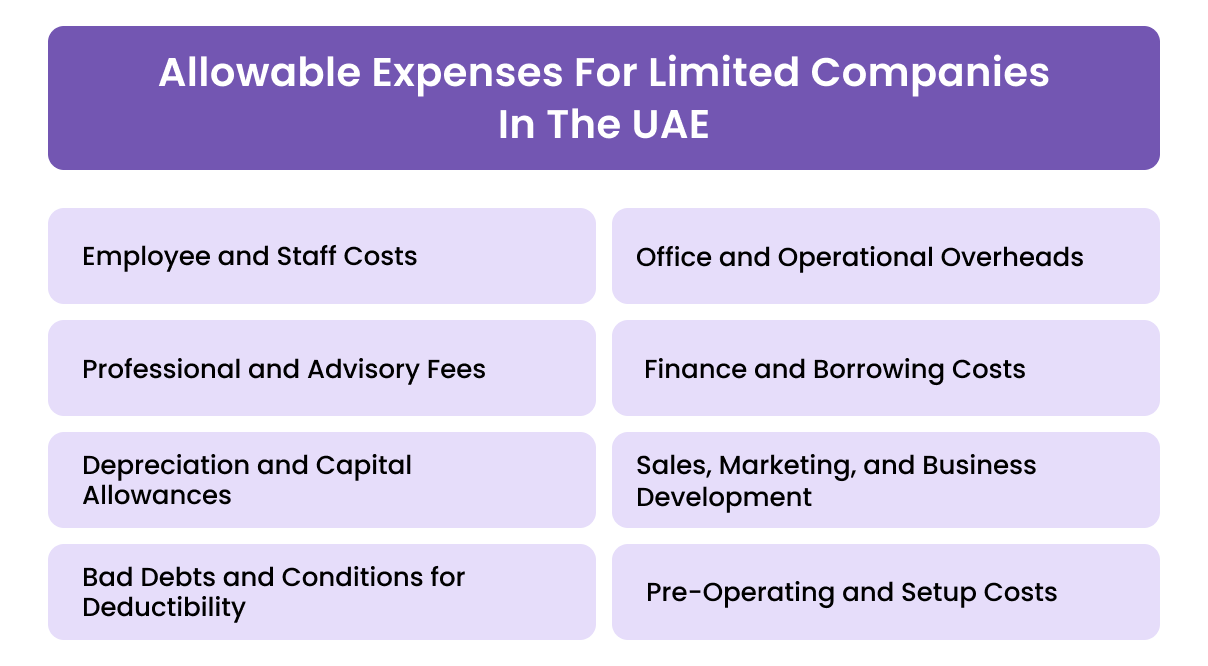
Below are the categories most commonly deductible for UAE limited companies when supported by proper records and business justification.
1. Employee and Staff Costs
These are typically allowable as long as they relate purely to employment:
- Salaries and wages
- End-of-service benefits
- Recruitment fees
- Training and upskilling related to the employee’s role
- Employee allowances that serve a legitimate business purpose
Where staff allowances overlap with personal benefits, e.g., housing allowances, the treatment depends on employment contracts and internal policies. Documentation and a clear rationale are essential.
2. Office and Operational Overheads
Operational continuity costs such as commercial rent, utilities, telecom and internet, software subscriptions, office supplies, and routine repairs and maintenance are usually deductible when linked to business use.
Companies must ensure that capital improvements, which enhance or extend an asset’s life, are separated from normal operating expenses to avoid misclassification and potential adjustments.
3. Professional and Advisory Fees
Fees paid to external advisers are normally deductible. This includes legal, audit, accounting, tax, regulatory, and consultancy fees, provided they relate to the business’s operations.
Ensure engagement letters and invoices describe the business purpose clearly.
4. Finance and Borrowing Costs
Finance costs are deductible but must adhere to interest limitation rules. The UAE Corporate Tax framework restricts net interest deductions above certain thresholds. Finance teams should calculate allowable interest each tax period and maintain supporting schedules.
Bank charges and processing fees incurred for business operations also fall under this category.
5. Depreciation and Capital Allowances
Capital assets cannot be expensed immediately. Instead, companies recover their cost through:
- Depreciation (accounting treatment)
- Capital allowances (for corporate tax purposes)
Repairs that do not extend the asset’s life are deductible; improvements that enhance the asset must be capitalised.
6. Sales, Marketing, and Business Development
Marketing costs that directly support business activity are allowable:
- Advertising
- Sponsorships
- Digital campaigns
- Business events and trade shows
Spend must be purely for business; personal or mixed-purpose promotional activities cannot be fully claimed.
7. Bad Debts and Conditions for Deductibility
A bad debt is deductible only if:
- Income from that receivable has already been recognised,
- The company has taken reasonable steps to recover it, and
- The amount is written off in the accounts.
“Reasonable steps” may include follow-up communication, legal notices, or formal write-off documentation.
8. Pre-Operating and Setup Costs
Costs incurred before operations begin, such as advisory fees, incorporation costs, and licence registration, can be deductible when they relate to establishing the business.
Also read: Post Expenses and VAT in ERP Systems
Expenses That Are Not Deductible for UAE Limited Companies
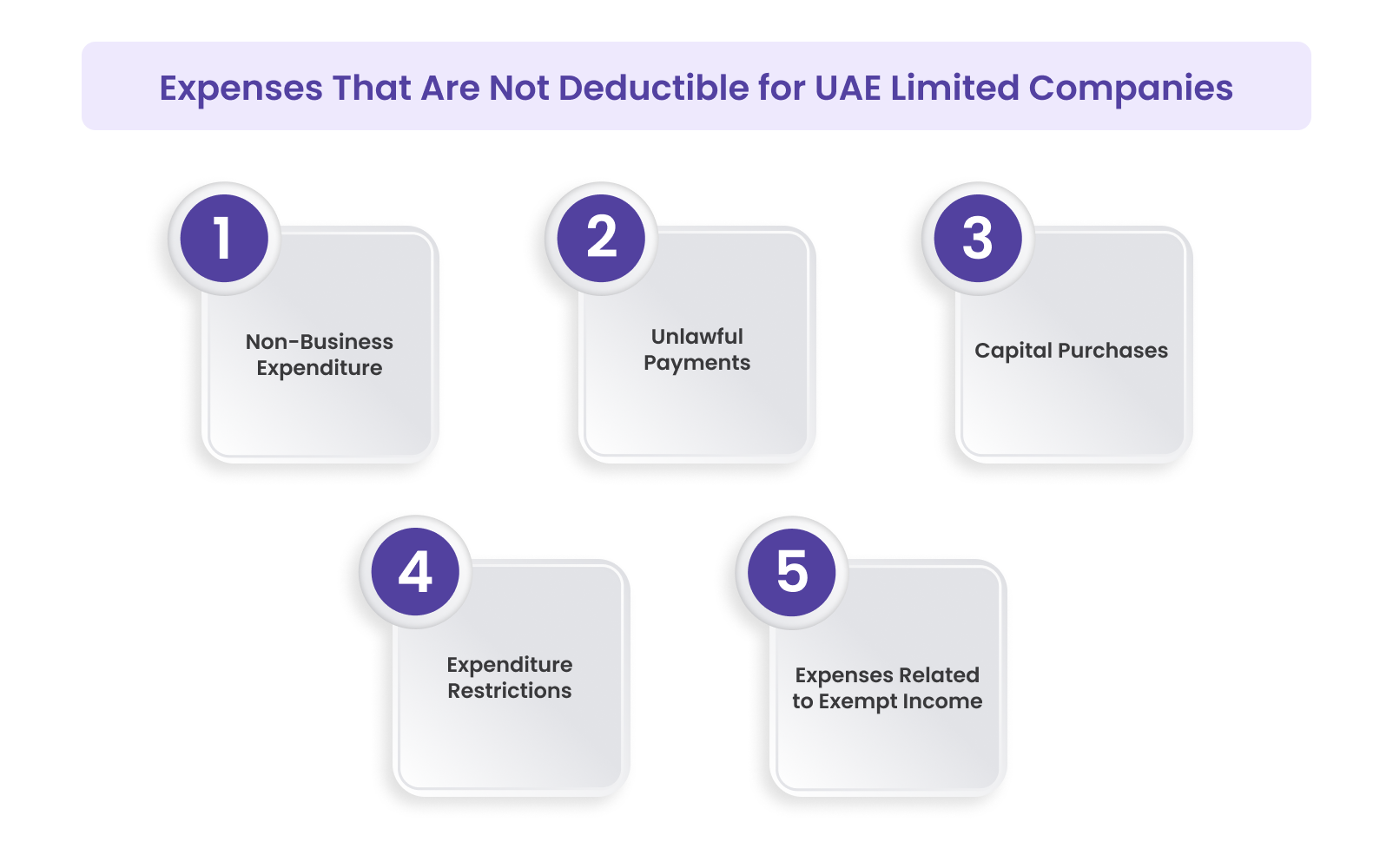
The UAE Corporate Tax Law explicitly disallows certain categories of expenditure. Finance teams should treat these items carefully, as claiming them can trigger adjustments or FTA queries.
1. Personal and Non-Business Expenditure
Any cost with a personal element, even partially, cannot be claimed in full. Examples include:
- Personal travel
- Private vehicle expenses
- Non-business entertainment
- Gifts lacking a direct business purpose
Where a cost has mixed use, only the business portion may be deductible and must be backed by clear allocation logic.
2. Fines, Penalties, and Unlawful Payments
Payments arising from legal violations, administrative penalties, regulatory fines, or unlawful transactions are non-deductible. This aligns with international tax norms and is applied strictly under UAE CT.
3. Capital Purchases
Capital items (machinery, computers, furniture, renovations) are not deductible as operating expenses. They must be capitalised and recovered through depreciation or capital allowances. Expensing such items directly in the P&L leads to inaccurate taxable income.
4. Entertainment Expenditure Restrictions
Entertainment costs are only 50% deductible under UAE CT when they meet the business-purpose test. This includes:
- Client meals
- Hospitality events
- Business-related entertainment
Any element that is personal or promotional without a direct business purpose may fall outside the allowable 50%.
5. Expenses Related to Exempt Income
Where a business earns exempt income, for example, certain qualifying free-zone operations, associated expenses may be disallowed or require allocation. Finance teams must document how each cost relates to taxable vs. exempt activities.
[cta-4]
How Finance Teams Should Assess and Substantiate Allowable Expenses
The FTA places strong emphasis on evidence, classification logic, and consistency across systems. Allowable expenses are not determined solely by the nature of the cost; they also depend on the quality of supporting documentation and internal controls.
Documentation Required for Corporate Tax Compliance
For an expense to qualify, the company should maintain:
- Supplier invoices with all mandatory details
- VAT-compliant invoices where applicable (TRN, invoice number, VAT amount)
- Payment evidence (bank transfer, card statement)
- Internal approval records
- Clear description of business purpose
Weak documentation is one of the most common reasons for disputes during tax reviews.
How to Demonstrate Business Purpose
Auditors typically expect:
- A clear link between the expense and revenue generation or operations
- Notes or internal memos explaining the purpose of ambiguous items
- Contracts or correspondence for advisory fees
- Itineraries or meeting notes for travel expenses
The stronger the business rationale, the smoother the tax review.
Handling Mixed-Use Expenses
Mixed-use costs require allocation. Examples:
- A vehicle used for both business and personal purposes
- Internet packages shared across the home and office use
- Travel combining business meetings with personal days
Companies should apply a reasonable allocation method, document the assumptions, and apply it consistently each period.
Consistent Accounting Classification
Misclassification in the chart of accounts leads directly to incorrect tax treatment. Finance teams must ensure:
- COA mapping is aligned with UAE CT categories
- Depreciable assets are coded correctly
- Entertainment costs follow the 50% rule
- Capital improvements are not coded as repairs
Accounting accuracy up front reduces year-end adjustments.
Related-Party Transactions and Arm’s-Length Requirements
Expenses involving related parties must reflect market value. Finance teams should retain:
- Agreements
- Benchmarking or pricing rationale
- Evidence of services delivered
This ensures compliance with CT provisions around related-party dealings.
VAT and Corporate Tax Alignment
VAT records help substantiate corporate tax claims. Mismatches between VAT filings, expense reports, and CT disclosures raise red flags. Ensure:
- The same invoice supports both VAT recovery and CT deductibility
- VAT-exempt or zero-rated items are treated consistently across systems
- The ERP holds complete, accurate invoice data
Also read: Understanding Chart of Accounts
Common Mistakes Companies Make When Claiming Allowable Expenses
Even well-structured finance teams run into recurring issues under UAE Corporate Tax. These mistakes are heavily cited across tax advisor publications and FTA commentary.
1. Treating Capital Items as Revenue Expenses
Expensing technology, office furniture, or asset upgrades as operating costs creates incorrect taxable income and attracts scrutiny.
2. Insufficient VAT-Compliant Invoices
Claims fail when:
- Invoices lack TRN
- Vendor details are incomplete
- VAT amounts are missing
- Supporting proof of payment is absent
A cost may be legitimate, but without proper evidence, it may be disallowed.
3. Overclaiming Entertainment Costs
Finance teams sometimes treat 100% of entertainment as allowable. The UAE’s 50% restriction must be applied consistently.
4. Mixing Personal and Business Expenditure
A common issue in SMEs: personal purchases made on business cards or through reimbursements. Even minor personal elements invalidate deductions unless clearly separated.
5. Weak Evidence for Bad-Debt Write-Offs
Writing off a debt requires showing:
- The income was previously recognised
- Reasonable recovery attempts were made
- The amount has been formally written off
Missing any of these leads to denial.
6. Incorrect Allocation of Shared Costs Across Entities or Free Zones
Groups operating multiple entities often misallocate costs. If an expense relates partly to exempt or qualifying free-zone income, the deductible amount must be apportioned.
Also read: VAT Compliance Health Check
How Alaan Helps Companies Maintain Compliant, Accurate Expense Records
Alaan is built to help finance teams apply UAE Corporate Tax rules consistently across every expense entry, not through manual reviews, but through structured controls and real-time verification.
Real-Time Visibility Over Spending
Our spend management platform provides finance teams with immediate visibility into every transaction. This ensures non-business or non-allowable costs are spotted early, long before filings or reconciliations are due. Real-time data reduces manual follow-ups and supports cleaner, more accurate expense books.
Policy Controls That Enforce Compliance at the Point of Spend
Our corporate cards and platform controls prevent non-allowable expenses from entering the workflow. Finance teams can set spending rules, merchant restrictions, departmental limits, and usage permissions in advance. This reduces entertainment overclaims, personal spending, and misclassified transactions before they reach accounting.
VAT-Compliant Invoice Capture and AI Verification
Alaan Intelligence reads receipts the moment they are uploaded. It extracts supplier information, VAT amounts, TRN data, and invoice details, and flags anything incomplete or non-compliant. This strengthens the evidence base needed for both VAT and Corporate Tax while reducing exceptions.
Accurate ERP Sync for Consistent Corporate Tax Classification
We integrate directly with Xero, QuickBooks, NetSuite, and Microsoft Dynamics. Every expense moves into the ERP with correct chart-of-accounts mapping, tax category, and entity allocation. This eliminates rework at month-end and ensures CT calculations rely on clean, consistent data.
Digital Audit Trails for Every Expense
Every transaction processed through Alaan includes a full audit trail, spender, purpose, documentation, approvals, coding, and VAT details. This gives companies a defensible record for FTA reviews and simplifies year-end reconciliations.
[cta-3]
Instead of correcting errors at month-end, finance teams work with complete, accurate data from the moment each transaction happens.
Also read: Corporate Expense Cards for UAE Businesses
Conclusion
For UAE limited companies, allowable expenses are not just a mechanism for reducing taxable income; they reflect the discipline and accuracy of the organisation’s financial governance. When expenses are recorded with complete evidence, classified correctly, aligned with VAT filings, and reviewed under consistent internal rules, finance teams reduce risk and operate with far greater confidence.
A structured, well-documented approach makes Corporate Tax compliance predictable rather than reactive. Companies that invest in clarity now avoid costly corrections, reduced deductions, and disputes later.
At Alaan, we help finance teams maintain accurate, compliant expense records from the moment a transaction occurs. Our corporate cards, policy controls, real-time visibility, and AI-driven receipt checks ensure every expense is properly documented, VAT-compliant, and mapped correctly for Corporate Tax treatment. If you want to strengthen internal controls and simplify CT compliance across your organisation, you can book a demo or request an integration walkthrough tailored to your setup.
Frequently Asked Questions (FAQs)
1. What qualifies as an allowable expense for a limited company in the UAE?
An expense is allowable if it is wholly and exclusively incurred for the business, supported by proper documentation, and not specifically disallowed under the UAE Corporate Tax Law. Examples include staff costs, rent, utilities, professional fees, marketing, and depreciation.
2. Are entertainment expenses fully deductible under UAE Corporate Tax?
No. Entertainment is only 50% deductible, even if it has a business purpose. This includes meals, hospitality, and business-related events. Personal entertainment is entirely non-deductible.
3. Can a company deduct expenses incurred before it starts operations?
Yes, pre-operating expenses such as licensing, incorporation fees, advisory costs, and regulatory filings can be allowable if they relate to establishing the business.
4. When are bad debts deductible for UAE CT purposes?
Bad debts are deductible only if the income was previously recognised, reasonable recovery efforts were made, and the write-off is reflected in the accounting records.
5. How does the FTA view mixed-use expenses like vehicles or home-office costs?
The business portion may be deductible, but companies must apply a reasonable allocation methodology and document how the business percentage was determined.
6. What happens if an invoice is missing VAT details? Can the expense still be deducted?
For Corporate Tax, the expense may still be allowable if the business purpose is clear and the payment is documented. However, VAT recovery would be denied without a compliant invoice. Maintaining VAT-compliant invoices also strengthens the CT position.



%201.avif)
