



Every time a forgotten lunch receipt, shared taxi fare, or last-minute ink cartridge sneaks past your approved budget, your finance team loses control, and you lose visibility. Manual petty cash remains one of the most unmonitored corners of business spend.
In fact, according to a recent article in Forbes, manual tasks like data-entry errors affect 1% to 3% of transactions and create dozens of mistakes per thousand processed.
For companies in the Middle East, where compliance and budgeting demands grow each year, petty cash mismatches can create significant audit headaches, compliance risks, and unexpected costs.
This guide is purpose-built for heads of finance and operations at organisations wanting a clean, structured solution. You’ll understand the essentials of petty cash, define the appropriate expense heads, follow accurate recording and reconciliation practices, and strengthen controls to eliminate gaps.
Key Takeaways:
- Petty Cash Purpose: A petty cash float is meant only for low-value, incidental spends that are inefficient to process through formal procurement or banking.
- Expense Heads Structure: Defined petty cash expenses heads make categorisation clearer, strengthen VAT accuracy and reduce month-end posting errors.
- Recording Discipline: Every petty cash entry must include proof, VAT details, and a sequential log, with reconciliation carried out before each replenishment.
- Control Essentials: Imprest floats, assigned custodians, receipt requirements, role separation, and VAT-compliant documentation are the foundations of secure petty cash management.
- Why Alaan Matters: Alaan eliminates manual petty cash by offering controlled corporate cards, AI-based receipt automation, real-time tracking, and VAT-ready records.
What Is Petty Cash and Why Does It Matter?
Petty cash is a small, dedicated float of physical cash kept on premises to pay for minor, incidental business expenses; items such as stationery, postage, small courier fees, or short taxi fares.
It exists to avoid the delay and administrative overhead of raising a purchase order or issuing a bank payment for low-value transactions. Petty cash is normally controlled under an imprest system and held by a designated custodian.
If left unmanaged, petty cash creates blind spots in your controls, raises the risk of error or fraud, and complicates month-end bookkeeping and VAT compliance. The points below show what you must track and why each step is essential.
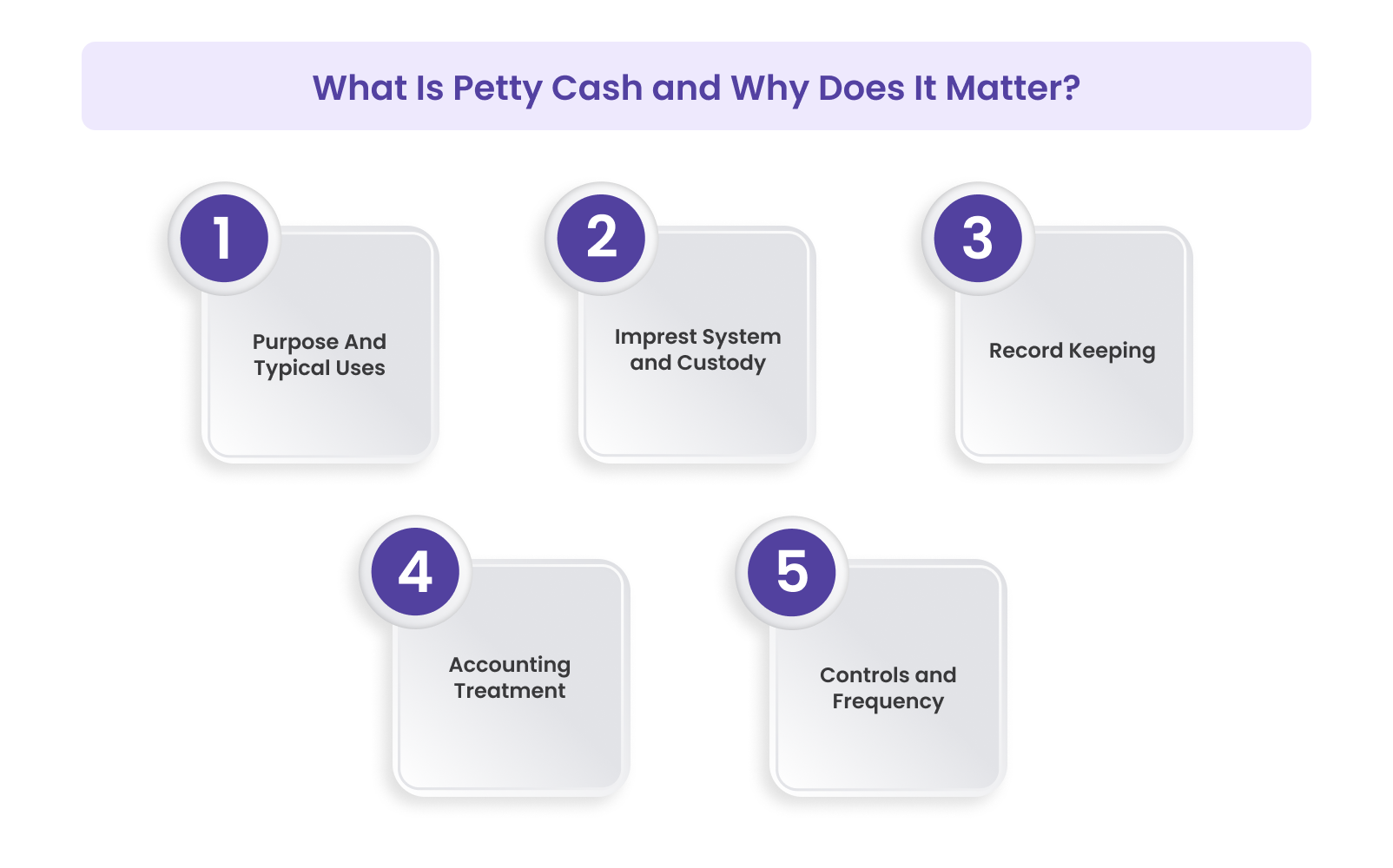
- Purpose And Typical Uses: Petty cash covers incidental expenses that are impractical to pay by cheque, card or supplier invoice. Typical examples include office supplies, minor repairs, refreshments, and small reimbursements.
- Imprest System and Custody: Most organisations operate petty cash on an imprest basis: a fixed float is provided and replenished to that fixed amount. A named custodian disburses funds and keeps receipts. This simplifies reconciliation and limits exposure.
- Record Keeping: Every disbursement should be recorded in a petty cash book or log with date, amount, payee, expense head, and receipt/voucher. Proper records support accounting entries and any VAT claims. HMRC accepts aggregated petty cash entries subject to rules and limits, so keep clear supporting documentation.
- Accounting Treatment: On funding the float, the company debits petty cash and credits bank/cash. On replenishment, expenses are debited to their respective accounts, and petty cash is credited. Reconciliation ties the cash on hand plus receipts to the imprest amount.
- Controls and Frequency: Controls reduce misuse. Appoint a custodian, require receipts or vouchers, set per-item limits, and reconcile regularly (weekly or monthly, depending on volume). Surprise counts help detect discrepancies early.
- Risks and When to Move On: Physical cash is vulnerable to loss, theft, and human error. As transaction volume grows, digital alternatives (prepaid corporate cards, expense tools) offer better audit trails and automation. Many finance teams are phasing out petty cash for these reasons.
Common Petty Cash Expense Heads
Consistent categorisation turns petty cash from an accounting nuisance into useful data. Clear expense heads make month-end posting simpler. They support quick analysis of recurring micro-spend.
They also help teams allocate VAT correctly and spot patterns that signal waste or process gaps. Use a limited set of heads that map directly to your chart of accounts and petty cash book columns.
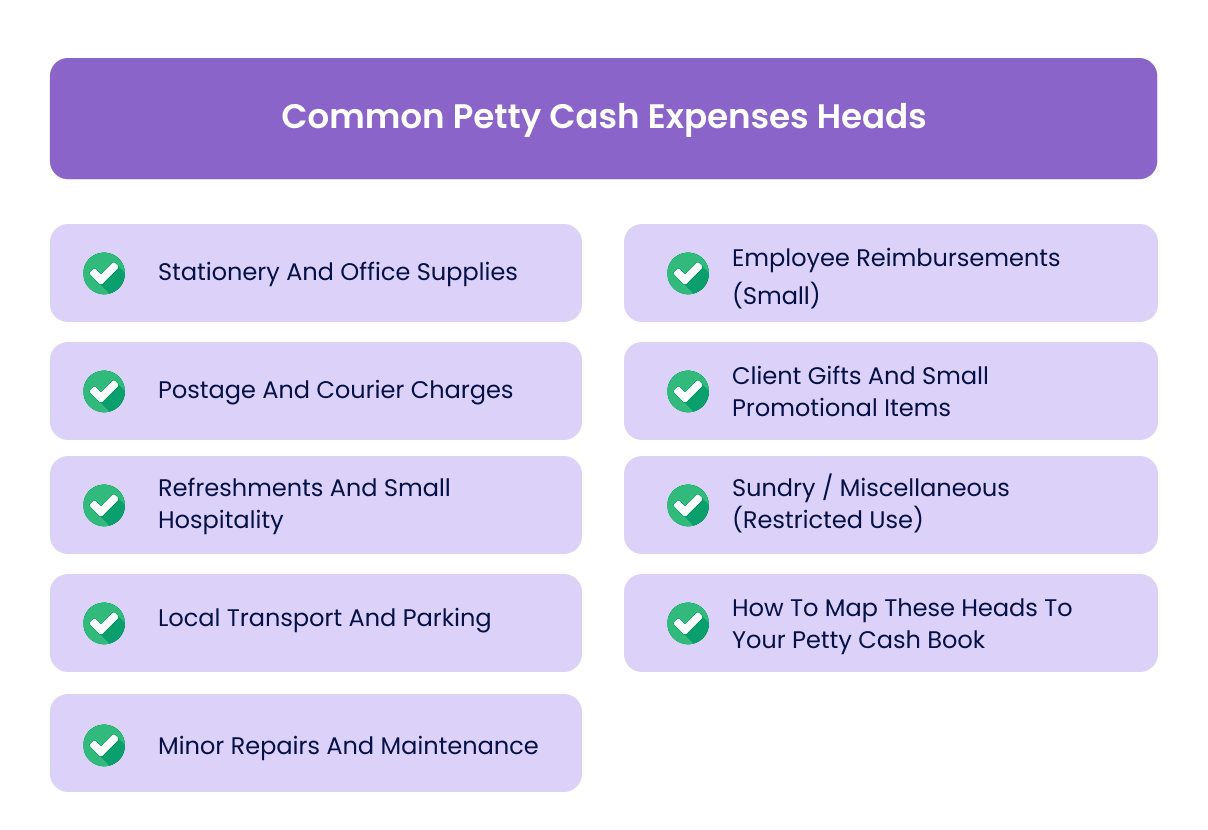
Below are the standard petty cash expense heads finance teams use most often, with what each head should include and why it matters for accounting and compliance.
1. Stationery And Office Supplies
Includes pens, notepads, printer cartridges, and small desk consumables. Track these separately to monitor recurring overheads and to code to the correct office-supplies ledger. Recording by head simplifies periodic purchase planning.
2. Postage And Courier Charges
Covers stamps, local courier fees, and urgent document delivery. Treat as an operating expense and retain receipts for VAT validation where applicable. Use a dedicated head to avoid mixing postage with travel or miscellaneous expenses.
3. Refreshments And Small Hospitality
Small staff refreshments, client tea/coffee for short meetings, and modest catering for internal groups. Label these clearly so hospitality and staff welfare costs remain separate from client entertainment or marketing spend.
4. Local Transport And Parking
Short taxi fares, parking charges, and last-mile travel reimbursements. This head helps reconcile petty cash against travel policies and simplifies reclassification if an expense should be charged to a project or client.
5. Minor Repairs And Maintenance
Small, ad-hoc fixes such as lightbulbs, door locks, or basic handyman purchases. Use this head to avoid overstating equipment maintenance or capital expense accounts.
6. Employee Reimbursements (Small)
Refunds for minor employee outlays where an invoice is impractical. Require a voucher or manager attestation. Keep this head distinct to control personal versus business spend and to support any payroll or reimbursement workflows.
7. Client Gifts And Small Promotional Items
Low-value customer tokens, branded stationery given to prospects, or small event giveaways. Separate this from regular marketing spend to track promotional effectiveness and ensure correct VAT/tax treatment.
8. Sundry / Miscellaneous (Restricted Use)
A limited, tightly controlled bucket for truly exceptional small expenses that do not fit other heads. Use sparingly and require an approver note. Regular review of this column often reveals items that should be reclassified and given their own head.
[cta-1]
Suggested Read: Filing and Making VAT Payments in UAE
Clear categories are only effective when every spend is captured consistently. This is where a structured recording process becomes essential.
How To Record Petty Cash
Recording petty cash in the UAE must balance operational speed with audit-ready documentation. Finance teams should capture every micro-spend with enough detail to support VAT treatment, e-invoicing rules where applicable, and the FTA’s record-keeping requirements.
Journal entries are typically posted at replenishment, not on each disbursement, but the underlying log must remain complete and verifiable.
Follow these concise, practical steps to keep petty cash traceable, compliant, and simple to post to the ledger.
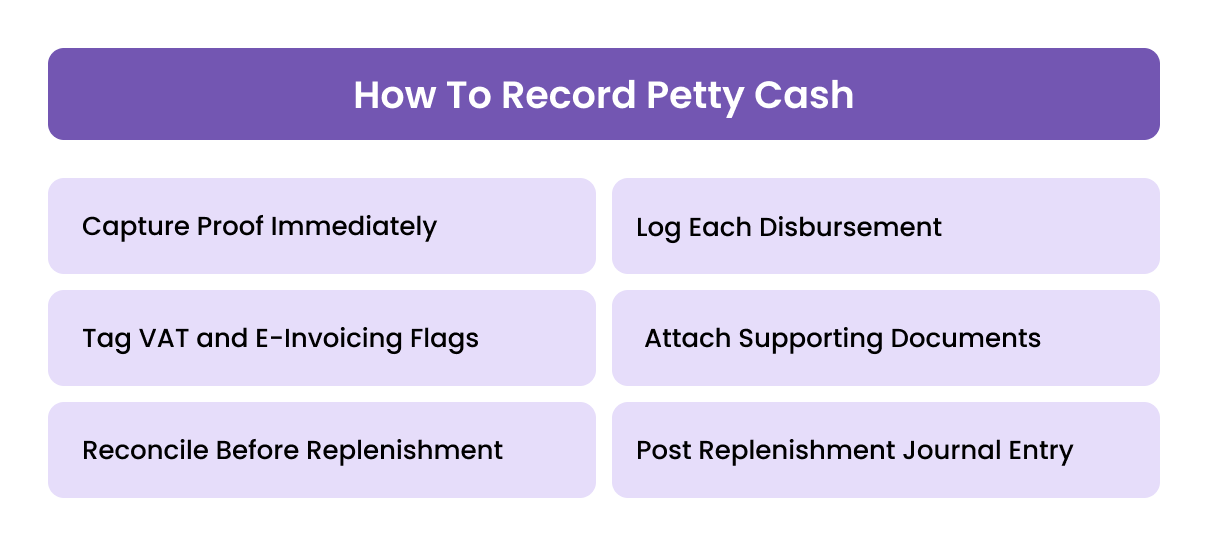
- Capture Proof Immediately — Require a receipt, tax invoice, or a signed petty-cash voucher at the time of payment. Photo images are acceptable if the original is unavailable. This supports VAT claims and FTA audits.
- Log Each Disbursement — Enter date, voucher number, payee, expense head, and amount in the petty cash book (or digital log). Keep entries sequential and tamper-evident.
- Tag VAT and E-Invoicing Flags — Mark whether the receipt is a valid tax invoice or an e-invoice. Segregate VAT-eligible items for input tax recovery and note missing TRNs for follow-up.
- Attach Supporting Documents — Staple or digitally attach the receipt/voucher to the corresponding petty cash entry. Maintain a clear audit trail for every line item.
- Reconcile Before Replenishment — Count cash on hand, sum receipts, and compare to the imprest amount. Resolve any variances before raising the replenishment request.
- Post Replenishment Journal Entry — When the custodian requests a top-up, post: Debit (various expense ledgers) and Credit petty cash; then restore bank/cash. Keep a clear narrative on the entry.
With the recording process defined, what matters next is ensuring every transaction is protected by the right checks and oversight.
Controls & Best Practices To Prevent Misuse
Petty-cash controls must satisfy both sound internal-control principles and local tax record-keeping rules. Strong controls reduce error and fraud, support VAT input recovery, and ensure you can produce audit-ready records for the Federal Tax Authority (FTA). Effective controls are simple, documented, and assign clear responsibility.
Below are the core controls finance teams in the UAE should adopt.
Also Read: A Guide for VAT Registration in the UAE
[cta-4]
Even with strong controls, managing petty cash still demands time, paperwork, and constant follow-up. This is where a modern alternative can make a meaningful difference.
Why Alaan for Managing Petty Cash Expenses
Petty cash is quick, but it leaves finance teams dealing with missing receipts, unclear approvals, and limited visibility. At Alaan, we remove that friction entirely. Our corporate cards and AI-powered automation give you real-time control, accurate records, and VAT-ready documentation, without the manual work or cash-handling risks.
Here’s how Alaan transforms petty-cash management into a controlled, seamless process.
- Unlimited Corporate Cards with Tailored Controls — Issue physical or virtual cards for teams, site staff, or projects, each with custom spend limits and merchant restrictions.
- Real-Time Expense Tracking and AI-Driven Receipt Automation — Every transaction posts instantly, receipts upload via mobile app, and intelligent OCR extracts vendor, VAT, and TRN details for you.
- Accounting Integrations & VAT-Ready Records — Transactions sync with major accounting tools (Xero, QuickBooks, NetSuite) and maintain audit-grade documentation for input-VAT claims and compliance.
- Cashback Rewards and Cost-Efficiency — Earn up to 2% unlimited cashback on eligible transactions, transforming small daily spends into cost-savings rather than liability.
- Scalable for Growth & Project-Based Spend — Whether your projects span multiple sites, locations, or business units, Alaan supports multi-entity control, budget tags, and mobile issuing to simplify decentralised spend.
Book a personalised demo today and see how Alaan’s platform turns petty cash from a risk zone into a high-control, value-adding part of your finance operation.
Conclusion
Petty cash works until it doesn’t. The moment your teams scale, operate across multiple sites, or manage time-sensitive purchases, manual cash handling begins to slow decision-making and create preventable gaps. The organisations that stay in control are the ones that treat everyday spending with the same discipline they apply to larger financial processes.
Alaan helps you do exactly that. With real-time oversight, precise documentation, and automated checks built into every transaction, you move beyond the limits of petty cash and give your finance team the clarity they need to work faster and with confidence.
Ready to see how this works in practice? Book a demo, and we’ll walk you through how Alaan can streamline small-value spending, build stronger controls, and give you complete visibility!
Frequently Asked Questions (FAQs)
1. What qualifies as a petty cash expense?
A petty cash expense is a low-value, incidental business cost that is impractical to pay through purchase orders or bank transfers, such as small office supplies, short taxi fares or minor repairs.
2. How do I choose the right petty cash expenses heads?
Use categories that match your chart of accounts, reflect your common small-value spends and support VAT documentation. Keep the list focused and apply it consistently.
3. Can petty cash expenses be claimed for VAT in the UAE?
Yes, but only if supported by a valid tax invoice with supplier TRN, date, and VAT amount. Without compliant documentation, input VAT cannot be recovered.
4. How often should petty cash be reconciled?
Reconciliation should be done when the float is low or on a scheduled basis. Weekly works for high activity, while monthly is sufficient for lower volumes.
5. When should a company stop using petty cash?
If small purchases increase, receipts go missing, or oversight becomes difficult, it may be more effective to move to corporate cards or automated expense tools.



%201.avif)
