.avif)


Cross-border payments are a core part of business operations in the UAE because they directly affect supplier timelines, cash flow, and transaction costs. With many UAE businesses relying on international vendors and services, transfer fees, exchange rates, and settlement speed can significantly influence operating expenses and financial accuracy.
These payments also create financial and compliance responsibilities. Businesses must manage currency conversion, ensure correct transfer details, and reconcile payments with invoices, as errors can lead to delays, extra costs, or reporting gaps.
This guide explains how cross-border payment services work in the UAE, including transfer methods, costs, regulations, and how finance teams can manage international payments efficiently and accurately.
TL;DR
- Cross-border payments help UAE businesses pay international suppliers, subscriptions, and remote teams, supporting global operations and continuity daily.
- International bank transfers, corporate cards, and payment platforms are the main methods UAE businesses use to send and manage overseas payments.
- Transfer fees, FX markups, and bank charges increase the true cost of cross-border payments and must be tracked for accurate financial reporting.
- Proper documentation, including invoices and payment records, ensures compliance with UAE regulations and supports accurate reconciliation processes.
- With Alaan, businesses can manage cross-border payments, track international expenses in real time, store receipts centrally, and maintain accurate records within a single connected workflow.
What Are Cross-Border Payment Services? Relevance in UAE
Cross-border payment services allow businesses to send or receive money between bank accounts in different countries. These payments usually involve currency conversion, international banking networks, and settlement processes that are different from domestic transfers.
For UAE businesses, cross-border payments are a routine part of operations because many suppliers, service providers, and partners are located outside the country. The UAE’s position as a global business hub makes international payments especially common.
Companies frequently pay overseas vendors, subscribe to international software platforms, and compensate remote employees or contractors working in other regions. These transactions ensure business continuity but also introduce additional cost and reconciliation considerations.
Common reasons UAE businesses use cross-border payments include:
- Paying international suppliers for goods and raw materials
- Paying global software and cloud service providers
- Compensating remote employees and independent contractors
- Paying overseas consultants, agencies, and professional service firms
- Settling marketplace, licensing, or subscription fees billed from abroad
Cross-border payments also play an important role in financial management. Exchange rates, transfer fees, and settlement timelines affect the final cost of transactions and how they appear in financial records.
Finance teams must track these payments accurately to ensure expenses are recorded correctly, vendor balances are reconciled, and financial reporting reflects the true cost of international operations.
Because of this, cross-border payment services are not just transfer tools. They are part of how UAE businesses manage global operations, maintain supplier relationships, and ensure financial accuracy across currencies and jurisdictions.
Also Read: Understanding Financial Statements for Beginners Guide
Common Cross-Border Payment Methods Available In The UAE
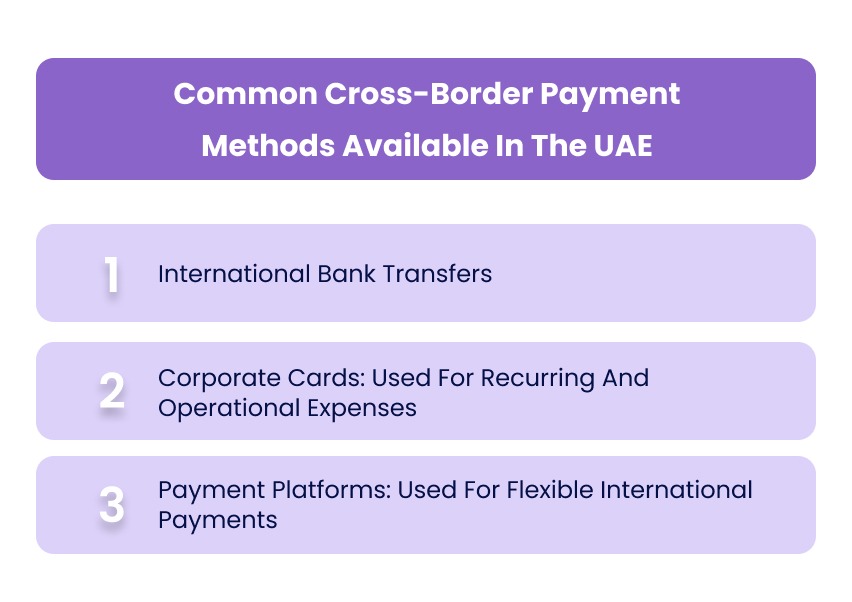
UAE businesses rely on multiple cross-border payment methods depending on the type of expense, payment urgency, and vendor requirements.
Some methods are better suited for large supplier payments, while others are designed for recurring operational expenses or frequent smaller transactions.
Choosing the right method helps ensure timely payments, cost control, and accurate financial tracking.
International Bank Transfers
International bank transfers are commonly used when businesses need to send funds directly from their UAE bank account to a supplier’s overseas bank account.
They are typically used when:
- Paying overseas manufacturers or product suppliers
- Settling high-value invoices such as equipment purchases
- Sending contractual payments to international partners
These transfers are preferred for formal business payments but may involve transfer fees and processing time.
Corporate Cards: Used For Recurring And Operational Expenses
Corporate cards are widely used for international operational spending, especially when vendors accept card payments online.
They are commonly used for:
- Software subscriptions such as cloud platforms
- Digital advertising and marketing tools
- Travel bookings including flights and hotels
- Online service providers billing in foreign currencies
Corporate cards also help finance teams track expenses instantly and maintain organised records.
Payment Platforms: Used For Flexible International Payments
Payment platforms are often used when businesses need flexibility, especially for frequent or lower-value payments.
They are useful when:
- Paying freelancers or remote team members
- Sending payments across multiple countries regularly
- Paying vendors who prefer platform-based payments
These platforms often provide faster transfers and clearer payment tracking.
Most UAE businesses use a combination of these methods. Bank transfers support large supplier payments, corporate cards handle operational expenses, and payment platforms help manage frequent international transactions efficiently.
Also Read: Types of Expenses Every Business Should Know
Costs And Fees Associated With Cross-Border Payments
Cross-border payments involve several cost components that affect the final amount paid and how the transaction is recorded. These costs do not always appear as a single line item, which makes them harder to identify during reconciliation.
For UAE businesses that regularly pay international vendors, understanding these charges is essential for accurate cost control and financial reporting.
Transfer fees are the most visible charge in international payments. Banks and payment providers apply a fixed fee each time a transfer is sent abroad. This fee applies whether the payment is large or small and is typically charged when paying overseas suppliers, service providers, or contractors.
Foreign exchange markups increase the total cost during currency conversion. When AED is converted into another currency, the provider applies its own exchange rate, which includes a margin above the market rate. This means the business pays more in AED even though the supplier receives the correct foreign currency amount.
Additional bank charges may apply during payment processing. Some international transfers pass through intermediary banks before reaching the recipient. These banks may deduct handling fees, which can result in the supplier receiving less than expected unless the full payment structure is planned in advance.
Processing time also affects the financial impact of cross-border payments. Unlike domestic transfers, international payments can take several business days to settle. This delay affects cash flow timing, vendor payment confirmation, and the accuracy of period-end financial reconciliation.
Because of these combined factors, the true cost of cross-border payments includes more than the invoice value. Transfer fees, exchange rate differences, banking charges, and settlement timelines all influence the total financial outcome.
Also Read: Guide to Preparing Financial Statements Efficiently
Regulatory And Compliance Considerations For UAE Businesses
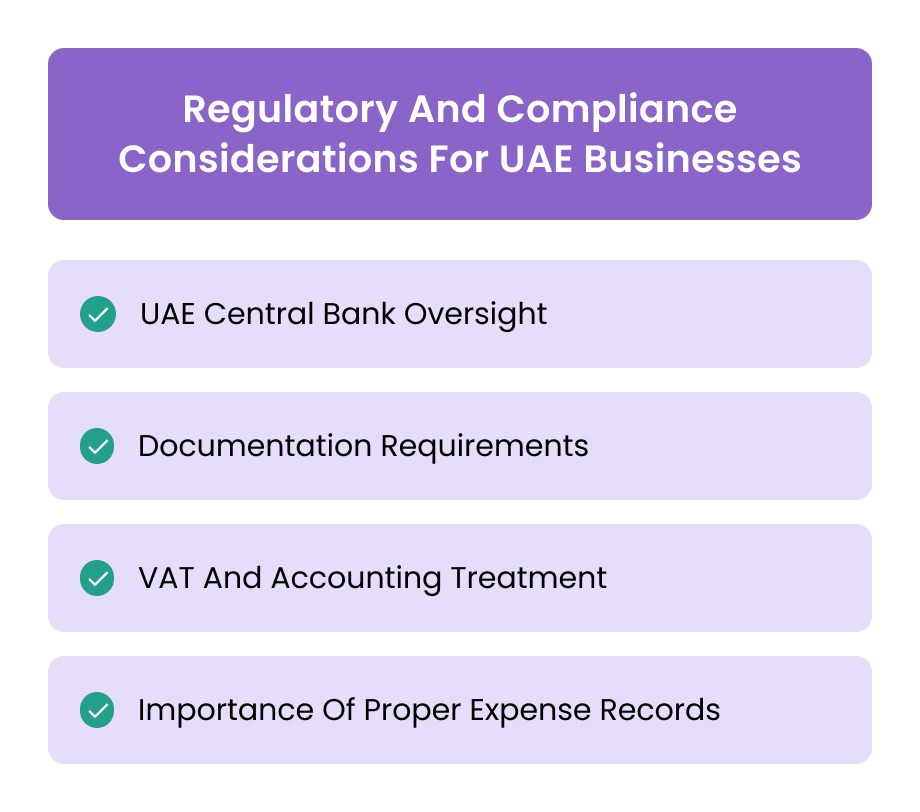
Cross-border payments in the UAE are subject to financial, tax, and accounting regulations that ensure transparency and accurate reporting.
Businesses must ensure that every international payment is properly authorised, supported by documentation, and recorded correctly in financial statements.
Compliance helps businesses avoid regulatory issues, maintain accurate books, and ensure payments are recognised correctly for audit and tax purposes.
UAE Central Bank Oversight
Cross-border payments are processed through banks and payment providers regulated by the Central Bank of the UAE.
The Central Bank is responsible for:
- Supervising licensed banks and payment institutions
- Ensuring secure and compliant international transfer systems
- Enforcing anti-money laundering and financial crime prevention rules
Businesses must send international payments through authorised channels to remain compliant with UAE financial regulations.
Documentation Requirements
Every cross-border payment must be supported by valid business documentation.
This typically includes:
- Supplier invoices showing the payment amount and purpose
- Contracts or service agreements, where applicable
- Bank transfer confirmations and payment references
These records help verify the transaction and ensure it can be properly recorded and audited.
VAT And Accounting Treatment
Cross-border payments must be recorded accurately for accounting and VAT purposes.
Finance teams must ensure:
- The expense is recorded at the correct value
- Currency conversion is reflected accurately in AED
- VAT treatment is applied correctly where required
This ensures compliance with UAE tax regulations and accurate financial reporting.
Importance Of Proper Expense Records
Maintaining proper records ensures cross-border payments remain compliant and traceable.
Accurate records help businesses:
- Support expense recognition in financial statements
- Maintain audit-ready documentation
- Ensure accurate VAT reporting where applicable
- Reconcile payments with supplier invoices
Proper documentation and recordkeeping ensure cross-border payments are compliant, transparent, and accurately reflected in the company’s financial position.
Also Read: Understanding General Ledger in Double-Entry Accounting
How Businesses Can Manage Cross-Border Payments Efficiently
Cross-border payments involve multiple currencies, vendors, and settlement timelines, which makes structured tracking essential for financial accuracy. Without proper visibility and documentation, businesses may face reconciliation delays, missing records, or incorrect expense reporting.
For UAE businesses that regularly pay international vendors, efficient payment management ensures that transaction values, currency conversions, and supporting records are captured correctly.
This helps finance teams maintain accurate financial statements and avoid delays during reconciliation and reporting.
1. Expense visibility improves financial control over international payments: When finance teams can see cross-border transactions as they occur, they can track converted amounts, understand the actual AED cost, and ensure expenses are recorded in the correct reporting period. This reduces unexpected variances and improves spending oversight.
2. Tracking international transaction details ensures accurate reporting and reconciliation: Each payment must be recorded with vendor information, foreign currency value, exchange rate, and payment date. This ensures the expense is reflected correctly in financial records and can be matched with supplier invoices.
3. Proper receipt and invoice management supports compliance and audit readiness: Supplier invoices and payment confirmations provide supporting evidence for each transaction. Maintaining these records ensures finance teams can verify payments, complete reconciliation faster, and support financial reporting requirements.
4. Using Alaan’s corporate cards and cross-border transfer capabilities helps businesses maintain real-time tracking, structured approvals, and complete documentation for international payments: At Alaan, we provide corporate cards and cross-border transfer workflows that businesses can use for international payments while maintaining real-time visibility, approvals, and expense tracking. Each transaction is captured instantly, and receipts are stored alongside the expense, helping finance teams maintain accurate and organised records.
This improves financial accuracy, supports compliance, and keeps international expense management structured and reliable.
How Alaan Helps Businesses Manage Cross-Border Payments
Since international payments involve exchange rates, transfer confirmations, and supplier invoices, maintaining complete records is essential for accurate accounting and compliance. Without structured expense management, finance teams may face reconciliation delays, incomplete records, or gaps in financial reporting.
At Alaan, we provide a spend management platform with corporate cards and cross-border transfers through Super Pay in a single workflow. This helps businesses manage international payments with real-time tracking, approvals, and complete documentation.
This structured recordkeeping supports cross-border payment management in several practical ways:
- Clear visibility into international expenses: Each transaction is recorded instantly, allowing finance teams to see the exact payment amount, currency, and converted value.
- Centralised invoice and receipt storage: All supporting documents are stored in one place, reducing the risk of missing records during reconciliation or audit review.
- Accurate, exportable expense reports: Finance teams can generate reports showing international transaction details, which helps ensure expenses are reflected correctly in financial statements.
- Improved reconciliation readiness: Because expenses are captured at the time of payment, finance teams do not need to reconstruct international payment records later.
While Alaan is not a bank and does not replace existing banking relationships, we enable cross-border transfers through Super Pay alongside corporate cards, approvals, and reconciliation workflows. This allows finance teams to manage international payments with greater visibility, control, and complete documentation within a single platform.
Also Read: Accounts Payable Automation and Invoice Management Software
Conclusion
Cross-border payments are a financial transaction, but they function like an operational system. They affect cash flow timing, vendor relationships, and the final recorded cost of expenses through exchange rates, fees, and settlement timelines. That is why proper management matters: gaps in tracking or documentation can distort financial reporting and delay reconciliation.
The core controls are consistent across businesses. Use the appropriate payment method, track foreign currency amounts accurately, maintain complete invoices and payment confirmations, and reconcile international transactions with financial records. These practices ensure cross-border expenses are reflected correctly and remain audit-ready.
At Alaan, we help finance teams manage international expenses with real-time visibility, structured documentation, and accurate records so reconciliation stays clean and financial reporting stays reliable.
Schedule a Free Demo Today to see how Alaan helps finance teams manage cross-border payments with greater visibility and control.
FAQs
1. Are Cross-Border Payments Subject To VAT In The UAE?
Yes, some cross-border services may fall under reverse charge VAT rules in the UAE. This means the business must account for VAT even if the supplier is outside the UAE. Proper classification ensures accurate VAT reporting and compliance.
2. What Exchange Rate Should Be Used For Accounting Cross-Border Payments?
Businesses should use the exchange rate applied at the time of the transaction or the rate provided by their bank. This ensures the AED value recorded matches the actual amount paid. Accurate conversion is important for correct financial reporting.
3. How Should Failed Or Reversed International Payments Be Recorded?
Failed or reversed payments must be recorded to reflect the cancellation of the original transaction. Finance teams should update expense records and reconcile bank statements accordingly. This ensures financial records remain accurate and complete.
4. Can Businesses Use Corporate Cards For Recurring International Payments?
Yes, corporate cards are commonly used for recurring international expenses such as software subscriptions. They allow payments to be processed automatically without manual transfers. This also helps maintain consistent expense tracking.
5. Why Do Some Cross-Border Payments Arrive With A Different Amount?
Differences can occur due to intermediary bank fees or exchange rate adjustments. These deductions happen during the transfer process before the payment reaches the recipient. Businesses must account for these differences during reconciliation.
Gain control over business expenses with Alaan corporate cards
Invygo earned AED 100,000 in cashback using Alaan cards
Personalise approval workflows to align with your business needs with Alaan's Spend Management platform
Discover the power of automated expense tracking and smarter spend control with Alaan
Turn data into actionable insights with Alaan's spend management tools
Stay Tax Compliant with UAE's #1 Corporate Card and Spend Management Platform
Customisable corporate card policy template
Know how much Corporate Tax you have to pay this fiscal year
Easily integrate Alaan with your ERP for accurate, real-time expense tracking
Close books faster with Alaan's AI-powered accounting automation
Reconcile your books in minutes instead of hours, every single month.
Keep petty cash organized with Alaan corporate cards and automated expense management