.avif)

What were the most important moments or decisions that shaped your journey into the CFO seat today?
The pivotal moments were when I shifted from purely transactional finance into operational finance. I started focusing on business priorities and stakeholder challenges. That shift in mindset increased my recognition and the value I was providing. For example, when I worked with our back-office operations outside the UAE, I identified gaps not only in finance but also across other areas. Streamlining those processes increased my visibility. Later, I focused on building relationships with department heads, resolving friction points, and establishing workflows. Taking ownership of functions like HR, legal, IT, and compliance also reduced the management team’s operational load and increased my perceived value. For me, it was never about chasing a title, it was about becoming a core part of the business. Once people understood that I could connect finance, operations, and strategy, I stepped into that role of strategic business partner.
Across your career, one theme stands out: building systems. Where does that builder mindset come from, and what’s one system you’re really proud of?
That’s a very insightful question. The builder mindset comes from my personal journey. Until the end of high school, academics weren’t easy for me. I had learning difficulties and couldn’t simply memorize large amounts of information. I had to work hard to keep up. What helped me was visualizing things, breaking down complex data into flow charts and logical steps. That became second nature: taking chaos and creating clarity. As for systems I’m proud of, the first is a cash projections system I built after COVID. Agency life is unpredictable, revenues fluctuate, retainers change, expenses vary. The system collected inputs from multiple departments on different cycles, allowing us to smooth cash flow and maintain reserves. The second is our month-end closing system. We consistently close within five to seven working days, and not just procedural closings, true business performance closings. It runs so seamlessly that others don’t feel the pressure, though it requires a lot of work from the team.
You’ve led companies through mergers, acquisitions, PE rounds, and integrations. What have you learned about staying grounded and sharp when the pressure is on?
One of the biggest lessons was realizing that deals are not about the present moment, they have long-term consequences. Negotiations aren’t about winning now but about building for the future. Another lesson is that while financial and operational synergies are important, the relationships and trust built during a deal are equally critical for integration. Finally, I learned that people observe you more closely than you think. They notice how you present yourself, your vision, intention, and passion. That impression lasts. For example, the credibility I built before COVID helped me renegotiate successfully during COVID.
You said it’s important how you present yourself. Could you elaborate?
People understand your vision, your intention, and your strategic view. If they see you as reliable, they’ll trust your judgment, when you call something good, bad, or difficult. That trust is invaluable, not only during integration but also for future relationships and deals.
How do you personally approach change or transformation, and how do you keep teams aligned?
I don’t see transformation as a project; I see it as a process. I usually have more visibility into the challenges and friction points, so I prepare early. Mainly,I don’t fixate on one outcome, I play out multiple scenarios in my head, including their pros, cons, and possible obstacles. That way, when reality happens, I can pivot quickly. When it comes to teams, I don’t aim for 100% alignment. Instead, I focus on the key stakeholders most affected by the change. I keep them informed about what’s fixed, what’s evolving, and what challenges may arise. I involve them in brainstorming solutions so they’re not blindsided, and alignment at the top cascades to the rest of the teams. Each department has its own language, so communication must be tailored, not a generic corporate message.
How do you get business teams to care about governance without it feeling like a chore?
Honestly, governance can sometimes feel like a chore. But I frame it as a shared responsibility, not just finance’s responsibility. I also acknowledge it’s extra work for revenue teams, so I approach with compassion and collaboration. I keep templates flexible, the outcome matters more than rigid formats. For senior leaders, though, compliance is non-negotiable. They need to own it as part of leadership.For wider teams, I focus on making governance useful for them. For example, revenue reports help finance with forecasting but also help client teams track portfolios, plan capacity, and allocate resources. When people see the value, cooperation improves. My belief is simple: any system sticks only if all parties benefit.
Where do most finance teams go wrong in partnering with the rest of the company?
Teams often act as if they have different agendas, but in reality, everyone is working toward the same goal. There’s also sometimes a bias that values, the revenue-generating teams more than non-revenue ones, and that creates friction. I believe CFOs must actively bridge this gap by showing value, building relationships, and aligning with revenue heads so trust cascades downward. Finance teams also need to be operationally savvy, understanding the daily realities of client-facing colleagues. And most importantly, change must come from the top. If the CEO doesn’t enable finance to act as a strategic partner, no matter how capable a CFO is, integration won’t happen.
When you look at AI and automation in finance, what makes you say “yes, this is worth it”? Have you found such a tool for your finance team yet, apart from the usual ones?
Today, AI tools aren’t optional, they’re essential. Industries are evolving at an exponential pace, and businesses must adopt new tools to keep up, remain profitable, and scale. Yes, we push teams to explore and rework workflows, because tools themselves are evolving rapidly.
In finance, I look for tools that:
(1) Integrate seamlessly with existing operations,
(2) Improve productivity without adding complexity, and
(3) Operate at a foundational level, not as standalone fixes.
Standalone tools may work today but fail tomorrow as the business evolves. Right now, we use smaller add-on tools that integrate well and reduce complexity, such as DocuSign or HR platforms. A full ERP change is still on the horizon.
When you’re hiring today, what’s one quality you look for that you didn’t emphasize earlier?
I’ve always looked for curiosity to learn and the willingness to unlearn, that’s been essential for building integrated finance approaches. But today, one new priority is tech savviness. Candidates need to explore tools, test solutions, and improve productivity on their own, not wait for managers. Five years ago, I emphasized adaptability and communication more, but today, tech ability is essential.
Bio
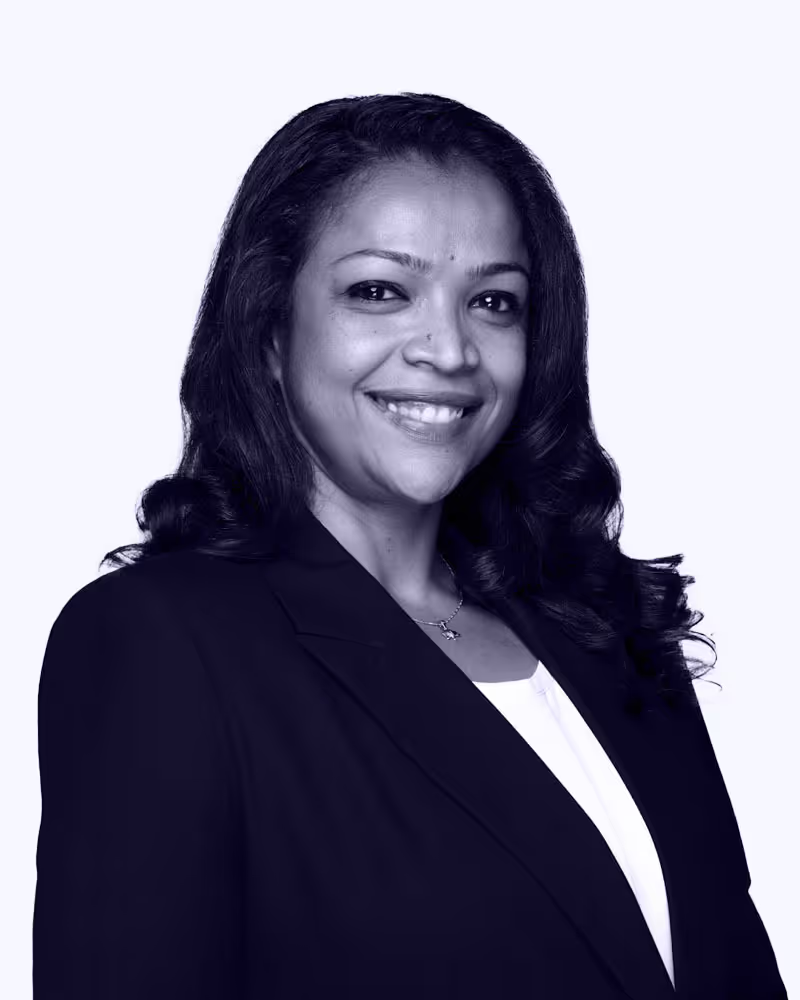
Sireesha Venkata is the Chief Financial Officer of BPG Group, a fully-integrated marketing agency, and previously CFO of Socialize\ We Are Social Dubai. With over two decades of experience across global organizations, she has led finance teams through transformation, integrations, and growth journeys. Recognized for building systems that streamline operations and for driving finance beyond reporting into strategy, she continues to champion resilience, foresight, and collaboration as hallmarks of the modern CFO.