.avif)


Cross-border payments are a daily reality for businesses operating in the UAE, but “routine” does not mean simple. Payments that should move in hours often take days. Costs that seem straightforward at initiation can balloon once FX spreads, intermediary fees, and receiving bank charges are applied. For finance teams, these frictions not only disrupt supplier relationships but also complicate cash forecasts, margin analysis, and month-end reconciliation.
The scale of the challenge is significant. The UAE is currently the second-largest hub for outbound remittances in the world, behind only the United States, driven by its large expatriate population and vibrant trade and investment links. This cross-border activity translates into nearly USD 39 billion(≈ AED 143 billion) in remittance market value, underlining the volume and importance of international transfers for both corporate and personal finance.
Against this backdrop, understanding how cross-border payments actually flow, through correspondent networks, direct bank corridors, or modern fintech rails is a practical imperative for UAE finance teams. It isn’t just about regulation or compliance; it’s about visibility into cost, timing, and documentation that affects working capital and forecasting.
In this blog, we break down the regulatory framework governing cross-border payments in the UAE, explain common routing and cost challenges, and offer practical controls and best practices to make international transfers more predictable and efficient.
Key Takeaways
- Cross-border payment risk in the UAE is driven more by opacity than regulation; teams struggle most with unknown FX spreads, hidden fees, and unclear settlement timelines.
- “Fast” and “cheap” are corridor-specific, not universal promises. Payment behaviour changes materially based on destination, currency, and routing.
- The true cost of an international transfer is only knowable when FX, intermediary fees, and receiving charges are captured upfront, not after settlement.
- Treasury accuracy improves when payment timing (float) is treated as a forecasting variable, not an operational afterthought.
- Bringing international payments into the same workflow as invoices, approvals, and reconciliation reduces margin leakage more effectively than switching providers alone.
Regulatory Framework: What UAE Regulators Require (CBUAE Rulebook)
Regulation is the non-negotiable baseline for cross-border payments in the UAE. The Central Bank of the UAE(CBUAE) sets rules for payment processing, AML/CTF checks, and reporting. That regulatory baseline shapes how banks and payment providers operate and what documents they require from corporate customers.
Key points treasury must know and act on.
- Customer Due Diligence And KYC
- Banks will ask for up-to-date corporate KYC for any account sending cross-border payments. Expect periodic refreshes.
- For higher-risk corridors or customers, banks request enhanced due diligence. This can include beneficial-owner information, the purpose of payment, and copies of contracts or invoices.
- Transaction Documentation
- Banks require clear supporting documents for many outgoing transfers. Typical acceptable evidence includes invoices, purchase orders, contracts, and shipment documents.
- The objective is to demonstrate the economic substance of the payment. Missing documents are the most common reason for manual holds.
- AML / Sanctions Screening
- Every cross-border transfer is screened for sanctions and AML risk. This is automated in most banks, but manual reviews are still routine for flagged items.
- Expect delays if a beneficiary is in a higher-risk jurisdiction or if the payment involves intermediary banks.
- Reporting And Thresholds
- Certain transactions trigger regulator reporting or enhanced bank reporting. Treasury teams should assume that transfers above predetermined thresholds require earlier notice or documentation.
- Maintain a simple log of transfers above your internal threshold to support quick responses to bank queries.
- Payment Types And Message Standards
- UAE banks still rely on standard payment messages such as SWIFT MT formats for many cross-border payments. The format influences what data the bank can carry with the payment and what the receiving bank sees.
- Ensure payment templates include full beneficiary details and invoice references. Short or ambiguous descriptions are common causes of reconciliation friction.
- What Causes Manual Holds Or Delays
- Common triggers include missing beneficiary information, incomplete invoice details, ambiguous payment purpose, and a mismatch between invoice currency and payment instruction.
- Proactive preparation eliminates most of these delays.
Practical Controls For Treasury Teams
- Standardise Payment Templates
- Create approved templates for each frequent supplier or corridor. Templates should include beneficiary name, account number, IBAN (if applicable), bank name, and a standard payment reference format that includes invoice number and PO number.
- Maintain A Document Pack For Each Supplier
- Keep invoices, contracts, and any regulatory certificates linked to the vendor record. When sending larger transfers, attach the document pack to the payment instruction.
- Pre-Check High-Value Or New Beneficiaries
- For new suppliers or payments over internal thresholds, run a pre-check for AML risk and verify beneficiary details before initiating the transfer.
- Decide Who Owns KYC Refreshes
- Assign ownership for KYC refresh cycles so the team does not scramble when a bank requests updated documents.
These measures reduce the chance of manual review, speed settlement, and preserve working capital. In many cases, quick wins are simply about packaging the right information with the payment.
Related: What is a VAT Compliance Health Check and How to Stay Audit-Ready in the UAE
How Cross-Border Payments Actually Flow (Mechanics And Message Paths)
.avif)
From a finance perspective, most problems with cross-border payments do not come from regulation or intent. They come from not fully understanding how a payment actually travels from sender to beneficiary.
In the UAE, cross-border payments typically move through one of three structures. Each has different implications for speed, cost, and reconciliation.
1. Bank-To-Bank Transfers Via Correspondent Networks
This is still the most common route for corporate cross-border payments.
A UAE bank sends the payment through the SWIFT network using standard message formats (commonly MT103 for customer transfers). If the sending bank does not have a direct relationship with the beneficiary’s bank, one or more correspondent banks sit in between.
Each correspondent may:
- Apply its own processing fee
- Perform sanctions and AML screening
- Delay settlement for manual checks
From the payer’s perspective, the payment “leaves” the account immediately, but final settlement can take multiple days. The exact routing is often opaque, which is why fees sometimes appear after the fact.
For finance teams, this structure creates two challenges:
- True landed cost is not always known upfront
- Reconciliation requires tracing charges across multiple banks
2. Direct Bank Corridors And Preferred Routes
Some UAE banks maintain direct relationships with banks in key corridors such as the UK, US, SEPA region, and parts of South Asia. Payments routed through these preferred corridors usually:
- Settle faster
- Incur fewer intermediary fees
- Provide clearer status updates
However, availability depends on currency, beneficiary bank, and payment purpose. Finance teams should not assume that every transfer will follow the same path, even within the same country.
Mapping which corridors are “direct” versus “correspondent-heavy” is a practical treasury exercise that pays off quickly.
3. Alternative Payment Rails And Fintech Networks
In recent years, payment service providers and fintech platforms have introduced alternative rails that bypass parts of the traditional correspondent model. These often rely on:
- Local clearing in destination countries
- Pooled accounts or network-based settlement
- Pre-funded liquidity rather than per-transaction routing
The benefit is greater predictability. Fees and FX costs are often known upfront, and settlement times are more consistent.
The trade-off is corridor coverage. Not all countries or currencies are supported, and some rails impose transaction limits or require additional onboarding steps.
Why Message Quality Matters
Regardless of the rail used, message quality directly affects outcomes. Incomplete beneficiary details, unclear payment purpose, or inconsistent invoice references increase the likelihood of manual review.
For finance teams, this means standardising how payment information is captured before initiation. Clean messages reduce delays, cost leakage, and reconciliation effort.
Related: What Are the Top Benefits of ERP Integration and Why Does It Matter?
Corridors, Speed And Availability: What Finance Teams Should Expect
In cross-border payments, speed is not a universal promise. It is corridor-specific. Finance teams that assume all international payments behave the same way usually discover the difference during month-end reconciliation or supplier escalation.
Understanding corridor behaviour is one of the most practical ways to reduce uncertainty.
What A Payment Corridor Really Means
A corridor refers to the payment route between two countries or currency zones. Each corridor is shaped by:
- Local clearing systems
- Correspondent bank relationships
- Currency controls in the destination country
- Regulatory screening requirements
For UAE businesses, common outbound corridors include the US, UK, SEPA region, India, Pakistan, Egypt, Bangladesh, and the Philippines. These corridors behave very differently from one another.
Typical Settlement Timelines By Corridor
While exact timing depends on provider and routing, finance teams generally see patterns:
- UK, US, SEPA
Often, same-day or next-business-day settlement when routed through preferred banking partners. These corridors tend to be more predictable and easier to reconcile. - South Asia And MENA
Settlement may take longer due to additional compliance checks, local clearing windows, or intermediary banks. Two to three business days is common, sometimes longer for first-time beneficiaries. - Emerging Or Restricted Corridors
Payments may require manual review, additional documentation, or local currency settlement. These are the corridors most likely to trigger delays.
The key point is that “fast” is not absolute. It is relative to the corridor and payment path.
Why Corridor Availability Differs By Provider
Banks and payment providers publish corridor lists, but availability is influenced by:
- Their correspondent network depth
- Local regulatory permissions
- Risk appetite for certain jurisdictions
Two providers may both advertise “international payments” while supporting very different country and currency combinations. Finance teams should verify corridor coverage upfront rather than assume parity.
Planning Around Corridor Constraints
Practical treasury planning includes:
- Scheduling payment runs based on corridor behaviour
- Avoiding last-day payments for slower corridors
- Pre-validating beneficiary details for new destinations
This approach reduces emergency follow-ups and supplier disputes.
Also Read: Cash Flow Optimisation Strategies for UAE Businesses in 2025
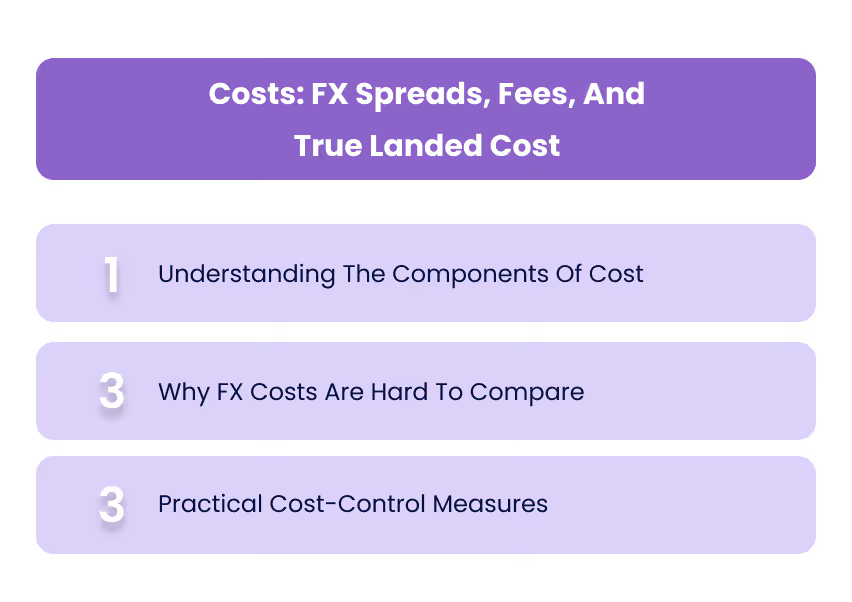
Costs: FX Spreads, Fees, And True Landed Cost
For most UAE businesses, the biggest weakness in cross-border payments is not speed. It is cost predictability. Finance teams often approve a payment based on an estimated amount, only to discover later that the actual cost is materially different.
This gap comes from how cross-border costs are constructed.
Understanding The Components Of Cost
A cross-border payment typically includes multiple cost layers:
- FX Spread
The difference between the market (mid) rate and the rate offered by the provider. This is often the largest cost component and the least transparent. - Upfront Processing Fees
Flat or percentage-based charges are applied by the sending bank or provider. - Intermediary Or Correspondent Fees
Fees are deducted by banks in the payment chain. These are frequently unknown at the time the payment is initiated. - Receiving Bank Charges
Fees applied by the beneficiary’s bank are sometimes deducted from the amount received rather than billed separately.
The combination of these charges determines the true landed cost. When fees are split across multiple parties, finance teams struggle to forecast and explain variances.
Why FX Costs Are Hard To Compare
FX pricing is rarely presented in a standard way. One provider may quote a low upfront fee but apply a wide FX spread. Another may advertise competitive FX while charging higher processing fees.
The only reliable comparison is the total cost for a specific corridor, currency, and amount. Finance teams should avoid evaluating providers on headline pricing alone.
Practical Cost-Control Measures
Experienced treasury teams apply a few consistent practices:
- Capture the FX rate and total cost at the time of approval
- Use consistent corridors and providers where possible
- Review FX and fee outcomes quarterly, not just at renewal
- Separate pricing discussions by corridor rather than globally
These steps reduce surprises and improve budgeting accuracy.
Related: Complete Guide to Corporate Card Reconciliation
Treasury And Cash Forecasting Implications
Cross-border payments affect more than expenses. They directly influence short-term liquidity and cash forecasting accuracy. The issue is timing.
How Float Impacts Cash Visibility
Two types of timing gaps matter to treasury:
- Disbursement Float
The period between initiating a payment and funds actually leaving the account. - Collection Float
The period between a payment being received and funds becoming usable.
In cross-border contexts, both floats can be longer and less predictable than domestic payments. If the treasury does not model these gaps, cash forecasts quickly lose accuracy.
Managing Liquidity Across Corridors
Finance teams that handle cross-border volume typically:
- Build corridor-specific settlement assumptions into forecasts
- Schedule high-value payments earlier in the cycle
- Avoid clustering large transfers near reporting deadlines
This reduces reliance on short-term borrowing and lowers stress during close periods.
Linking Payment Timing To Decision-Making
Understanding settlement patterns also improves decision quality. For example:
- Whether to delay or accelerate a payment
- Whether to pre-fund accounts for predictable outflows
- Whether to consolidate payments to reduce exposure
These are treasury decisions, not operational ones, but they rely on accurate payment behaviour data.
Also Read: Cash Flow Forecasting: Best Practices and Key Methods
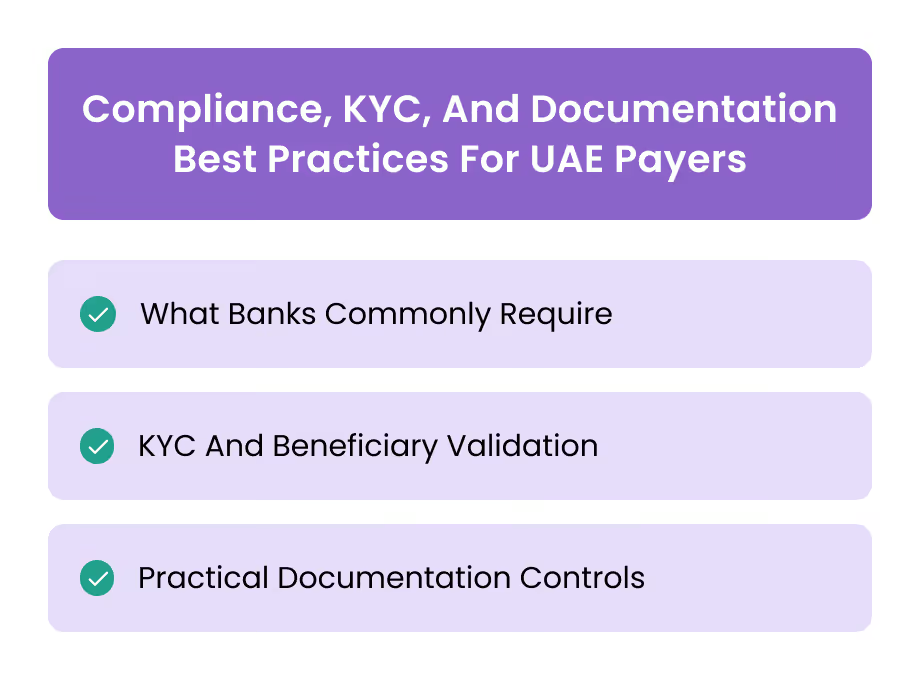
Compliance, KYC, And Documentation Best Practices For UAE Payers
In the UAE, most cross-border payment delays are not caused by a lack of funds or incorrect routing. They are caused by incomplete or inconsistent documentation. Finance teams that treat documentation as an afterthought end up reacting to bank queries instead of controlling timelines.
What Banks Commonly Require
For outbound cross-border transactions, banks typically expect:
- Clear beneficiary details (legal name, account number, IBAN where applicable)
- A defined purpose of payment
- Supporting documents such as invoices, contracts, or purchase orders
- Alignment between invoice currency, payment currency, and amount
When any of these elements are missing or unclear, payments are more likely to be flagged for manual review.
KYC And Beneficiary Validation
Banks perform KYC not only on the sender but also on beneficiaries, especially for new vendors or higher-risk jurisdictions. From a treasury perspective, this means:
- New suppliers often trigger additional checks on the first payment
- Changes in beneficiary details can cause delays if not pre-validated
- Periodic re-validation is normal, not exceptional
Proactively validating beneficiary information before initiating payment saves time later.
Practical Documentation Controls
Effective finance teams adopt a few simple practices:
- Standardise payment descriptions to include invoice and PO references
- Maintain a document pack for each vendor that can be shared quickly
- Flag transactions above internal thresholds for pre-review
- Keep a basic audit trail linking approvals, invoices, and payments
These controls reduce friction without adding bureaucracy.
Related: What is a VAT Compliance Health Check and How to Stay Audit-Ready in the UAE
Provider Choice: Banks, PSPs, And Fintechs
Choosing a cross-border payment provider is not just about pricing. It is about predictability, coverage, and operational fit.
1. Banks
Traditional banks offer broad corridor coverage and strong regulatory alignment. They are often preferred for:
- High-value transfers
- Established counterparties
- Complex jurisdictions
However, banks may offer less transparency on intermediary fees and FX spreads, which complicates landed-cost forecasting.
2. Payment Service Providers And Fintechs
PSPs and fintech platforms often compete on:
- Faster settlement for supported corridors
- Upfront FX and fee transparency
- Better digital interfaces and tracking
The trade-off is selective corridor coverage and transaction limits. Finance teams should confirm these constraints early.
What Finance Teams Should Evaluate
A practical evaluation checklist includes:
- Corridor and currency coverage
- Total landed cost visibility before approval
- Settlement timelines and SLA clarity
- Reconciliation and reporting support
- Integration with accounting or ERP systems
The best provider is usually not universal. Many finance teams use different providers for different corridors based on these criteria.
Also Read: What Are the Top Benefits of ERP Integration and Why Does It Matter?
Practical Steps For Finance Teams Managing Cross-Border Payments

Most issues with cross-border payments are preventable. Finance teams that apply a structured playbook reduce delays, FX surprises, and reconciliation effort without increasing bureaucracy.
Step 1: Map Your Payment Corridors
Start by documenting where money actually goes. List countries, currencies, average ticket sizes, and payment frequency. Corridor-specific patterns quickly emerge and should guide provider selection and scheduling.
Step 2: Standardise Payment Templates
Create approved templates per corridor or key supplier. Each template should include:
- Beneficiary details
- Payment currency
- Standard payment reference format
- Required supporting documents
Templates reduce message errors and speed approvals.
Step 3: Capture Total Cost At Approval Stage
Require FX rate and total expected cost to be visible before approval. This prevents disputes later and improves budget accuracy.
Step 4: Align Payment Timing With Cash Forecasts
Schedule high-value or slow-settling corridor payments earlier in the cycle. Avoid last-day processing for corridors prone to manual review.
Step 5: Separate Exception Handling From Routine Payments
Define thresholds for when enhanced review or documentation is required. This keeps routine payments moving while protecting high-risk transfers.
Step 6: Centralise Visibility And Reconciliation
Ensure payments, approvals, invoices, and FX details live in one place. Fragmentation is the biggest driver of reconciliation delays.
Step 7: Review Providers And Pricing Regularly
FX spreads and fees change over time. Quarterly reviews by corridor often reveal savings without renegotiating global contracts.
Applied consistently, this playbook turns cross-border payments from a reactive process into a predictable one.
Related: Steps to Automate Expense Management and Approvals
Future Outlook For Cross-Border Payments In The UAE
The UAE is actively investing in faster, more transparent cross-border payment infrastructure. Finance teams should expect gradual change rather than overnight disruption.
1. Increased Use Of Direct And Real-Time Rails
Banks and regulators are pushing toward more direct settlement routes and faster payment schemes. Over time, this reduces reliance on long correspondent chains for key corridors.
2. CBDC And Bilateral Settlement Initiatives
The UAE’s involvement in central bank digital currency pilots and bilateral currency arrangements signals a long-term shift toward alternative settlement models. While still early, these initiatives aim to lower costs and improve transparency for cross-border trade.
3. Greater Emphasis On Transparency
Regulators and customers increasingly expect clearer disclosure of fees, FX rates, and settlement timelines. Providers that cannot offer upfront visibility will face pressure.
For finance leaders, the implication is clear: systems and processes built around visibility and documentation will age better than those relying on manual intervention.
Also Read: Future Directions and History of Global E-invoicing
How Alaan Helps UAE Businesses Manage Cross-Border Payments End-to-End
Many UAE finance teams manage cross-border payments outside their primary spend stack. Cards cover SaaS, ads, and employee expenses, but international suppliers, imports, and bulk payments still force teams back to banks, exchange houses, or standalone FX tools, fragmenting visibility and control.
Alaan Cross-Border Transfers (SuperPay) brings international payments into the same system teams already use to manage business spend, approvals, and reconciliation, without replacing banks or overcomplicating workflows.
What Alaan Covers Beyond Just The Transfer
Alaan is not only a cross-border payments tool. It combines international transfers with core spend and finance controls that reduce friction before and after money moves.
1. Cross-Border Transfers With Upfront Cost Visibility
Finance teams can check FX rates and expected total cost before approving a transfer, helping avoid post-payment surprises caused by wide spreads or hidden fees. Payments are supported on selected corridors in Phase 1, with expansion planned.
2. Two-Level Approval Workflows
Separate invoice approval and payment approval flows allow teams to validate the obligation first, then authorise the transfer, especially useful for high-value or higher-risk international payments.
3. Centralised Vendor And Beneficiary Management
Supplier details, documentation, and payment history are stored centrally. This reduces first-time payment delays, beneficiary errors, and repeated KYC-related follow-ups.
4. Integrated Spend, Not Standalone Transfers
Unlike FX-only tools, Alaan also supports:
- Corporate cards for SaaS, ads, and employee spend
- Expense tracking and receipt capture
- Email invoice forwarding
- Automated checks (duplicate detection, tax invoice detection)
This allows finance teams to manage local spend and international payments in one place, rather than stitching together multiple tools.
5. Cleaner Reconciliation And Accounting Sync
Payment data, FX details, invoices, and approvals stay linked and sync with accounting systems. This simplifies month-end reconciliation and reduces time spent explaining FX or fee variances.
What Alaan Is (And Is Not)
Alaan is not a bank and does not replace existing banking relationships.
Alaan Cross-Border Transfers (SuperPay) works alongside banks and payment providers to give finance teams better visibility, control, and predictability, especially for payments where cards are not an option.
Related: Top Enterprise Spend Management Software Solutions for 2025
Conclusion
Cross-border payments are a fact of life for UAE businesses, but unpredictability does not have to be. Most issues, unexpected FX costs, delays, reconciliation gaps, and supplier friction stem from poor visibility and fragmented workflows rather than the payments themselves.
Finance teams that understand corridor behaviour, capture true cost upfront, and standardise documentation are far better positioned to control margins and protect cash flow. As payment infrastructure evolves, the advantage will increasingly sit with teams that can combine speed with transparency and discipline.
Alaan supports this shift by bringing cross-border transfers into a single, controlled workflow, making costs clearer, approvals stronger, and reconciliation easier, without adding operational overhead.
Want to see your true FX cost before committing to a transfer?
Book a free demo with Alaan to see how UAE businesses are simplifying cross-border payments and reducing surprises.
Frequently Asked Questions (FAQs)
1. Are Cross-Border Payments Regulated Differently In The UAE Compared To Other Countries?
Yes. Cross-border payments from the UAE are governed by Central Bank of the UAE (CBUAE) regulations, with strong emphasis on AML/CTF checks, KYC, and transaction documentation. While the underlying frameworks are globally aligned, UAE banks tend to apply stricter documentation and screening for certain corridors, especially for first-time or high-value payments.
2. Why Do International Transfers Sometimes Take Days Even When Funds Leave Immediately?
Because debiting the sender’s account is not the same as settlement. Many cross-border payments move through correspondent banks, each of which may apply fees, compliance checks, or manual reviews. These intermediate steps introduce delays that are invisible at initiation but material at receipt.
3. What Is The Difference Between FX Rate And True Landed Cost?
The FX rate shows the currency conversion price, but the true landed cost includes FX spread, sending fees, intermediary bank charges, and receiving bank fees. These costs are often split across institutions, which is why finance teams only see the full impact after the payment completes.
4. Which Cross-Border Corridors Are Typically Faster From The UAE?
Payments to the UK, US, and SEPA countries are generally faster and more predictable due to mature clearing systems and direct banking relationships. Corridors into South Asia, parts of MENA, and emerging markets often take longer due to additional compliance checks and intermediary routing.
5. Why Do Banks Ask For Invoices Or Contracts For Some Transfers?
Banks are required to validate the economic purpose of cross-border payments under AML and sanctions regulations. Invoices, contracts, or purchase orders help demonstrate legitimate business activity. Missing or unclear documentation is one of the most common reasons for payment holds.
6. How Do Cross-Border Payments Affect Cash Flow Forecasting?
International payments introduce disbursement and collection float that is harder to predict than domestic payments. If treasury models do not account for corridor-specific settlement timing, cash forecasts can become inaccurate, especially around reporting deadlines or high-volume payment cycles.
Gain control over business expenses with Alaan corporate cards
Invygo earned AED 100,000 in cashback using Alaan cards
Personalise approval workflows to align with your business needs with Alaan's Spend Management platform
Discover the power of automated expense tracking and smarter spend control with Alaan
Turn data into actionable insights with Alaan's spend management tools
Stay Tax Compliant with UAE's #1 Corporate Card and Spend Management Platform
Customisable corporate card policy template
Know how much Corporate Tax you have to pay this fiscal year
Easily integrate Alaan with your ERP for accurate, real-time expense tracking
Close books faster with Alaan's AI-powered accounting automation
Reconcile your books in minutes instead of hours, every single month.
Keep petty cash organized with Alaan corporate cards and automated expense management