.avif)
.avif)

Finance teams today face a very different set of expectations from the ones they were originally built for. Leaders no longer view finance as a function that simply records numbers and ensures compliance; they expect sharper insight, faster cycles, cleaner data, and genuine commercial partnership. Yet many finance departments still operate with fragmented processes, heavy manual work, and no unifying sense of purpose.
A well-defined finance vision addresses this gap. It provides direction, clarifies the role finance plays in shaping organisational performance, and sets the standards the team must meet. Without a clear vision, even capable teams drift into reactive work: chasing deadlines, correcting data, resolving exceptions, and leaving little room to influence strategic decisions.
A strong finance vision is not a description of what finance is today, but a statement of what it must become to support the organisation’s growth, resilience, and long-term goals.
In this blog, we’ll show you how to define a practical, measurable vision for your finance department so it moves from reactive bookkeeping to strategic partnership.
TL;DR / Key Takeaways
- A finance vision is a leadership tool, not a slogan, that defines how the function contributes to growth, resilience, and decision-making.
- Strong visions consistently rest on four pillars: strategic purpose, operating ambitions, capability expectations, and technology/data outcomes.
- Measurable outcomes (e.g., close-cycle duration, forecast accuracy, automation rates) turn intent into accountability.
- The finance vision shapes the operating model from partnering structures to automation strategy, talent decisions, and governance frameworks.
Why a Clear Finance Vision Matters
Across industries, finance is being asked to move beyond reporting and compliance into areas that directly impact business performance. Leaders expect finance to provide sharper insights, accelerate decision cycles, and manage risk proactively while operating with higher accuracy and efficiency.
These expectations cannot be met through incremental improvements alone. Finance teams need a clear vision that articulates:
- The purpose of the function and how it creates value
- The standards and behaviours expected from the team
- What “excellent” looks like in terms of service delivery and business impact
Without this clarity, finance defaults to reactive tasks: reconciling errors, responding to exceptions, and focusing on short-term deadlines instead of long-term performance.
A strong finance vision creates alignment, sets priorities, and guides investment decisions across people, technology, and process. In mature organisations, it becomes the backbone of the operating model, shaping hiring, automation strategy, governance, forecasting practices, and analytical capabilities.
Also read: Understanding Financial Statements for Beginners
What a Finance Department Vision Should Cover
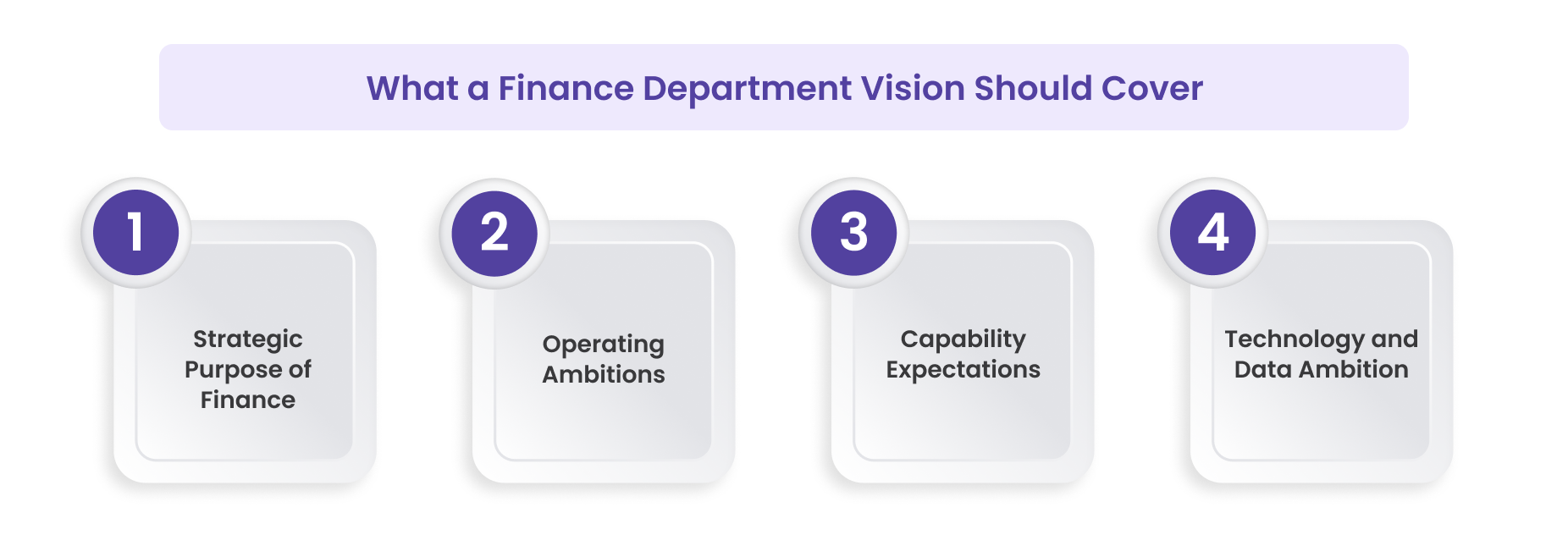
A finance vision has to do more than sound polished. It must set a direction that is strategic, operationally grounded, and credible for the organisation’s maturity and market context. The following four components form the core of any robust finance vision.
1. Strategic Purpose of Finance
This defines the department’s primary value to the organisation. A modern finance function does far more than safeguard compliance; it shapes business performance. Examples include:
- enabling growth through better capital allocation,
- improving margins through cost discipline and analytics,
- strengthening resilience through proactive risk identification,
- equipping executives with the financial clarity to make faster decisions.
This strategic purpose sets the bar for every capability the department builds.
2. Operating Ambitions
The vision must state how finance intends to operate. These ambitions become the non-negotiables that drive process redesign and automation priorities. Examples include:
- shortening the close cycle,
- elevating forecast accuracy,
- reducing manual journal corrections,
- delivering real-time visibility into cash and spending,
- enforcing consistent governance across entities or departments.
These ambitions translate the vision into measurable operational outcomes.
3. People and Capability Expectations
Finance cannot fulfil its vision without the right behaviours and skills. This part of the vision defines what is expected from the team:
- commercial understanding in addition to accounting fundamentals,
- data literacy and analytical capability,
- strong business partnership and communication,
- ownership, curiosity, and a continuous improvement mindset.
A clear capability vision directly shapes hiring, performance reviews, training, and team structure.
4. Technology and Data Ambition
Modern finance excellence is technology-enabled. A credible vision will detail what the function aims to achieve, such as:
- integrated ERP with clean master data,
- automated high-volume accounting workflows,
- real-time reporting dashboards,
- trusted operational and financial datasets,
- reduced reliance on spreadsheets.
This ambition does not list tools; it defines the desired outcomes technology must deliver.
Also read: Effective Business Spending Policies
Examples of Strong Finance Vision Statements
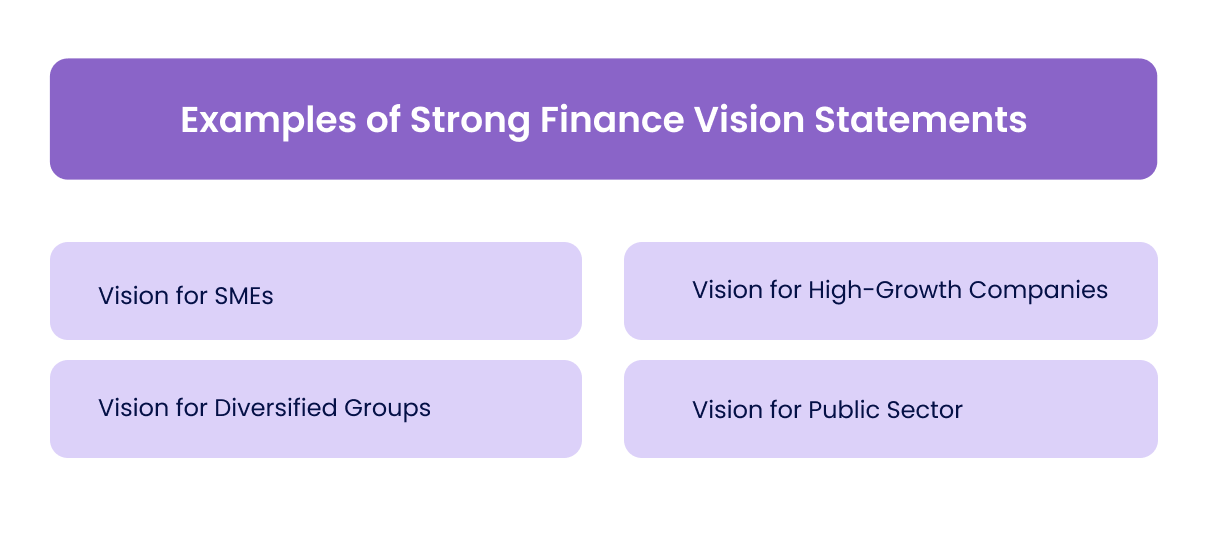
A finance vision must be short, directional, and practical enough to influence real decisions. Below are examples tailored to different organisational contexts. Each provides a clear strategic purpose and operating expectation, the two elements that finance teams anchor around.
1. Vision for SMEs
"To provide disciplined financial oversight and dependable insights that strengthen cash flow, support sustainable growth, and ensure every decision is grounded in financial clarity."
Useful when the business needs stability, better controls, and sharper visibility into spending and liquidity.
2. Vision for High-Growth Companies
"To build a scalable, automation-led finance function that delivers real-time financial intelligence, supports rapid expansion, and acts as a trusted advisor to product and commercial teams."
Works well for companies expanding quickly and needing speed, accuracy, and forward-looking insight.
3. Vision for Diversified Groups
"To unify financial governance, elevate reporting quality, and create a group-wide financial view that improves capital allocation and strengthens performance across all business units."
Suitable for multi-entity structures seeking consistency and cross-entity insight.
4. Vision for Public Sector or Regulated Environments
"To ensure transparent stewardship of public funds, deliver accurate reporting, strengthen compliance, and provide financial insight that improves service delivery outcomes."
Use cases: government bodies, regulators, non-profits, or organisations that must meet strict reporting and compliance standards.
Each vision clarifies what finance promises to deliver, and what the organisation can expect from the function daily.
Also read: How UAE Businesses Can Reduce Procurement Costs with These 20 Strategies
How to Craft a Vision for the Finance Function (Practical 6-Step Approach)
.png)
Finance leaders often struggle with vision because it can seem abstract. This 6-step approach makes it concrete and operational.
1. Align with Corporate Strategy and Leadership Priorities
A finance vision cannot be created in isolation. It must reflect:
- the company’s growth horizon,
- commercial strategy,
- risk appetite,
- regulatory environment, and
- investment priorities.
A finance vision is credible only when it directly supports organisational strategy.
2. Define the Core Promise to Business Stakeholders
This is the single sentence that captures finance’s value proposition. Examples:
- “Finance will enable faster decision-making with real-time insight.”
- “Finance will improve capital efficiency through disciplined analysis.”
This promise becomes the anchor for all future initiatives.
3. Select Three to Five Strategic Pillars
These are not tasks; they are enduring focus areas. For example:
- Reliable reporting and compliance
- Faster, data-driven decision support
- Cash and capital efficiency
- Process consistency and automation
- Risk and governance discipline
Pillars provide structure to the vision and clarity to teams.
4. Set Measurable Outcomes (KPIs) to Anchor the Vision
Without measurable outcomes, the vision stays aspirational. KPIs might include:
- close cycle duration,
- forecast accuracy,
- cost-to-serve for finance,
- automation percentage of reconciliations,
- time spent on strategic analysis vs manual tasks.
These provide clear signals of progress or drift.
5. Identify Capability and Operating Model Gaps
Capability gaps can include a lack of data literacy, limited business partnering skills, outdated controls, inconsistent processes, or reliance on spreadsheets. Operating model gaps may include fragmented teams, unclear roles, or decentralised decision-making.
A vision only becomes real when the organisation acknowledges and plans for these gaps.
6. Build a 12–36 Month Roadmap Around the Vision
A roadmap translates ambition into action:
- first 12 months → stabilisation and foundational improvements,
- 12–24 months → automation and analytical uplift,
- 24–36 months → integration, forecasting sophistication, and partner-led decision support.
Roadmaps ensure the vision evolves from a statement to an execution plan.
Also read: Modern Expense Management Guide
KPIs That Show the Finance Vision Is Working
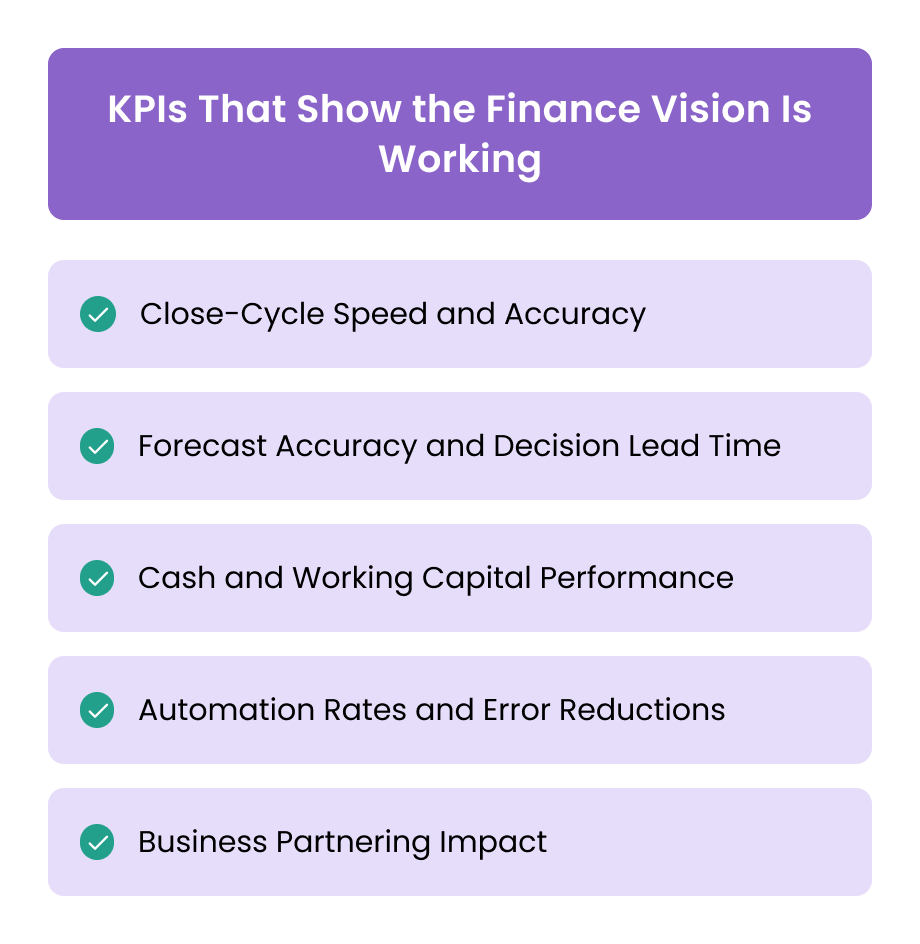
A finance vision only has value if progress can be measured. These KPIs serve as practical indicators that the function is moving toward its strategic intent. They can be adapted depending on company size, complexity, and industry.
1. Close-Cycle Speed and Accuracy
- Days to close is the clearest operational barometer.
- Error rates in journals, accruals, and reconciliations show whether processes are stable.
A consistent reduction signals stronger controls and fewer manual interventions.
2. Forecast Accuracy and Decision Lead Time
- Forecast accuracy for revenue, cost, and cash flow reflects analytical maturity.
- “Decision lead time”, how quickly finance can provide decision-ready insights, demonstrates how well finance supports the business.
Companies with high accuracy and short decision cycles operate more confidently.
3. Cash and Working Capital Performance
- Days sales outstanding (DSO)
- Inventory days
- Days payable outstanding (DPO)
- Daily cash visibility
These KPIs reflect both the discipline and agility of the finance function.
4. Automation Rates and Error Reductions
- Percentage of reconciliations automated
- Expense or invoice automation coverage
- Reduction in manual journal entries
Higher automation indicates progress toward a more resilient, insight-focused team.
5. Business Partnering Impact
This measures how effectively finance influences outcomes:
- quality of insights provided to commercial teams,
- forecast deviations explained in advance,
- involvement in pricing, capex, and scenario planning,
- satisfaction ratings from business leaders.
A mature finance function is invited early into strategic decisions, not after budgets are set.
Also read: Cash Flow Optimisation Strategies
Organisational Design Considerations for a Modern Finance Function
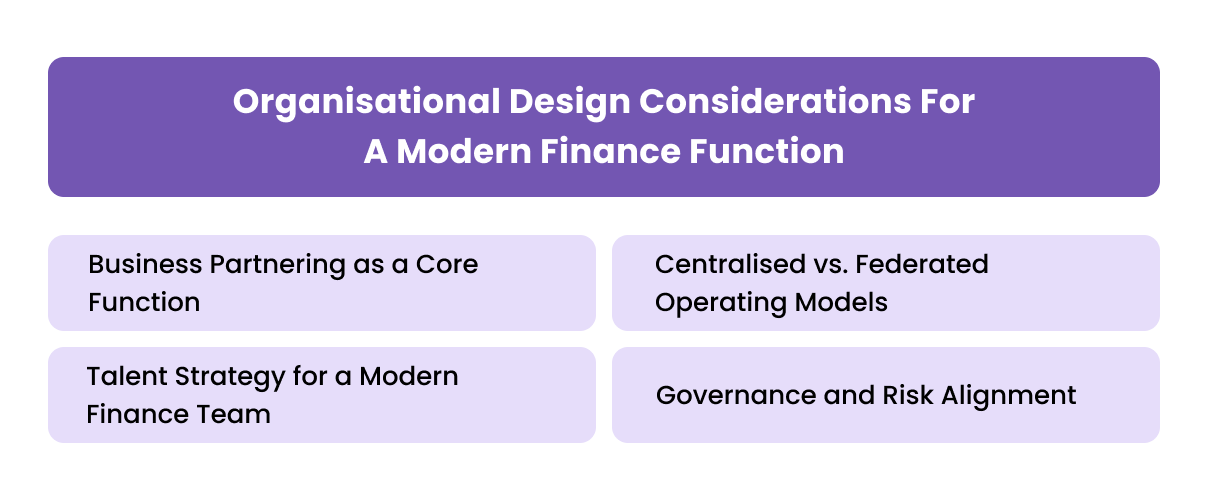
A strong vision is ineffective without the organisational structure to deliver it. Finance leaders must define how teams collaborate, where expertise sits, and how work flows across roles.
1. Business Partnering as a Core Function
High-performing finance functions embed partners directly with product, sales, or operations teams. Their role is not reporting; it is shaping decisions through insight and challenge. Partnering must be resourced properly; one partner stretched across too many units becomes a messenger, not a strategist.
2. Centralised vs. Federated Operating Models
A centralised model works best when the organisation needs consistency, strong governance, and unified reporting.
A federated model (central core + distributed partners) suits businesses with multiple units or geographies that require local autonomy.
Most mature organisations adopt a hybrid: centralised accounting + decentralised partnering.
3. Talent Strategy for a Modern Finance Team
Finance capability requirements are evolving. The modern function needs:
- accountants with analytical fluency,
- analysts with commercial intuition,
- team members who understand data models and automation tools,
- individuals trained to communicate financial impact clearly.
The talent strategy must reflect the vision, a vision that promises insight requires people who can deliver insight.
4. Governance and Risk Alignment
A finance function without strong governance cannot support strategic ambitions. Key elements include:
- clear authority matrices and approvals,
- consistent controls across entities,
- audit-ready data trails,
- structured policy frameworks for spending, risk, and compliance.
Governance enables reliability; reliability enables trust; trust enables strategic influence.
Also read: Improving Internal Control for Financial Reporting (ICFR)
Technology and Data Capabilities Needed to Deliver the Vision
A finance vision is only as strong as the systems and data that support it. The shift from a transactional finance function to a strategic one depends on technology that reduces manual workload, improves accuracy, and enables real-time insight. This section outlines the capabilities a modern finance function needs, not tools, but outcomes.
1. ERP and Core Accounting Stability
A unified, well-implemented ERP remains the backbone of the finance infrastructure. It must provide:
- clean, consistent master data,
- reliable posting logic,
- automated reconciliations wherever possible,
- consistent treatment of tax, revenue, and expense categories.
Without a stable ERP foundation, analytics, forecasting, and automation rest on unreliable inputs.
2. Real-Time Reporting and Decision-Ready Insight
Leaders increasingly expect finance to provide timely, actionable insight. This requires:
- dashboards that refresh automatically,
- drill-down capability to trace variances,
- a single source of truth across business units,
- data models that support scenario planning.
Static month-end reporting is no longer enough. Finance needs to deliver clarity when decisions are being made, not after.
3. Automation of High-Volume Finance Processes
Automation is not a trend; it is a requirement. The finance vision must articulate which repetitive tasks should be automated to free capacity for higher-value work. Common targets include:
- expense reviews and coding
- invoice processing
- account reconciliations
- intercompany eliminations
- journal entry posting
- variance explanations driven by machine learning insights
Removing manual steps reduces errors and accelerates the entire financial cycle.
4. Intelligent Spend Management and Compliance Controls
Spend management is now a core competency of modern finance. Intelligent systems should enable:
- transaction-level policy enforcement,
- real-time visibility into spending behavior,
- VAT-compliant documentation capture,
- prevention of duplicate or mischaracterized expenses,
- automated reconciliation into the ERP.
These capabilities protect the organisation financially and operationally.
[cta-1]
Common Pitfalls When Defining or Implementing a Finance Vision
Even capable finance teams stumble during vision design. These pitfalls are based on patterns observed across transformation programs and internal audits.
1. Vision Statements That Are Too Generic
Phrases like “world-class finance function” or “trusted business partner” lack meaning unless defined. A vision must be specific and directional, or it will not shape behaviour or priorities.
2. Overemphasis on Technology Without Process Redesign
Automation does not fix weak processes. Without clarity on what should change and why, technology becomes a patchwork of tools layered over inefficiencies.
3. Lack of Measurable Outcomes
If a finance vision has no KPIs, progress becomes subjective. Teams cannot understand what “good” looks like or when the function is drifting from its goals.
4. Fragmented Ownership and Poor Communication
A vision cannot sit only with the CFO. Controllers, FP&A leads, tax teams, shared services, and business partners must all own parts of it. Fragmented ownership creates inconsistent execution.
5. Insufficient Capability Building
A modern finance vision requires data fluency, commercial insight, communication skills, and analytical techniques. Without structured upskilling, the function will not deliver the outcomes leadership expects.
Also read: Understanding Spend Visibility and Business Benefits
Roadmap Example for a Future-Ready Finance Function (12–36 Months)
This roadmap provides a practical, realistic trajectory. It avoids overly ambitious timelines and focuses on the sequence that produces sustainable change. Finance transformations fail when everything is attempted at once; they succeed when the roadmap balances quick wins with foundational improvements.
1. Foundation Stage (0–12 Months)
Focus: stability, visibility, and control.
Key initiatives include:
- stabilising the chart of accounts and ERP structure,
- improving close cycle discipline,
- standardising core policies (spend, travel, approvals),
- enabling basic dashboards for cash, spend, and P&L visibility,
- automating one or two high-volume processes to demonstrate value,
- setting baseline KPIs for the vision.
The goal of this phase is to remove noise, errors, inconsistencies, and manual workarounds.
2. Acceleration Stage (12–24 Months)
Focus: automation, integration, and forecasting.
Initiatives typically include:
- expanding automation into expenses, AP, AR, and reconciliations,
- embedding business partners with commercial and product teams,
- implementing rolling forecasts,
- improving scenario modelling and cost discipline frameworks,
- enabling real-time reporting for leadership teams.
By this phase, finance begins shifting from transactional execution to analytical partnership.
3. Scale & Optimisation Stage (24–36 Months)
Focus: full strategic alignment and advanced decision support.
Possible initiatives:
- deploying advanced analytics for margin analysis, pricing, or risk,
- refining capital allocation frameworks,
- creating centres of excellence for FP&A or data,
- upgrading governance models across decentralised units,
- enhancing liquidity, working capital, and investment modelling.
This stage makes the finance vision fully operational, a strategic function that influences decisions across the business.
Also read: Top Enterprise Spend Management Software Solutions for 2025
How Alaan Supports a Modern Finance Vision
A future-ready finance function relies on accurate data, strong governance, reduced manual workload, and consistent policy enforcement. Alaan strengthens each of these pillars by embedding financial discipline directly into the organisation’s daily spending activity. The platform does not replace finance processes; it reinforces them.
Strengthening Spend Governance
Alaan enables finance teams to set precise rules around spending behaviour, from merchant restrictions to department-level limits to approval workflows. These controls reduce ambiguity and ensure that spending always aligns with policy intent.
Automating Expense Handling and Reconciliation
With automated receipt capture, VAT extraction, coding suggestions, and duplicate detection, Alaan removes a significant amount of manual work from the close cycle. This frees finance capacity for analysis and decision support.
Improving Policy Adherence Across Teams
Alaan enforces policy at the moment of spend, not after. Whether it’s blocking unapproved merchants or ensuring complete documentation, the platform prevents exceptions before they become accounting issues.
Ensuring Accurate VAT and Accounting Treatment
Alaan syncs data directly into ERP systems with correct categories, VAT flags, and documentation attached. This reduces journal corrections, strengthens audit readiness, and makes the month-end significantly cleaner.
Enabling Real-Time Visibility and Insight
Finance leaders gain instant visibility into all card transactions and employee spend. This supports better cash planning, quicker variance investigation, and stronger forecasting.
[cta-5]
Conclusion
A finance vision is not a statement to be presented once and archived. It is a leadership tool that clarifies expectations, improves focus, and shapes how finance shows up in the business every day. When articulated well, the vision determines where automation is applied, how teams are structured, what KPIs matter, and how finance partners with the rest of the organisation.
Finance functions that operate without a clear vision often find themselves reacting to operational noise. Teams that operate with a defined vision move with purpose: they build reliable processes, deliver insight with speed and consistency, and support growth with disciplined financial governance.
A modern finance vision is ultimately about trust, trust that the numbers are accurate, trust that decisions are informed, and trust that finance is contributing meaningfully to the organisation’s long-term goals.
At Alaan, we help finance teams move closer to their vision by reducing manual work, improving compliance, and delivering real-time visibility across all spending.
If your organisation is building a more strategic, insight-driven finance function, Alaan can support that journey with automation, transparency, and stronger control. Book a Demo Today!
Frequently Asked Questions (FAQs)
1. Why does a finance department need a vision statement?
A vision provides direction, clarifies the department’s value, and guides investment, hiring, and process redesign. Without it, finance becomes reactive and inconsistent.
2. How detailed should a finance vision be?
It should be specific enough to influence priorities and measurable outcomes but high-level enough to remain stable over several years.
3. Who is responsible for defining the finance department’s vision?
The CFO leads the process, but controllers, FP&A leads, business partners, and senior executives must contribute to ensure alignment and credibility.
4. What role does technology play in enabling the finance vision?
Technology supports automation, accuracy, and real-time insight. It shifts finance’s focus from manual processing to analysis and decision support.
5. How often should a finance vision be revisited?
Most organisations review and refine the vision every 2–3 years or when there is a major shift in strategy, structure, or market conditions.
6. How does Alaan help finance teams achieve their vision?
Alaan reduces manual expense work, enforces policy compliance, provides real-time spend visibility, and ensures accurate VAT and accounting treatment, all of which strengthen finance’s ability to operate strategically.
Gain control over business expenses with Alaan corporate cards
Invygo earned AED 100,000 in cashback using Alaan cards
Personalise approval workflows to align with your business needs with Alaan's Spend Management platform
Discover the power of automated expense tracking and smarter spend control with Alaan
Turn data into actionable insights with Alaan's spend management tools
Stay Tax Compliant with UAE's #1 Corporate Card and Spend Management Platform
Customisable corporate card policy template
Know how much Corporate Tax you have to pay this fiscal year
Easily integrate Alaan with your ERP for accurate, real-time expense tracking
Close books faster with Alaan's AI-powered accounting automation
Reconcile your books in minutes instead of hours, every single month.
Keep petty cash organized with Alaan corporate cards and automated expense management