.avif)


Discussions around “UAE Vision 2030” often surface in boardrooms and strategy decks, but the term itself is less a single document than a shorthand for the direction shaping the country’s economic and institutional environment. That direction is already measurable. The UAE’s GDP reached approximately AED 1.776 trillion in 2024, with non-oil sectors contributing about 75.5% of output, underscoring the depth of diversification underway.
Policy ambition extends beyond the current scale. National economic targets include raising GDP toward AED 3 trillion within the next decade, reinforcing investment and regulatory momentum across technology, trade, and infrastructure development.
For business leaders, this evolving framework matters less as rhetoric and more as an operating context. This article breaks down what the term actually refers to, the major tracks shaping the UAE roadmap toward 2030, and what decision-makers should realistically pay attention to.
TL;DR
- “UAE Vision 2030” is a directional construct, not a single policy artifact. Business relevance emerges from the interaction between emirate-level economic frameworks and federal targets shaping market incentives, capital allocation, and regulatory evolution.
- Diversification and digitisation are structural shifts, not policy themes. Investment flows, infrastructure build-out, and administrative digitisation indicate a transition toward productivity-driven competition where operational capability increasingly differentiates firms.
- Sustainability and human capital priorities are becoming financially material. Environmental alignment, workforce development, and governance maturity are progressively influencing funding access, supply-chain participation, and market positioning.
- Scaling within this environment increases governance complexity. As trade, digital integration, and cross-border activity expand, organisations face rising demands around transparency, documentation discipline, and financial control structures.
- Operational readiness depends on integrated spend oversight. Platforms like Alaan align invoice capture, approvals, execution visibility, and reconciliation into a single workflow, helping finance teams scale alongside national growth without accumulating control friction.
What the UAE Vision 2030 Actually Refers To
“UAE Vision 2030” is commonly used as shorthand, but the most explicit formal framework tied to that timeline is the Abu Dhabi Economic Vision 2030, which sets out long-term priorities such as economic diversification, competitiveness, environmental protection, and human capital development.
At the federal level, the guiding framework today is We The UAE 2031, a national vision focused on strengthening society, the economy, diplomacy, and infrastructure through technological and human-capital development.
This federal vision includes measurable economic ambitions such as:
- Doubling GDP from AED 1.49 trillion to AED 3 trillion
- Increasing non-oil exports
- Expanding tourism’s contribution to GDP
- Raising foreign trade volumes
These targets shape the environment businesses operate in, particularly through policies encouraging growth, diversification, and international competitiveness.
Taken together, the practical interpretation for business leaders is simple:
“UAE Vision 2030” should be understood as the combined national and emirate strategies guiding economic, technological, and social development toward the end of this decade.
The UAE Roadmap To 2030 In One View
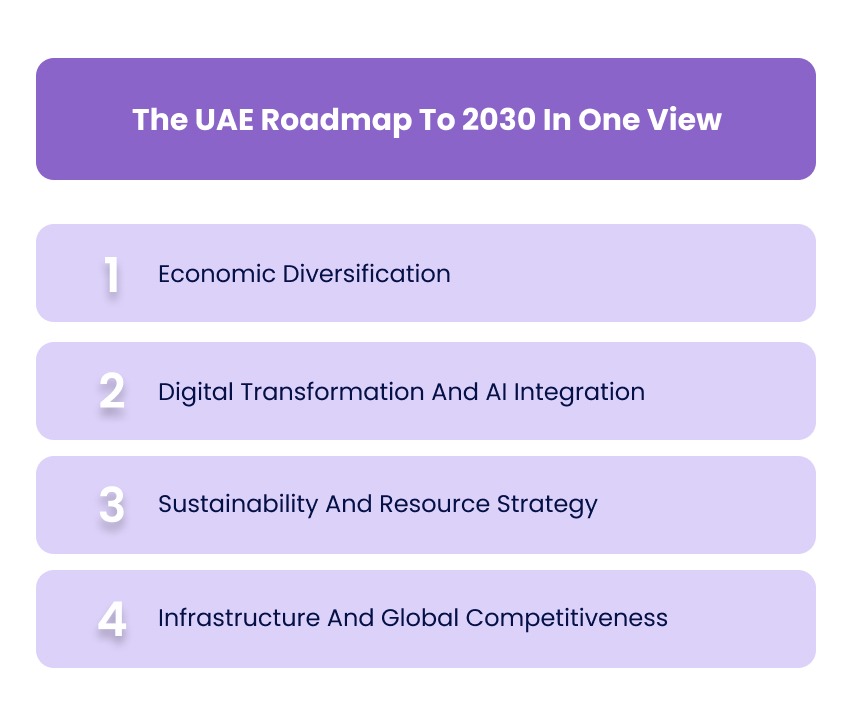
Across federal and emirate strategies, several consistent tracks define how the UAE economy is evolving. These are not abstract policy goals; they are visible in capital allocation, regulation, infrastructure, and sector prioritisation.
1. Economic Diversification
Reducing reliance on hydrocarbons remains a central objective, with emphasis on knowledge sectors, entrepreneurship, and competitiveness as investment destinations.
This shift is already measurable, non-oil sector contribution to GDP has expanded significantly in recent years, reflecting sustained diversification momentum.
2. Digital Transformation And AI Integration
The UAE’s national digital trajectory is anchored in technology deployment across public services and infrastructure, with artificial intelligence positioned as a core economic driver.
AI adoption is projected to contribute up to 20% of non-oil GDP by 2031, highlighting the scale of transformation expected across industries.
Government strategies also aim for full reliance on AI in service delivery and data analysis in the coming decade, signalling continued digitisation of regulatory and administrative processes.
3. Sustainability And Resource Strategy
Environmental protection and sustainable development form explicit pillars in emirate-level visions, covering natural resource management, food security, and ecosystem protection.
This direction is reflected commercially through growing investment in sustainable finance and climate initiatives, positioning Abu Dhabi among global centres shaping low-carbon capital flows.
4. Infrastructure And Global Competitiveness
Long-term development plans emphasise world-class infrastructure, transport connectivity, tourism capacity, and digital networks to support growth and attract investment.
Parallel investment and trade ambitions, including higher FDI inflow targets, reinforce the UAE’s positioning as an international economic hub.

Abu Dhabi Economic Vision 2030
When people refer to “UAE Vision 2030,” they are often implicitly referencing the Abu Dhabi Economic Vision 2030, which remains one of the most explicit long-horizon strategic frameworks tied to that timeline. Its objective is straightforward: transform the emirate into a diversified, sustainable, knowledge-driven economy while maintaining social and environmental balance.
The Vision centres on reducing reliance on oil revenues and strengthening sectors driven by innovation, entrepreneurship, and global competitiveness. Key priorities include:
- Building a diversified economy based on knowledge industries
- Strengthening food security through technology and partnerships
- Enhancing competitiveness to attract investment
- Protecting environmental resources
- Developing human capital and governance capability
- Improving public services and living standards
These priorities are designed to create long-term economic resilience and improve quality of life, not just growth metrics.
For businesses, the relevance is practical. Policies and investment flows influenced by this direction tend to favour companies that demonstrate productivity, innovation adoption, workforce development, and environmental responsibility. Firms positioned around efficiency and capability building generally align more naturally with this trajectory.
Also Read: Cost Management in UAE: Key Steps, Benefits & Proven Strategies for 2025
We The UAE 2031
While the Abu Dhabi Vision anchors the “2030” timeframe, the UAE’s current federal guiding framework is We The UAE 2031, which sets measurable national targets shaping economic conditions across this decade.
The vision is structured around four pillars:
- Forward Society, improving societal capability and participation
- Forward Economy, emphasising human capital as a growth driver
- Forward Diplomacy, strengthening global positioning
- Forward Ecosystem, advancing infrastructure and digital government
Concrete national indicators tied to these pillars include:
- Doubling GDP from AED 1.49 trillion to AED 3 trillion
- Generating AED 800 billion in non-oil exports
- Raising foreign trade value to AED 4 trillion
- Increasing tourism GDP contribution to AED 450 billion
These ambitions are already shaping sector strategies. For example, tourism expansion programmes aim to attract investment and scale visitor capacity, reinforcing diversification away from hydrocarbons and strengthening service industries.
From an operational perspective, the implication for businesses is clear: the environment is being engineered toward scale, competitiveness, and digital capability, not merely stability.
Also Read: Cash Flow Forecasting: Best Practices and Key Methods
What Changes For UAE Businesses Between Now And 2030
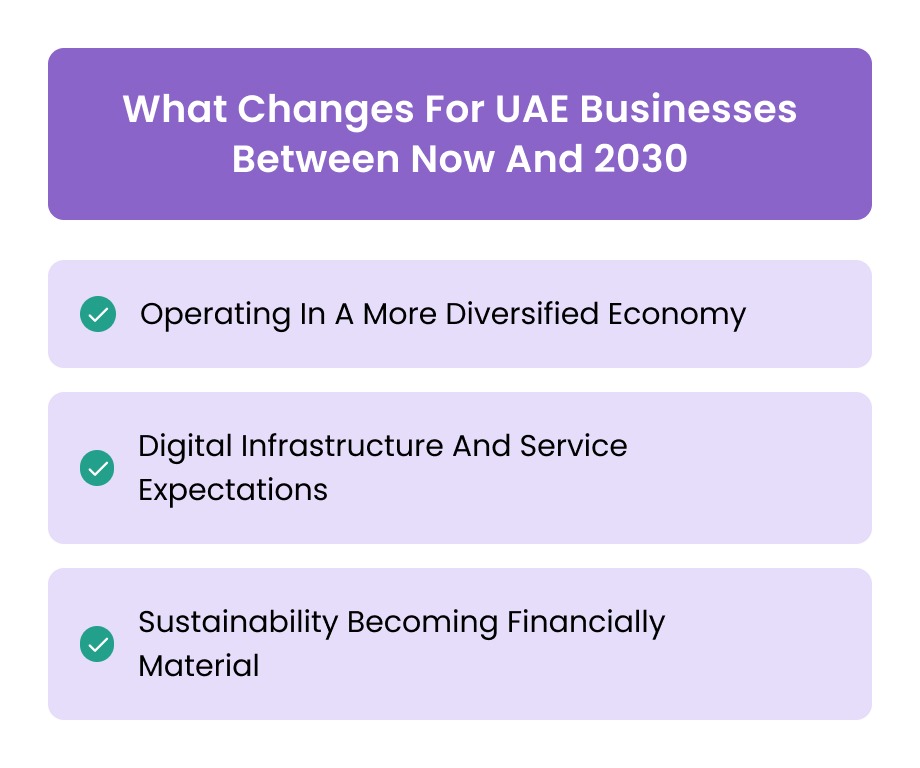
Strategic visions matter only if they alter the conditions companies operate in. Between now and the end of the decade, several shifts are already visible and likely to intensify.
1. Operating In A More Diversified Economy
Diversification efforts continue expanding sectors such as tourism, logistics, finance, and technology, reducing concentration risk and increasing competitive intensity. The UAE already derives a large share of output from non-oil activity, and policy direction aims to deepen that shift further.
For companies, this means new market opportunities, but also higher expectations for productivity, efficiency, and value differentiation.
3. Digital Infrastructure And Service Expectations
Digital capability is not being treated as optional infrastructure. The federal roadmap places strong emphasis on technological adoption, digital government services, and advanced innovation ecosystems as engines of economic expansion.
Operationally, this translates into:
- Faster administrative cycles
- Higher transparency expectations
- More data-driven reporting environments
Businesses lagging in workflow digitisation will increasingly feel friction relative to peers.
3. Sustainability Becoming Financially Material
Environmental policy direction is now embedded in national development frameworks. Initiatives supporting energy transition, green growth, and net-zero commitments are expected to influence labour markets, industrial activity, and GDP growth.
This shifts sustainability from reputational positioning to operational consideration, affecting supply chains, procurement, and financing conversations.
Also Read: Cash Flow Optimisation Strategies for UAE Businesses in 2025
What Finance Leaders Should Track And Implement
Strategic visions translate into operational pressure through policy direction, investment flows, and administrative evolution. Finance leaders do not need to track every government initiative, but there are practical areas worth attention as the decade progresses.
1. Governance Over Cross-Border Spend
As trade volumes and global integration expand, supplier ecosystems grow more distributed. This increases exposure to FX variability, documentation inconsistencies, and reconciliation workload. Structuring vendor onboarding, payment references, and approval layers early reduces operational friction as transaction volumes scale.
2. Digitisation Of Financial Workflows
Government strategies emphasising digital infrastructure and AI adoption signal an environment where administrative and regulatory interactions continue moving toward digital-first processes. Businesses benefit from aligning internal workflows accordingly, including invoice capture, approval routing, and expense visibility, to avoid manual bottlenecks as reporting expectations evolve.
3. Sustainability Awareness In Financial Planning
Environmental strategy direction increasingly influences procurement expectations, financing access, and supply-chain requirements. While the intensity varies by sector, leadership teams benefit from tracking where sustainability considerations begin affecting cost structures or reporting obligations.
4. Operational Scalability And Audit Readiness
Growth ambitions embedded in national targets encourage companies to scale activity. Scaling without strengthening internal controls typically results in reconciliation issues, duplicated spend, and approval ambiguity. Strengthening audit trails and documentation discipline early prevents operational debt later.

How Alaan Supports Financial Governance In A Scaling UAE Environment
Economic diversification, digital integration, and cross-border expansion are increasing operational complexity for UAE businesses. As transaction volumes grow and supplier networks expand, maintaining control over spending, documentation, and reporting becomes essential for financial stability and regulatory readiness.
At Alaan, we support organisations by structuring how expenses are executed, evaluated, and recorded within a connected workflow, enabling finance teams to scale operations without losing visibility or control.
- Corporate Cards And Real-Time Spend Visibility
We provide corporate cards that allow organisations to issue and control team spending while capturing transactions instantly within a centralised platform. Finance leaders gain immediate visibility into allocation patterns and vendor usage, supporting informed oversight as operational activity expands alongside market opportunities. - Expense Capture And Approval Workflows
Invoices and receipts are collected digitally and routed through configurable approval chains aligned with organisational policy. This ensures spending decisions are evaluated before funds move, strengthening accountability and reducing corrective effort as supplier ecosystems and project activity grow. - Accounting Integration And Reconciliation Support
Transaction data synchronises with accounting systems, allowing expense information to flow directly into financial records. This continuity supports cleaner reconciliations, reduces manual data entry, and improves reporting consistency as businesses adapt to increasingly digitised administrative environments. - Spend Analytics And Cost Insight
Categorisation and analytics provide structured visibility into cost behaviour, vendor trends, and usage patterns. These insights enable finance teams to optimise resource allocation, evaluate supplier relationships, and maintain discipline in cost structures within a more competitive and diversified economy.
As operating conditions evolve alongside national economic priorities, financial governance increasingly depends on structured visibility and connected workflows rather than fragmented processes. By bringing spending, approvals, and reconciliation into one environment, we help organisations maintain clarity, accountability, and operational stability as they scale within the UAE’s changing business landscape.
Also Read: Expense Management Software for Business Spend Tracking
Conclusion
“UAE Vision 2030” is best understood not as a single national document but as the collective direction formed by emirate-level strategies and federal ambitions shaping economic diversification, digital capability, sustainability, and global competitiveness across this decade. These forces influence capital flows, operational expectations, and regulatory environments in ways that directly affect how businesses plan, invest, and govern financial activity.
For leadership teams, the practical response is not to track strategy announcements in isolation but to ensure operational foundations are aligned with an environment defined by growth, transparency, and efficiency. Strengthening workflow governance, maintaining financial visibility, and improving audit readiness position organisations to adapt smoothly as policy and economic conditions evolve.
At Alaan, we help UAE businesses bring visibility, approval discipline, and reconciliation clarity into one connected spend workflow so finance teams can scale operations without losing control. Book a Demo Today!
FAQs
1. How should SMEs interpret national strategy documents?
Rather than tracking policy releases individually, SMEs benefit from observing investment direction, regulatory digitisation, and sector prioritisation; these indicators reveal practical operating changes.
2. Will diversification reduce competition or increase it?
Typically, it increases competition by expanding market participation and attracting new entrants, particularly in technology, logistics, finance, and services sectors.
3. How might AI policy direction affect compliance requirements?
Expanded digital governance often leads to higher expectations for structured data reporting, automated filings, and traceable financial records across regulatory interactions.
4. Are sustainability expectations uniform across industries?
No, impact varies significantly by sector. Energy, logistics, and manufacturing face earlier material shifts, while service sectors typically experience gradual adoption through procurement or financing pressures.
5. How can businesses track policy direction without dedicated research teams?
Monitoring budget allocation trends, sector incentives, infrastructure investments, and trade initiatives often provides more actionable signals than reviewing high-level strategy publications.
6. What risks arise from ignoring long-term national strategy signals?
Misalignment can manifest as reduced competitiveness, weaker access to capital, operational inefficiencies, or regulatory friction as the economic environment evolves.
Gain control over business expenses with Alaan corporate cards
Invygo earned AED 100,000 in cashback using Alaan cards
Personalise approval workflows to align with your business needs with Alaan's Spend Management platform
Discover the power of automated expense tracking and smarter spend control with Alaan
Turn data into actionable insights with Alaan's spend management tools
Stay Tax Compliant with UAE's #1 Corporate Card and Spend Management Platform
Customisable corporate card policy template
Know how much Corporate Tax you have to pay this fiscal year
Easily integrate Alaan with your ERP for accurate, real-time expense tracking
Close books faster with Alaan's AI-powered accounting automation
Reconcile your books in minutes instead of hours, every single month.
Keep petty cash organized with Alaan corporate cards and automated expense management