.avif)


Cash flow challenges are common in construction, driven by complex projects, phased payments, and frequent cost variations. Research by Alvarez and Marsal shows that 70 percent of construction projects face claims and 85 percent experience cost overruns, averaging 28 percent above the original budget.
These overruns directly impact cash availability, often leaving construction companies struggling to manage day-to-day expenses despite profitable contracts. In markets like the UAE, where project timelines are tight and payment cycles can be unpredictable, understanding the cash flow statement of a construction company is critical.
This guide explains how construction businesses can track cash inflows and outflows accurately, identify risks early, and use cash flow statements to maintain financial stability across projects.
Key Takeaways
- Construction firms can be profitable yet cash-strained. Cash flow statements reveal real liquidity beyond paper profits.
- Long UAE payment cycles and 5–10% retentions make cash flow tracking critical for contractors and subcontractors.
- Project-level cash flow tracking helps identify funding gaps early and prevents one project draining another.
- Cost overruns and delayed invoicing quickly weaken cash flow, even on well-managed construction projects.
- Real-time expense visibility improves cash flow statement accuracy and supports better financial decisions.
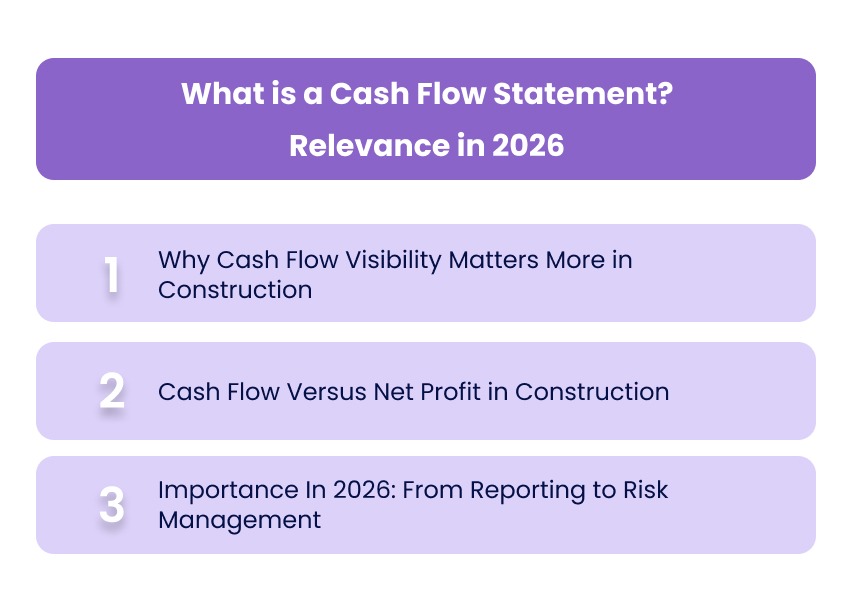
What is a Cash Flow Statement? Relevance in 2026
A cash flow statement shows how money actually moves in and out of a construction company over a specific accounting period. Unlike the income statement or balance sheet, it focuses purely on cash inflows and outflows, offering a clear view of liquidity rather than profitability on paper.
For construction companies, this distinction is critical. Cash may come in through client payments, financing, or asset sales, while cash goes out through wages, materials, subcontractor fees, equipment hire, loan repayments, and taxes.
The cash flow statement brings all these movements together, typically across three areas: operating activities, investing activities, and financing activities.
Why Cash Flow Visibility Matters More in Construction
Cash flow management is particularly complex in construction due to long project timelines, high upfront costs, and payment structures that delay income. Staged payments, retentions, variations, and late client settlements can turn even profitable projects cash-negative for extended periods.
Without a clear view of cash movement, construction businesses risk delayed supplier payments, stalled work, strained subcontractor relationships, and exposure to penalties or insolvency.
This is why finance teams rely on cash flow statements to assess whether the business can meet short-term obligations while sustaining multiple projects at once.
Cash Flow Versus Net Profit in Construction
Net profit and cash flow are closely related but fundamentally different. Net profit reflects what remains after expenses are deducted from revenue on the income statement. Cash flow reflects whether the business actually has money available to pay its bills.
In construction, it is common for a company to be profitable on paper while struggling with negative cash flow due to slow collections or high upfront costs. The cash flow statement exposes this gap, helping finance teams understand whether the business can sustain operations despite reported profits.
In short, the cash flow statement is central to managing financial stability in construction. As projects grow more complex and margins come under pressure, its role in guiding decisions, managing risk, and supporting long-term growth will only become more important.
Importance In 2026: From Reporting to Risk Management
In 2026, the cash flow statement is no longer just a historical reporting tool. Rising material costs, tighter credit conditions, and closer regulatory scrutiny across the Middle East have made proactive cash flow monitoring essential for construction companies.
Finance leaders increasingly use cash flow statements to:
- Forecast funding gaps before they disrupt projects
- Identify pressure points caused by delayed receivables or cost overruns
- Assess the cash impact of operational, investment, and financing decisions
- Maintain adequate reserves to absorb payment delays or cost spikes
A strong understanding of the cash flow statement allows construction businesses to take corrective action early, negotiate better payment terms, control labour and inventory costs, and protect liquidity during market fluctuations.

Also read: Track and Manage Business Expenses
How to Calculate Cash Flow in Construction? A Detailed Guide
At a basic level, cash flow in construction is calculated by subtracting the cash going out of the business from the cash coming in during a specific period.
Cash flow = Cash Inflows − Cash Outflows
In practice, construction cash flow is analysed across three categories. Together, they explain where money is coming from, where it is being used, and whether the business has enough cash to operate smoothly.
1. Cash Flow From Operating Activities
Operating cash flow shows how much cash your construction business generates from its core activities, such as delivering projects and collecting payments from clients.
This includes:
- Cash received from client invoices and progress payments
- Cash paid for labour, subcontractors, materials, site expenses, rent, and overheads
Operating cash flow excludes non-cash items such as depreciation or amortisation. It focuses only on real money entering or leaving the business.
A simple way to calculate it is:
Operating Cash Flow = Net Income + Non-Cash Expenses ± Changes in Working Capital
In construction, changes in working capital often come from delayed receivables, retention amounts, or rising material costs. This is why operating cash flow can be negative even when projects appear profitable.
2. Cash Flow From Investing Activities
Investing cash flow reflects money spent on, or generated from, long-term assets.
Common construction examples include:
- Purchasing or selling equipment, vehicles, or machinery
- Buying or disposing of property or long-term assets
- Acquiring another business or selling part of the company
These cash movements are usually irregular and not part of day-to-day operations. For example, selling unused equipment may boost cash temporarily, but it is not a sustainable way to fund payroll or project costs.
3. Cash Flow From Financing Activities
Financing cash flow shows how the business raises or repays funds.
This includes:
- Loan drawdowns or repayments
- Issuing or buying back shares
- Capital injections from owners
- Dividend payments
For construction companies, financing cash flow is often used to manage timing gaps between project expenses and client payments, especially during high-cost or slow-payment phases.
Bringing it all together: To understand your overall cash position, add the net cash from operating, investing, and financing activities to your opening cash balance. This shows how much cash the business has available at the end of the period.
How to Analyse Construction Cash Flow Statement Effectively
A cash flow analysis helps finance teams understand not just whether cash is increasing or decreasing, but why.
Key points to assess include:
- Are payment delays or retentions reducing operating cash flow?
- Are equipment purchases creating short-term cash pressure?
- Is the business relying heavily on debt to stay liquid?
Negative cash flow over a short period is not always a red flag in construction. It may reflect seasonality, upfront project costs, or planned investments. However, sustained negative cash flow without clear recovery points can signal deeper issues.
Equally, positive cash flow does not always mean the business is healthy. A company may have cash available while carrying high debt or thin margins.
This is why regular cash flow tracking and analysis is essential for construction businesses that want to stay solvent, fund new projects, and grow sustainably.

How to Improve Cash Flow Statement in Construction Projects
Managing cash flow in construction requires more than tracking payments at a company level. Each project carries its own timelines, cost structures, and payment risks, which makes cash flow highly sensitive to delays, variations, and cost overruns. Even well-run projects can become cash-negative if inflows and outflows are not carefully aligned.
The most effective construction businesses take a proactive approach. They forecast cash flow by project, invoice promptly, negotiate realistic payment terms, and maintain tight control over costs throughout the project lifecycle.
Supported by accurate data and the right systems, these practices help finance teams anticipate challenges early and maintain financial stability across multiple projects:
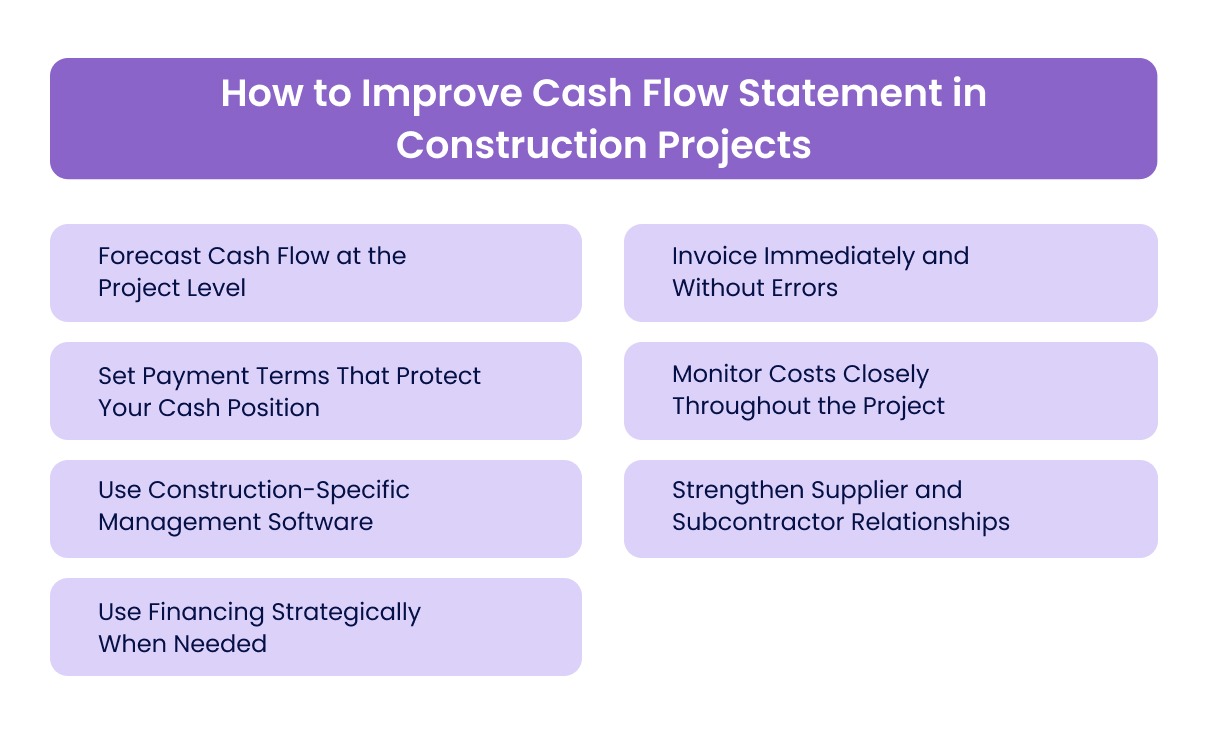
Forecast Cash Flow at the Project Level
Build a cash flow forecast for every project, mapping expected inflows from client payments against outflows such as labour, materials, plant, and subcontractor costs.
Update forecasts regularly to reflect variations, delays, or scope changes. A live project-level forecast helps you:
- Identify cash gaps before they become critical
- Align spending with incoming payments
- Make informed decisions on resourcing and procurement
Invoice Immediately and Without Errors
Issue invoices as soon as milestones are achieved or work is completed. Delays at this stage almost always lead to delayed payments.
Each invoice should clearly include:
- Agreed payment terms
- Detailed work descriptions
- Supporting documents, where required
Where possible, structure contracts to include deposits, staged payments, or incentives for early settlement. Follow up quickly on overdue invoices to avoid cash flow strain.
Set Payment Terms That Protect Your Cash Position
Standard payment terms often favour the client. Where possible, negotiate:
- Upfront deposits or mobilisation fees
- Shorter client payment cycles
- Longer payment terms with suppliers and subcontractors
Balancing inflows and outflows reduces reliance on external financing and limits exposure to payment delays.
Monitor Costs Closely Throughout the Project
Effective cash flow control requires ongoing cost discipline. Regularly review:
- Material usage and wastage
- Labour productivity and overtime
- Variations and unapproved scope changes
Using real-time cost data allows teams to spot overspending early and correct course before it impacts cash availability.
Use Construction-Specific Management Software
Construction-focused ERP and project management systems provide better visibility than spreadsheets.
The right software can help you:
- Track cash flow by project in real time
- Automate invoicing, approvals, and billing
- Manage retentions and variations accurately
Centralising cost, contract, and cash data gives finance and project teams a shared view of cash performance across all active projects.
Strengthen Supplier and Subcontractor Relationships
Strong relationships improve flexibility when cash flow is under pressure. Clear communication, reliable payments, and transparency build trust.
When challenges arise, trusted suppliers are more open to:
- Adjusted payment schedules
- Temporary extensions on terms
- Collaborative problem-solving
These relationships can be critical to keeping projects moving during tight periods.
Use Financing Strategically When Needed
Short-term financing options, such as invoice financing or project-based loans, can help bridge timing gaps between expenses and client payments.
Financing should support cash flow, not replace good financial discipline. Used carefully, it can help maintain momentum without creating long-term dependency.
In construction, strong cash flow management is as important as delivering projects on time. Without it, even profitable jobs can put the business at risk.
By forecasting at the project level, invoicing promptly, negotiating fair terms, controlling costs, and using the right systems, construction businesses can reduce uncertainty and build a more resilient financial foundation.
Related: Deductible and Non Deductible Expenses Under UAE Corporate Tax
Common Cash Flow Issues for Construction Businesses in UAE
In the UAE construction sector, cash flow pressure is rarely caused by a single issue. Instead, it builds up through payment delays, retention practices, contract structures, and high upfront costs.
Even financially sound contractors can face liquidity challenges if cash inflows and outflows are not tightly managed across projects.
1. Paying suppliers and subcontractors too early
In the UAE, maintaining strong supplier relationships is critical, but paying invoices immediately can strain working capital. When client payments are delayed, early supplier payments reduce available cash for payroll, site expenses, or mobilisation on new projects.
Aligning payments with agreed credit terms helps preserve liquidity without harming trust.
2. Limited or no mobilisation payments
Many UAE construction contracts include low mobilisation advances or none at all. Yet contractors often incur significant costs before work begins, including permits, materials procurement, and site setup.
Without adequate upfront funding, projects start cash-negative.
3. Delays in issuing progress invoices
Late invoicing is a common internal issue. In the UAE, where payment cycles are often long, even small delays in submitting certified invoices can push receipts back by weeks or months, impacting cash flow across multiple projects.
4. Extended payment cycles from clients
Payment terms of 60 to 90 days are common in the region, particularly on large commercial or government-linked projects.
Contractors and subcontractors further down the chain may experience even longer waits, increasing reliance on internal cash reserves or short-term financing.
5. Retention practices
Retention amounts, typically five to ten percent of contract value, are widely used in UAE construction.
These amounts are often released only after project completion or the defects liability period. Without planning for retained sums, contractors may face prolonged cash gaps.
6. High upfront material and labour costs
Rising material prices, imported components, and skilled labour costs require early cash outflows.
When costs escalate faster than payment receipts, projects can become cash-constrained even if margins remain intact.
7. Poor alignment of payables and receivables
Cash flow problems arise when subcontractors and suppliers require payment before contractors receive certified payments from clients.
Without careful scheduling of accounts payable and receivable, businesses may fund projects using their own capital.
8. Change orders not approved on time
Variations are common in UAE construction projects. However, delays in formal approval or documentation often result in completed work not being billed promptly.
This leads to revenue being recognised late and cash inflows being postponed.
9. Disputes and payment holds
Payment disputes related to scope changes, certification delays, or quality issues can lead to withheld payments.
Resolving disputes through contractual mechanisms or legal channels takes time, during which cash flow remains under pressure.
10. Joint venture and consortium risks
Joint ventures are frequently used for large UAE projects. If funding obligations, cash contributions, or profit distributions are not clearly defined, delays or defaults by one partner can disrupt cash flow for all parties involved.
11. Project delays due to external factors
Approvals, inspections, weather conditions, or supply chain disruptions can delay project timelines.
When billing is linked to progress milestones, these delays directly affect when cash can be invoiced and collected.
12. Weak cash flow forecasting
Many contractors focus on profitability rather than liquidity. Without detailed, project-level cash flow forecasting that accounts for payment delays, retentions, and staged receipts, businesses struggle to anticipate shortfalls early.
Understanding these UAE-specific cash flow risks helps construction businesses plan realistically and protect their financial position.
Best Practices to Improve Cash Flow Statement in UAE
Strong cash flow does not happen by chance in construction. In the UAE, where payment cycles are long and projects are capital-intensive, contractors need disciplined financial practices that account for retentions, staged payments, and upfront costs.
The following best practices help construction businesses stabilise cash flow while supporting growth:
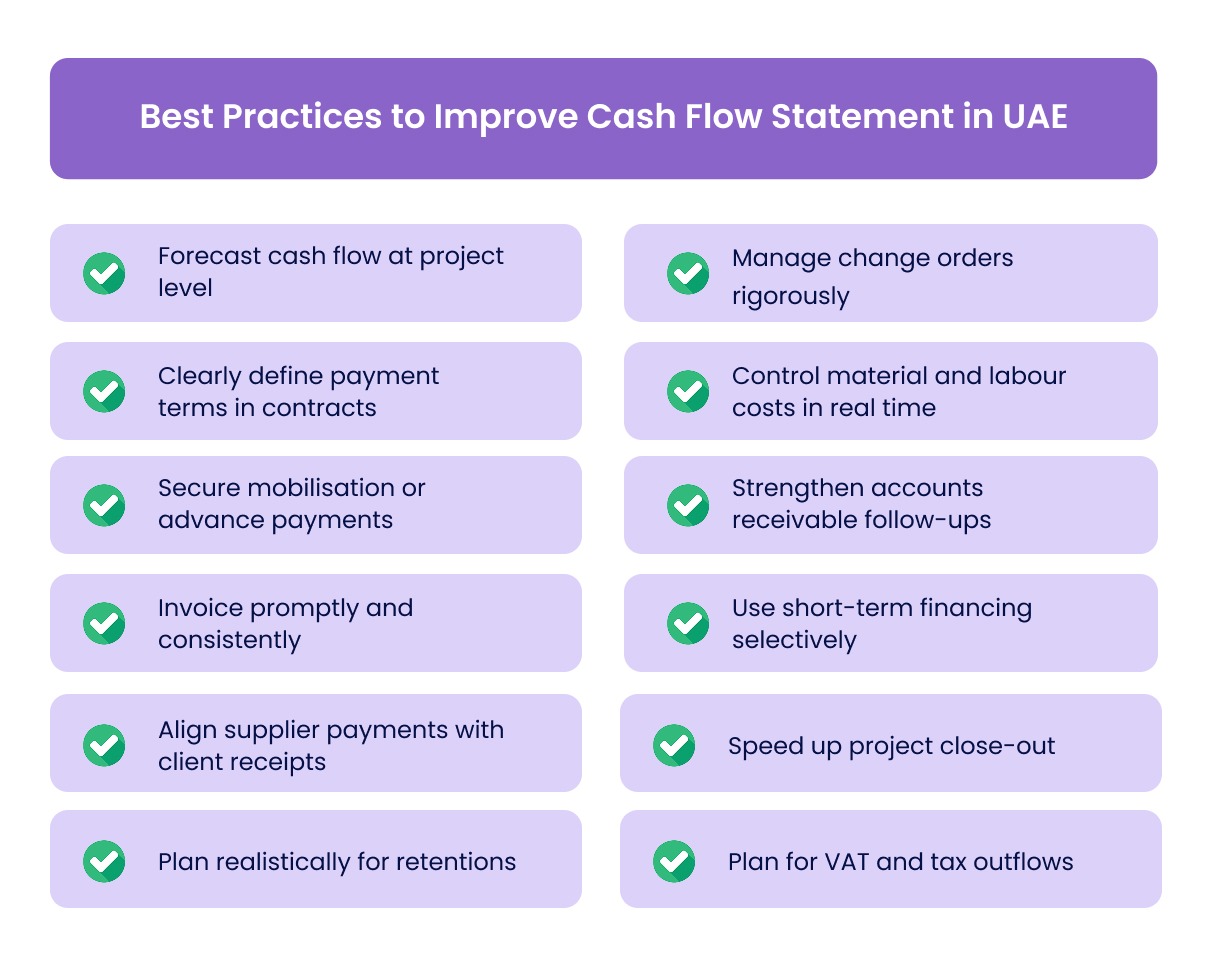
- Forecast cash flow at project level: Prepare detailed cash flow forecasts for each project, not just at a company level. Factor in mobilisation costs, expected payment timelines, retentions, VAT outflows, and variations. Update forecasts regularly to reflect delays, scope changes, or cost escalations.
- Clearly define payment terms in contracts: Every contract should specify payment timelines, certification processes, documentation requirements, and conditions for final payment. In the UAE, ambiguity around approvals or completion certificates is a common cause of delayed receipts.
- Secure mobilisation or advance payments: Where possible, negotiate mobilisation advances to cover early-stage costs such as permits, materials, and site setup. Even modest upfront payments can significantly reduce early cash pressure.
- Invoice promptly and consistently: Submit invoices as soon as milestones are achieved and certifications are ready. Delayed invoicing often leads to missed payment cycles, especially when clients operate on monthly approval schedules.
- Align supplier payments with client receipts: Avoid paying suppliers and subcontractors far in advance of receiving client payments. Structured payment schedules help maintain liquidity while preserving supplier relationships.
- Plan realistically for retentions: Retentions of five to ten percent are standard in UAE construction. Treat retained amounts as unavailable cash in forecasts and ensure working capital covers the gap until release.
- Manage change orders rigorously: Ensure all variations are documented, approved, and priced before work proceeds where possible. Delays in approving change orders often result in completed work remaining unbilled for months.
- Control material and labour costs in real time: Track cost commitments against budgets throughout the project lifecycle. Early visibility into overspending allows corrective action before cash flow is affected.
- Strengthen accounts receivable follow-ups: Actively monitor overdue invoices and follow up regularly. Clear communication with clients on payment status helps reduce extended delays without escalating disputes.
- Use short-term financing selectively: Facilities such as working capital loans or invoice financing can help bridge temporary cash gaps caused by delayed payments. These should support cash flow, not replace disciplined financial control.
- Speed up project close-out: Final payments and retention releases depend on timely completion of administrative close-out tasks, including inspections, punch lists, and documentation. Organised project records help accelerate this process.
- Plan for VAT and tax outflows: VAT payments can significantly impact cash flow if not planned for. Ensure VAT on expenses and invoices is tracked accurately and included in cash forecasts to avoid unexpected shortfalls.

Automation closes the gap between policy intent and real-world behaviour by embedding controls directly into daily workflows.
To see how this works in practice, read how Washmen put its spend management on autopilot and saved 80+ hours per week using Alaan.
How Alaan Supports Accurate Cash Flow Statements
Preparing an accurate cash flow statement for a construction company is not only about compiling figures at month-end. In practice, reliable cash flow reporting depends on real-time visibility into cash outflows, consistent expense categorisation, and alignment between spend data and accounting records.
Alaan supports UAE construction finance teams by strengthening the foundations that cash flow statements rely on. As an AI-powered spend and expense management platform built for the UAE, Alaan helps construction businesses maintain clean, timely, and structured expense data throughout the spend lifecycle, rather than correcting gaps only during financial reporting.
In practice, Alaan supports accurate cash flow statements through:
- Corporate cards that capture real cash outflows at source: Alaan’s corporate cards record project and operational spending digitally at the point of payment. This gives finance teams clear visibility into actual cash outflows, which directly supports the operating activities section of the cash flow statement.
- Real-time expense capture instead of delayed reporting: Expenses are logged as they occur and supported by digital receipts. This reduces reliance on estimates or manual accruals and allows cash flow statements to reflect true cash movement rather than delayed or incomplete data.
- Consistent categorisation for cash flow classification: Expenses are categorised in a structured and standardised manner across projects and teams. This makes it easier to group cash movements correctly when preparing cash flow statements for construction businesses managing multiple sites and contracts.
- Accounting integrations that reduce reconciliation gaps: Through integrations with accounting systems such as Xero, QuickBooks, NetSuite, and Microsoft Dynamics, approved expenses flow directly into the general ledger. This helps keep expense records, bank transactions, and cash flow statements aligned.
- Improved visibility for cash flow analysis and forecasting: With up-to-date spend data and clear tracking of operating cash outflows, finance teams can analyse historical cash flow statements more effectively and build more reliable cash flow forecasts for ongoing and future projects.
Together, Alaan’s corporate cards, expense management, and accounting automation help finance leaders prepare cash flow statements that are more accurate, timely, and reflective of on-ground project activity.
For UAE construction companies, this means better visibility into operating cash flows, fewer reconciliation issues at reporting time, and stronger financial control across projects and reporting periods.

Also read: Modern Expense Management Systems
Conclusion
A clear cash flow statement is essential for construction companies in the UAE to manage liquidity, fund ongoing projects, and plan ahead with confidence. Accurate visibility into cash inflows and outflows helps finance teams prevent shortfalls and maintain operational stability.
In practice, cash flow reporting often suffers from delayed expense submissions, fragmented payments, and incomplete data, limiting real-time insight into actual cash movement.
Alaan helps UAE construction businesses improve cash flow visibility through controlled corporate cards, real-time expense capture, and structured spend categorisation. By recording cash outflows accurately as they occur, finance teams gain a clearer, more reliable view of operating cash flow with less manual effort.
To see how Alaan supports stronger cash flow control, book a free demo today!
Frequently Asked Questions (FAQs)
1. How often should a construction company prepare a cash flow statement?
For construction businesses, preparing a cash flow statement monthly is the minimum best practice. In the UAE, companies handling multiple live projects or long payment cycles often benefit from weekly internal cash flow tracking to anticipate funding gaps before they affect site operations or payroll.
2. How does retainage impact the cash flow statement in construction?
Retainage delays a portion of cash inflows until project completion, which can significantly distort operating cash flow if not tracked separately. In the UAE, where retainage commonly ranges from 5 to 10 percent, treating retained amounts distinctly helps finance teams avoid overstating available cash.
3. What is the difference between project cash flow and company-level cash flow?
Project cash flow tracks inflows and outflows for a specific site or contract, while company-level cash flow aggregates all projects, overheads, financing activities, and capital expenses. UAE contractors must monitor both, as surplus cash in one project may be required to support another with slower collections.
4. Can VAT timing affect a construction company’s cash flow statement?
Yes. In the UAE, VAT paid on expenses is often recovered later through VAT returns, creating a temporary cash outflow. If VAT recovery timelines are not accounted for correctly, operating cash flow can appear weaker than it truly is, especially during high-spend project phases.
5. How does delayed project close-out affect cash flow reporting?
Incomplete documentation, unresolved variations, or pending final certificates delay final payments and release of retainage. This causes prolonged gaps between reported revenue and actual cash inflows, making the cash flow statement less reflective of the company’s true financial position.
Gain control over business expenses with Alaan corporate cards
Invygo earned AED 100,000 in cashback using Alaan cards
Personalise approval workflows to align with your business needs with Alaan's Spend Management platform
Discover the power of automated expense tracking and smarter spend control with Alaan
Turn data into actionable insights with Alaan's spend management tools
Stay Tax Compliant with UAE's #1 Corporate Card and Spend Management Platform
Customisable corporate card policy template
Know how much Corporate Tax you have to pay this fiscal year
Easily integrate Alaan with your ERP for accurate, real-time expense tracking
Close books faster with Alaan's AI-powered accounting automation
Reconcile your books in minutes instead of hours, every single month.
Keep petty cash organized with Alaan corporate cards and automated expense management