.avif)


Advance payments are common across many UAE businesses, especially in services, construction, and long-term contracts. Yet they remain one of the most misunderstood areas under VAT. Finance teams often struggle with questions around timing, invoicing, and whether VAT should be charged when money is received or when the actual supply takes place.
Getting this wrong can lead to incorrect VAT reporting, rejected claims, or unnecessary audit exposure. The challenge is not the VAT law itself, but how it applies in real business scenarios where payments and supplies do not always happen at the same time.
This guide explains how VAT on advance payments works in the UAE, what the Federal Tax Authority expects, and how finance teams can handle advance payments confidently and compliantly.
Key Takeaways
- VAT timing matters: VAT can become due when an advance payment is received, even if the supply of goods or services happens later.
- Advance payments are not deposits: Only payments that represent consideration for a taxable supply trigger VAT; refundable deposits may not.
- VAT applies only to the amount received: VAT should be charged on the advance portion and adjusted in the final invoice to avoid double taxation.
- Documentation protects you: Clear tax invoices and linked records are essential, as advance payments are frequently examined during VAT audits.
- Visibility reduces risk: Centralised tracking of payments, invoices, and approvals makes VAT reporting more accurate and audit responses more efficient.
What Is an Advance Payment Under UAE VAT Law?
Under UAE VAT law, an advance payment refers to any amount received by a supplier before the actual supply of goods or services takes place. This could be a partial payment or the full consideration agreed under a contract.
Advance payments are commonly seen in:
- Service retainers
- Construction or milestone-based projects
- Event bookings or long-term contracts
It is important to distinguish an advance payment from a refundable security deposit. A deposit that is fully refundable and not linked to consideration for supply may not be subject to VAT at the time of receipt.
However, once a payment is treated as consideration for a future supply, it falls within the scope of VAT rules.
For finance teams, correctly identifying whether a payment is an advance or a deposit is the first step in determining when VAT becomes due and how it should be reported.
When do Advance Payments Trigger VAT Obligations?
Yes, VAT can be applicable on advance payments in the UAE, but only when certain conditions are met. Under UAE VAT law, VAT becomes due at the earlier of the date of supply or the date on which payment is received.
This means that if you receive an advance payment before the supply takes place, VAT may become due at the time you receive that payment, even though the goods or services have not yet been delivered.
VAT is charged at 5% (standard rate) on taxable supplies, including advance payments that are consideration for supply.
For finance teams, the key point is this:
If an advance payment represents consideration for a taxable supply, VAT must be accounted for at the time the payment is received.
However, VAT is not automatically applicable to every payment received upfront. Payments that are refundable and not linked to a confirmed supply, such as certain security deposits, may fall outside the scope until they are applied against an actual supply.
If you are revisiting the fundamentals of how VAT works locally, this overview of the key highlights of VAT in the UAE provides helpful context.
Understanding the Date of Supply for Advance Payments
The concept of the date of supply plays a central role in how VAT is applied to advance payments in the UAE.
In straightforward transactions, the date of supply is usually when goods are delivered or services are completed. Advance payments change this timeline.
When Advance Payments Trigger the Date of Supply
Under UAE VAT rules, the date of supply is triggered on the earlier of:
- The date the goods or services are supplied, or
- The date an advance payment is received
If an advance payment is received before the supply, the date of supply is considered to be the date of receipt of that payment, but only to the extent of the amount received.
Practical Timeline Example
- A service contract is signed in March
- An advance payment is received in April
- The service is delivered in June
In this scenario, VAT becomes due in April on the advance payment amount, not in June when the service is delivered.
For finance teams, this timing affects:
- VAT return periods
- Tax invoice issuance
- Cash flow planning
Clear tracking of advance payments and their corresponding supplies is critical to ensure VAT is reported in the correct tax period and in line with Federal Tax Authority expectations.
Since timing directly affects reporting, this guide on how to file VAT returns in the UAE explains how such transactions flow into VAT return periods.
How VAT Should Be Charged on Advance Payments
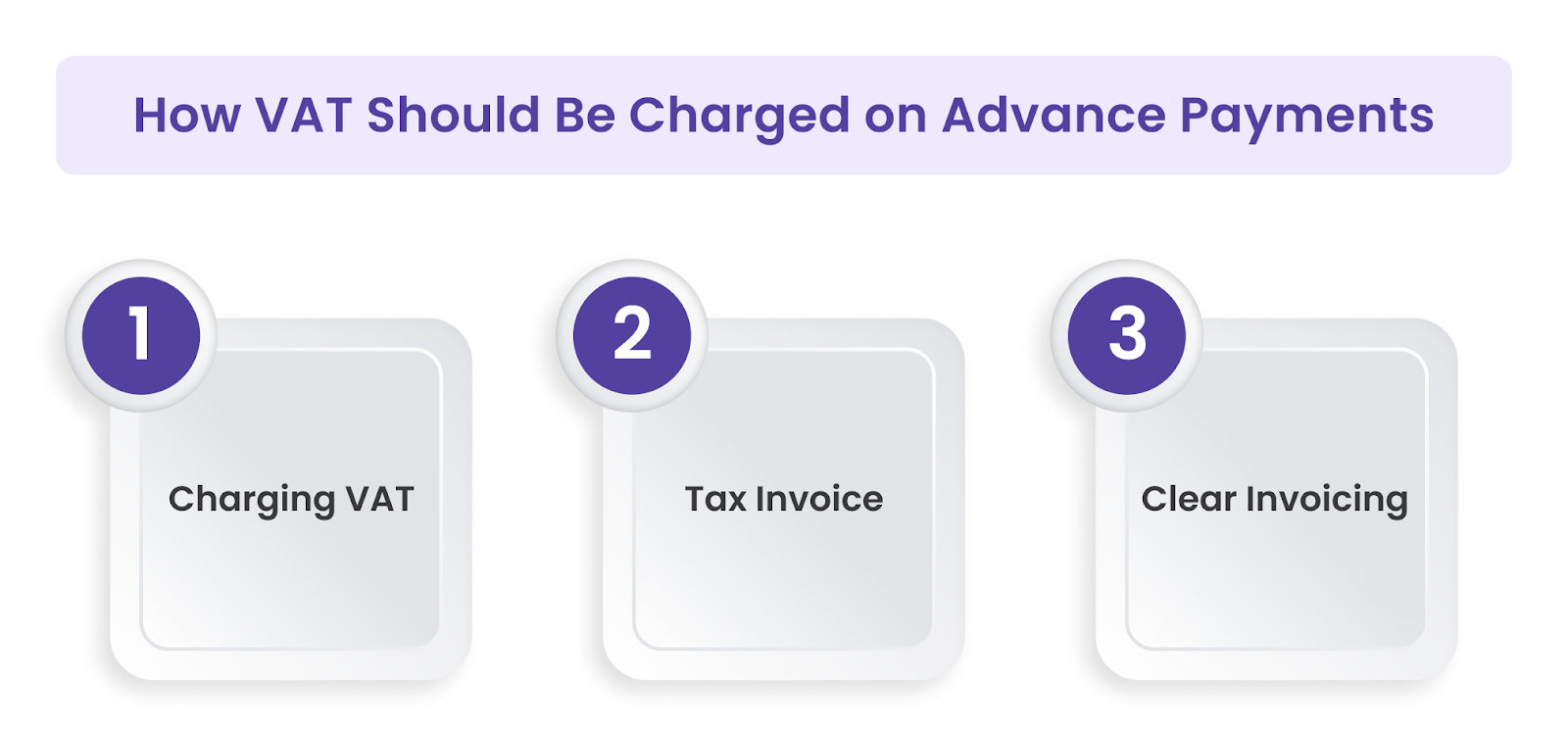
When VAT becomes due on an advance payment, it must be charged on the amount received, not on the total contract value, unless the full amount has been paid upfront.
Charging VAT on the Advance Amount
If you receive a partial advance, VAT is calculated only on that portion. For example:
- Contract value: AED 100,000
- Advance received: AED 30,000
- VAT due at receipt: VAT is charged on AED 30,000
The remaining VAT is accounted for when the balance payment is received or when the supply takes place, whichever occurs first.
Issuing a Tax Invoice for an Advance Payment
Once VAT is due on an advance payment, you are required to issue a tax invoice within the time limits prescribed by the UAE Federal Tax Authority. The invoice should clearly indicate:
- That the invoice relates to an advance payment
- The amount received
- The VAT charged on that amount
This documentation is critical for audit trails and VAT reporting accuracy.
Why Clear Invoicing Matters
Incorrect or unclear invoicing at the advance stage often leads to errors later, including double taxation or missed VAT reporting.
For finance teams, having a clear process for issuing and recording advance payment invoices helps maintain compliance and reduces reconciliation issues at the time of final billing.
For businesses assessing the broader impact of VAT on cash flow, this article on the advantages of VAT in the UAE for growth and cash flow offers a useful perspective.

Adjusting VAT When the Final Supply Takes Place
Once the actual supply of goods or services is completed, the VAT treatment must be adjusted to reflect what has already been accounted for at the advance stage.
Issuing the Final Tax Invoice
The final tax invoice should show:
- The full value of the supply
- The total VAT due on the supply
- The advance payment received
- The VAT already charged on the advance
Only the remaining VAT balance, if any, should be charged at this stage.
Handling Partial Advances
Where multiple advances are received over time, VAT should be accounted for each time a payment is received. The final invoice then acts as a reconciliation document, ensuring VAT is neither underreported nor duplicated.
Avoiding Double Taxation
One of the most common errors occurs when VAT is charged again on the full amount at final invoicing, without adjusting for VAT already paid on advances. Clear tracking of advances and VAT applied at each stage is essential to prevent this issue.
For finance teams, disciplined documentation and consistent tracking ensure that VAT reporting remains accurate throughout the lifecycle of the transaction.
Common VAT Mistakes Businesses Make on Advance Payments
Even when finance teams understand the VAT rules in principle, advance payments often lead to errors in execution. These mistakes usually surface during audits or VAT return reviews.
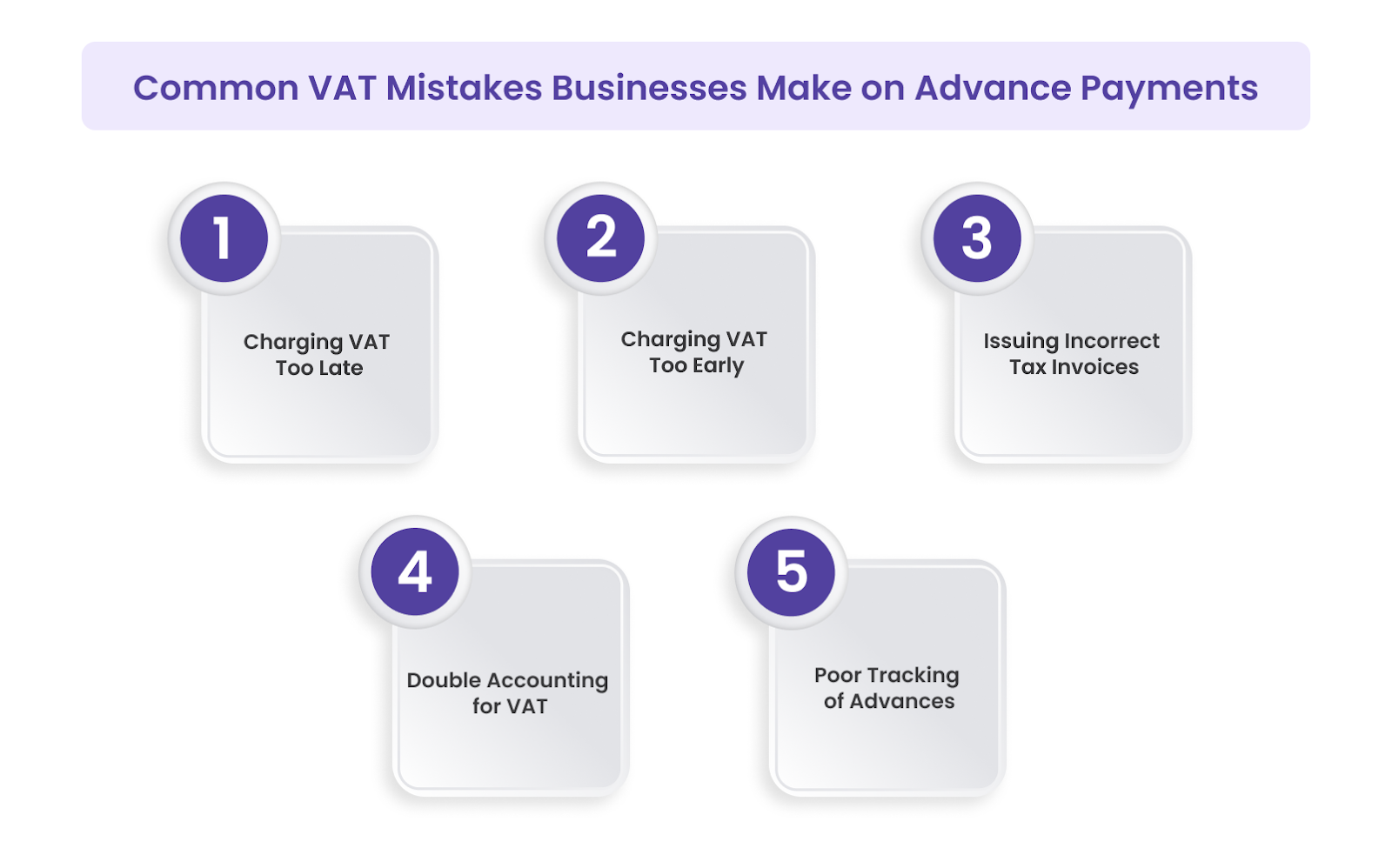
1. Charging VAT Too Late
One of the most common mistakes is waiting until the final supply takes place to charge VAT, even though an advance payment was received earlier. This results in VAT being reported in the wrong tax period, which can trigger penalties or interest.
2. Charging VAT Too Early
The opposite issue also occurs. Some businesses charge VAT on amounts that are refundable deposits rather than consideration for a supply. This leads to unnecessary VAT payments and complications when refunds are issued.
3. Issuing Incorrect Tax Invoices
Advance payment invoices that do not clearly state they relate to an advance often create confusion later. Missing references, incorrect amounts, or unclear VAT calculations make reconciliation difficult and weaken audit trails.
4. Double Accounting for VAT
Another frequent issue is charging VAT again on the full contract value at the time of final invoicing, without adjusting for VAT already accounted for on advances. This results in over-reporting VAT and additional correction work.
5. Poor Tracking of Advances
When advance payments are tracked outside formal systems, finance teams lose visibility. This increases the risk of missed VAT, incorrect reporting, and delays during audits.

Record-Keeping and VAT Reporting Requirements
Advance payments increase the importance of accurate record-keeping. From a VAT perspective, the UAE Federal Tax Authority expects finance teams to clearly demonstrate when VAT became due, how it was calculated, and how it was reported.
What Needs to Be Recorded
For each advance payment, finance teams should maintain:
- The date the payment was received
- The amount received and VAT charged
- The tax invoice was issued for the advance
- A clear reference to the related contract or supply
These records help establish the correct date of supply and support VAT reporting during audits.
VAT Return Reporting
VAT charged on advance payments must be reported in the VAT return for the tax period in which the payment is received.
When the final supply takes place, the VAT return should reflect only the remaining VAT due, after adjusting for any VAT already accounted for on advances.
Audit Readiness
During audits, advance payments are often reviewed closely. Inconsistent documentation, missing invoices, or unclear links between payments and supplies can raise questions.
Clear records and traceable documentation help finance teams respond confidently and avoid unnecessary follow-ups.
Strong documentation practises also play a key role during audits. This guide on navigating VAT and tax audit procedures in the UAE outlines what authorities typically review.
How Finance Teams Can Reduce VAT Risk on Advance Payments
Managing VAT on advance payments becomes significantly easier when finance teams focus on prevention rather than correction.
Standardise Advance Payment Processes
Clear internal guidelines on how advances are invoiced, recorded, and reported reduce inconsistency. This includes standard invoice templates and defined steps for recognising VAT.
Maintain Clear Visibility Across Payments
Advance payments should not be tracked in isolation. Finance teams benefit from having a single view that links payments, invoices, and VAT treatment throughout the lifecycle of a transaction.
Reconcile Regularly, Not at Year-End
Regular reconciliation between advance payments, VAT charged, and final invoices reduces the risk of errors accumulating over time. This also makes month-end and VAT return preparation more predictable.
Use Systems That Support Accuracy
Where payments and documentation are managed digitally, it becomes easier to track advances, attach supporting invoices, and ensure VAT is accounted for in the correct period.
At Alaan, we support finance teams with clear payment visibility and documented expense flows that integrate with accounting automation systems, helping reduce manual errors without replacing existing finance tools.
Reducing VAT risk on advance payments is less about complex interpretation and more about disciplined processes and consistent tracking.
Many of these controls become even more important once you are actively filing and paying VAT. This walkthrough on filing and making VAT payments in the UAE explains what to expect.
How Alaan Supports Accurate VAT Tracking and Visibility
Finance teams across 1,000+ UAE businesses use Alaan to reduce manual effort and maintain clear visibility over business spending. To date, our customers have saved over AED 100 million and reduced reconciliation work by 16 hours each month, outcomes that directly support more accurate VAT tracking.
Managing VAT on advance payments depends on having clear links between payments, invoices, approvals, and accounting records.
At Alaan, we support this by centralising spend activity and documentation, helping finance teams apply VAT rules consistently. While Alaan is not an accounting or tax filing tool, it integrates with accounting systems to support VAT-ready workflows.
With Alaan, finance teams can:
- Issue and manage prepaid corporate cards with real-time visibility into business payments
- Set spend limits and vendor controls to ensure payments align with internal policies
- Capture invoices and receipts digitally via mobile app or Chrome extension
- Use AI-powered receipt verification to extract invoice details and flag discrepancies
- Track expense status in real time, including submission, approval, and corrections
- Apply accurate expense categorisation and VAT details before syncing with accounting systems
- Integrate with accounting tools such as Xero, QuickBooks, NetSuite, and Microsoft Dynamics
- Maintain audit-ready records without relying on spreadsheets or manual follow-ups
By improving visibility and documentation discipline, finance teams are better positioned to apply VAT rules correctly, reconcile advance payments efficiently, and respond confidently during audits.
Conclusion
Advance payments are a normal part of doing business in the UAE, but their VAT treatment requires careful attention to timing, documentation, and reporting. VAT can become due earlier than many businesses expect, which is why advance payments often create compliance risk when processes are unclear or inconsistent.
For finance teams, the key is not just understanding the VAT rules but applying them consistently across contracts, invoices, and VAT returns. Clear identification of advance payments, timely invoicing, and disciplined record-keeping help reduce errors and audit exposure.
As payment volumes grow, having better visibility and structured workflows makes it easier to manage VAT obligations with confidence.
If you are reviewing how advance payments are tracked and documented in your organisation, book a demo with Alaan to see how improved spend visibility can support stronger VAT compliance.
FAQs
1. Is VAT always applicable to advance payments in the UAE?
No. VAT applies only when an advance payment represents consideration for a taxable supply. Fully refundable deposits may not trigger VAT until applied against an actual supply.
2. When should a tax invoice be issued for an advance payment?
A tax invoice must be issued when VAT becomes due, which is usually when the advance payment is received, in line with UAE Federal Tax Authority timelines.
3. How is VAT reported if multiple advance payments are received?
VAT should be reported each time an advance payment is received. The final invoice then adjusts for VAT already accounted for on earlier advances.
4. What happens if an advance payment is refunded?
If a VAT-charged advance is refunded, VAT adjustments may be required in a subsequent VAT return, supported by appropriate documentation.
5. Can poor tracking of advances affect VAT audits?
Yes. Missing invoices, unclear payment records, or inconsistent reporting can raise audit queries and increase compliance risk.
Gain control over business expenses with Alaan corporate cards
Invygo earned AED 100,000 in cashback using Alaan cards
Personalise approval workflows to align with your business needs with Alaan's Spend Management platform
Discover the power of automated expense tracking and smarter spend control with Alaan
Turn data into actionable insights with Alaan's spend management tools
Stay Tax Compliant with UAE's #1 Corporate Card and Spend Management Platform
Customisable corporate card policy template
Know how much Corporate Tax you have to pay this fiscal year
Easily integrate Alaan with your ERP for accurate, real-time expense tracking
Close books faster with Alaan's AI-powered accounting automation
Reconcile your books in minutes instead of hours, every single month.
Keep petty cash organized with Alaan corporate cards and automated expense management