.avif)

Procurement teams are not short on information. They are short on time, clean data, and workflow consistency. Supplier records sit in one place, contracts in another, approvals in inboxes, and spend analysis usually arrives after the purchasing decision has already been made. That is exactly why AI is gaining traction in procurement: not because teams want a futuristic sourcing function, but because they want to reduce manual drag without giving up control.
The momentum is already visible. Deloitte found that 92% of chief procurement officers were planning or assessing generative AI, but only 37% were actively piloting or deploying it. That gap matters. It suggests the real question is no longer whether AI belongs in procurement, but where it can improve sourcing, approvals, contract review, and spend visibility without weakening governance. For UAE businesses, that makes AI in procurement less of a trend story and more of an execution question.
In this article, we explain where AI creates real value in procurement, what it still cannot fix, how businesses should adopt it without losing control, and where stronger spend execution still matters after the procurement decision is made.
TL;DR / Key Takeaways
- AI in procurement focuses on reducing manual effort and improving decision support, not replacing judgement.
- The most practical use cases include supplier shortlisting, spend analysis, contract review, approval routing, and risk detection.
- AI improves speed and visibility, but it depends on clean data, clear policy, and structured workflows.
- Weak approval design or supplier governance cannot be fixed by AI alone.
- Businesses should start with narrow, high-volume workflows rather than full automation. Alaan helps ensure procurement decisions remain controlled during execution through approvals, spend visibility, and documentation.
Why AI Is Moving Into Procurement
Procurement teams already sit on large volumes of data, but most of that data is scattered across supplier records, quotations, contracts, invoices, emails, approval logs, and ERP entries. As the business grows, the problem is not just volume. It is fragmentation. Teams spend too much time pulling information together before they can even make a decision.
That is where AI becomes useful. It can process repetitive procurement data far faster than manual review, identify patterns across categories and vendors, and surface exceptions that would otherwise be buried in routine work. This matters because procurement is not only an operational function. It shapes supplier risk, payment terms, policy compliance, and ultimately how efficiently the business converts approved spend into controlled outcomes.
The strongest case for AI in procurement is therefore not “doing everything automatically”. It is removing low-value manual effort from high-volume tasks so procurement and finance teams can focus on judgement, negotiation, and policy enforcement.
Where AI Creates Real Value In Procurement
AI for procurement is most useful when applied to specific workflows rather than treated as a broad transformation label. In practice, the strongest value usually appears in five areas.
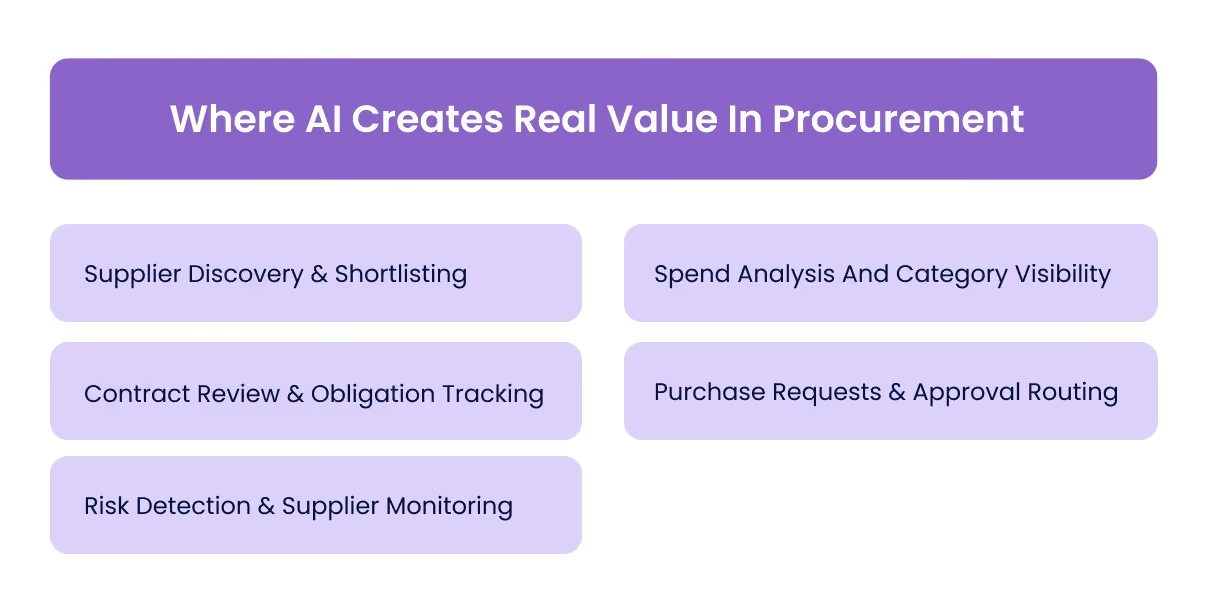
1. Supplier Discovery And Shortlisting
Early-stage supplier research often involves reviewing vendor profiles, comparing capabilities, checking commercial fit, and narrowing options before formal sourcing begins. AI can accelerate that work by organising supplier data, comparing inputs across multiple criteria, and helping teams produce a stronger shortlist in less time.
That does not remove human judgement. Procurement still has to decide whether a supplier is commercially suitable, operationally reliable, and aligned with policy. What AI improves is the speed and structure of the review.
2. Spend Analysis And Category Visibility
Many businesses do not have a clear view of procurement spend until after it has already fragmented. Similar purchases sit under different suppliers, categories are used inconsistently, and off-contract buying becomes harder to detect over time.
AI helps by classifying spend patterns, grouping related supplier activity, and flagging anomalies that suggest leakage or duplication. This is one of the most practical uses of artificial intelligence in procurement process design because it turns historical transaction data into decision support for future purchasing.
3. Contract Review And Obligation Tracking
Procurement teams regularly work through payment terms, renewal dates, service clauses, pricing structures, and non-standard exceptions. That review is time-consuming, especially when contracts are handled across different teams and formats.
AI can extract key terms, highlight deviations, and surface obligations earlier in the review cycle. This reduces the chance of missing details that later affect cash flow, supplier disputes, or compliance. It also improves coordination between procurement, finance, and legal by making contract information easier to interpret consistently.
4. Purchase Requests And Approval Routing
Approval friction remains one of the biggest causes of procurement delay. Requests sit in inboxes, approval paths vary by team, and urgent purchasing often bypasses the intended process altogether.
AI can help route requests based on rules, transaction context, or historical patterns, which shortens turnaround time and makes approvals more consistent. However, the value is not just speed. Better routing also improves auditability because the business can see how requests moved, who approved them, and where exceptions were introduced.
5. Risk Detection And Supplier Monitoring
AI can also support procurement by flagging unusual supplier behaviour, recurring exceptions, or patterns that suggest control issues. That is particularly relevant when procurement decisions affect regulated spending, multi-entity operations, or large supplier bases.
The objective here is not to automate trust. It is to make risk signals easier to catch before they become operational or financial problems.
What This Means For Finance Teams
Finance leaders should care about AI in procurement because procurement decisions do not end when a supplier is selected. They continue through approvals, documentation, purchasing, payment, and reconciliation. If AI improves the front end of procurement but the actual spend still moves through weak controls, the business only shifts the problem downstream.
That is why the real value of AI for procurement lies in disciplined execution. Faster evaluation is useful. Faster sourcing is useful. But both matter most when the resulting spend remains visible, policy-aligned, and easy to verify across the rest of the finance workflow.
What Artificial Intelligence In Procurement Process Still Cannot Fix
AI can improve procurement speed, pattern recognition, and workflow consistency. It cannot fix a procurement function that lacks structure. This distinction matters because many businesses adopt AI expecting better decisions, when the underlying issue is actually weak policy, inconsistent data, or unclear ownership.
That is why the most useful procurement teams treat AI as an execution layer, not a substitute for process design. If the operating model is weak, AI often makes the weaknesses move faster rather than making them disappear.
1. Poor Supplier And Spend Data
Most procurement systems are not short on data. They are short on clean data. Supplier names are duplicated, spend categories are used inconsistently, contract records are incomplete, and supporting documentation sits across too many systems.
In that environment, AI outputs become less reliable. Deloitte has noted that procurement leaders see data quality as one of the biggest internal barriers to successful AI adoption. That is logical. If supplier records are fragmented and category logic is weak, even a strong model will struggle to produce dependable recommendations or accurate analysis.
This is why AI in procurement usually works best after a business improves vendor master data, spend categorisation, and document discipline. Without that foundation, the technology may look impressive while still producing noisy results.
2. Broken Approval Design
AI can route requests faster. It cannot decide what your approval structure should be.
If budget thresholds are unclear, if emergency purchases regularly bypass policy, or if too many approvers are inserted into the same workflow, AI will not solve the underlying governance problem. It may reduce administrative delay, but it will not create accountability where none exists.
In practice, procurement control depends on clear authority: who can approve what, under which limits, with which documentation, and under which exceptions. AI can support that structure. It cannot invent it.
3. Weak Supplier Policy
A business still has to define what good procurement looks like. That includes preferred supplier logic, onboarding requirements, competitive bidding rules, restricted categories, contract review standards, and escalation paths for exceptions.
AI for procurement can help apply policy more consistently, but it still depends on policy being explicit in the first place. If supplier selection rules differ by team or are handled informally through email and verbal approvals, AI will only reflect that inconsistency.
This is one reason the UAE Ministry of Finance’s 2024 workshop on AI procurements is relevant. The workshop focused on selection criteria, the role of AI consultants, and a structured process for informed procurement decisions. That signals the real maturity question: not whether AI exists, but whether the organisation knows how to procure and govern it properly.
4. Accountability And Commercial Judgement
Procurement is not only administrative. It is commercial. Teams still need to assess supplier fit, negotiate terms, interpret context, and make judgement calls where the answer is not binary.
AI can summarise contracts, compare options, or flag anomalies. Final ownership, however, still belongs to people. That is particularly important in supplier selection, pricing decisions, contract deviations, and exceptions with financial or compliance implications.
A strong procurement function does not ask AI to replace judgement. It asks AI to reduce manual effort around judgement so people can focus on the decisions that actually require experience.
How To Use AI For Procurement Without Losing Control
Businesses get the most value from AI in procurement when they apply it narrowly, measure it properly, and keep decision rights clear. The goal is not to automate the entire source-to-pay cycle in one step. The goal is to remove friction from the workflows that create the most operational drag.
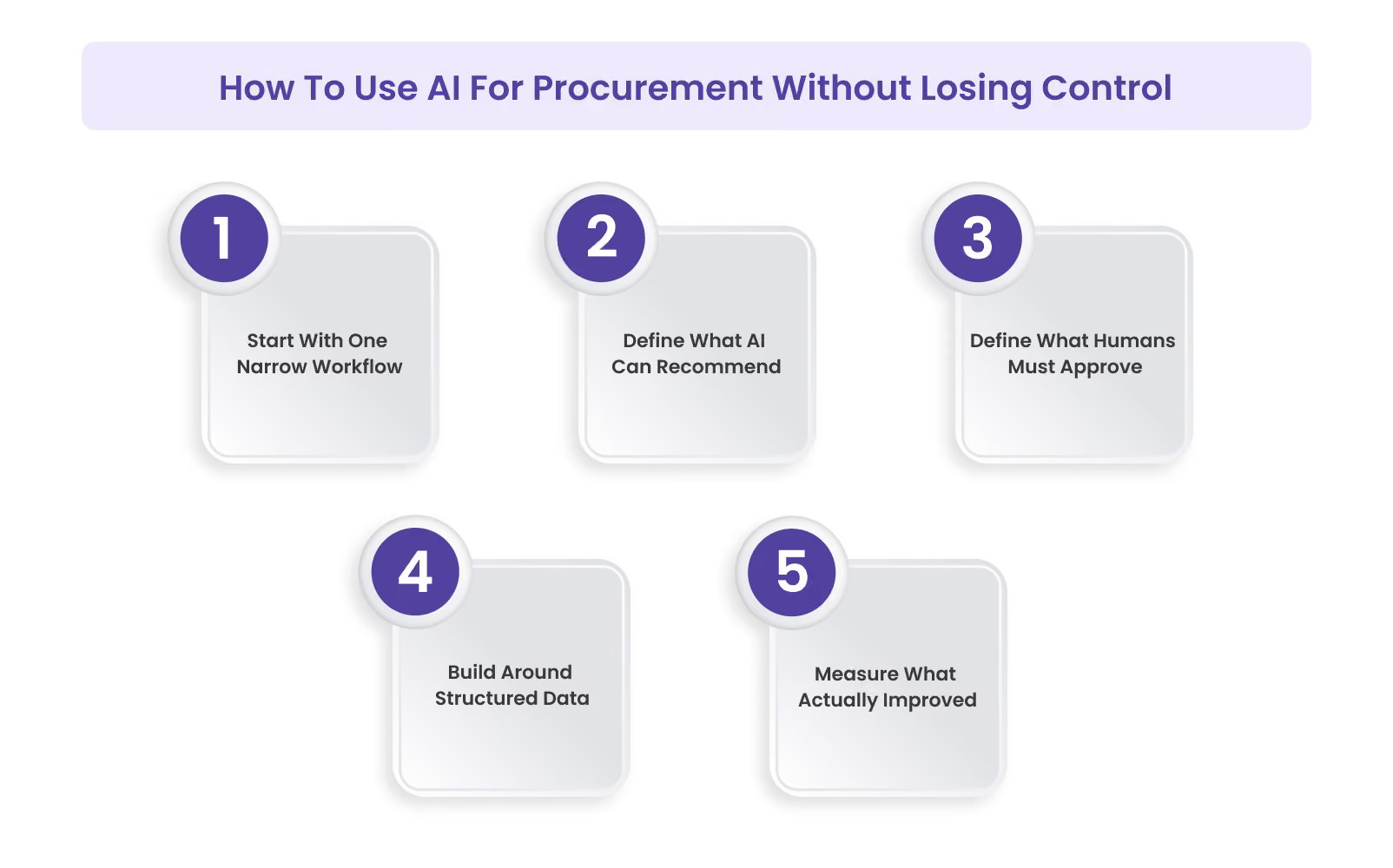
1. Start With One Narrow Workflow
The best AI use cases in procurement are usually repetitive, high-volume, and rules-based enough to benefit from structured support. Examples include supplier shortlisting, spend classification, contract term extraction, purchase request routing, and exception flagging.
This approach keeps implementation realistic. It also makes it easier to test whether AI is genuinely improving cycle time, reducing rework, or increasing visibility. Oracle’s procurement guidance reflects this practical lens, focusing on applications such as spend analysis, vendor management, demand forecasting, and risk reduction rather than presenting AI as a single all-encompassing procurement answer.
2. Define What AI Can Recommend
AI should have a clearly limited role. It can summarise, classify, compare, detect, draft, and flag. Those are meaningful capabilities, but they are not the same as approval authority.
For example, AI might:
- Suggest similar suppliers based on historical transactions
- Classify spend into the correct category
- Pull renewal clauses from supplier contracts
- Flag a request that falls outside the usual purchasing pattern
- Draft a comparison summary between competing quotations
These are strong operational use cases because they support decision-making without taking ownership away from the business.
3. Define What Humans Must Approve
High-impact procurement decisions should remain explicitly human-owned. That includes supplier selection, commercial negotiation, off-policy purchasing, contract deviations, budget exceptions, and any transaction with material financial or regulatory consequences.
This control layer matters because procurement does not fail only when data is wrong. It also fails when no one is clearly accountable for an exception. AI can raise the signal. Someone still has to decide what to do with it.
4. Build Around Structured Data And Rules
AI in procurement becomes far more useful when it sits on top of clean vendor records, consistent category structures, standard approval paths, and well-maintained documentation. This is the operational foundation that turns AI from an experiment into an embedded workflow tool.
In practical terms, that means businesses should tighten:
- Supplier master data
- Spend category logic
- Approval matrices
- Contract storage standards
- Documentation requirements for purchase requests and invoices
When those foundations are weak, AI tends to create surface-level efficiency while preserving deeper control problems.
5. Measure What Actually Improved
Procurement AI should not be judged by novelty. It should be judged by operational outcomes.
Useful metrics include sourcing cycle time, approval turnaround, duplicate supplier reduction, contract review speed, exception rates, rework, and off-policy purchasing patterns. If those numbers do not improve, the technology may be adding activity without adding real control or efficiency.
That is why mature adoption usually looks disciplined rather than dramatic. A business does not need AI in every procurement workflow. It needs AI where repetitive work is slowing down informed decisions.
What UAE Businesses Should Prioritise First
For UAE businesses, AI in procurement is most valuable where complexity is already visible. That often means fast-growing teams, multiple approvers, high supplier volumes, cross-border payments, and increasing pressure to keep documentation accurate and audit-ready.
The first priority should be repetitive procurement work that consumes time without requiring much commercial creativity. Spend classification, supplier comparison support, contract extraction, and approval routing usually sit here.
The second priority should be visibility. If the business cannot clearly see who is buying, from whom, under which terms, and with which approvals, AI will only partially improve procurement. Visibility has to improve alongside speed.
The third priority should be control after the procurement decision. This is where many businesses underinvest. They improve sourcing and vendor review, but the actual purchasing and payment workflow remains fragmented across cards, invoices, transfers, receipts, and disconnected approvals. That weakens the value of everything that happened upstream.
How Alaan Supports Procurement Execution After AI-Led Decisions
AI improves how procurement decisions are made. But once a supplier is selected, the real risk shifts to execution. If purchases happen through fragmented approvals, unclear documentation, or uncontrolled payment methods, the value created upstream starts breaking down.
Alaan operates at this execution layer, helping finance teams ensure that approved procurement decisions translate into controlled, visible, and audit-ready spending.
- Corporate Cards With Spend Controls And Vendor Restrictions
Alaan enables businesses to issue cards with defined limits and merchant controls, ensuring procurement-related purchases stay within approved boundaries. - Structured Approval Workflows Before Spend Happens
All purchases can be routed through configurable approval flows, so procurement decisions are enforced before money leaves the business, not reviewed after. - Real-Time Visibility Into Procurement Spend
Finance teams can track spend by supplier, category, and team as it happens, making it easier to detect off-contract purchases or unexpected category spikes early. - Centralised Invoice And Receipt Capture
Invoices and receipts are automatically linked to transactions, reducing fragmented documentation and making supplier-related spend easier to verify. - Cleaner Reconciliation And Accounting Sync
With integrations into systems like Xero, QuickBooks, NetSuite, and Microsoft Dynamics, procurement spend flows cleanly into accounting without manual gaps. - Better Audit Readiness Across Supplier Transactions
Every transaction carries a clear trail of approval, documentation, and categorisation, reducing audit friction and improving control over procurement activity.
In practice, this means procurement does not lose control after supplier selection. It remains structured, visible, and enforceable throughout the spend lifecycle.
Conclusion
AI in procurement is valuable when it improves how decisions are made, not when it simply adds another layer of technology. The strongest use cases are the ones that reduce manual effort, improve visibility, and help teams act faster without weakening control.
However, AI does not replace the need for structured workflows. Procurement still depends on clear supplier policies, defined approval authority, and reliable documentation. Without that foundation, even advanced tools will struggle to produce consistent outcomes.
For most businesses, the right approach is focused adoption. Start with high-volume workflows where AI can remove friction, measure what improves, and keep decision ownership clearly defined.
And once procurement decisions are made, execution becomes the next control point. That is where Alaan helps finance teams ensure spending remains aligned with approvals, visible in real time, and properly documented across the business. Book a Demo Today!
FAQs
1. Is AI in procurement mainly useful for large enterprises?
No. Larger organisations may have more data and more supplier volume, but smaller and mid-sized businesses can still benefit where procurement work is repetitive, fragmented, or approval-heavy. The key is not company size alone. It is whether manual effort is slowing decisions or hiding spend patterns.
2. What is the safest first AI use case in procurement?
Usually a narrow, rules-based workflow. Spend classification, contract term extraction, supplier comparison support, or approval routing tend to be more practical starting points than trying to automate full sourcing decisions from day one.
3. Can AI help reduce maverick or off-policy purchasing?
It can help surface unusual patterns, inconsistent supplier use, or requests that fall outside normal buying behaviour. But it works best when the business already has clear supplier rules and approval thresholds in place.
4. Does AI make procurement decisions more objective?
It can make comparison and data review more structured, but it does not remove judgement. Supplier selection still depends on commercial fit, service quality, negotiation outcomes, and policy context that need human ownership.
5. What should procurement teams measure after introducing AI?
They should look at actual workflow outcomes, such as sourcing cycle time, approval turnaround, duplicate supplier reduction, contract review speed, exception rates, and off-policy purchasing patterns. If those do not improve, the AI layer may not be adding meaningful value.
6. Why do procurement teams often struggle to scale AI beyond a pilot?
Because the pilot may work technically while the wider process remains messy. Weak supplier data, inconsistent category logic, unclear ownership, and fragmented document handling usually limit expansion more than the model itself.
Gain control over business expenses with Alaan corporate cards
Invygo earned AED 100,000 in cashback using Alaan cards
Personalise approval workflows to align with your business needs with Alaan's Spend Management platform
Discover the power of automated expense tracking and smarter spend control with Alaan
Turn data into actionable insights with Alaan's spend management tools
Stay Tax Compliant with UAE's #1 Corporate Card and Spend Management Platform
Customisable corporate card policy template
Know how much Corporate Tax you have to pay this fiscal year
Easily integrate Alaan with your ERP for accurate, real-time expense tracking
Close books faster with Alaan's AI-powered accounting automation
Reconcile your books in minutes instead of hours, every single month.
Keep petty cash organized with Alaan corporate cards and automated expense management