.avif)

One missing invoice number can quietly turn a routine payment into a compliance risk.
If you manage invoices at scale, you’ve likely seen how small numbering errors snowball into bigger issues. Under UAE VAT law, a unique, sequential invoice number is a mandatory requirement on every tax invoice, and missing or duplicate numbers can trigger audit queries or rejected claims.
In fact, the UAE Federal Tax Authority explicitly lists invoice numbering as a core tax invoice requirement for VAT compliance.
For businesses processing hundreds of invoices monthly, manual numbering increases the risk of gaps, duplication, and reconciliation delays. This blog breaks down what an invoice number is, why it matters for compliance and financial control, and how to assign it correctly, so your invoicing process stays audit-ready, accurate, and scalable as your business grows.
Key Takeaways
- An invoice number is a mandatory, unique identifier that underpins VAT compliance, audit trails, and payment tracking.
- Effective invoice numbers follow a fixed structure, prefix, date reference, and sequential number, maintained consistently within a financial year.
- Reusing numbers, assigning them to drafts, or changing formats mid-year creates reconciliation and audit risks.
- Manual invoice numbering does not scale and increases the likelihood of gaps, duplicates, and reporting errors.
- Automated validation and sequencing significantly reduce compliance exposure and month-end workload.
- Platforms like Alaan embed invoice number control into expense workflows, keeping records accurate and audit-ready as volumes grow.
What Is an Invoice Number?
An invoice number is a unique identification code assigned to each invoice issued by a business. Its primary role is to distinguish one invoice from another across financial records, tax filings, audits, and payment systems.
Unlike invoice dates or amounts, which can repeat, an invoice number must never be duplicated. Once assigned, it becomes the permanent reference used by finance teams, customers, banks, tax authorities, and auditors to trace that transaction end-to-end.
An invoice number serves multiple operational and compliance purposes at the same time:
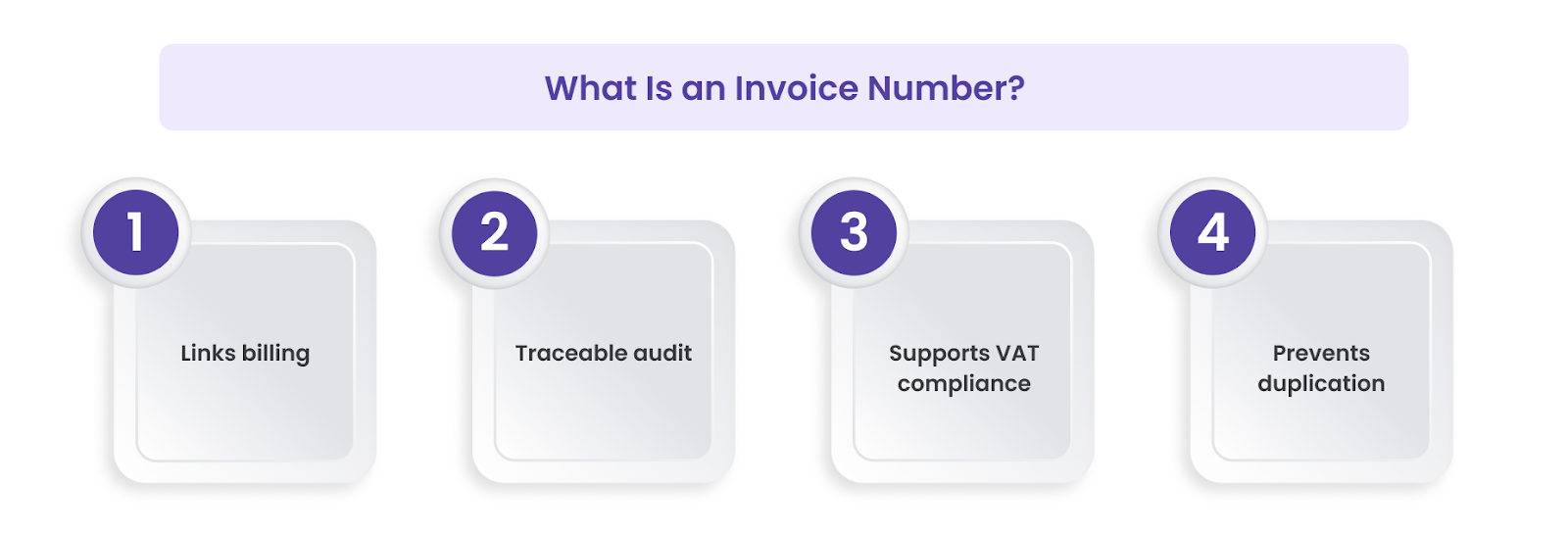
- Links billing to payment: Customers reference the invoice number when making payments, helping finance teams match receipts accurately.
- Creates a traceable audit trail: Auditors use invoice numbers to verify transaction completeness and detect missing or altered records.
- Supports VAT compliance: Tax authorities rely on invoice numbers to validate VAT reporting and input tax claims.
- Prevents duplication and fraud: Sequential numbering makes gaps or repeated entries immediately visible.
An invoice number appears prominently on the invoice itself and is carried across accounting systems, payment references, VAT filings, and audit records. It serves as the single reference point for billing, payment, and reporting.
Once issued, the invoice number must remain unchanged across all systems; any alteration can disrupt reconciliation and raise compliance concerns.
Now let's have a look at the key components that actually make an invoice number valid, reliable, and scalable.
Key Elements of an Invoice Number
An effective invoice number follows a clear structure that ensures uniqueness, traceability, and compliance, even as invoice volumes grow. While formats may vary by business, strong invoice numbers share a few essential elements.
1. Prefix (Context Identifier)
A prefix helps identify the invoice type, entity, or business unit. For example, INV for sales invoices or a location code for multi-entity businesses. Prefixes add clarity without affecting sequence integrity.
2. Date Component (Period Reference)
Including a year or month (e.g., 2025 or 2025-04) helps finance teams quickly associate invoices with the correct tax period, especially during VAT reviews and audits.
3. Sequential Number (Control Mechanism)
The sequential number is the core of invoice traceability. It must increase logically and never be reused. Gaps are acceptable only when voided invoices are clearly documented.
4. Format Consistency
The structure, prefix, date, and sequence should remain unchanged within the same financial year. Format changes mid-period complicate reconciliation and reporting.
5. Scale and System Readiness
Zero-padded sequences (e.g., INV-2025-000345) prevent renumbering as volumes grow and ensure compatibility across accounting tools, banking references, and VAT filings.
You've seen the benefits, now turn those into action with this exact FTA-approved process.
How Do You Assign Invoice Numbers?
UAE FTA requires unique, sequential numbers on every tax invoice, no gaps permitted across all branches, starting from 001 per cycle. Use central software tied to your TRN for audit-proof records, ready for the 2026 e-invoicing rollout.
Here’s a step-by-step guide for assigning UAE FTA complaint invoice numbers:
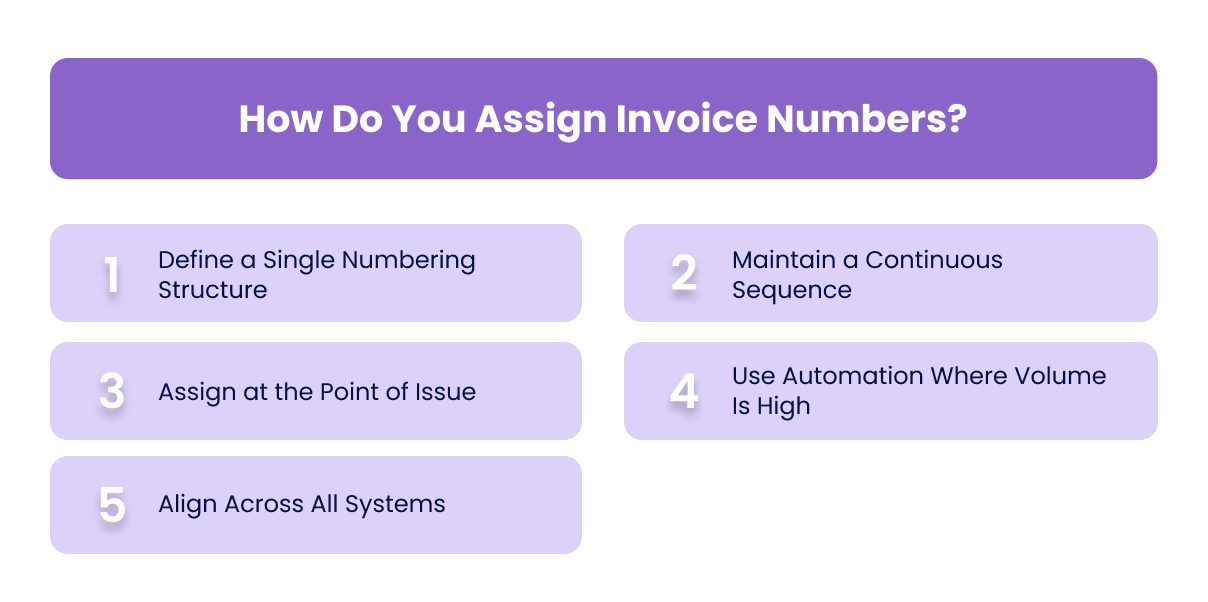
1. Define a Single Numbering Structure
Start by locking one structure that will be used consistently across the financial year. A reliable format usually includes:
- Prefix to identify the document (e.g., INV)
- Date element to indicate the tax period (e.g., 2025 or 2025-04)
- Sequential number that increments automatically
Example: INV-2025-000127
Once defined, this structure should not change mid-year.
2. Maintain a Continuous Sequence
Invoice numbers must increase logically with each new invoice.
- Never reuse a number, even if an invoice is cancelled
- If an invoice is voided, keep the number unused and document the reason
- This preserves sequence integrity, which auditors rely on to confirm completeness.
3. Assign at the Point of Issue
Invoice numbers should be generated only when the invoice is issued, not when it’s drafted. This prevents gaps caused by abandoned or edited drafts entering the sequence.
4. Use Automation Where Volume Is High
Manual assignment increases the risk of duplicates and skipped numbers. Automated systems ensure:
- Numbers are assigned once and only once
- Sequences remain intact across users and departments
- The same invoice number flows into accounting tools and reports
5. Align Across All Systems
The assigned invoice number must remain identical across:
- The invoice document
- Accounting or ERP systems
- Bank payment references
- VAT records and audit files
Any mismatch creates reconciliation delays and compliance exposure.

Knowing the formats is helpful, but it’s the underlying discipline behind numbering that determines whether the system holds up over time.
Invoice Numbering Best Practices for Accuracy and Compliance
Invoice numbering best practices are not about adding structure for its own sake. They exist to protect sequence integrity, ensure VAT traceability, and keep financial records defensible under review. When applied consistently, these practices reduce manual checks, prevent duplication, and make invoice histories easy to validate.
Follow these proven rules for your business:
1. Lock the Format for the Financial Year
Choose a structure at the start of the year and stick to it. Changing prefixes or sequences mid-year makes it harder to trace invoices during audits and reconciliations.
2. Never Reuse or Edit Issued Numbers
Once an invoice number is issued, it should remain permanent, even if the invoice is cancelled. Voided invoices must stay in the sequence with clear documentation.
3. Assign Numbers Only at Issuance
Avoid assigning numbers to drafts. Numbers should be generated only when an invoice is officially issued to prevent gaps caused by abandoned drafts.
4. Keep Numbers System-Friendly
Avoid special characters or overly long strings. Invoice numbers must work across accounting software, ERP tools, banking references, and VAT filings without truncation.
5. Separate Invoices from Adjustments
Use distinct prefixes for invoices and credit notes (e.g., INV vs. CN). This prevents sequence contamination and protects audit clarity.
6. Review Sequences Regularly
Run periodic checks to confirm there are no unexplained gaps or duplicates. Early detection avoids painful corrections during audits.
When followed consistently, these practices turn invoice numbering into a built-in control that supports compliance, clean reporting, and operational confidence.
However, even well-designed numbering systems fail when a few avoidable mistakes creep into day-to-day execution.
Common Mistakes to Avoid with Invoice Numbering
Invoice numbering errors rarely look serious at first, but they often surface later as delayed payments, audit queries, or broken records. Below are the most common mistakes finance teams make, and why they matter.
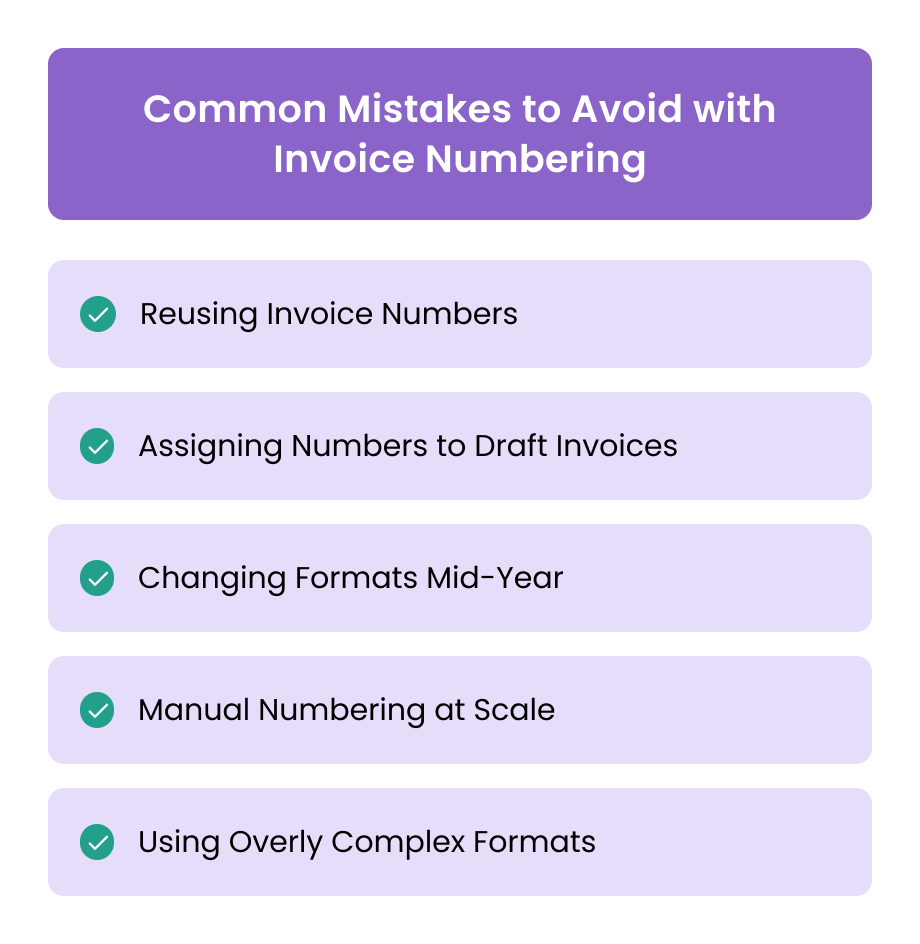
1. Reusing Invoice Numbers
Reusing a number, even for a cancelled invoice, creates ambiguity. It becomes unclear which transaction the number refers to, making payment matching and audit verification difficult.
Auditors expect each invoice number to map to one unique transaction. Reuse raises red flags around record integrity.
2. Assigning Numbers to Draft Invoices
When invoice numbers are generated at the draft stage, abandoned or edited drafts often leave gaps in the sequence.
Unexplained gaps suggest missing invoices unless clearly documented, increasing audit scrutiny.
3. Changing Formats Mid-Year
Switching prefixes, date structures, or sequencing halfway through a financial year breaks continuity.
It complicates reconciliation, confuses reporting, and makes it harder to prove completeness during reviews.
4. Manual Numbering at Scale
Manually assigning invoice numbers across teams increases the chances of duplicates, skipped numbers, or inconsistent formats.
As volume grows, manual controls fail, errors multiply, and are harder to trace after the fact.
5. Using Overly Complex Formats
Long strings with unnecessary symbols or mixed logic may look detailed, but often fail in accounting systems or bank references.
System rejection can break the link between invoices, payments, and VAT records.
Avoiding mistakes is one part of the equation; the real improvement comes when invoice numbering no longer depends on manual checks at all.
Automate Invoice Numbering with Alaan
Alaan is an AI-powered expense management platform designed for businesses in the Middle East, helping finance teams control spending, track invoices, and maintain clean, audit-ready records.
When it comes to invoice numbering, Alaan removes the risk that comes with manual handling. Invoices submitted through Alaan are captured, validated, and linked to expenses in real time, ensuring invoice numbers remain accurate, unique, and consistently applied across records.
Here’s how Alaan strengthens invoice numbering in practice:
- Automatic invoice capture and validation: Alaan extracts invoice numbers directly from uploaded invoices and checks them for duplication or format inconsistencies before they enter the workflow.
- Real-time duplicate detection: If the same invoice number is submitted more than once, intentionally or by error, Alaan flags it immediately, preventing reconciliation issues later.
- End-to-end traceability: Each invoice number is tied to the expense, approver, category, and payment record, creating a clear audit trail without manual cross-checks.
- System-ready data flow: Invoice numbers stay consistent as data moves from Alaan into accounting tools like QuickBooks or NetSuite, reducing errors during month-end close.
Explore how Alaan simplifies invoice and expense management with built-in automation. Schedule a free demo to see it in action.

Final Thoughts
Invoice numbers are more than administrative details; they are a core control that supports VAT compliance, accurate reconciliation, and audit-ready financial records. When structured correctly and assigned consistently, they reduce errors, prevent disputes, and make invoice tracking reliable as volumes grow.
By pairing disciplined numbering practices with automation, businesses can remove manual risk and maintain clean, traceable records across systems.
Alaan simplifies this process by embedding invoice number validation and control directly into expense management, helping finance teams stay compliant, efficient, and confident as they scale. Connect with us today.
FAQs
1. Can invoice numbers be reset at the start of a new financial year?
Yes, invoice numbers can restart at the beginning of a new financial year, provided the reset is clearly documented, and the sequence remains continuous within that year.
2. Are invoice numbers required for zero-rated or exempt VAT invoices?
Yes. Even zero-rated or VAT-exempt invoices must carry a unique invoice number to meet documentation and audit requirements.
3. How long should businesses retain invoice numbers and records?
In the UAE, VAT records, including invoice numbers, must be retained for at least five years from the end of the tax period.
4. Can two different suppliers issue invoices with the same invoice number?
Yes. Invoice numbers only need to be unique per supplier, not across different businesses.
5. What happens if an invoice number is missing on a received invoice?
The invoice may be considered non-compliant, and VAT recovery could be challenged until a corrected invoice is issued.
Gain control over business expenses with Alaan corporate cards
Invygo earned AED 100,000 in cashback using Alaan cards
Personalise approval workflows to align with your business needs with Alaan's Spend Management platform
Discover the power of automated expense tracking and smarter spend control with Alaan
Turn data into actionable insights with Alaan's spend management tools
Stay Tax Compliant with UAE's #1 Corporate Card and Spend Management Platform
Customisable corporate card policy template
Know how much Corporate Tax you have to pay this fiscal year
Easily integrate Alaan with your ERP for accurate, real-time expense tracking
Close books faster with Alaan's AI-powered accounting automation
Reconcile your books in minutes instead of hours, every single month.
Keep petty cash organized with Alaan corporate cards and automated expense management