.avif)
.avif)

For most small businesses, travel is not a discretionary perk. It is tied to sales, client delivery, site visits, hiring, and partnerships. Yet it is one of the least predictable cost categories on the P&L. Trips are approved quickly, booked under time pressure, expensed later, and reviewed long after the money has already left the business.
When finance teams ask what the average travel expenses for a small business look like, they are usually not looking for a generic number. They are trying to answer more practical questions. How much should a typical trip cost? What is reasonable versus excessive? And where does travel spend quietly exceed expectations despite having a policy in place?
The challenge is that travel costs do not behave like fixed overheads. They fluctuate based on destination, booking lead time, employee role, and payment method. A single delayed reimbursement or last-minute booking can distort monthly cash flow in ways that are hard to forecast.
This guide breaks down what “average” really means in a small-business context, how finance teams should benchmark travel costs realistically, and how to build a budget that holds up once real trips start happening.
What “Average Travel Expenses” Really Means for a Small Business
The word average is often misleading when applied to business travel. There is no single number that applies across industries, trip types, or destinations. For finance teams, an average is only useful if it is anchored to a clear unit of measurement.
In practice, small businesses use two definitions that actually work.
1. Average Cost Per Trip
This is the most intuitive metric. It looks at the total cost of a completed business trip from start to finish, including airfare, accommodation, meals, ground transport, and incidentals.
Cost per trip is useful for:
- budgeting annual travel spend,
- comparing trip types (sales vs operations),
- and evaluating whether certain routes or destinations consistently exceed expectations.
However, it can hide important details. A three-day regional trip and a seven-day international trip may average out to a similar number, while behaving very differently from a policy and cash-flow perspective.
2. Average Cost Per Travel Day
This metric normalises spend across trip length. It looks at how much the business spends per traveller per day, excluding one-time transport costs like flights.
Finance teams use this when:
- setting meal and incidental limits,
- comparing destinations,
- or evaluating whether hotel and daily spend policies are working.
For small businesses, the most reliable budgets usually combine both views: a cost-per-trip benchmark for planning, and a cost-per-day benchmark for policy enforcement.
The key point is this: without defining the unit of “average,” travel budgets either feel arbitrary or are constantly challenged by exceptions.
Also Read: Understanding Per Diem Rates And Their Application
Benchmarks Finance Teams Can Use Without Guesswork
While every business is different, finance teams still need reference points. The goal is not to copy global averages blindly, but to use them as guardrails and then adjust for context.
Global Business Travel Benchmarks as a Baseline
Across global business travel surveys, the average cost of a business trip typically falls in the range of USD 1,100 to USD 1,500 (~AED 4,000 to AED 5,500) per traveller. This includes flights, hotels, meals, and local transport.
Breaking that down further, commonly cited planning benchmarks include:
- Airfare: roughly USD 600–750 (~AED 2,200–2,750) per trip on average
- Hotel rates: around USD 150–170 (~AED 550–625) per night
- Meals and incidentals: USD 40–70 (~AED 150–260) per day, depending on destination
- Ground transport: USD 40–100 (~AED 150–370) per trip
For a small business, these figures are not targets. They are reference ranges. Actual costs may be lower for regional GCC travel and higher for long-haul or client-facing trips.
Translating Benchmarks Into a Small-Business Model
Rather than relying on one average number, finance teams typically create two or three travel bands, for example:
- Lean travel: internal meetings, regional trips, short stays
- Standard travel: sales visits, partner meetings, moderate lead time
- Client-facing or critical travel: conferences, executive travel, short-notice bookings
Each band has its own expected cost range per trip and per day. This approach is far more effective than a single “average travel cost” figure because it reflects how travel actually happens.
Why UAE Small Businesses Need Local Context
In the UAE, there is no government-mandated per diem for private companies. Businesses set their own limits. This flexibility is useful, but it also means travel budgets fail when they are copied from global templates without adjustment.
Factors that materially affect UAE travel spend include:
- higher hotel rates during peak seasons and events,
- frequent short-notice regional travel,
- and a mix of expatriate and local employee travel patterns.
Finance teams that acknowledge these realities upfront spend less time explaining variances later.
Also Read: Cash Flow Optimisation Strategies for UAE Businesses in 2025
A Practical Cost Model Finance Teams Can Actually Use
Most travel budgets fail because they are built as rough estimates rather than structured models. Finance teams approve trips, but the underlying assumptions are rarely documented. When costs exceed expectations, there is no clear reference point to diagnose why.
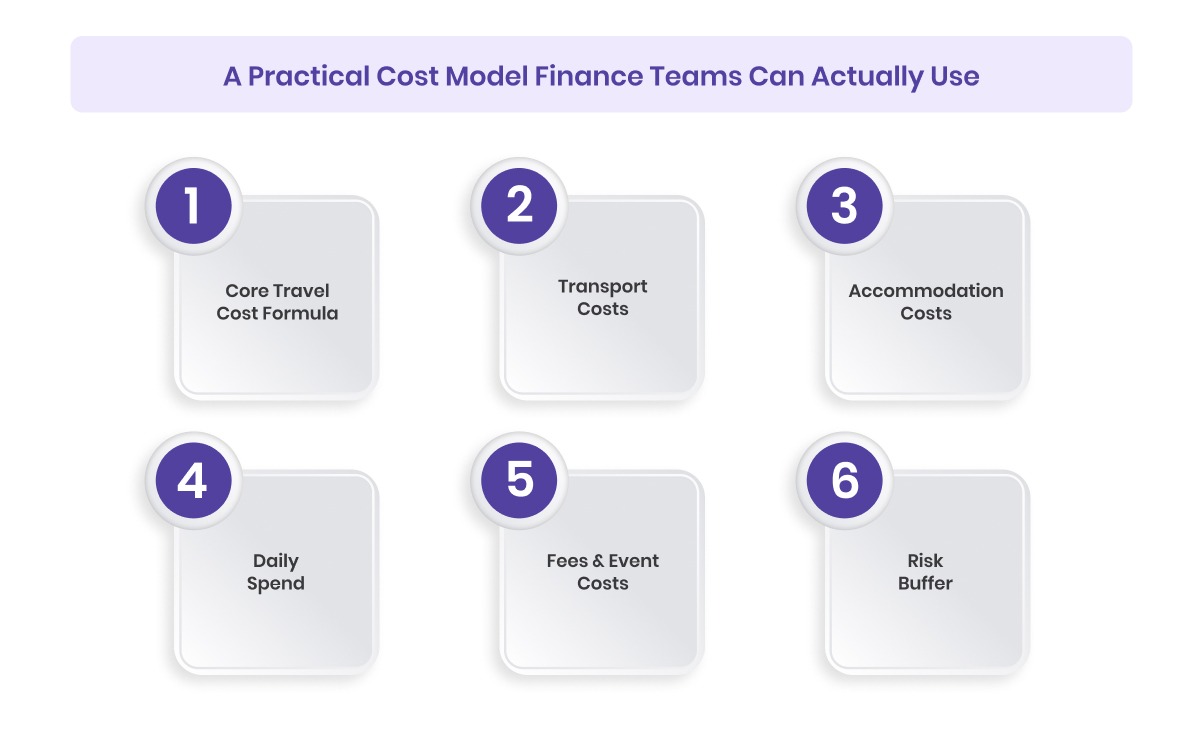
A simple, repeatable model works far better than a detailed spreadsheet that no one revisits.
1. The Core Travel Cost Formula
For budgeting purposes, small businesses can model travel spend as:
Trip Cost = Transport + Accommodation + Daily Spend + Fees + Risk Buffer
Each component behaves differently and should be reviewed separately.
2. Transport Costs
This includes airfare, rail, baggage fees, seat selection, and where applicable, visa or travel insurance costs. Transport is usually the largest single expense and the most sensitive to booking lead time.
From a finance perspective, transport costs are best controlled through:
- advance booking guidelines,
- fare class restrictions,
- and clear rules for last-minute exceptions.
Trying to optimise transport costs after the trip has taken place rarely delivers savings.
3. Accommodation Costs
Hotels are the most predictable part of travel spend, but only if caps are enforced consistently. Nightly rates multiplied by stay length quickly exceed expectations when:
- trips are extended informally,
- peak-season pricing is ignored,
- or policy caps are treated as guidelines rather than limits.
Many finance teams underestimate how much accommodation overruns contribute to total trip variance.
4. Daily Spend: Meals, Local Transport, Incidentals
This category includes meals, taxis, ride-hailing, public transport, and small incidental purchases. Individually, these expenses appear minor. Collectively, they are one of the biggest sources of leakage.
This is where per-day benchmarks or per diem limits are most effective. Without them, finance teams rely on post-trip judgement calls rather than clear standards.
5. Fees And Event-Related Costs
Conference tickets, client entertainment, roaming charges, and Wi-Fi fees are often approved implicitly rather than explicitly. These costs tend to bypass standard travel budgets, even though they are travel-related in substance.
Explicitly listing them in the cost model prevents under-budgeting.
6. Risk Buffer
Changes, cancellations, and short-notice rebooking are a reality of business travel. A small contingency buffer helps finance teams avoid treating every change as an exception.
The goal of this model is not precision. It is transparency. When each trip is broken down this way, overruns can be explained and addressed systematically.
Also Read: Spending Policy for Businesses: A Complete Compliance Guide
What Actually Drives Travel Costs Up (And Where Control Is Possible)
Travel costs rarely exceed budgets for one dramatic reason. They creep up through a series of small decisions that compound over time. Understanding these drivers helps finance teams focus on controls that matter.
1, Booking Lead Time
The single biggest cost driver is how early a trip is booked. Short-notice bookings inflate airfare and limit accommodation choices. This is often outside finance’s direct control, but it can be influenced.
Clear approval timelines and expectations around travel planning reduce last-minute costs more effectively than post-hoc cost reviews.
2. Destination And Seasonality
The same trip can cost materially different amounts depending on timing. Events, holidays, and peak business seasons drive up hotel rates and availability constraints.
Finance teams that budget without accounting for seasonality often mistake predictable price increases for policy breaches.
3. Traveller Behaviour And Role Expectations
Not all employees travel the same way. Client-facing roles, leadership travel, and operational site visits carry different expectations. Problems arise when these differences are not reflected in policy.
A single set of limits applied universally tends to create exceptions rather than compliance.
4. Reimbursements And Delayed Visibility
When employees pay out of pocket and claim later, finance teams lose real-time visibility into travel spend. Costs appear weeks after the trip, often concentrated in reimbursement cycles that distort monthly expenses.
This delay makes it harder to intervene early or adjust future travel plans based on current spend.
5. Payment Method And Control Mechanisms
How travel is paid for matters as much as how much it costs. Centralised payment methods provide immediate visibility and enforce limits at the point of spend. Decentralised payments rely on trust and after-the-fact review.
Small businesses often underestimate how much travel overspend is driven by payment structure rather than policy gaps.

Per Diem Vs Actual Reimbursement: What Works Better For Small Businesses In The UAE
Small businesses often struggle to decide between per diem allowances and actual reimbursement. The right answer is rarely ideological. It depends on how predictable travel patterns are and how much control the finance team needs.
Where Per Diem Works Well
Per diem models work best when travel is frequent and relatively uniform. For example, repeated regional trips or operational travel where daily spending patterns do not vary significantly.
From a finance perspective, per diem:
- simplifies administration,
- reduces receipt scrutiny,
- and provides predictable daily costs.
However, it only works when limits are realistic. Unrealistically low per diems create constant exceptions. Overly generous ones quietly inflate spend.
Where Actual Reimbursement Makes More Sense
Actual reimbursement is better suited to client-facing travel, international trips, or situations where costs vary widely by destination. It provides accuracy but increases workload.
The main downside is delayed visibility. Finance teams only see costs after the trip, which makes proactive control difficult.
The Hybrid Model Most UAE Small Businesses Use
In practice, many UAE small businesses adopt a hybrid approach:
- Airfare and accommodation: actuals, within defined caps
- Meals and incidentals: per diem or daily limits
- Client entertainment: actuals, with explicit approval
This model balances predictability with flexibility and reduces post-trip disputes.
Also Read: Steps to Automate Your Travel and Expense Management
How To Set A Travel Budget That Survives Real Usage
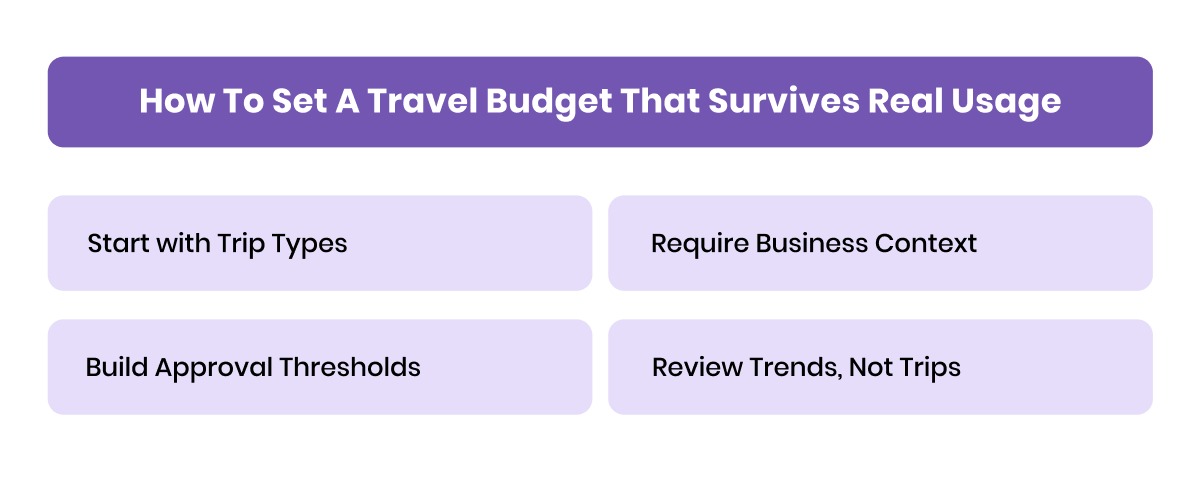
Travel budgets fail when they exist only on paper. A usable budget reflects how trips are approved, booked, and paid for in practice.
1. Start With Trip Types, Not Annual Totals
Instead of beginning with an annual number, finance teams should define expected trip categories:
- regional operational trips,
- domestic client visits,
- international conferences or sales travel.
Each category gets an expected cost range. Annual spend then becomes a function of volume, not guesswork.
2. Build In Approval Thresholds
Not every trip needs the same level of scrutiny. Clear thresholds based on trip cost or role prevent both over-approval and bottlenecks.
This keeps finance involved where it matters without slowing the business.
3. Require Business Context Early
Travel costs are easier to justify when purpose is captured upfront. Knowing why a trip is happening improves post-trip review and future planning.
Budgets that lack context often turn into blunt cost-cutting tools rather than decision frameworks.
4. Review Trends, Not Individual Trips
Finance teams gain more insight by reviewing patterns than by auditing every receipt. Metrics such as average cost per trip, per traveller-day, and exception frequency reveal where policies need adjustment.
Also Read: Understanding Spend Visibility and Business Benefits
How Alaan Helps Finance Teams Control Travel Spend
At Alaan, we work with finance teams that want visibility and control without adding friction for employees. Travel spend is one of the clearest examples of where this balance matters.
Our focus is on controlling spend as it happens, not weeks later.
Key Ways Alaan Supports Travel Spend Control
- Corporate Cards For Business Travel
Travel expenses are paid directly from company funds rather than reimbursed later, improving cash flow visibility. - Real-Time Transaction Visibility
Finance teams see travel spend as soon as it occurs, regardless of location or currency. - Spend Limits And Category Controls
Card-level limits and merchant restrictions prevent out-of-policy spend at the point of payment. - Receipt Capture At The Time Of Spend
Receipts are uploaded immediately, reducing follow-up and month-end reconciliation effort. - Approval Workflows That Match Policy
High-value or exception expenses can be routed for review without slowing routine travel spend. - Accounting Integration For Cleaner Reconciliation
Travel expenses sync directly into accounting systems, reducing manual entry and reporting delays.
The result is fewer surprises, faster reimbursements where needed, and travel budgets that reflect reality rather than assumptions.

Conclusion
There is no single number that defines the average travel expenses for a small business, especially in the UAE. What matters is whether finance teams can predict costs, spot overruns early, and keep travel aligned with business priorities. When travel spend is reviewed only after reimbursements are filed, “average” becomes a backward-looking guess rather than a planning tool.
At Alaan, we work with UAE finance teams to bring travel expenses under control at the point of spend, not weeks later. By paying for travel through Alaan corporate cards, setting role-based limits, and tracking transactions in real time, businesses get immediate visibility into how much each trip actually costs, and whether it stays within policy. The result is fewer surprises on the P&L, faster closes, and travel budgets that reflect how teams really operate.
When travel spend is visible, controlled, and easy to review, averages stop being abstract benchmarks and start supporting better financial decisions. That is how small businesses turn travel from an unpredictable cost into a manageable, growth-supporting expense.
Gain control over business expenses with Alaan corporate cards
Invygo earned AED 100,000 in cashback using Alaan cards
Personalise approval workflows to align with your business needs with Alaan's Spend Management platform
Discover the power of automated expense tracking and smarter spend control with Alaan
Turn data into actionable insights with Alaan's spend management tools
Stay Tax Compliant with UAE's #1 Corporate Card and Spend Management Platform
Customisable corporate card policy template
Know how much Corporate Tax you have to pay this fiscal year
Easily integrate Alaan with your ERP for accurate, real-time expense tracking
Close books faster with Alaan's AI-powered accounting automation
Reconcile your books in minutes instead of hours, every single month.
Keep petty cash organized with Alaan corporate cards and automated expense management