.avif)


Cash float is often treated as a minor operational detail until it becomes a problem. It surfaces during reconciliations that do not tie, audits that raise questions about cash handling, or expense reviews where documentation is missing. What looks like a small amount of money can quickly expose gaps in controls, accountability, and visibility.
In UAE and GCC businesses, cash float continues to play a role across offices, retail counters, clinics, logistics operations, and field teams. It exists to keep operations moving when digital payments are impractical. At the same time, unmanaged cash float introduces risk. Expenses are harder to trace, timing differences distort visibility, and responsibility becomes unclear.
Understanding cash float properly means separating operational convenience from financial control. This blog explains what cash float actually means in business, how different types of float are used, and where finance teams need to draw firm boundaries.
TL;DR
- Cash float is a control design choice, not a convenience habit. When floats grow or are frequently used, they usually compensate for broken approval or payment workflows elsewhere.
- Operational float and banking float solve different problems. Petty cash controls behaviour on the ground; disbursement and collection float affect short-term liquidity and forecasting accuracy.
- Reconciliation frequency matters more than float size. Small floats reconciled weekly are safer than larger floats reviewed monthly.
- High petty cash usage is a signal, not an outcome. It often indicates limited access to approved payment methods rather than genuine cash necessity.
- The fastest way to reduce float risk is not tighter rules, but better payment access. When teams can pay quickly within controls, cash dependence drops naturally.
What Is Cash Float? (Cash Float Meaning In Practice)
Cash float refers to a fixed amount of cash that a business sets aside to support transactions that need to be settled immediately. It is not discretionary cash, and it is not revenue. It is working cash, held temporarily to bridge timing or practical gaps in payment processes.
The defining feature of cash float is that the amount is predetermined and controlled. As cash is paid out, receipts or vouchers replace the physical notes. When the float is reviewed, the total of remaining cash plus documented expenses should equal the original float amount. The float itself does not change unless formally revised.
Cash Float Meaning
In practical terms, cash float is the cash allocated at the start of a day or period to enable small payments without delay. This may include petty cash held in an office, opening cash kept at a retail counter, or operational cash assigned to a field location.
For example, if a business sets a petty cash float of AED 2,500, that amount remains constant. If AED 400 is spent on minor expenses, the remaining cash should be AED 2,100, with receipts accounting for the AED 400. When the float is replenished, it is topped back up to AED 2,500, not increased or reduced arbitrarily.
This structure allows finance teams to track usage without treating cash handling as a separate accounting process.
Cash Float Vs Cash Balance
Cash float is often confused with the overall cash balance, but the two serve different purposes. Cash balance represents the total cash available to the business across bank accounts and on-hand holdings. Cash float is a small, ring-fenced portion of that balance, allocated for specific operational use.
Unlike general cash, float is not meant to fluctuate. Any difference between the expected and actual float balance indicates a documentation gap, recording error, or control issue. This is why float is closely linked to internal controls rather than liquidity management.
Also Read: Effective Cash Float Management: Calculation, Monitoring, and Best Practices
Types Of Cash Float Businesses Use
The term cash float is used broadly, which is why confusion is common. In practice, businesses deal with two distinct categories of float. One supports day-to-day operations involving physical cash. The other arises from timing differences in payment processing and banking systems. Both matter, but they are managed very differently.
1. Operational Cash Floats
Operational cash floats involve physical cash that is actively used within the business. These floats exist to support continuity when small or immediate payments cannot wait for formal processing.
1.1 Petty Cash Float
Petty cash float is the most common form of operational float. It is a fixed amount of cash assigned to cover small, incidental business expenses that are not practical to process through bank transfers or cards.
The petty cash float meaning is simple: the float amount is set in advance, expenses are paid from it, and it is replenished back to the same level after review. The float itself should never increase or decrease informally.
Typical use cases include small office purchases, local transport, minor repairs, or urgent operational needs. Petty cash float is not intended for recurring expenses, travel, or vendor payments.
Because petty cash is easy to access, it requires strict documentation and clear ownership to remain controlled.
1.2 Till Or Operational Float
Till float is used in customer-facing environments such as retail stores, clinics, hospitality desks, or service counters. The purpose is to ensure enough cash is available at the start of the day or shift to provide change and process cash transactions smoothly.
This float is counted at opening and closing. Any variance indicates a recording or handling issue that must be investigated. While till float supports revenue activity rather than expenses, the control principle is the same: the float amount must always reconcile.
2. Banking And Payment Floats
Banking and payment floats are not physical cash held by the business. They arise from timing differences between when payments are initiated, received, and settled through banking systems. These floats affect cash visibility and forecasting rather than daily cash handling.
2.1 Disbursement Float
Disbursement float refers to the time gap between when a business issues a payment and when the funds are actually deducted from its bank account. For example, a cheque issued today may not clear for several days, during which the cash still appears in the bank balance.
Finance teams consider disbursement float when scheduling payments and managing short-term liquidity.
2.2 Collection Float
Collection float is the opposite timing gap. It refers to the period between when a payment is received from a customer and when those funds become available for use. Processing delays, clearing cycles, and bank posting schedules all contribute to collection float.
Until the funds are available, they should not be treated as usable cash.
2.3 Net Float
Net float represents the difference between collection float and disbursement float. A positive net float means more cash is in the process of being collected than paid out at a given point in time. A negative net float indicates the reverse.
Net float is mainly a treasury and cash forecasting concept, rather than an operational control.
2.4 Mail, Processing, And Availability Float
These are subcomponents of banking float that explain where delays occur. Mail float relates to physical delivery time, processing float to internal or bank handling time, and availability float to when funds are actually usable after posting. While digital payments have reduced some delays, timing gaps still exist.
Understanding these distinctions helps finance teams apply the right controls to the right type of float.
Also Read: Understanding and Managing Petty Cash System: Types and Best Practices
Petty Cash Float Explained
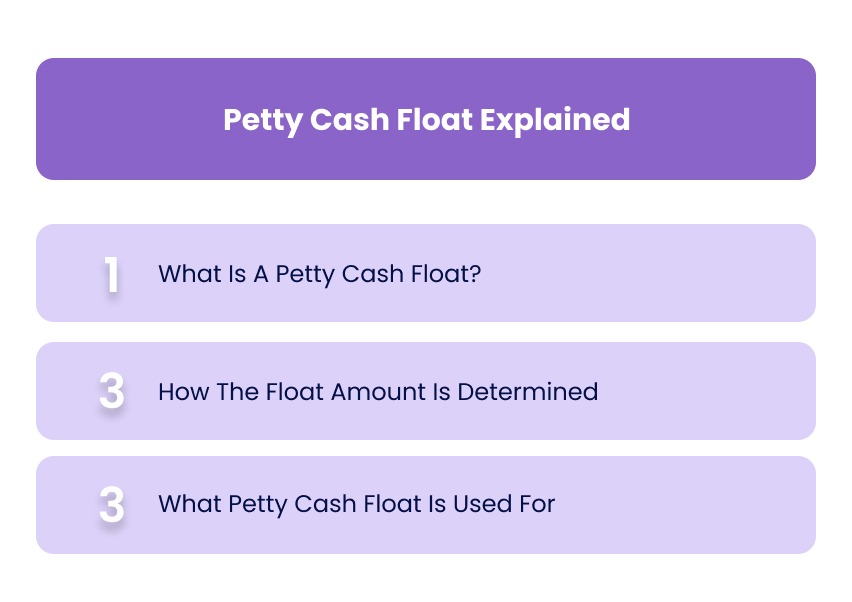
Petty cash float is often viewed as a minor administrative detail. In practice, it is one of the clearest indicators of how disciplined a business is about expense control. Because the amounts are small, weaknesses tend to be tolerated longer than they should be.
What Is A Petty Cash Float?
A petty cash float is a fixed amount of cash allocated to cover low-value, incidental business expenses. The emphasis is on fixed. The float amount is approved in advance and should remain unchanged unless formally revised.
As expenses are paid from the float, physical cash is replaced by receipts. At any point, the remaining cash plus documented expenses should equal the original float amount. If it does not, the issue is not accounting complexity. It is a control failure.
Petty cash float exists to avoid operational delays, not to bypass approval or documentation requirements.
How The Float Amount Is Determined
The float amount petty cash is usually based on expected usage over a defined period. Finance teams typically consider:
- Average number of petty cash transactions
- Typical value per transaction
- How often the float will be reviewed and replenished
- Availability of alternative payment methods
A float that is too small creates constant replenishment requests and operational friction. A float that is too large increases exposure and weakens accountability. The objective is adequacy, not convenience.
Once set, changes to the float amount should be rare and well-documented. Informal increases often hide process gaps elsewhere.
What Petty Cash Float Is Used For
Petty cash float is intended for expenses that are low in value, irregular, and difficult to process digitally. Common examples include small office supplies, local transport, minor maintenance items, or emergency purchases.
It should not be used for travel expenses, recurring subscriptions, staff advances, or regular vendor payments. When petty cash starts absorbing routine spending, it is usually compensating for slow approvals or inaccessible payment options.
As businesses mature, many petty cash use cases can be replaced by controlled digital payments. Persistent reliance on cash is often a signal, not a necessity.
Also Read: 7 Best Petty Cash Management Software for UAE Businesses
How Cash Float Works In Day-To-Day Operations
Cash float only stays controlled when daily routines are clear and consistently followed. Problems usually do not come from large errors but from small lapses repeated over time.
1. Issuing The Cash Float
At the start of a day, shift, or review period, the cash float is issued at its approved amount. This amount should be counted and acknowledged by the person responsible for holding the cash. Clear ownership matters. A float without a named custodian almost always leads to reconciliation issues.
For petty cash, custody is usually assigned to an office administrator or operations manager. For till float, responsibility may rotate by shift, but it must always be recorded.
2. Paying Expenses From The Float
When an eligible expense arises, payment is made directly from the float. Every payment must be supported by a receipt or voucher stating the date, amount, and business purpose. There should be no exceptions based on urgency or familiarity.
This is the stage where control typically weakens. Delayed or missing receipts turn cash float into untraceable spending rather than a controlled process.
3. Recording Usage As It Happens
Each transaction should be logged in a simple register, physical or digital. The objective is traceability, not complexity. At any point, finance teams should be able to identify how much cash remains, what it was spent on, and who approved it.
When records are updated retrospectively, discrepancies become harder to explain.
4. Reconciling The Float
At the end of the day or review period, the remaining cash is counted. The total of physical cash plus documented expenses should match the original float amount. Any difference must be investigated immediately rather than carried forward.
Repeated small differences are rarely accidental. They usually point to weak documentation or unclear access controls.
5. Replenishing Back To The Fixed Amount
Once expenses are reviewed and approved, the float is replenished back to its original level. Replenishment is not a reset. It confirms that expenses have been validated and recorded elsewhere.
If replenishment happens without review, the float loses its function as a control point.
Also Read: Recording Business Expenses: A Practical Guide to Smarter Company Spending
Cash Float Accounting And Recording
Cash float is often treated like an expense because money physically leaves the drawer. From an accounting perspective, that assumption is incorrect. Cash float itself is not an expense. It is a temporary holding of cash that sits on the balance sheet until expenses are formally recognised.
How Cash Float Appears In Accounting Records
When a cash float is first created, the accounting entry is simply a transfer of cash from a bank or main cash account into a designated float account. There is no impact on profit or loss at this stage.
As payments are made from the float, no immediate expense entry is recorded. Instead, receipts accumulate as supporting documentation. Expenses are recognised only when those receipts are reviewed, approved, and posted to the appropriate expense accounts.
This distinction matters. Treating every cash payout as an instant expense removes the review layer that makes float controllable.
Why Reconciliation Is Central To Float Accounting
At any point, the sum of physical cash on hand plus recorded receipts should equal the approved float amount. If it does not, the issue is not timing or classification. It is a reconciliation failure that needs investigation.
Regular reconciliation ensures that:
- Expenses are recorded in the correct period
- Cash balances are accurate
- Discrepancies are caught early
This is why auditors focus closely on cash float, even when amounts are small.
Also Read: Understanding Types and Examples of Expense Accounts
Common Issues And Risks With Cash Float
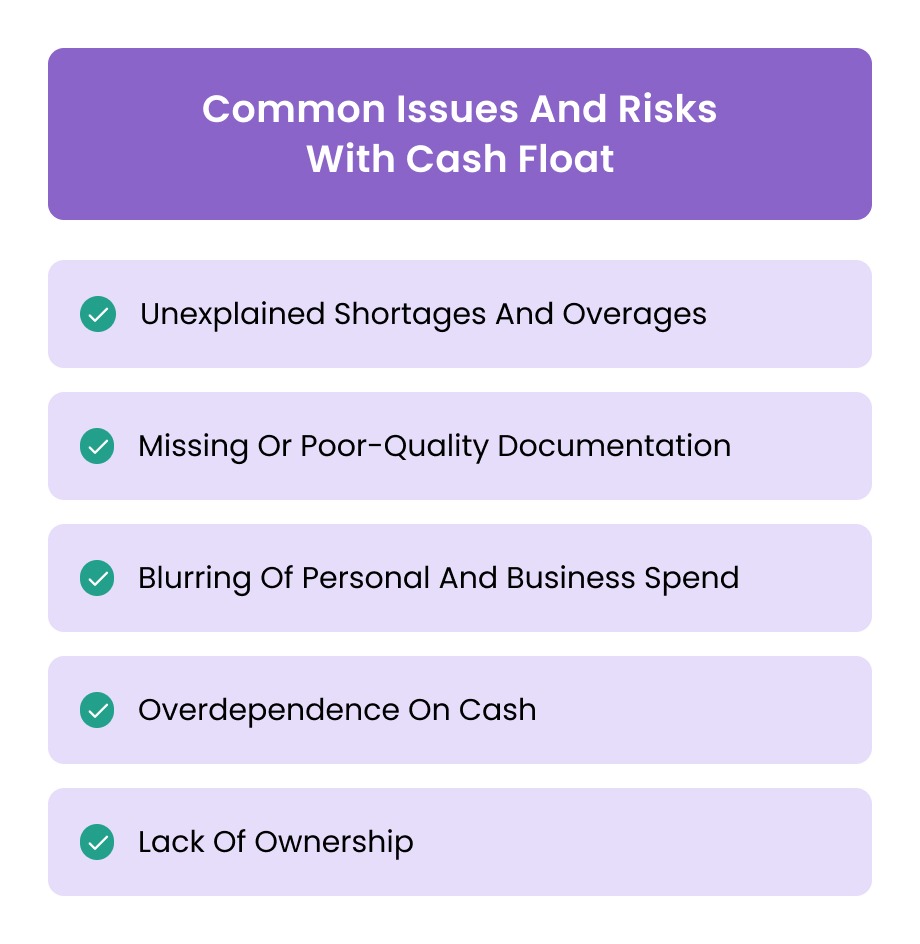
Cash float attracts risk not because it is complex, but because it relies on discipline. When controls loosen, issues accumulate quietly.
1. Unexplained Shortages And Overages
Differences between expected and actual float balances are often written off as minor errors. Over time, these differences signal weak controls rather than isolated mistakes.
2. Missing Or Poor-Quality Documentation
Receipts that are unclear, delayed, or missing undermine expense verification. Without documentation, finance teams are forced to rely on explanations rather than evidence.
3. Blurring Of Personal And Business Spend
Because cash is easy to access, it is sometimes used casually. This creates grey areas where personal expenses are justified retrospectively or business expenses lack clear approval.
4. Overdependence On Cash
When petty cash is used frequently or for predictable expenses, it usually compensates for slow approvals or inaccessible payment tools. This increases cash exposure without improving efficiency.
5. Lack Of Ownership
Shared access to a float often means no one feels accountable. Clear custodianship is essential to resolve discrepancies quickly.
Also Read: Improving Internal Control over Financial Reporting (ICFR)
Best Practices For Managing Cash And Petty Cash Float
Effective float management is procedural, not technical. The strongest controls are usually the simplest ones.
1. Set And Enforce Fixed Float Limits
Define the float amount clearly and review it periodically. Any change should require approval and documentation.
2. Define Eligible Expense Categories
Specify exactly what the float can and cannot be used for. Clear rules reduce subjective decisions during review.
3. Require Documentation For Every Payment
No receipt should mean no reimbursement. Consistency here matters more than the amount involved.
4. Reconcile Frequently
Frequent reconciliations reduce the risk of accumulated discrepancies and make issues easier to resolve.
5. Reduce Cash Usage Over Time
As businesses scale, many petty cash use cases can be replaced with controlled digital payments. Reducing cash exposure improves visibility and audit readiness.

How Alaan Helps Reduce Reliance On Cash Float
Cash float exists because teams need to pay quickly when formal processes feel slow or restrictive. The problem is not speed. It is visibility.
At Alaan, we help businesses move everyday spending out of cash and into a controlled, real-time system that preserves speed without weakening oversight.
1. Corporate Cards With Built-In Spend Controls
We issue corporate cards that can be assigned to teams, roles, or projects with predefined limits. This reduces the need for petty cash while ensuring spend stays within policy.
2. Real-Time Transaction Visibility
Every transaction appears instantly, giving finance teams visibility while the spend is happening rather than during reconciliation or reimbursement.
3. Receipt Capture At The Point Of Spend
Receipts can be uploaded immediately through the app. This removes the documentation gap that typically exists with cash float.
4. Clear Ownership And Accountability
Each card is linked to a user. This eliminates shared access issues common with cash drawers and petty cash boxes.
5. Seamless Accounting Integration
Expenses sync into accounting systems with complete data, reducing manual posting and month-end clean-up.
For finance teams, this means fewer reconciliations, lower audit exposure, and far less dependence on physical cash, without slowing operations.

Also Read: Corporate Card Reconciliation Guide
When Businesses Should Move Away From Cash Float
Cash float is designed to support exceptions. When it starts functioning as a primary payment method, it signals that existing processes are no longer aligned with how the business operates.
One clear indicator is transaction frequency. If petty cash is used daily or for predictable expenses, the float is absorbing routine spend that should move through structured payment channels.
Audit and compliance pressure is another signal. As organisations grow, even small cash balances attract scrutiny. Repeated reconciliation issues, documentation gaps, or audit queries often prompt a reassessment of cash usage.
Visibility also becomes a constraint. Cash float provides limited real-time insight into spending patterns, cost centres, and accountability. For finance teams responsible for budgeting, forecasting, or spend control, this delay reduces decision quality.
At this stage, many businesses shift toward controlled digital alternatives that preserve speed while improving traceability and reporting.
Also Read: Simple Steps to Track and Manage Business Expenses
Conclusion
Cash float is not informal cash and it is not flexible spending power. It is a controlled operational balance designed to keep small, immediate transactions moving without compromising financial discipline. When managed well, it supports efficiency. When managed loosely, it becomes a source of leakage, reconciliation issues, and audit risk.
For finance teams, the objective is not to eliminate cash float entirely, but to keep it limited, purposeful, and visible. Clear float limits, defined usage, consistent documentation, and frequent reconciliation turn cash float into a predictable control rather than a recurring exception.
At Alaan, we help businesses reduce over-reliance on cash float by enabling controlled, visible alternatives for everyday spending. By shifting expenses to corporate cards with real-time tracking and built-in controls, finance teams gain immediate visibility without slowing operations. Book a Free Demo Today!
Frequently Asked Questions (FAQs)
1. Is Cash Float The Same As Working Capital?
No. Cash float is a temporary operational allocation of cash, while working capital measures a business’s overall ability to meet short-term obligations. Float affects control and timing; working capital reflects financial position.
2. Can Cash Float Create Fraud Risk In Small Amounts?
Yes. Most cash-related fraud does not involve large one-time losses. It accumulates through small, repeated gaps such as missing receipts, shared access, or informal approvals.
3. How Often Should Petty Cash Float Be Reviewed In Growing Businesses?
As transaction volume increases, weekly or bi-weekly reviews are more effective than monthly checks. Review frequency should increase before float size does.
4. Do Digital Payments Completely Eliminate Float?
No. Digital payments reduce operational cash float, but banking float still exists due to settlement timing. However, digital tools significantly improve visibility and auditability.
5. Should Cash Float Be Included In Expense Budgets?
The float itself should not be budgeted as an expense. Only the underlying costs paid from the float should be budgeted and analysed.
Gain control over business expenses with Alaan corporate cards
Invygo earned AED 100,000 in cashback using Alaan cards
Personalise approval workflows to align with your business needs with Alaan's Spend Management platform
Discover the power of automated expense tracking and smarter spend control with Alaan
Turn data into actionable insights with Alaan's spend management tools
Stay Tax Compliant with UAE's #1 Corporate Card and Spend Management Platform
Customisable corporate card policy template
Know how much Corporate Tax you have to pay this fiscal year
Easily integrate Alaan with your ERP for accurate, real-time expense tracking
Close books faster with Alaan's AI-powered accounting automation
Reconcile your books in minutes instead of hours, every single month.
Keep petty cash organized with Alaan corporate cards and automated expense management