.avif)


Business travel is one of the hardest expense categories for finance teams to control in real time. Not because policies are missing, but because spend happens outside normal workflows. Flights are booked early, hotels are charged mid-trip, meals and transport are paid on the move, and reimbursements surface weeks later. By the time finance teams see the full picture, the trip is already complete.
In many UAE organisations, travel expenses form a large share of discretionary spend. Yet visibility into that spend is delayed and fragmented. Bookings, card transactions, receipts, approvals, and reimbursements all live in different places. This makes it difficult to track costs as they happen, enforce policy consistently, or understand where budgets are drifting.
Travel expense visibility is not about better reporting at the month-end. It is about giving finance teams timely, usable insight while travel is still ongoing, when decisions can still be influenced, and costs can still be controlled.
In this blog, we examine why travel expenses are so difficult for finance teams to track in real time, where visibility breaks down, and what it takes to regain control while travel is still ongoing.
Key Takeaways
- Travel expense visibility fails because spend happens faster than finance systems capture it. Bookings, card payments, and reimbursements move on different timelines, creating blind spots that no policy alone can fix.
- Reimbursements are the biggest visibility killer in business travel. When employees pay first and claim later, finance teams lose real-time insight and short-term cash flow accuracy.
- Visibility only matters if it arrives early enough to change behaviour. Seeing travel costs after trips end improves reporting, not control. Real value comes from seeing the spend during booking and during travel.
- Context is as important as cost. Finance teams cannot manage travel spend effectively without knowing why the trip happened and who owns the cost, not just how much was spent.
- The fastest path to control is consolidating payment, capture, and approval. When travel expenses live in one place with shared visibility, approval delays drop, and policy enforcement becomes consistent.
How Finance Teams Should Define Travel Expense Visibility
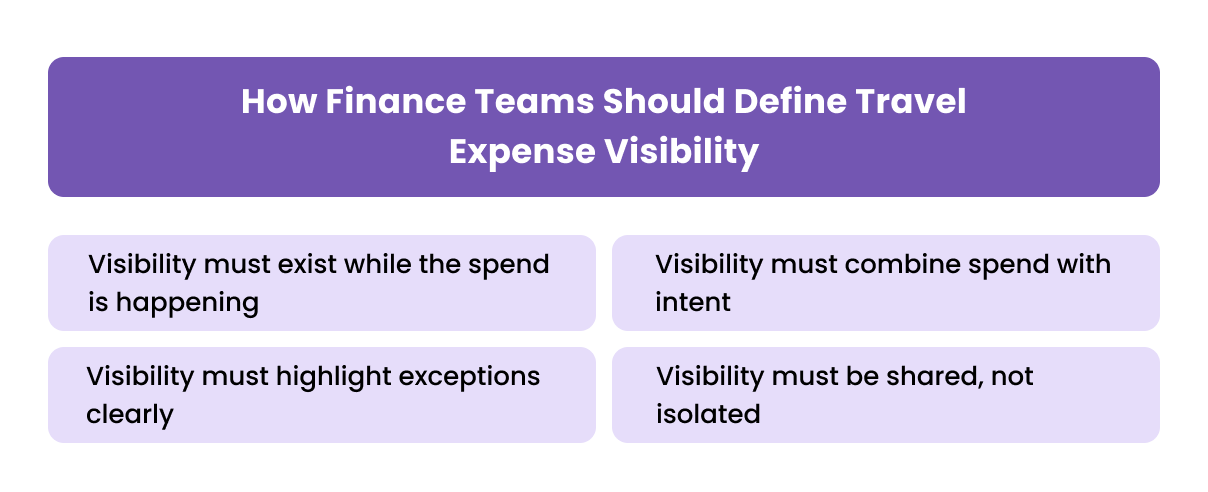
For finance teams, travel expense visibility should be treated as a control capability rather than a reporting outcome. It determines whether travel spend is actively managed or simply reviewed after the fact.
1. Visibility must exist while the spend is happening
Seeing travel costs only at the reimbursement stage is too late. Finance teams need visibility at booking, during travel, and immediately after transactions occur to intervene early.
2. Visibility must combine spend with intent
Amounts alone do not explain travel costs. Finance teams need to know who travelled, why the trip occurred, and which department, project, or client the expense relates to.
3. Visibility must highlight exceptions clearly
Out-of-policy spend, missing receipts, and incomplete VAT documentation should be immediately visible so attention is focused where it matters.
4. Visibility must be shared, not isolated
When managers and finance teams see the same data, approvals move faster, and policy discussions become objective rather than opinion-driven.
Also Read: Understanding Spend Visibility And Business Benefits
Where Travel Expense Visibility Typically Fails
Travel expense visibility usually breaks down not because of weak intent, but because systems are not aligned with how travel spend actually occurs. The gaps are structural and repeat across organisations.
1. Travel spend is fragmented across systems
Flights and hotels are booked in travel tools, while meals, taxis, and incidentals are paid through cards or cash. Reimbursements then arrive separately. Finance teams are left reconciling fragments instead of managing a complete view.

2. Expense capture happens too late
Receipts are uploaded days or weeks after travel. By the time expenses are visible, opportunities to intervene, question, or redirect behaviour have already passed.
3. Policy checks happen after the spend
Many organisations enforce travel policy at the reimbursement or review stage. This may correct accounting, but it does not prevent overspending or repeated policy breaches.
4. Out-of-pocket claims delay cost recognition
When employees pay first and claim later, travel costs are hidden from finance during the period they matter most. This distorts short-term visibility and weakens cash planning.
Also Read: Expense Reimbursement Management Definitions
The Financial Impact Of Limited Travel Expense Visibility
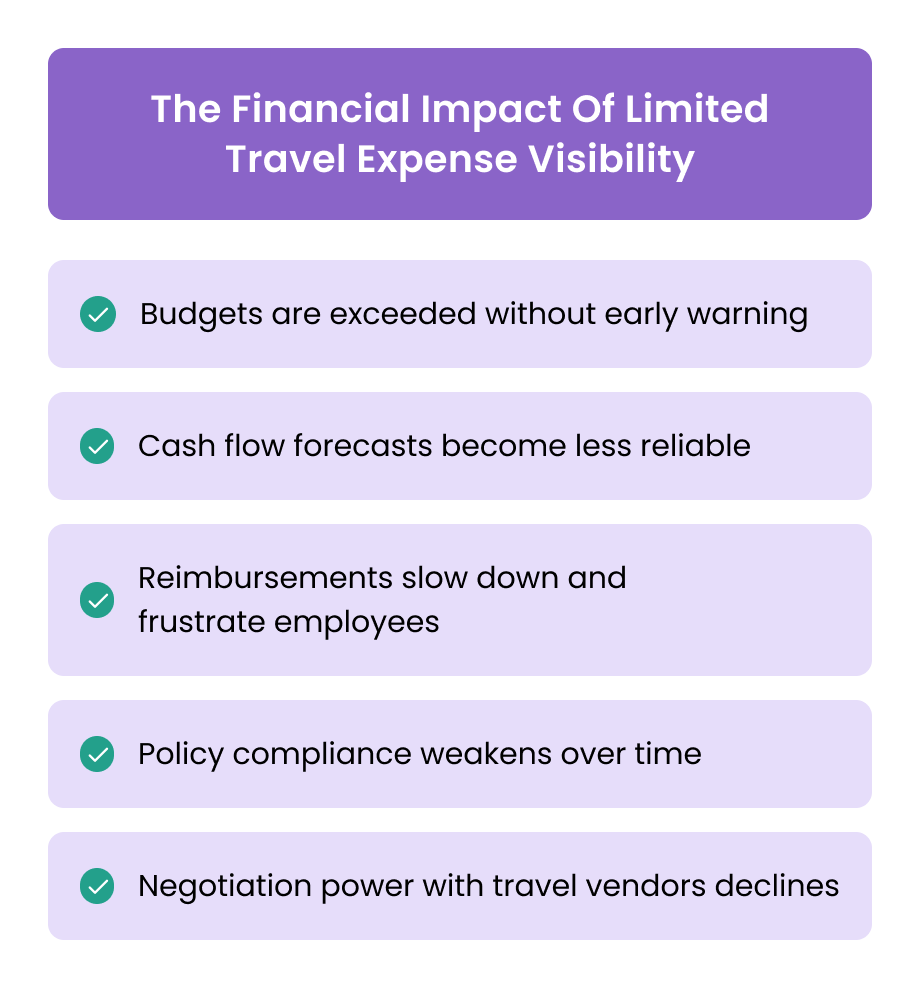
When travel expenses are not visible early, the consequences compound quietly. Finance teams spend more time correcting outcomes instead of guiding decisions. Over time, this weakens both cost control and trust in the process.
1. Budgets are exceeded without early warning
Finance teams often only discover travel overruns after trips are complete. At that stage, there is no opportunity to course-correct. Overspend turns into explanation, not prevention.
2. Cash flow forecasts become less reliable
When reimbursements and card expenses surface weeks later, short-term cash planning becomes inaccurate. This is particularly disruptive during peak travel periods or quarter-end activity.
3. Reimbursements slow down and frustrate employees
Missing receipts, unclear policy interpretation, and manual reviews extend reimbursement cycles. Employees experience delays, while finance teams face repeated follow-ups.
4. Policy compliance weakens over time
When exceptions are addressed only after the fact, policy gradually loses authority. Employees learn that non-compliance is corrected later rather than prevented upfront.
5. Negotiation power with travel vendors declines
Without consolidated, timely travel spend data, finance teams lack the insight needed to negotiate rates with airlines, hotels, and corporate travel partners.
Also Read: Cash Flow Optimisation Strategies And Techniques
What Good Travel Expense Visibility Looks Like In Practice
Strong travel expense visibility changes how finance teams operate day to day. It reduces reactive work, shortens approval cycles, and brings predictability to a spend category that is otherwise difficult to manage.
1. Travel spend is visible while trips are still in progress
Finance teams can see bookings, card transactions, and submitted receipts during travel, not weeks later. This allows early clarification and intervention when needed.
2. All trip-related costs are consolidated into one view
Flights, accommodation, meals, ground transport, and incidentals are visible together. Finance teams do not need to reconcile multiple tools to understand total trip cost.
3. Policy exceptions are flagged immediately
Out-of-policy categories, overspend against limits, and missing receipts are surfaced as they occur, not during reimbursement review.
4. Managers and finance teams work from the same information
Approvals are faster because approvers see the full context, including trip purpose, receipts, and policy status.
5. Month-end close becomes lighter and more predictable
With fewer unresolved travel expenses, finance teams spend less time reconciling and more time reviewing insights.
Also Read: Enterprise Spend Management Software Solutions
Practical Ways To Improve Travel Expense Visibility
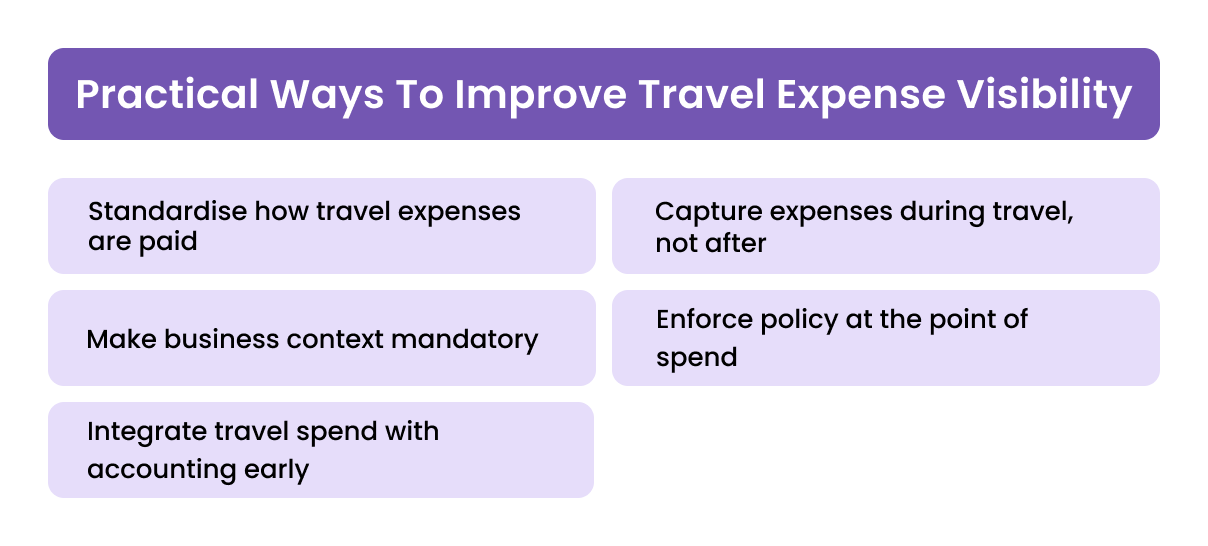
Improving visibility does not require redesigning the entire travel programme. It requires aligning payment methods, capture timing, and approvals with how travel spend actually occurs.
1. Standardise how travel expenses are paid
Reducing reliance on reimbursements and increasing the use of corporate cards improves immediate visibility and reduces delayed cost recognition.
2. Capture expenses during travel, not after
Mobile receipt uploads and real-time transaction capture close the gap between spend and visibility.
3. Make business context mandatory
Trip purpose, department, and project information should be required at the point of spend, not requested later.
4. Enforce policy at the point of spend
Category restrictions, spend limits, and approval thresholds prevent non-compliant expenses before they occur.
5. Integrate travel spend with accounting early
Early posting into accounting systems improves cash flow forecasting and avoids month-end visibility gaps.
Also Read: Corporate Card Reconciliation Guide
How Alaan Enables Real Travel Expense Visibility
Alaan is built to close the visibility gaps that typically appear in business travel spend. The focus is not on adding more steps, but on giving finance teams timely, reliable insight without increasing friction for employees.
- Travel spend and receipts live in one place
Card transactions, uploaded receipts, and approvals are captured within a single platform. Finance teams no longer need to reconcile data from multiple tools to understand the total trip cost. - Spend is visible as it happens
Transactions appear in real time, allowing finance teams to see travel costs during the trip rather than weeks later. This supports earlier intervention and better cost control. - Context travels with the expense
Trip purpose, department, and project information can be captured alongside each expense. This makes reviews faster and analysis more meaningful. - Approvals are faster and more consistent
Managers review expenses with full visibility into policy alignment, receipts, and supporting details. This reduces delays and back-and-forth during approval. - Reduced dependency on reimbursements
Corporate cards shift travel spend away from out-of-pocket payments, improving visibility while also creating a smoother experience for employees. - Cleaner accounting and VAT readiness
Travel expenses sync into accounting systems with complete documentation, reducing corrections and improving accuracy during VAT filing periods.

Conclusion
Controlling travel spend starts with visibility. Without it, finance teams operate reactively, correcting costs after they have already been incurred. With it, they gain the ability to guide behaviour, enforce policy fairly, and plan cash flow with confidence.
For organisations with frequent business travel, improving expense visibility is often the most effective way to reduce leakage, speed up reimbursements, and bring discipline to discretionary spend. The shift does not require tighter policies. It requires earlier insight and better alignment between how travel happens and how finance tracks it.
At Alaan, we help finance teams gain real-time visibility into business travel spend by consolidating payments, receipts, approvals, and accounting in one place. This allows teams to move from reviewing travel costs after the trip to managing them while decisions can still be influenced. When visibility improves, control follows naturally.
Book a demo to see how Alaan brings travel spend, approvals, and accounting together.
Frequently Asked Questions (FAQs)
1. What Is Travel Expense Visibility In Corporate Finance?
Travel expense visibility refers to the ability of finance and travel teams to see all costs incurred during business travel in real time — including bookings, transactions, reimbursements, policy exceptions, and audit data. It means finance leaders aren’t waiting for end-of-month reports but can make decisions throughout the travel lifecycle.
2. Why Is Travel Expense Visibility Important For Growing Organisations?
Travel expenses are often one of the largest controllable cost categories after payroll. Without visibility, companies risk overspending, inconsistent policy enforcement, and late reimbursements. High visibility helps with budgeting, compliance, fraud detection, and supplier negotiations.
3. How Can Finance Teams Achieve Better Travel Expense Visibility?
Implementing tools that offer real-time tracking, automated capture of receipts and transactions, and integration with travel booking systems ensures that travel spend is visible to both travellers and finance leaders. Dashboards and reports further enable policy enforcement and strategic insights.
4. What Role Does Policy Play In Travel Expense Visibility?
A clear travel expense policy improves visibility by standardising what can be claimed, the documentation required, and how transactions are categorised. Policies supported by integrated systems increase compliance and reduce ambiguity in expenses.
5. How Does Visibility Affect Employee Reimbursement Speed?
When travel costs are captured accurately at the point of spend and tied directly to the employee’s expense report system, reimbursement cycles shrink significantly. Managers can review and approve claims quickly without chasing paper receipts or emails.
Gain control over business expenses with Alaan corporate cards
Invygo earned AED 100,000 in cashback using Alaan cards
Personalise approval workflows to align with your business needs with Alaan's Spend Management platform
Discover the power of automated expense tracking and smarter spend control with Alaan
Turn data into actionable insights with Alaan's spend management tools
Stay Tax Compliant with UAE's #1 Corporate Card and Spend Management Platform
Customisable corporate card policy template
Know how much Corporate Tax you have to pay this fiscal year
Easily integrate Alaan with your ERP for accurate, real-time expense tracking
Close books faster with Alaan's AI-powered accounting automation
Reconcile your books in minutes instead of hours, every single month.
Keep petty cash organized with Alaan corporate cards and automated expense management