.avif)


Delayed supplier payments rarely fix themselves. In fact, studies show that invoices not settled within the first 30 days of becoming overdue are far more likely to remain outstanding for 90 days or longer.
Once delays extend beyond that initial window, recovery becomes harder, reconciliation gets messier, and supplier relationships come under strain.
This is why finance teams place so much emphasis on invoice-level discipline. Knowing exactly which bill is paid, which remains open and what balance is outstanding is critical to maintaining control over payables.
Bill-to-bill payment is one such approach. It links every payment directly to a specific invoice, bringing clarity, accuracy and accountability to the supplier payment process.
In this article, we explain bill-to-bill payment in business, how the process works, why it matters for financial control, and how automation is transforming bill management.
Key Takeaways:
- Bill-to-bill payment brings invoice-level clarity to accounts payable. By linking every payment to a specific invoice, businesses gain accurate visibility into what’s paid, partially paid, or still outstanding.
- It offers stronger control than on-account payments. Bill-to-bill tracking reduces reconciliation effort, lowers error risk, and creates cleaner audit trails compared to supplier-level settlements.
- Invoice-linked payments improve cash-flow planning and vendor trust. Real-time visibility into open bills and due dates supports better liquidity management and reduces supplier disputes.
- Manual bill-to-bill processes don’t scale well. As invoice volumes grow, manual tagging, reconciliation, and tracking introduce errors, delays, and operational overhead.
- Automation is key to making bill-to-bill payments scalable. Platforms like Alaan connect invoices, approvals, payments, and reconciliation in one system, turning bill-to-bill payments into a consistent, low-risk workflow at scale.
What Is Bill-to-Bill Payment in Business?
Bill-to-bill payment refers to the accounting practice of matching a payment directly to a specific supplier invoice or bill. Instead of recording payments as general vendor settlements, bill-to-bill tracking ensures each payment clears a particular outstanding bill.
In accounts payable, vendors often issue multiple invoices over time. Without bill-to-bill matching, finance teams may record lump-sum payments without identifying which invoices were settled.
This can create confusion, inaccurate reporting, and reconciliation challenges.
Bill-to-bill payment improves clarity by:
- Linking payments to individual invoices
- Tracking partial or full bill settlements
- Maintaining accurate vendor balances
- Supporting transparent audit trails
- Strengthening financial reporting accuracy
By maintaining clear invoice-to-payment mapping, businesses gain better control over outstanding liabilities and vendor payment history.
How is Bill-to-Bill Payment Different From On-Account Payment?
Both methods are used to settle supplier dues, but they differ in how payments are tracked and reconciled. The table below highlights the practical differences.
| Aspect | Bill to Bill Payment | On-Account Payment |
|---|---|---|
| Payment Allocation | Linked to a specific invoice | Paid without linking to a specific invoice |
| Tracking Level | Invoice-level tracking | Supplier-level tracking |
| Outstanding Visibility | Clear view of open and partially paid bills | Outstanding bills may not be visible immediately |
| Reconciliation Effort | Minimal and straightforward | Requires manual adjustment later |
| Audit Readiness | Strong, with clear trails | Weaker until invoices are adjusted |
| Use Cases | Regular supplier invoices, partial payments | Advance payments, urgent settlements |
| Risk of Errors | Low | Higher due to manual allocation |
| Finance Control | High | Moderate to low |
For businesses managing multiple supplier invoices, bill-to-bill payments offer better accuracy, control and reconciliation.
How Bill-to-Bill Payment Works
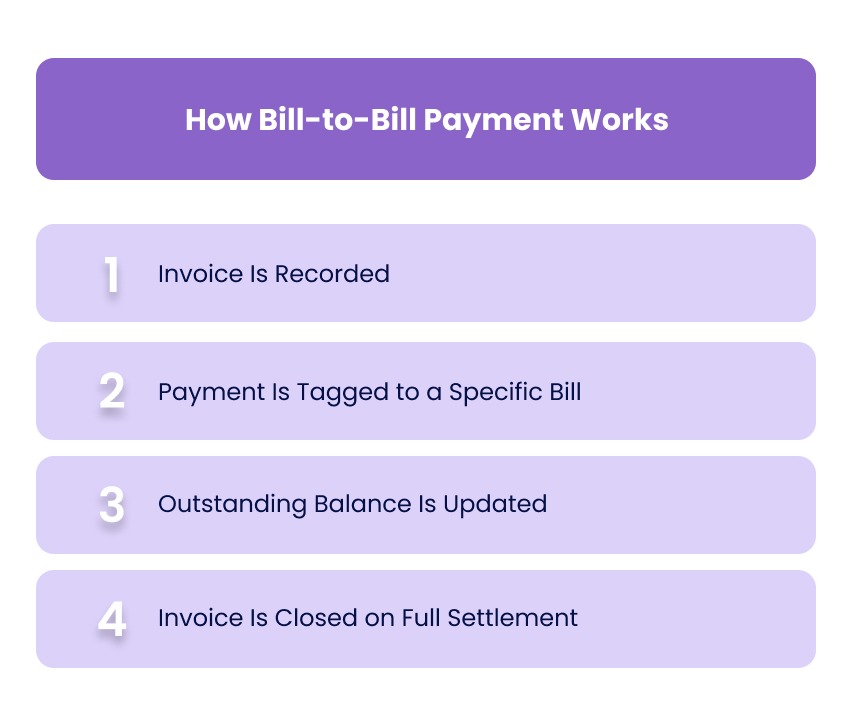
Bill-to-bill payment is designed to give finance teams precise control over supplier dues by tracking payments at the invoice level. Instead of treating payments as general credits, each transaction is tied to a specific bill, ensuring clarity from recording to settlement.
Step 1: Invoice Is Recorded
The process starts when a supplier invoice is received and entered into the accounts payable system. Each invoice is logged with key details such as invoice number, supplier name, amount, due date and tax information.
At this point, the invoice is recognised as an outstanding liability and becomes part of payable tracking and ageing reports.
Step 2: Payment Is Tagged to a Specific Bill
When a payment is made, it is explicitly linked to the relevant invoice. This is the defining step of bill-to-bill payment.
Tagging ensures the payment clears the correct invoice, even when a supplier has multiple open bills, preventing ambiguity in payables.
Step 3: Outstanding Balance Is Updated
If the invoice is paid partially, the system updates the remaining balance against that specific bill. Finance teams can clearly see what has been paid, what is still due and when the balance is expected to be settled.
This visibility improves cash flow planning and reduces confusion during follow-ups with suppliers.
Step 4: Invoice Is Closed on Full Settlement
Once the total invoice amount is paid, the bill is marked as fully settled and closed. The system retains a complete record of the invoice and all related payments.
This creates clean reconciliation, accurate reporting and a strong audit trail.
Also read: Accounts Payable Automation and Invoice Management Software
Why Businesses Use Bill-to-Bill Payments
Businesses use bill-to-bill payments to maintain clarity and control over their payables, especially when managing multiple suppliers and invoices. This approach reduces ambiguity and strengthens financial discipline across accounts payable.
- Accurate reconciliation: By linking each payment to a specific invoice, bill-to-bill payments eliminate guesswork during reconciliation. Finance teams can easily match payments to bills, reducing manual adjustments and closing books faster.
- Clear visibility for vendors: Suppliers can see exactly which invoices have been paid, partially paid or remain outstanding. This reduces payment disputes, follow-ups and confusion around settlement status.
- Better cash-flow tracking: Tracking payments at the invoice level gives finance teams a clearer picture of upcoming obligations. Outstanding balances, ageing and due dates are visible in real time, supporting more accurate cash-flow planning.
- Stronger audit readiness: Each invoice carries a complete payment trail, making audits easier and more transparent. Bill-to-bill payments provide clear documentation for reviewers, reducing compliance risk and audit queries.
- Improved internal accountability: Bill-to-bill payments make it clear which team or cost centre authorised and settled each invoice. This reduces finger-pointing and strengthens ownership across departments.
- Fewer duplicate or overpayments: Since each invoice must be cleared explicitly, the risk of paying the same bill twice or overpaying a supplier is significantly reduced.
- Cleaner reporting and ageing analysis: Invoice-level tracking improves ageing reports and payable summaries, helping finance teams prioritise payments and manage working capital more effectively.
The advantages of bill-to-bill payments are clear, but real value comes from disciplined execution. To achieve this consistently, businesses need structured processes and clear controls.
How to Manage Bill-to-Bill Payments Effectively
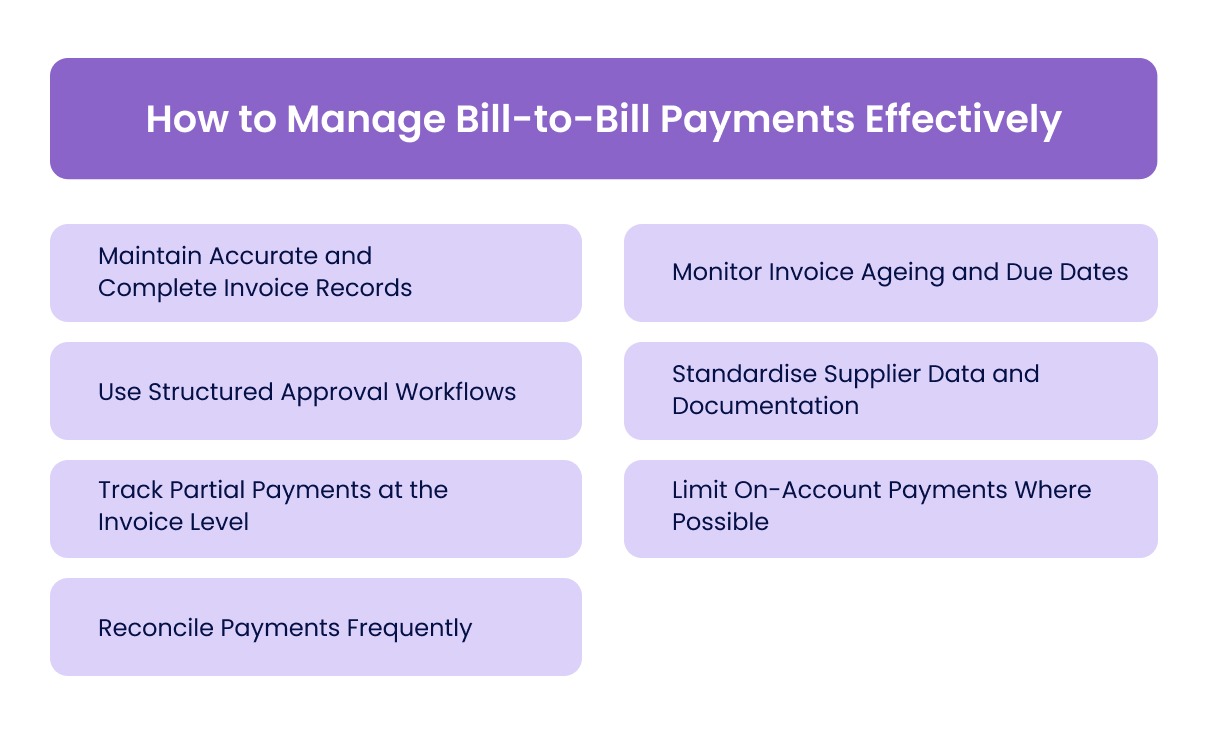
Managing bill-to-bill payments works best when supported by disciplined processes and consistent controls. These practices help finance teams reduce errors, improve visibility and maintain clean accounts payable records.
1. Maintain Accurate and Complete Invoice Records
Bill-to-bill payments depend on clean, reliable invoice data. Incomplete or inconsistent invoices make it difficult to match payments accurately and often create reconciliation issues later.
What matters most at this stage:
- Invoice identifiers: Ensure invoice numbers, amounts and due dates are recorded correctly to avoid mismatches.
- Tax and VAT details: Capture clear tax breakdowns to support compliance and accurate reporting.
- Invoice consistency: Standardised invoice formats across suppliers make matching and verification easier.
2. Use Structured Approval Workflows
Approval workflows ensure invoices are reviewed and authorised before payments are released. Clear approval rules reduce delays, prevent unauthorised payments and strengthen accountability.
To keep approvals effective:
- Defined approval rules: Set thresholds based on invoice value, department or entity.
- Clear ownership: Assign responsibility for approving each invoice to avoid bottlenecks.
- Approval trails: Maintain documented approvals to support audits and internal reviews.
3. Track Partial Payments at the Invoice Level
When invoices are paid in instalments, each payment must be applied to the same bill and the remaining balance updated accurately.
To avoid confusion:
- Outstanding balance updates: Adjust the remaining amount after every partial payment.
- Partial settlement visibility: Clearly identify invoices that are not fully paid.
- Payment linkage: Ensure every payment is tied to the correct invoice.
4. Reconcile Payments Frequently
Reconciliation should happen regularly rather than only at month-end. Ongoing checks make mismatches easier to identify and correct.
To keep records clean:
- Continuous matching: Match payments to invoices as they occur, not in bulk later.
- Early discrepancy checks: Investigate mismatches before they compound.
- Current balances: Keep payable balances accurate throughout the period.
5. Monitor Invoice Ageing and Due Dates
Invoice ageing helps finance teams prioritise payments and manage cash flow proactively.
To stay ahead:
- Overdue invoices: Identify and follow up on past-due bills promptly.
- Upcoming obligations: Track near-term payments that impact liquidity.
- Recurring delays: Spot suppliers that frequently appear in ageing reports.
6. Standardise Supplier Data and Documentation
Consistent supplier records reduce errors and simplify invoice matching over time.
To improve consistency:
- Bank and tax accuracy: Maintain up-to-date payment and tax details.
- Standard payment terms: Apply consistent terms to avoid confusion.
- Supplier naming conventions: Use uniform naming to prevent duplicate records.
7. Limit On-Account Payments Where Possible
Using bill-to-bill payments as the default approach reduces manual allocation and reconciliation effort later.
To maintain discipline:
- Clear exceptions: Define when on-account payments are allowed.
- Timely allocation: Assign advance payments to invoices as soon as possible.
- Invoice-first mindset: Prioritise invoice-linked settlements wherever feasible.
When applied consistently, these practices keep bill-to-bill payments accurate and controlled. However, as invoice volumes and suppliers increase, maintaining this discipline manually becomes increasingly difficult.
Common Challenges in Bill-to-Bill Payment Management
While bill-to-bill payments improve accuracy and control, managing them manually can introduce new challenges, especially as transaction volumes grow. Without the right systems in place, finance teams often face operational friction that undermines the benefits.
1. Manual Tagging Errors
When payments are linked to invoices manually, mistakes are easy to make. Payments may be tagged to the wrong bill, partially applied incorrectly or left unallocated, leading to confusion and rework during reconciliation.
2. Missing or Incomplete Invoices
Bill-to-bill payments rely on complete invoice documentation. Missing invoices or incomplete tax details break the payment chain, delay settlement and create compliance risks, particularly in VAT-regulated environments.
3. Payment Mismatches
Differences between invoice amounts and payment values can occur due to partial payments, currency differences or manual entry errors. Without clear tracking, these mismatches are difficult to identify and resolve quickly.
4. Time-Consuming Reconciliation
Reconciling invoice-level payments across multiple suppliers and bank accounts can become a heavy manual task. As volumes increase, finance teams spend more time matching transactions than analysing payables or managing cash flow.
5. Poor Visibility Across Payables
When invoice data, approvals and payments sit in separate systems, finance leaders lack a real-time view of outstanding liabilities. This limits cash-flow planning and increases the risk of missed or delayed payments.
Also read: How Corporate Expense Cards Works for UAE Businesses?
How Automation Simplifies Bill-to-Bill Payments
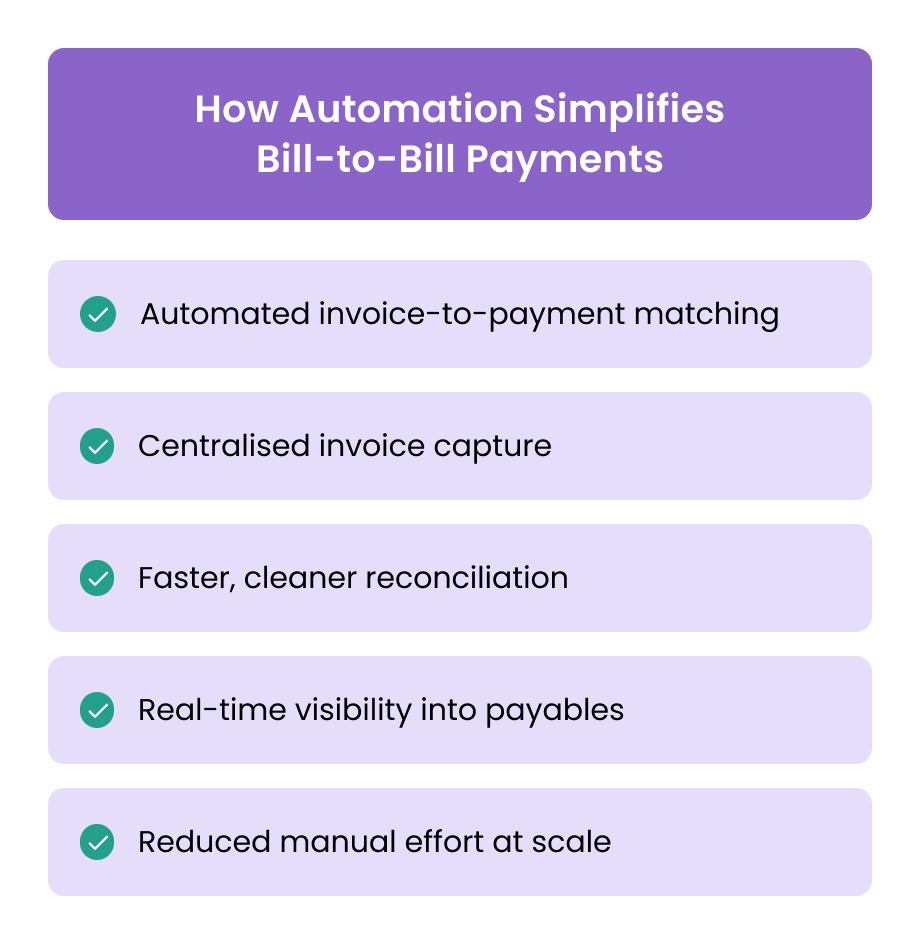
Automation removes the operational friction that often comes with managing invoice-level payments manually. It brings structure, accuracy and visibility to the entire bill-to-bill payment process.
- Automated invoice-to-payment matching: Payments are linked directly to the correct invoice, reducing manual tagging errors and misallocations.
- Centralised invoice capture: Invoices are stored digitally with complete tax and approval details, eliminating missing documents and follow-ups.
- Faster, cleaner reconciliation: Automated matching between invoices, payments and approvals reduces reconciliation effort and highlights only true exceptions.
- Real-time visibility into payables: Live ageing, outstanding balances and due dates give finance teams a clear view of liabilities at any moment.
- Reduced manual effort at scale: As invoice volumes grow, automation ensures consistency without increasing workload or risk.
Automation solves individual pain points, but managing bill-to-bill payments at scale requires an integrated approach that connects every step of the process.
Use Alaan To Make Bill to Bill Payments Scalable
Bill-to-bill payments work well in principle, but they often break down as invoice volume, suppliers and payment types increase. At Alaan, we make bill-to-bill payments scalable by connecting invoices, approvals, payments and reconciliation in one unified system.
- Smart corporate cards with spend controls: Alaan issues unlimited corporate cards with configurable limits and vendor restrictions that align spend with company policies, reducing unauthorised or misallocated payments.
- Works beyond cards with Super Pay: For suppliers where cards do not apply, such as international vendors, imports or large procurement payments, Super Pay enables invoice-linked transfers while maintaining bill-to-bill discipline.
- Digitised expense capture and receipt matching: Transactions and receipts are automatically recorded and categorised, eliminating manual tagging errors and giving finance teams real-time insight into spend as it occurs.
- Real-time visibility and control: Dynamic dashboards provide live visibility into all spending, helping leaders manage outstanding payables, ageing and cash flow without waiting for period-end reports.
- Accounting automation and sync: Alaan integrates with leading accounting and ERP systems, enabling one-click accounting updates and reducing reconciliation workload. Expenses flow into books with accurate coding and tax treatment, helping keep payable records clean.
Alaan turns bill-to-bill payments from a manual control exercise into a scalable, system-driven process that grows with the business.

Wrapping Up
Bill-to-bill payment is a disciplined approach to managing supplier payments, helping businesses maintain clarity, accuracy and control across accounts payable. By linking each payment directly to a specific invoice, finance teams improve reconciliation, strengthen cash-flow tracking and stay audit-ready, even as payment volumes grow.
As businesses scale, manual processes make bill-to-bill payments harder to manage across suppliers, currencies and payment methods.
At Alaan, we simplify this by bringing invoices, approvals, payments and reconciliation into one system, across both cards and transfers.
Schedule a demo to see how Alaan can help your finance team manage payments with greater visibility, control and confidence.
FAQs
1. Who is “bill to” on an invoice?
“Bill to” refers to the individual or organisation responsible for paying the invoice. It includes the legal entity name, address and tax details of the payer, which may differ from the “ship to” party receiving the goods or services. Accurate “bill to” details are essential for proper accounting and compliance.
2. What is the meaning of bills to pay?
Bills to pay represent outstanding invoices or obligations that a business needs to settle with its suppliers. In accounting terms, these are recorded under accounts payable and reflect future cash outflows that must be managed to maintain healthy cash flow and supplier relationships.
3. How is bill-to-bill payment different from vendor settlement?
Vendor settlement records payments against suppliers generally, while bill-to-bill payment matches payments to individual invoices.
4. How does automation help bill-to-bill payment tracking?
Automation extracts invoice data, matches payments automatically, and syncs records with accounting systems to improve accuracy and efficiency.
Gain control over business expenses with Alaan corporate cards
Invygo earned AED 100,000 in cashback using Alaan cards
Personalise approval workflows to align with your business needs with Alaan's Spend Management platform
Discover the power of automated expense tracking and smarter spend control with Alaan
Turn data into actionable insights with Alaan's spend management tools
Stay Tax Compliant with UAE's #1 Corporate Card and Spend Management Platform
Customisable corporate card policy template
Know how much Corporate Tax you have to pay this fiscal year
Easily integrate Alaan with your ERP for accurate, real-time expense tracking
Close books faster with Alaan's AI-powered accounting automation
Reconcile your books in minutes instead of hours, every single month.
Keep petty cash organized with Alaan corporate cards and automated expense management