.avif)

Cross-border trade remains central to the UAE economy. The UAE Ministry of Economy reports that non-oil foreign trade exceeded AED 2.2 trillion, reinforcing how deeply embedded international supplier payments are in daily operations.
At the same time, global cross-border eCommerce transactions are projected to exceed USD 3.3 trillion (approximately AED 12.12 trillion) by 2028, reflecting sustained growth in international payment flows.
For UAE finance teams, this growth does not just mean more payments. It means more FX exposure, more corridor-specific settlement rules, and more reconciliation pressure. Yet many businesses still manage invoices, approvals, FX pricing, and execution across separate systems, often discovering the true cost only after funds are delivered.
A well-structured global payment system changes the sequence of control. It makes cost visibility, approval discipline, and tracking part of the workflow before money moves, which is where financial predictability actually begins.
In this blog, we examine how global payment systems should operate for UAE finance teams and what to evaluate before selecting one.
TL;DR
- Global payments systems work best when customer collections and supplier payouts are treated as separate workflows.
- The biggest operational failures come from hidden cost drivers, cut-off driven delays, compliance holds, tracking ambiguity, and reconciliation gaps.
- The right global payment services provide upfront cost clarity, enforce approvals, and keep evidence connected to the transaction.
- At Alaan, SuperPay brings invoices, approvals, transparent FX, and cross-border transfers into one workflow, improving predictability and month-end outcomes.
Why Global Payment Systems Matter For UAE Businesses
Cross-border payment volume is rising, and UAE businesses are increasingly operating in multi-currency environments. Broader market data also points to rising international payment flows and growing expectations around speed and transparency. The UAE payments market is also forecast to grow to roughly USD 274.79 billion by 2031, reflecting sustained momentum in digital payment adoption and infrastructure.
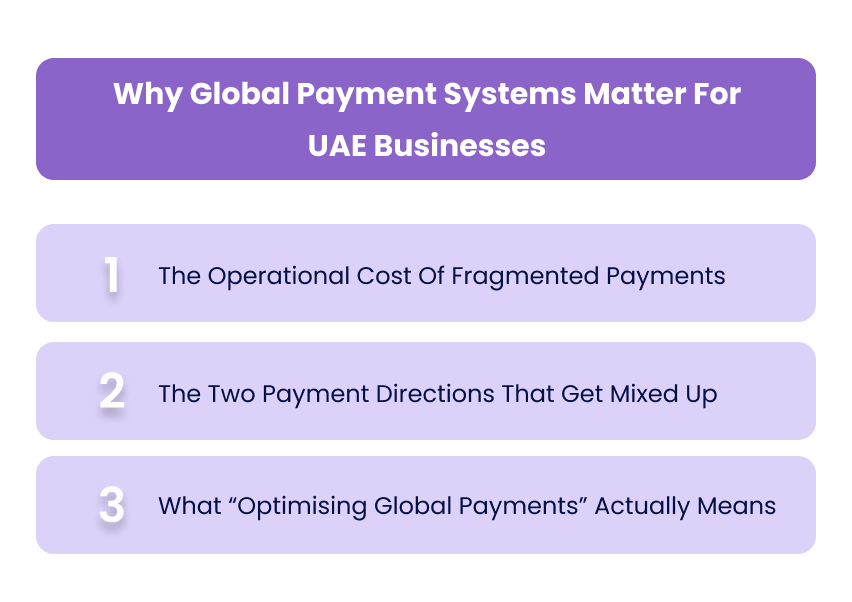
1. The Operational Cost Of Fragmented Payments
When collections, supplier payments, FX conversion, and reconciliation sit in different tools, finance teams pay the “fragmentation tax” in the form of exceptions and manual work. Common symptoms include:
- Unclear total cost after fees and FX spread.
- Delayed settlement due to cut-offs, weekends, and intermediary steps.
- Missing context when payments need compliance checks or supporting documents.
- Slow month-end close because references and confirmations are scattered.
2. The Two Payment Directions That Get Mixed Up
Most businesses need two different workflows, and they break for different reasons:
- Collecting from international customers: Emphasis is on acceptance methods, conversion rates, chargebacks, and settlement schedules.
- Paying overseas suppliers: Emphasis is on delivered amount, fees, documentation, tracking, and reconciliation to invoices.
Treating these as one problem leads to wrong tool choices and mismatched expectations.
3. What “Optimising Global Payments” Actually Means
For finance leaders, optimisation is not “lowest headline fee.” It is:
- Predictability: Knowing what it will cost and when it will land.
- Control: Approvals, limits, and policy enforcement before money moves.
- Visibility: Being able to answer where a payment is and why.
- Accounting readiness: Clean references and records that reduce reconciliation effort.
Also Read: The Essential Guide to Cross-Border Payments in UAE
What A Global Payment System Includes
A global payment system is not one product. It is a stack of capabilities that handle acceptance, payouts, currency management, risk controls, and reporting. The right setup depends on whether you primarily collect internationally, pay internationally, or do both.
1. Payment Acceptance Layer
This is the infrastructure used to take money from customers across borders. It typically includes payment gateways and processors that support cards and region-preferred methods, then settle funds to your business account based on a defined schedule.
The finance questions to solve here are settlement timing, chargebacks, and the difference between headline FX rates and the effective delivered amount.
2. Business Payout Layer
This is the layer for sending money out of the business: supplier payments, contractor payouts, and partner transfers. The priorities are different from customer acceptance because the pain points usually come from:
- Fee handling and intermediary deductions.
- Corridor-specific timelines and cut-off windows.
- Documentation and compliance holds.
- Traceability back to invoices and approvals.
3. Multi-Currency And FX Layer
This layer governs how you handle currency exposure and conversion timing. The practical job is to reduce avoidable conversions, make FX pricing visible, and align conversion decisions with budgeting assumptions.
4. Risk, Security, And Compliance Layer
For global payment services, risk controls are not optional. A credible system supports:
- Fraud controls appropriate to the payment type (collections vs payouts).
- KYC and AML controls for cross-border transfers.
- Data protection and security standards aligned with how payment data is stored and processed.
5. Reporting And Reconciliation Layer
This is the part many teams underestimate until the month-end. A system is only “global-ready” if it can produce consistent references, audit trails, and exports that make reconciliation fast and defensible.
Also Read: How International Payment Processing Works in the UAE?
How Global Payment Systems Work
Global payments systems typically support two distinct flows. One is money coming in from customers across borders. The other is money going out to overseas suppliers and partners. The mechanics overlap, but the failure modes are different, which is why finance teams should treat them as separate workflows.
1. Collecting From International Customers
In a customer-collection flow, the “payment” is not complete when the customer clicks pay. It moves through authorisation, risk checks, and settlement timing.
A typical flow looks like this:
- Customer payment initiation through a supported method (cards, wallets, local methods).
- Authorisation and risk checks to confirm the payment is valid and reduce fraud.
- Capture and processing by the gateway/processor.
- Settlement to your account based on the acquirer’s settlement schedule and your settlement currency settings.
- Post-payment events such as chargebacks, refunds, and disputes that affect net revenue.
The finance outcome to optimise is the net delivered amount and how predictably funds land, not just acceptance rates.
2. Paying Overseas Suppliers
A supplier-payment flow is closer to an operational workflow than a consumer payment. The biggest pain points show up around documentation, visibility, and reconciliation, not at initiation.
A typical flow looks like this:
- Invoice and approval with payment purpose and reference captured upfront.
- Payment instruction creation through a transfer rail or payment platform.
- FX conversion if the payment currency differs from your funding currency.
- Processing and routing which may include intermediary steps depending on the corridor.
- Settlement and crediting to the beneficiary account.
- Confirmation and reconciliation back to the invoice, approval record, and accounting entries.
For finance teams, the goal is a payment lifecycle where cost, timing, and evidence are predictable enough to manage without constant follow-up.
Common Breakdowns In Global Payment Systems
Most cross-border payment issues are not caused by one dramatic failure. They are caused by repeatable weak points that create cost surprises, delays, and manual work. Understanding these breakdowns helps you evaluate global payment services with the right questions and avoid “feature-led” selection.
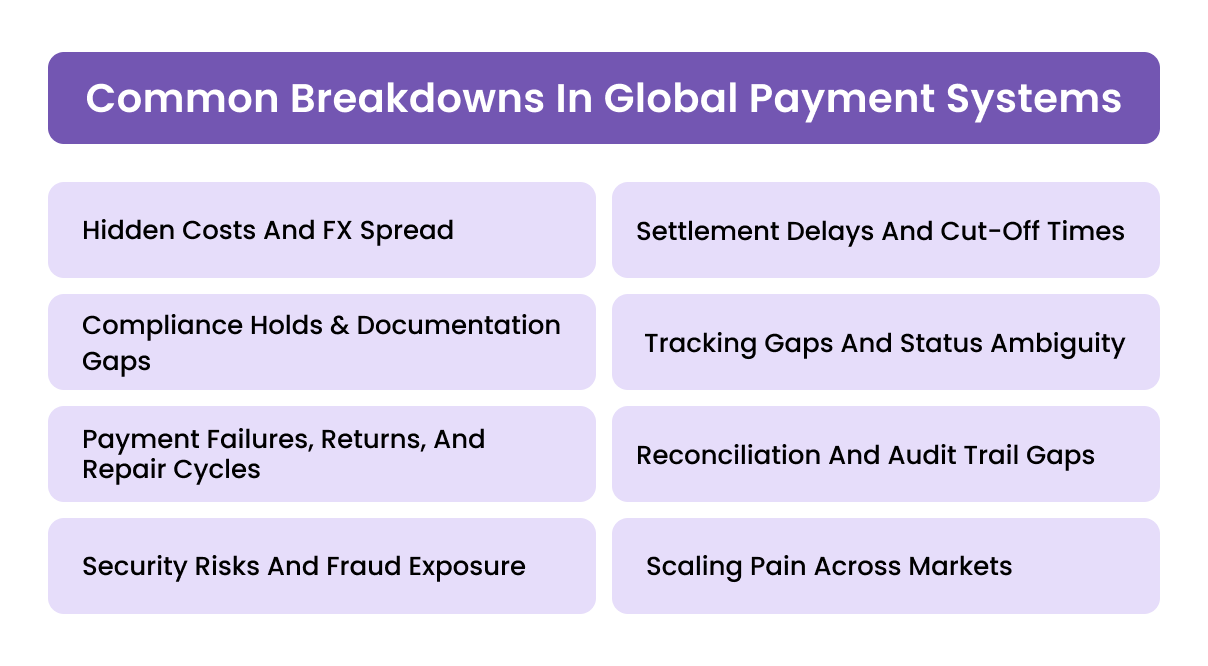
1. Hidden Costs And FX Spread
The headline fee is rarely the full cost. Total cost often includes transfer fees, FX pricing, and deductions that only become visible after execution. This is one of the main reasons teams struggle to budget accurately for international activity.
2. Settlement Delays And Cut-Off Times
Cross-border payments run on processing windows, not intent. Cut-off times, time zones, weekends, and corridor calendars can push a transfer into the next processing window even when it is initiated “on time.”
3. Compliance Holds And Documentation Gaps
Payments can be held when beneficiary details, payment purpose, or supporting documents are incomplete or inconsistent. Holds are operationally expensive because they usually appear mid-process and require manual responses.
4. Tracking Gaps And Status Ambiguity
Many systems provide a status that is too broad to be actionable. Finance teams end up fielding the same questions repeatedly because “processing” does not confirm where funds are or when the recipient will be credited.
5. Payment Failures, Returns, And Repair Cycles
Returns and repair cycles are typically data-quality problems. Name mismatches, missing mandatory fields, or corridor-specific formatting requirements can force rework and re-initiation, which adds both time and administrative cost.
6. Reconciliation And Audit Trail Gaps
When invoice references, approvals, confirmations, and FX outcomes live across different tools, reconciliation becomes manual. This slows close and increases the risk of misclassification or missing evidence during audit queries.
7. Security Risks And Fraud Exposure
Cross-border flows increase attack surface because more parties and systems touch the transaction. A global business payment system needs strong controls, but they must be applied in a way that does not push teams into bypass behaviour.
8. Scaling Pain Across Markets
As you expand, payment preferences and rails change by region. Systems that work in one market may require new integrations or new compliance approaches in another. The scaling risk is operational inconsistency, where each market becomes its own payment process.

How To Choose Global Payment Services
Choosing global payment services is less about picking the most popular brand and more about matching the system to your two real workflows: collecting from customers and paying suppliers. A good choice reduces exceptions, improves cost predictability, and keeps your accounting trail clean as volume grows.
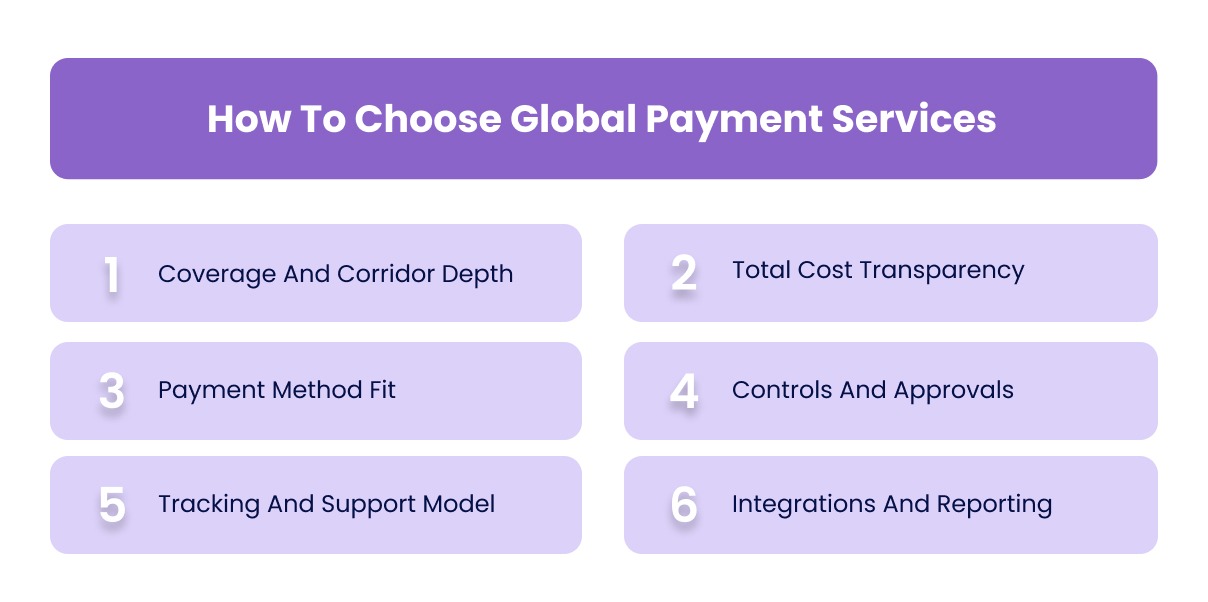
1. Coverage And Corridor Depth
“Global” can mean very different things. Some systems are strong for customer collections but weak for supplier payouts, and vice versa. Evaluate coverage based on where you actually operate and what payment direction matters most.
Key checks that usually matter in practice:
- Supported send and receive corridors for your top markets.
- Settlement behaviour by corridor, not just generic “fast payments” claims.
- Fallback options when a corridor has stricter requirements.
2. Total Cost Transparency
The cost that matters is the all-in delivered cost, not the headline fee. Ask for clarity on what will happen before execution, not after.
Look for the ability to see, upfront:
- Fee structure (including any deductions that reduce delivered amount).
- FX pricing approach and how markup/spread is applied.
- Delivered amount in the recipient currency.
3. Payment Method Fit
A common failure is forcing one rail onto every payment type. The system should support the way your business actually pays and gets paid.
- Customer collections often need local methods and strong dispute handling.
- Supplier payouts need documentation, tracking, and clean reconciliation to invoices.
- Merchant vendors (SaaS, ads, travel) may be best served by cards rather than transfers.
4. Controls And Approvals
Global payments systems work best when they enforce governance before money moves. If approvals live outside the payment workflow, exceptions multiply and audit trails weaken.
Prioritise systems that support:
- Approval workflows aligned to payment size and risk.
- Policy controls to reduce ad hoc payments.
- Consistent references tied to invoices, POs, or contracts.
5. Tracking And Support Model
Tracking is not a “nice-to-have” once volume increases. It is the difference between confidence and constant chasing.
Evaluate:
- Status clarity (actionable stages, not a vague “processing”).
- Ownership visibility so it is clear who initiated and who approved.
- Exception handling (how fast repairs/returns are resolved and how you are notified).
6. Integrations And Reporting
If your payment system does not produce accounting-ready outputs, you will pay for it at close.
Look for:
- Export quality (fields, references, categories).
- Integration depth with your accounting/ERP stack.
- Audit trail completeness (confirmation artefacts and FX details linked to the transaction).
Related: What Are the Top Benefits of ERP Integration and Why Does It Matter?
How Alaan Helps You Run A Global Business Payment System
A global business payment system should not split into disconnected tools for invoices, approvals, transfers, and reconciliation. At Alaan, we built our platform to bring these workflows together so global payments are easier to control, easier to track, and easier to close out at month-end.
1. SuperPay For International Supplier Payments
SuperPay is built for cross-border supplier payments, connecting invoices, approvals, FX, and transfers in one workflow.
What this changes operationally:
- Transparent And Competitive FX with clear pricing and preferential beta rates; beta customers get zero transfer fees and our lowest FX markup, with full transparency and no hidden correspondent bank charges.
- Built-In Controls where every transfer follows your approval workflows and spend policies, reducing side channels and workarounds.
- Centralised Payment Visibility for cards and transfers with clear status, ownership, and context.
- Faster Month-End Close because transfers are structured and traceable from day one, reducing manual stitching and confirmation chasing.
2. Corporate Cards For Global Merchant Spend
Not every global payment should be a transfer. For merchant vendors that accept cards, corporate cards can be the cleaner rail for speed, controls, and transaction data. Our corporate cards are designed with smart controls as part of the broader spend workflow.
3. Security And Compliance Built Into The Stack
Security is part of system selection, especially when global payments increase your operational exposure. Alaan’s platform highlights PCI DSS compliance, which supports safer handling of card payment data.
Conclusion
Global payments systems succeed when they reduce uncertainty across cost, timing, and accountability. Once finance teams separate customer collections from supplier payouts, require upfront cost visibility, enforce approvals, and keep records reconciliation-ready, cross-border payments stop behaving like exceptions.
At Alaan, we built SuperPay to help finance teams manage international supplier payments with transparent FX, zero transfer fees for beta customers, built-in controls, centralised visibility, and faster month-end close. Book A Free Demo Today!
FAQs
1. What Is The Difference Between A Payment Gateway And A Global Business Payment System
A payment gateway is typically focused on accepting customer payments online. A global business payment system covers a wider workflow, including payouts to suppliers, multi-currency handling, approvals, tracking, and reconciliation.
2. What Should Finance Ask About FX Pricing Before Choosing A Provider
Ask how the effective rate is formed and what is included. The most useful answers explain markup/spread, whether fees are itemised, and whether you can see total cost and delivered amount before execution.
3. Why Do Global Payments Sometimes Show “Processed” But The Recipient Has Not Received Funds
“Processed” often means the instruction moved forward, not that the beneficiary account was credited. Settlement can still depend on corridor timelines, intermediary steps, and compliance checks.
4. What Is PCI DSS And Why Does It Matter In Global Payments
PCI DSS is a security standard for handling cardholder data. If your global payments setup includes card acceptance or corporate cards, PCI DSS alignment reduces the risk of payment data mishandling and supports stronger security posture.
5. How Do You Decide Which Payments Should Be Transfers Versus Cards
Transfers are typically used for supplier invoices and payouts that need documentation and traceability. Cards are often best for merchant vendors like SaaS, advertising, and travel where card acceptance is native and controls can be applied at the point of spend.
Gain control over business expenses with Alaan corporate cards
Invygo earned AED 100,000 in cashback using Alaan cards
Personalise approval workflows to align with your business needs with Alaan's Spend Management platform
Discover the power of automated expense tracking and smarter spend control with Alaan
Turn data into actionable insights with Alaan's spend management tools
Stay Tax Compliant with UAE's #1 Corporate Card and Spend Management Platform
Customisable corporate card policy template
Know how much Corporate Tax you have to pay this fiscal year
Easily integrate Alaan with your ERP for accurate, real-time expense tracking
Close books faster with Alaan's AI-powered accounting automation
Reconcile your books in minutes instead of hours, every single month.
Keep petty cash organized with Alaan corporate cards and automated expense management