.avif)


Payments between the UAE and India sit within one of the most economically active cross-border corridors in the world. India has remained the largest recipient of remittances globally, receiving about $125 billion (≈ AED 459 billion) in inflows in 2023, according to World Bank data.
The structural depth of this corridor reflects migration and commercial ties rather than short-term financial activity. The Indian expatriate community is the largest in the UAE, estimated at roughly 4.3 million residents, about 35% of the population. This presence spans sectors from infrastructure and logistics to professional services and technology, supporting continuous trade and supplier relationships between the two economies.
For UAE businesses, sending money to India is therefore routine. Yet operational friction often appears in practice. Settlement delays frequently arise not from payment mechanics but from documentation inconsistencies, unclear commercial purpose descriptions, or insufficient cost visibility before execution. Exchange-rate spreads and intermediary deductions can also create variance between approved and settled amounts, complicating reconciliation and forecasting.
This article focuses on how UAE finance teams approach these transfers in practice, evaluating payment methods, preparing information that financial institutions typically require, and understanding cost structures before authorising execution.
Key Takeaways
- Payment outcomes are shaped upstream, not at execution. Data integrity in supplier onboarding and documentation alignment has more influence on settlement predictability than which transfer rail is selected.
- Pricing comparison requires outcome-based benchmarking. Evaluating providers through the lens of “INR delivered vs AED sent” exposes hidden spread effects and intermediary leakage that flat-fee comparisons conceal.
- Regulatory metadata behaves like routing logic. Transaction purpose classification and supporting context effectively determine how funds move through compliance checkpoints across jurisdictions.
- Cross-border payments are increasingly part of treasury orchestration. Mature finance teams treat transfers as nodes in liquidity planning, approval governance, and accounting continuity rather than isolated disbursement events.
- Embedding execution inside spend-control layers reduces fragmentation. Platforms such as Alaan consolidate invoice validation, approval sequencing, cost visibility, and reconciliation data, compressing operational surface area around supplier payments.
Main Payment Methods Used by UAE Businesses
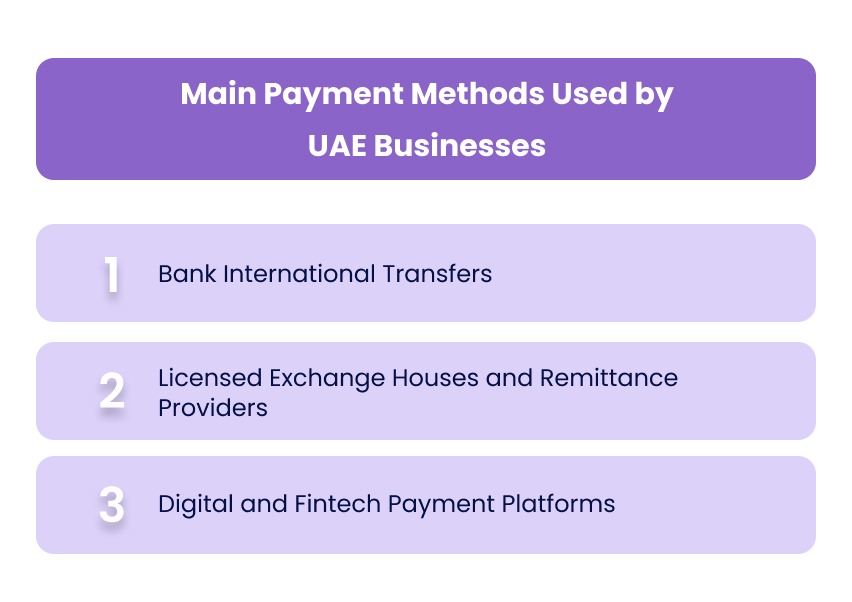
UAE companies sending funds to India generally rely on a small set of established payment routes. The decision is rarely about access; most organisations can use several of these, but it is about operational fit. Finance teams typically weigh traceability, documentation handling, settlement predictability, and cost visibility before selecting a rail.
In practice, three categories dominate commercial usage across the corridor.
1. Bank International Transfers
International wire transfers through UAE banks remain the default mechanism for many businesses. Institutions such as Emirates NBD, Abu Dhabi Commercial Bank, Mashreq, HSBC UAE, and First Abu Dhabi Bank route payments through correspondent banking networks into Indian clearing systems. Once funds reach India, they are processed through domestic settlement rails such as NEFT, RTGS, or IMPS, depending on the receiving bank configuration.
Execution normally occurs through corporate online banking portals or treasury channels. Beneficiary onboarding requires precise account details and routing identifiers. Emirates NBD confirms that transfers submitted before operational cut-off times may be processed the same working day, subject to funding availability and detail accuracy, while overall timelines depend on receiving bank schedules.
From an operational perspective, these rails are typically selected where:
- transaction value is high,
- governance requires structured confirmation records,
- or audit traceability is prioritised over cost optimisation.
This reflects market behaviour highlighted in cross-border payment positioning analysis, banks are widely trusted incumbents, but are often perceived as opaque on pricing and slower in execution compared with newer infrastructure models.
Also read: Building a Robust Cash Management Control System for UAE Businesses
2. Licensed Exchange Houses and Remittance Providers
Exchange houses regulated by the UAE Central Bank represent another long-standing route. Organisations such as Al Ansari Exchange and Lulu Exchange maintain corridor partnerships enabling account credit or instrument issuance into Indian banks. These institutions operate under regulatory frameworks requiring verification of customer identity, transaction purpose, and supporting documentation where thresholds or risk indicators apply.
For instance, Central Bank standards require additional source-of-funds verification for outward transfers of AED 75,000 or more conducted in cash, reflecting enhanced due diligence expectations.
In commercial settings, exchange-house channels are typically used by smaller firms or operational teams familiar with branch-based processes. However, accounting linkage and approval integration usually remain manual, meaning reconciliation and record-keeping often occur outside the execution environment.
Market positioning research consistently places exchange houses as cost-competitive but workflow-limited, offering attractive pricing yet minimal process integration or visibility controls for finance teams.
3. Digital and Fintech Payment Platforms
Digital cross-border payment infrastructures have expanded rapidly as supply chains and distributed service delivery have increased. UAE banks themselves have invested in partnerships extending digital corridor capabilities, while independent platforms provide additional routing options.
The macro context behind this shift is structural: global cross-border payment flows are projected to exceed $250 trillion by 2027, driven by trade fragmentation and e-commerce expansion, prompting investment in faster and more transparent settlement rails.
For businesses, these models are generally evaluated on operational characteristics rather than novelty. Finance teams examine whether platforms provide:
- visibility into exchange pricing before approval,
- integration with internal approval workflows,
- structured transaction data for reconciliation.
This aligns with emerging positioning models where execution is increasingly embedded inside broader spend-control workflows rather than treated as an isolated transaction step, a shift that reflects how organisations manage supplier payments across multiple rails today.
Related: Understanding the Procure-to-Pay (P2P) Process
Practical Execution Workflow for Business Transfers
Regardless of channel selection, UAE finance teams tend to follow a consistent operational sequence when executing payments to India. Structuring the process deliberately reduces settlement delays and improves downstream accounting outcomes.
1. Beneficiary Verification
The process begins with validating beneficiary legal identity, banking coordinates, and routing information. Errors at this stage are among the most common sources of trace investigations or processing holds later in the lifecycle.
2. Commercial Documentation Alignment
Invoices, contracts, or engagement records are reviewed to ensure alignment between payment descriptions and transaction values. Financial institutions may request clarification where inconsistencies appear during monitoring.
3. Internal Approval Controls
Well-governed organisations separate invoice validation from payment release decisions. This preserves spending oversight and supports cash-flow planning where FX exposure or liquidity considerations exist.
4. Execution and Reference Capture
Transfers are executed through the selected rail, with finance teams retaining transaction identifiers and confirmations for traceability and audit continuity.
5. Reconciliation and Close
Finally, settlement records are matched against accounting entries, and FX variance is resolved as part of the closing process. Integrating this step prevents exception accumulation at the month's end.
Related: Accounts Payable Automation and Invoice Management Software
Documentation and Compliance Dynamics Across the Corridor
Cross-border payments between the UAE and India operate within regulatory frameworks designed to ensure the traceability and legitimacy of fund movement. Finance teams rarely interact with the regulations directly, but their operational impact is visible in documentation requests, payment holds, and reporting requirements. Understanding what institutions are validating helps prevent unnecessary friction.
1. Expectations on the UAE Side
Banks, exchange houses, and payment providers operate under Central Bank supervision and AML legislation that requires customer identification, transaction monitoring, and verification of funds where necessary. Institutions must confirm customer identity, understand the purpose of the transaction, and assess whether the activity aligns with the customer profile.
Customer due diligence processes, therefore, commonly involve validating the source of funds and supporting documentation, particularly when risk indicators appear or transactions occur in cash.
For international wires, ordering institutions must ensure the required sender and beneficiary information accompanies the transfer, reinforcing traceability across the processing chain.
These controls reflect broader UAE regulatory expectations under AML/CFT frameworks governing financial institutions and exchange houses, where licensing and compliance obligations are actively supervised by the central bank.
In operational terms, this is why finance teams may be asked for:
- business identification documents
- invoices or contracts
- clarification of payment purpose
- source-of-funds explanation
These checks are procedural rather than exceptional.
2. Requirements on the Indian Receiving Side
Payments arriving in India are classified under the Reserve Bank of India foreign-exchange reporting frameworks. Every inward remittance must be tagged with a purpose code that identifies the nature of the transaction, ensuring regulatory reporting and compliance under FEMA rules.
Purpose codes distinguish whether funds relate to services, trade, investment, or other commercial categories, and incorrect selection can delay crediting or require clarification.
Supporting records typically include invoices, agreements, and KYC documentation. Banks may also issue confirmation documentation, such as a Foreign Inward Remittance Certificate, which acts as formal evidence that funds were received from abroad.
For business recipients, additional record-keeping expectations exist. Documentation supporting inward remittances should be maintained for audit and tax purposes, and purpose code alignment directly affects compliance outcomes.
From a practical standpoint, this explains why settlement queries often originate from the receiving side rather than the sending institution; classification accuracy is mandatory.
Also read: Improving Internal Control over Financial Reporting (ICFR)
Evaluating Cost Before Authorising Transfers
Finance teams often discover cost variance only after settlement, primarily because the visible transfer fee is only one component of the total economic outcome.
1. Exchange Rate Markups and Spreads
Currency conversion generally includes a margin applied above the wholesale interbank rate. Providers quote buy and sell prices with a difference, known as the spread, that represents built-in revenue for the institution executing the transaction.
This margin reflects the gap between the mid-market rate and the rate actually offered to the customer.
Banks and payment processors commonly generate income from this spread, meaning advertised “zero transfer fees” may still result in meaningful costs through exchange-rate pricing.
Understanding this mechanism is essential when comparing payment routes, as headline pricing alone rarely reflects economic impact.
2. Additional Transfer Charges
Beyond FX margins, institutions may apply:
- Outgoing wire fees
- Correspondent processing deductions
- Currency conversion service charges
These elements collectively influence the final credited value and are frequently embedded within the settlement rather than previewed upfront.
Common Operational Mistakes Finance Teams Encounter
Execution issues rarely stem from access to payment rails. They typically arise from procedural inconsistencies that compound across the transaction lifecycle.
- Payment references that do not match invoice narratives
- Beneficiary details captured without independent verification
- Approval executed before full cost visibility is obtained
- FX variance left unresolved until the month-end close
These errors increase reconciliation effort and can trigger additional institutional queries.
Also read: Understanding the Importance of Business Spend Management and Its Tools.
Where Alaan Fits in Business Payment Workflows
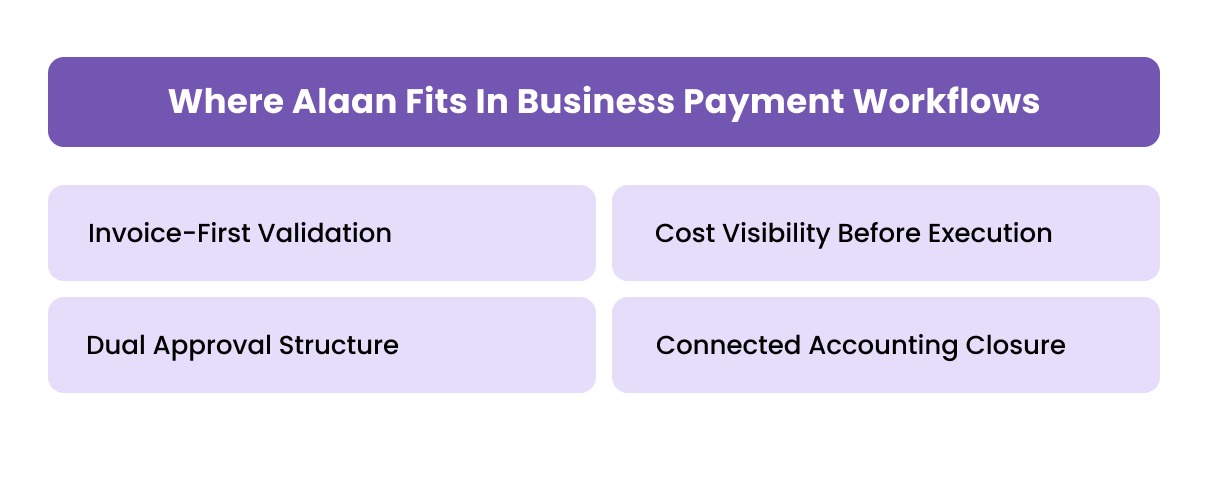
Where Alaan Fits in UAE to India Business Payment Workflows
For many organisations, transferring funds to India is not technically difficult. The operational strain usually appears around preparation and follow-through, invoices arriving through multiple channels, approvals happening outside payment tools, and reconciliation being reconstructed afterwards. This fragmentation increases exception handling and obscures cost visibility.
At Alaan, through Super Pay, we support finance teams by connecting these stages so cross-border supplier payments sit within a governed workflow rather than outside it.
- Centralised Invoice Review Before Scheduling Payments
Invoices can be captured and validated before execution is considered. Confirming supplier details, commercial context, and documentation early helps reduce routing issues or classification queries that may arise when funds reach Indian banking systems. - Approval Separation for Spend Validation and Payment Timing
Approval workflows distinguish between confirming the legitimacy of spend and deciding when funds should be released. This structure aligns with typical finance practices in UAE organisations, supporting cash planning and FX timing decisions rather than forcing approvals under operational pressure. - Transfers Executed Through SuperPay Within Supported Corridors
For vendor settlements requiring bank-account credit, transfers to supported corridors, including India, can be executed within the same environment used for validation and approvals. Keeping execution inside this workflow preserves reference continuity and reduces reliance on disconnected banking portals. - Visibility Into Cost Implications Before Execution
For supported international transfers, finance teams can review cost implications prior to authorisation. This supports clearer liquidity planning and reduces post-settlement variance investigation during reconciliation. - Linked Records Supporting Reconciliation and Audit Trails
Invoices, approvals, and payment references remain connected and synchronise with accounting integrations. Maintaining this continuity simplifies tracing settlement outcomes, addressing supplier queries, and supporting internal review or audit activity.

By embedding execution inside structured approvals and documentation continuity, we help organisations manage supplier payments across the UAE–India corridor while maintaining visibility and governance across the full lifecycle.
Tracking and Verifying Payments After Execution
Once a transfer is executed, visibility becomes operationally important, particularly when suppliers request confirmation or when settlement timing affects downstream activity. Most cross-border bank wires move through SWIFT messaging infrastructure, which provides traceability through structured transaction identifiers.
When an international payment is initiated, the sending bank generates a confirmation message commonly referred to as an MT103. This document contains the full payment metadata and reference identifiers used for tracking. Retaining this record is standard practice because it allows the sender or recipient to check the status or initiate investigations if delays occur.
Tracking typically involves contacting the sending institution with the reference number or using bank interfaces that display transfer status. Many banks provide monitoring through SWIFT-linked systems that show whether the payment is processing, completed, or pending compliance review.
Modern tracking improvements come from SWIFT gpi infrastructure, which enables near real-time visibility and delivery confirmation across participating institutions. These tools provide transparency into fee deductions, routing progress, and final credit status, features intended to support liquidity management and reconciliation accuracy for corporate users.
From a practical finance-operations standpoint, maintaining a process where MT103 confirmations are stored alongside invoice records significantly reduces friction when counterparties request proof of settlement.
Related: Importance and Steps in Account Reconciliation
Final Considerations Before Sending Funds
Cross-border execution quality depends less on which rail is selected and more on preparation discipline. Organisations that treat payments as part of a controlled workflow consistently encounter fewer settlement exceptions.
Several practical behaviours support predictable outcomes:
- Beneficiary details should be validated independently rather than relying solely on invoice information.
- Payment references should mirror invoice narratives to avoid classification ambiguity.
- Exchange pricing should be reviewed before approval rather than reconciled afterwards.
- Confirmation documentation should be captured and stored immediately after execution.
These are procedural measures rather than technical ones, yet they materially influence settlement speed and reconciliation effort.
Conclusion
Sending money from the UAE to India for business purposes is operationally routine but structurally complex. Multiple rails exist, from correspondent-bank wires to exchange-house channels and digital platforms, each with distinct implications for cost visibility, traceability, and workflow integration. The most effective payment strategies, therefore, emphasise preparation and evaluation rather than execution speed alone.
Documentation alignment, purpose classification accuracy, and cost transparency shape outcomes more than channel choice. Finance teams that embed these considerations into their approval workflows typically encounter fewer settlement disruptions and maintain clearer reconciliation trails.
At Alaan, cross-border payments are approached as part of a governed spend lifecycle rather than an isolated transaction step. By connecting invoice validation, approval controls, execution visibility, and accounting closure within a single workflow, businesses can reduce fragmentation between payment decision and financial reporting. Book a Free Demo Today!
FAQs
1. How long does it take to send money from UAE to India?
It depends on the method. Exchange houses and fintech platforms can deliver funds the same day or within one business day. Bank transfers typically take one to four business days, depending on intermediaries and cut-off times.
2. What is the cheapest way to send money from UAE to India?
There is no single cheapest option in all cases. Online fintech platforms often provide the lowest total cost for small-to-medium transfers due to transparent FX pricing. For larger amounts, costs should be compared using the final INR credited.
3. Can I send money from UAE to an Indian business account?
Yes. Business transfers are common but require additional documentation, such as invoices, contracts, and a clear purpose of remittance. Indian beneficiary banks may review and request clarification before crediting funds.
4. Are there limits on how much money I can send from UAE to India?
Limits vary by provider and method. Banks and regulated platforms may impose transaction or daily limits and apply enhanced checks for large amounts.
5. Why do some transfers get delayed or partially credited?
Delays usually occur due to missing documentation, inconsistent payment references, or intermediary bank deductions. First-time payments are more likely to be reviewed.
6. Can I track my transfer from UAE to India?
Most banks, exchange houses, and fintech platforms provide tracking references. Bank transfers use SWIFT references, while fintech platforms show real-time status updates in their dashboards.
Gain control over business expenses with Alaan corporate cards
Invygo earned AED 100,000 in cashback using Alaan cards
Personalise approval workflows to align with your business needs with Alaan's Spend Management platform
Discover the power of automated expense tracking and smarter spend control with Alaan
Turn data into actionable insights with Alaan's spend management tools
Stay Tax Compliant with UAE's #1 Corporate Card and Spend Management Platform
Customisable corporate card policy template
Know how much Corporate Tax you have to pay this fiscal year
Easily integrate Alaan with your ERP for accurate, real-time expense tracking
Close books faster with Alaan's AI-powered accounting automation
Reconcile your books in minutes instead of hours, every single month.
Keep petty cash organized with Alaan corporate cards and automated expense management