.avif)

In the UAE, the payments sector will reach $27.3 billion (AED 100.26 billion) in revenue by 2028, reflecting the scale and complexity finance teams manage every day.
In growing organisations, business bill payment rarely breaks down overnight. Manual transfers often exist alongside scheduled payments, automation runs parallel to corporate cards, and visibility is still maintained through spreadsheets.
At this stage, bill payment stops being just an operational task and becomes a governance challenge. How payments are structured begins to determine whether control, visibility, and compliance can be sustained as the business scales.
In this blog, you’ll explore how to manage business bill payments effectively, what matters most as operations expand, and how the right workflows help maintain control even as complexity increases.
TL; DR
- Business Bill Payments Don't Rely On a Single Method: UAE finance teams use a mix of manual transfers, scheduled payments, automation, and cards, each chosen based on risk, approval needs, and cash timing.
- Pre-Payment Controls are More Effective Than Post-Payment Checks: Systems that enforce limits, approvals, and documentation before execution prevent cash leakage and reduce follow-up work.
- The Right Platform Centralises Control: Tools that combine bill payments, approvals, accounting sync, and documentation help reduce coordination issues.
- Strong Processes Protect Cash Discipline: Clear ownership, reconciliation-first design, and regular rule reviews help you scale without losing control.
- Platforms Should Adapt Without Redesign: Systems that allow rules, limits, and workflows to be adjusted help finance teams maintain control as complexity increases.
5 Types of Business Bill Payment Models in the UAE
Finance teams in the UAE usually rely on a mix of bill payment models rather than sticking to just one. Each model affects control, cash timing, and risk in its own way, which makes payment choice a governance decision.
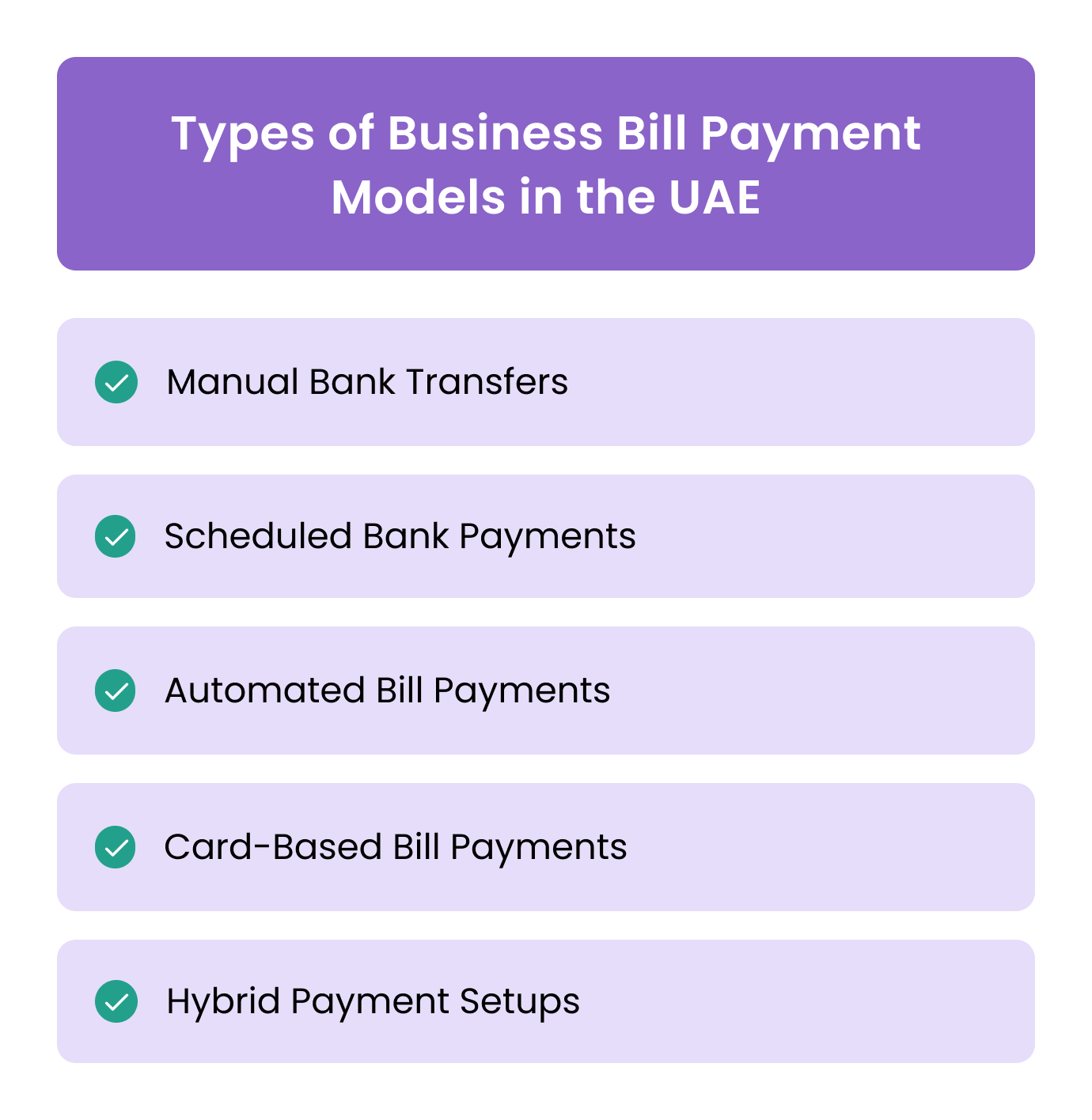
Below are the payment models most growing and established businesses use today, along with how each one shapes day-to-day finance operations.
1. Manual Bank Transfers
Manual transfers remain common for high-value or sensitive payments. You keep clear visibility over who authorises payments and when they go out, which supports accountability.
This model tends to fit well when:
- Payment volumes stay manageable
- Approvals need deliberate review
- Exceptions require close attention
As scale increases, heavier reliance on manual handling often leads to approval delays and unpredictable cash timing.
2. Scheduled Bank Payments
Scheduled payments add predictability by releasing funds on set dates. You often use this model for rent, utilities, and recurring supplier invoices.
Operationally, this brings:
- Better short-term cash planning
- Fewer last-minute approvals
- Lower day-to-day operational noise
Risk rises when invoice values or commercial terms change without timely review.
3. Automated Bill Payments
Automated payments run on predefined rules, thresholds, and triggers. Control shifts upstream into configuration rather than sitting in daily approvals.
This model supports:
- Consistent execution at scale
- Lower operational workload
- Clear separation between routine and exception payments
As execution speeds up, strong visibility and regular rule checks become even more important.
4. Card-Based Bill Payments
Cards are widely used for digital vendors, subscriptions, and time-sensitive services. They remove reimbursement cycles and enable faster settlement.
You usually experience:
- Quicker vendor payments
- Easier handling of ad hoc or online spend
- More pressure on budget discipline
Results depend heavily on spending limits, category controls, and real-time visibility.
Suggested Read: How to Set Up Card Payments for Small Business in the UAE
5. Hybrid Payment Setups
Most UAE organisations operate with a hybrid setup that combines transfers, scheduled payments, automation, and cards. For international payments, simplified payment workflows are essential to maintain control and ensure FX visibility when processing both cross-border and domestic transactions.
Strong hybrid models bring clarity around:
- Which payments always need active approval
- Which can move within defined limits
- Where real-time visibility matters most.
At Alaan, we see this first-hand. We help finance teams manage supplier payments, corporate cards, and transfers through a single, centralised workflow, ensuring visibility and approvals are not scattered across different systems.
By bringing together spend policies, AI-powered automation, and real-time tracking into a single platform, finance teams stay in control even as payment complexity increases.
Understanding the different business bill payment models in the UAE helps highlight which features are most important when choosing the right system.
8 Features That Actually Matter in a Business Bill Payment System
As payment volumes grow, you can quickly notice which features actually help you stay in control and which ones just look useful on the surface. A good bill payment system increases visibility, keeps approvals on track, and makes cash flow more predictable as things get more complex.
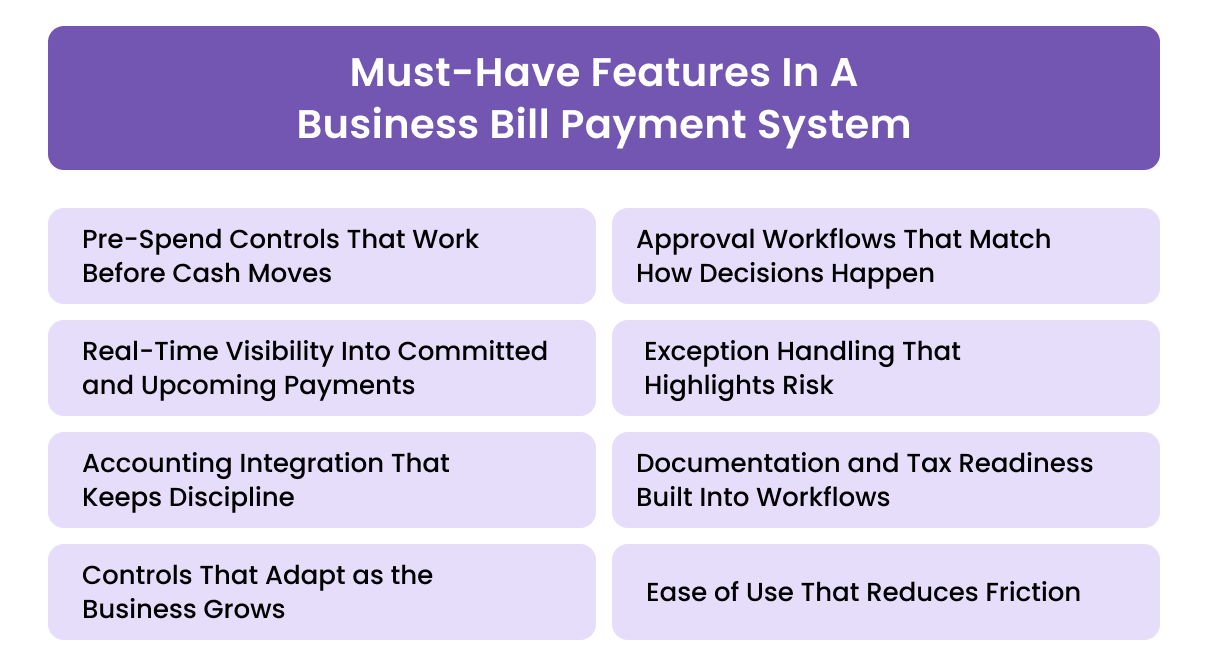
Below are the key features that actually matter in a business bill payment system.
1. Pre-Spend Controls That Work Before Cash Moves
Control is weakest when issues are spotted after payment. The most valuable systems enforce intent upfront.
Look for controls that let you:
- Set limits by vendor, category, or budget owner
- Require approvals based on value, risk, or exceptions
- Block or pause payments when thresholds are exceeded
When controls are tested before execution, you can prevent leakage rather than having to explain it later.
2. Approval Workflows That Match How Decisions Happen
Rigid approval chains slow teams down, become loose, and are bypassed. What works is context-aware approval workflows that reflect risk and responsibility.
Effective workflows:
- Escalate only when amounts or vendors warrant it
- Adapt to roles, not just job titles
- Preserve an audit trail without forcing manual follow-ups
3. Real-Time Visibility Into Committed and Upcoming Payments
Monthly reports are too late. You need to see what’s about to leave the business.
Practical visibility includes:
- A live view of scheduled and automated payments
- Clear separation between approved, pending, and executed transactions
- Immediate alerts when activity deviates from expectations
This stabilises forecasting and supports timely intervention.
4. Exception Handling That Highlights Risk
High-volume payment environments generate noise. The goal is better prioritisation.
Systems should:
- Flag anomalies based on defined rules
- Surface duplicates, unusual timing, or unexpected vendors
- Let you act quickly without halting the routine flow
Exception-based oversight scales far better than manual reviews.
5. Accounting Integration That Keeps Discipline
Payment systems shouldn’t create extra work downstream. When data flows cleanly into accounting tools, you close faster with fewer corrections.
Key points include:
- Consistent coding and categorisation at the source
- Continuous syncing
- Clear alignment with existing charts of accounts
For international payments, smooth integration between payment systems and accounting tools ensures the accurate tracking of expenses, including FX rates and cross-border charges. By keeping this data linked, teams can reconcile payments faster and with greater accuracy.
At Alaan, we integrate directly with major accounting and ERP systems, allowing automatic syncing of expense and bill data. This helps teams maintain consistent coding and categorisation at the source, enables automated syncing, and aligns transactional data with their existing chart of accounts.
6. Documentation and Tax Readiness Built Into Workflows
Compliance issues usually come from missing or incomplete documentation. Systems that embed documentation checks quietly reduce risk.
Strong setups include:
- Linking invoices and records directly to payments
- Capturing and validating required tax details during approval workflows
- Finding and surfacing gaps early, when they’re easy to fix
This is especially important in environments with close tax scrutiny.
7. Controls That Adapt as the Business Grows
Features that work at one stage often fail at the next. What matters is whether the system adapts without forcing a redesign every quarter.
That means:
- Adding users, vendors, and approval layers without friction
- Adjusting limits and workflows as spend patterns change
- Maintaining visibility as complexity grows
8. Ease of Use That Reduces Friction
Even the most powerful features fail if they’re hard to operate. Intuitive design, clear dashboards, and responsive tools keep teams efficient.
Look for systems that:
- Provide a simple, central dashboard for approvals, payments, and exceptions
- Offer mobile access and notifications for on-the-go decision-making
- Minimise repetitive manual tasks through automation and clear workflows
- Good usability ensures teams fully adopt processes, reducing errors and improving control.
Knowing the key features to look for makes it easier to compare and choose from the top business bill pay platforms in 2026.
Top 7 Business Bill Payment Platforms in 2026
Business bill payment platforms sit at the centre of how you manage vendor payments, approvals, and cash flow as operations grow.
When payment volumes increase and compliance rules become tighter, these tools help you stay on top of every transaction, apply the right controls, and reduce the time spent on manual tasks.
Below is a comparison of the top seven business bill pay platforms in 2026.
1. Alaan
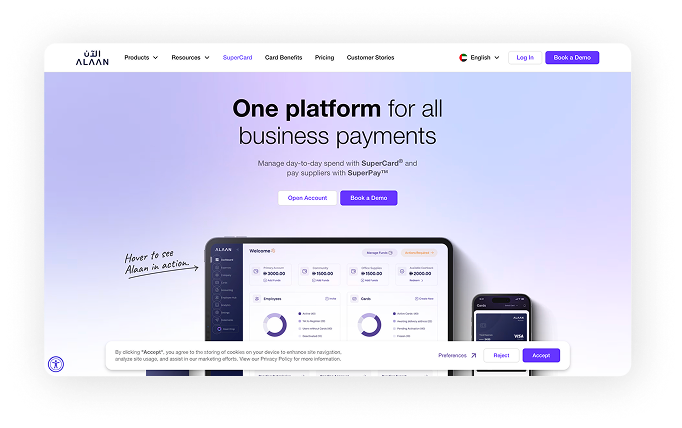
Alaan is an AI-powered spend management and business bill pay platform headquartered in Dubai, United Arab Emirates, designed specifically for modern finance teams in the Middle East.
It combines invoice-based payments, corporate cards, expense management, and accounting integrations into a single platform that gives finance teams greater oversight and control over outgoing payments.
Alaan focuses strongly on the Middle East and is built to support regional financial and compliance requirements, helping teams keep expense tracking aligned with local regulations.
Key Features
- Corporate Bill Payments: Helps pay vendors and suppliers through structured approval workflows with centralised tracking of outgoing payments.
- Cross-Border Transfers: Make international supplier payments from the UAE through Super Pay, using the same structured workflow as for domestic bills, with upfront FX visibility, full cost transparency, and controlled approvals before funds move.
- Unlimited Corporate Cards: Issue as many physical and virtual cards as you need, with custom spend limits and approval workflows to keep expenses under control.
- AI-Powered Automation: Uses OCR and automation to capture receipt data and reduce manual entry.
- VAT-Ready Workflows: Capture VAT-related details, such as invoice data and tax amounts, to support compliant reporting and audits.
- Accounting and ERP Integrations: Integrates with accounting systems, including QuickBooks Online, Xero, Oracle NetSuite, Microsoft Dynamics 365, Odoo, SAP, and Zoho Books for reconciliation and reporting.
- Real-Time Insights: Gives instant visibility into expenses, making it easier to track spending patterns and make informed financial decisions.
- Up to 2% Cashback: Earns cashback on eligible international transactions, helping businesses save on overseas spending.
- No Setup Fees: Quick and easy onboarding with no upfront costs, keeping it simple and affordable to get started.
Pros
- Designed specifically for UAE and MENA compliance requirements.
- Supports spend tracking at the branch and subsidiary level, making it easier to manage different teams and locations.
- Capture and upload receipts via WhatsApp to reduce friction in expense reporting.
- No monthly fees and clear, transparent pricing make it a budget-friendly option.
Cons
- Availability currently limited to Middle East–based businesses.
- Smaller global footprint compared to long-established international platforms.
Pricing
- Starter plan: AED 0/month
- Premium plan: Book a demo
- Enterprise plan: Custom pricing

Also Read: How can virtual cards help with B2B payments
2. Ramp
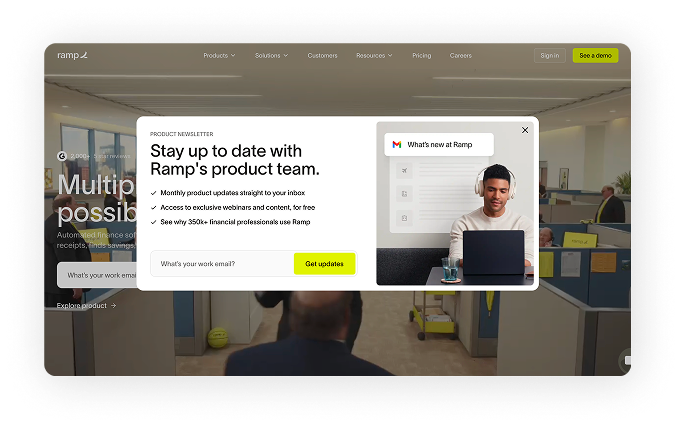
Ramp is a US-based business bill pay platform that helps finance teams handle vendor payments, invoice processing, and approval workflows as part of a wider accounts payable and spend management system.
Its bill pay tools support structured vendor payouts, providing teams with clear visibility and control over outgoing cash.
Key Features
- Vendor Bill Payments: Pay suppliers through ACH, cheque, or virtual card once approvals are complete.
- Invoice Capture and Processing: Upload vendor invoices into one central system, where the platform extracts data and sends bills through approval workflows
- Recurring and Batch Payments: Schedule recurring vendor bills or send multiple payments at once to reduce manual effort on routine tasks.
- Accounting Integrations: Syncs bill payment data with accounting tools like QuickBooks and Xero to make reconciliation and reporting easier.
Pros
- Brings accounts payable and bill payment execution into one platform with clear workflow visibility.
- Custom approval rules help teams maintain payment control as invoice volumes increase.
- Recurring and batch payments reduce repetitive manual work.
Cons
- Processes payments in USD, creating foreign-exchange exposure for businesses outside the US.
- Does not support VAT handling or region-specific tax workflows.
Pricing
- Free plan: AED 0 per month
- Plus plan: AED 55.09 per month
- Enterprise plan: Custom pricing
3. Rippling
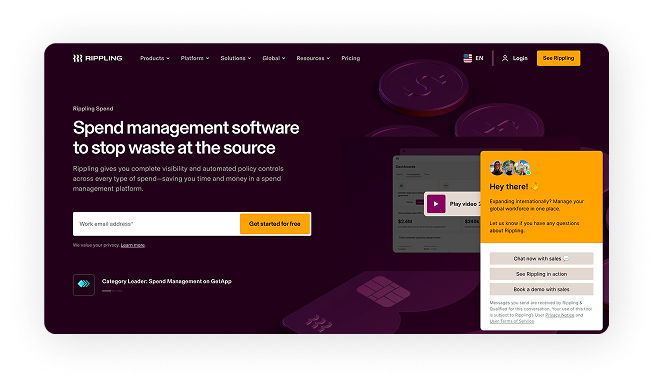
Rippling is a US-based spend management and bill pay platform that helps finance teams manage vendor invoices and payments within a wider system that also connects payroll, HR, corporate cards, and other financial workflows.
It brings company spend into one place and cuts down manual work across accounts payable and day-to-day operations.
Key Features
- Automated Invoice Capture: Uses OCR to pull key details like invoice date, amount, vendor, and due date from uploaded invoices, reducing manual data entry.
- Custom Approval Workflows: Routes bills through configurable approval paths based on roles, departments, vendors, or invoice criteria.
- Vendor Portal and Self-Service: Let vendors securely upload invoices and update payment details independently.
- Accounting Sync and GL Integration: Connects bill payment data with general ledger and accounting systems to simplify reconciliation and reporting.
Pros
- Brings together bill pay, payroll, corporate cards, and expenses so finance teams get a real-time view of company spend.
- Centralises vendor information and payment history for better visibility.
- Reduces manual back-and-forth between finance and operational teams.
Cons
- Offers fewer specialised bill-pay features than dedicated accounts payable platforms.
- Delivers the most value when teams also use Rippling’s wider product suite.
Pricing
Custom pricing plans.
4. Brex
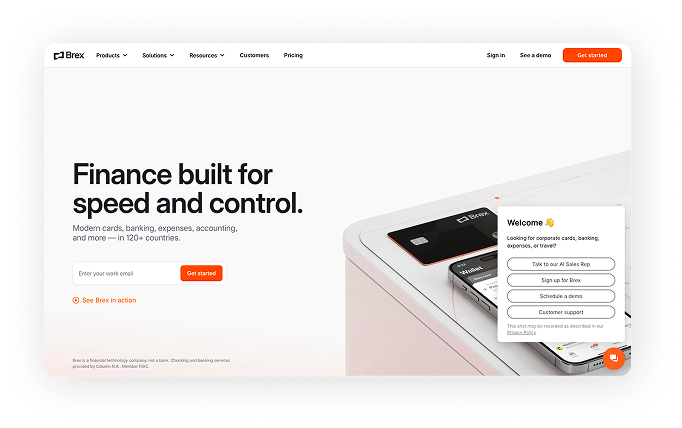
Brex is a US-based spend and finance operations platform that supports business bill payments, invoice workflows, approvals, and expense controls as part of a wider financial management suite.
It is often used to manage vendor obligations, centralise outgoing payments, and keep visibility over both recurring and one-off bills.
Key Features
- Centralised Vendor Bill Payments: Finance teams can handle vendor payments through a single bill-pay workflow, with invoices reviewed and approved before funds are disbursed.
- Invoice Upload and Data Capture: Teams can upload or email vendor invoices to the platform, where Brex captures key details and routes them according to preset rules.
- Configurable Approval Workflows: Teams can set approval logic based on invoice value, department, or vendor category, helping maintain spend controls and separation of duties.
- Accounting System Integrations: Bill payment and invoice data sync with accounting tools like QuickBooks and Xero to support reconciliation and financial reporting.
Pros
- Works well for companies managing large volumes of vendor bills alongside corporate cards and expenses.
- Keeps invoice reviews, approvals, and payment execution in one place.
- Offers structured controls that grow with expanding finance and AP teams.
Cons
- Does not support local UAE payment rails, which limits its fit for UAE-focused businesses.
- Advanced finance and automation features are available only with paid plans.
Pricing
- Essentials plan: AED 0 per month
- Premium plan: AED 44.07 per month
- Enterprise plan: Custom pricing
5. Expensify
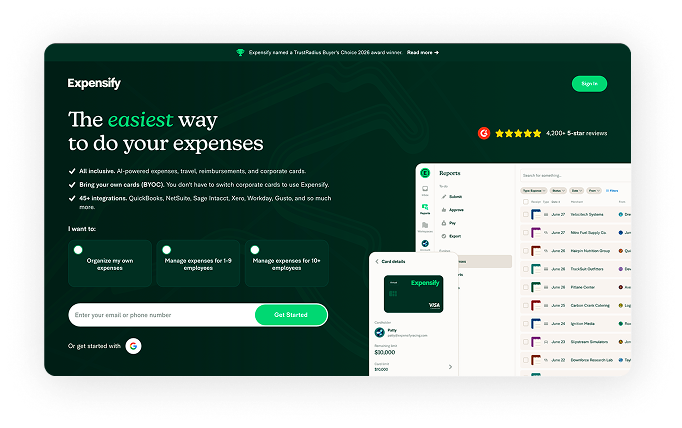
Expensify is a cloud-based spend and expense management platform that helps organisations capture receipts, submit and approve expense reports, reimburse employees, and manage vendor invoices and bill payments in one system.
The platform reduces manual work and keeps accounting data in sync for easier reconciliation and reporting.
Key Features
- Vendor Bill Pay Management: System scans, categorises, routes supplier invoices for approval, and then pays vendors directly through ACH, cards, or other options.
- Automated Receipt and Invoice Capture: Snap a photo or forward a receipt or vendor invoice by email, and it automatically scans it and pulls key details like vendor, date, and amount.
- Corporate Card and Spend Controls: Supports corporate cards, including virtual cards and bring-your-own-card setups, and automatically matches card transactions with receipts and policy rules.
- Accounting and ERP Integrations: Sync expenses, bills, and payment data with platforms like QuickBooks, Xero, NetSuite, and others to support bookkeeping and reporting.
Pros
- Brings vendor bill payments and expense approvals together in one platform.
- Works across devices and integrations, with mobile capture, desktop access, and strong connections that keep accounting systems aligned.
- Automates data capture for receipts and invoices, cutting manual entry and helping reduce errors.
Cons
- Approval and workflow depth may feel limited for organisations with highly complex, multi-layered authorisation needs.
- Provides limited support for complex approval setups in larger organisations.
Pricing
Starts at AED 18.36 per unique member per month
6. BILL
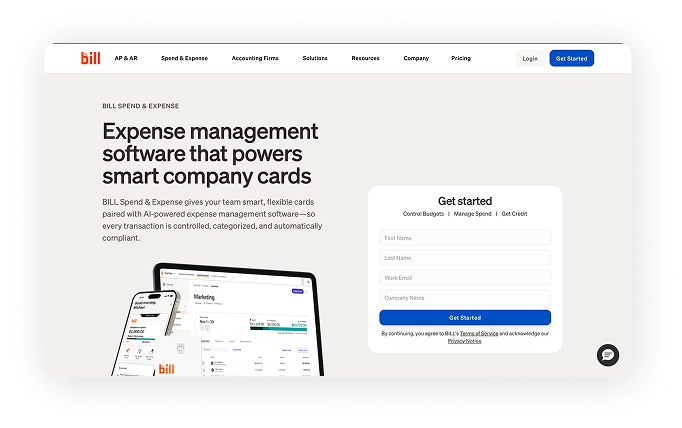
BILL is a cloud-based financial operations platform that helps businesses automate and centralise accounts payable workflows, bill payments, invoice approvals, and accounting integrations.
It improves visibility into payables and connects financial workflows across vendors and internal teams.
Key Features
- Automated Invoice Capture and Entry: Helps upload bills, including PDFs or emailed invoices, and extract key details to speed up processing.
- Centralised Payment Management: Pay vendors via ACH, virtual cards, credit cards, and other methods once invoices are approved, all from a single dashboard.
- Custom Approval Workflows: Set structured approval chains that route bills based on value, department, or user roles before releasing payments.
- Accounting Software Integrations: Automatically sync data with platforms like QuickBooks Online, Xero, Sage Intacct, and others to support reconciliation and reporting.
Pros
- Handles large invoice volumes and payment workflows while reducing manual entry and errors.
- Custom approvals and dashboards help finance teams enforce controls and maintain a clear audit trail.
- Works well for organisations managing high volumes of vendor invoices.
Cons
- Customer support can feel slow or less responsive than expected.
- The per-user subscription model can become expensive for larger teams.
Pricing
- Essentials plan: AED 179.95 per user per month
- Team plan: AED 238.71 per user per month
- Corporate plan: AED 326.85 per user per month
- Enterprise plan: Custom pricing
7. Coupa

Coupa is an enterprise-level spend management platform that sits inside a broader source-to-pay ecosystem. Large and complex organisations use it to manage procurement, vendor invoices, approvals, and payments through controlled end-to-end procure-to-pay workflows.
Key Features
- Integrated Invoice Processing Within P2P Workflows: Brings invoice intake, matching, approvals, and payments directly into procure-to-pay processes, linking invoices to purchase orders, contracts, and internal policies.
- Policy-Driven Approval Hierarchies: Supports configurable, multi-level approvals based on spend limits, cost centres, legal entities, and organisational structure to maintain financial control.
- Centralised Supplier and Contract Data: Stores supplier profiles, contracts, compliance documents, and transaction history in one place to support consistent vendor governance
- Deep ERP Integration for Financial Control: Integrates with enterprise ERP systems like SAP and Oracle to support accounting alignment, reconciliation, and financial reporting.
Pros
- Built for multi-entity, global teams that need structured controls, auditability, and policy enforcement.
- Provides end-to-end visibility from procurement through to bill payment.
- Creates detailed system records and approval trails that support compliance, internal audits, and regulatory reviews.
Cons
- Requires significant time, internal resources, and change management to set up and run effectively.
- Cost and operational complexity often exceed what small or mid-sized finance teams need.
Pricing
Custom pricing plans.
Once you examine the leading platforms, you can compare their features and performance side by side.
Comparison of Top Business Bill Payment Platforms
Below is a comparison of the top business bill payment platforms in 2026.
| Platform | Key Features | Best For |
|---|---|---|
| Alaan | Corporate bill payments with approvals, unlimited physical and virtual cards, VAT-ready invoices, and receipt automation | Middle Eastern businesses managing vendor payments, expenses, and VAT compliance in one system |
| Ramp | Vendor bill payments, centralised invoice capture, recurring and batch payments | US-based teams handling regular vendor payments with simple approval workflows |
| Rippling | Automated invoice capture, custom approval workflows, and multi-method vendor payments | Companies that want bill pay connected with payroll, HR, and core operations |
| Brex | Centralised vendor bill payments, configurable approval workflows, and international payment support | Growing companies managing vendor bills alongside corporate cards and expenses |
| Expensify | Vendor bill payments, automated receipt and invoice capture, and expense approvals | Teams combining employee expenses and vendor bills in a single platform |
| BILL | Automated invoice capture, custom approval workflows, and real-time payment tracking | Finance teams processing high volumes of vendor invoices |
| Coupa | Procure-to-pay invoice processing, policy-driven approval hierarchies, deep ERP integrations | Large enterprises requiring structured procure-to-pay controls and audit readiness |
While the platforms offer various features, businesses still face common challenges in managing bill payments efficiently.
3 Common Challenges of Business Bill Payment Processes
Bill payment processes start to feel the pressure as transactions, vendor numbers, and urgency grow across teams. Delays in approvals, scattered visibility, and more exceptions slowly reduce control and make it harder to feel confident about cash management.
Below are some common challenges in the business bill payment process.
1. Visibility Lags Behind Execution
- Challenge: Payments spread across transfers, scheduled payments, automation, and cards make it harder to see committed and upcoming cash outflows in one place.
- Solution: Centralised payment tracking provides you with a single view of pending, scheduled, and completed payments across the entire cash cycle.
2. Cash Forecasting Loses Accuracy
- Challenge: Payment timing becomes harder to predict when approvals, automation, and manual execution operate separately.
- Solution: Bill payment execution aligns with real-time visibility into scheduled and committed payments, helping stabilise short-term forecasting.
Must Read: Cash Forecasting Methods CFOs Trust for Accurate Liquidity
3. Governance Weakens Through Incremental Fixes
- Challenge: Small fixes add new payment methods without clear ownership, gradually weakening policy enforcement.
- Solution: Explicit rules clarify when each payment method applies, supported by regular reviews as volume and complexity grow.
Final Thoughts
Business bill payments are unavoidable as organisations grow, but loss of control is not. Delays, visibility gaps, cash surprises, and reconciliation issues usually arise from fragmented payment methods and unclear workflows.
Finance teams that standardise how bills are approved, paid, and tracked are much better equipped to scale without adding risk. As things get more complex, the advantage goes to teams that can combine speed with discipline, early visibility, and clear accountability.
At Alaan, we help you make this shift by bringing bill payments, approvals, and spend controls into one seamless workflow. This keeps visibility intact before cash moves, reduces exceptions, and makes reconciliation and compliance easier as operations grow. Finance teams often benefit from clearer controls and real-time visibility into bill payment workflows.
Schedule a free demo to see how Alaan helps finance teams in the UAE manage business bill payments with greater control and visibility.
FAQs
Q1. How do finance teams decide which bills should never be automated?
A1. Bills linked to changes in commercial terms, disputes, or performance conditions are usually handled manually. These payments need human judgment that rules can’t manage well. Automation works best when you stay hands-on in areas where outcomes can change.
Q2. What is the biggest early warning sign that a bill pay process is no longer fit for scale?
A2. The biggest early warning sign is when cash surprises appear during reconciliation. This usually means visibility is scattered across different payment methods. By the time finance teams spot the issue, the money has already gone.
Q3. How should finance teams handle vendor bills that frequently change amounts or terms?
A3. Finance teams should move these vendors into stricter approval workflows with clear escalation paths. Frequent changes often signal unclear contracts or weak controls earlier in the process, so treat them as risk signals, not just day-to-day operational issues.
Q4. Does faster bill payment always improve vendor relationships?
A4. When payments stay accurate and predictable, it helps improve vendor relationships. Speed without consistency creates confusion, especially when teams later dispute invoices. Vendors care more about reliability than pure speed.
Q5. How often should bill pay rules and approval thresholds be reviewed?
A5. At least once every quarter for stable organisations. High-growth teams often need monthly reviews as vendors, teams, and spending patterns change. Waiting too long lets outdated rules slowly weaken control.
Gain control over business expenses with Alaan corporate cards
Invygo earned AED 100,000 in cashback using Alaan cards
Personalise approval workflows to align with your business needs with Alaan's Spend Management platform
Discover the power of automated expense tracking and smarter spend control with Alaan
Turn data into actionable insights with Alaan's spend management tools
Stay Tax Compliant with UAE's #1 Corporate Card and Spend Management Platform
Customisable corporate card policy template
Know how much Corporate Tax you have to pay this fiscal year
Easily integrate Alaan with your ERP for accurate, real-time expense tracking
Close books faster with Alaan's AI-powered accounting automation
Reconcile your books in minutes instead of hours, every single month.
Keep petty cash organized with Alaan corporate cards and automated expense management