.avif)


The AED to EGP exchange rate determines how much an Egyptian supplier, contractor, or employee receives when a UAE business makes a payment. Even small changes in this rate can affect the final cost recorded in AED and the amount credited in Egyptian Pounds.
For businesses that regularly transfer money between the UAE and Egypt, understanding this exchange rate is essential for accurate budgeting and financial reporting.
This guide explains what the AED to EGP exchange rate means, how it is calculated, why it changes, and how it affects business payments. It also covers how finance teams track and manage exchange rate impact to maintain accurate and reconciliation-ready financial records.
TL;DR
- The AED to EGP exchange rate directly affects business costs: Even small exchange rate differences can significantly change the final AED value of supplier and service payments.
- Provider exchange rate margins increase total payment expenses: The rate offered by banks and providers often includes a margin, which can cost more than the visible transfer fee.
- Exchange rate fluctuations impact budgeting and financial planning: Changes in currency value can affect expense forecasts, supplier payments, and overall cost control.
- Proper recording of foreign currency payments is essential for accurate accounting: Finance teams must track exchange rates, invoices, and payment confirmations to ensure reconciliation-ready records.
- Alaan helps UAE businesses manage AED to EGP expenses with full visibility: With real-time tracking, automated documentation, and accounting integration, Alaan simplifies international expense management.
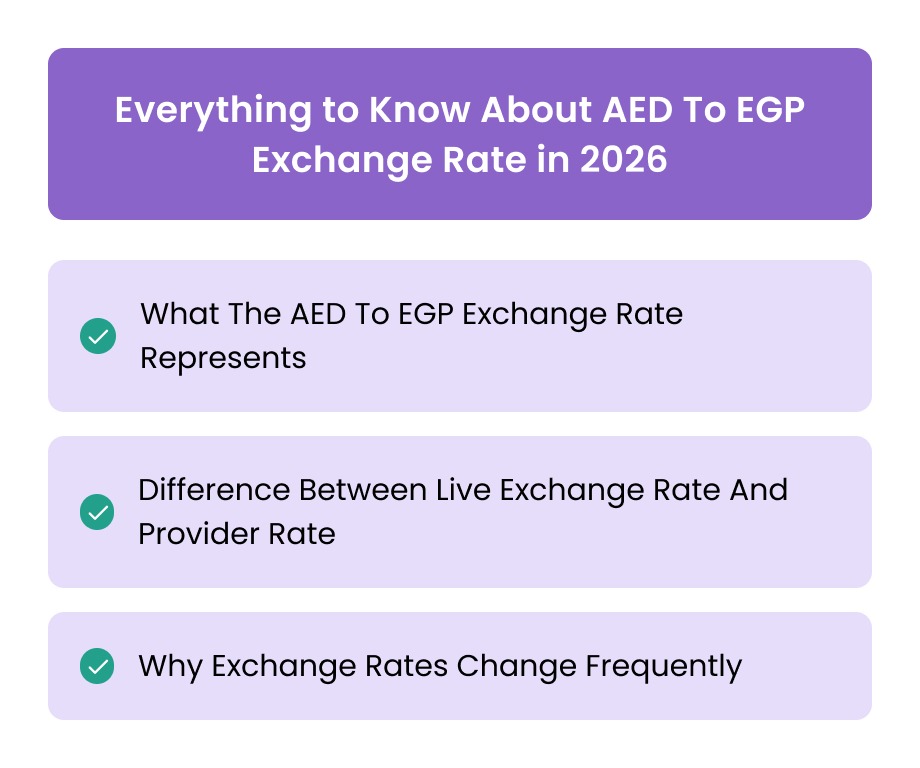
Everything to Know About AED To EGP Exchange Rate in 2026
The AED to EGP exchange rate determines how much an Egyptian supplier receives when a UAE business makes a payment. Even small changes in this rate can affect the final cost recorded in AED and the amount credited in Egyptian Pounds.
For finance teams, understanding how exchange rates work is essential for accurate accounting, cost control, and payment planning.
What The AED To EGP Exchange Rate Represents
The AED to EGP exchange rate shows the value of one UAE Dirham in Egyptian Pounds. It tells businesses how much EGP their supplier or contractor will receive for each AED sent.
This rate is used in several common business scenarios, including:
- Supplier payments for goods and materials
- Contractor and service provider payments
- Employee expense reimbursements
- Other business transfers between the UAE and Egypt
For example, if the exchange rate is 1 AED = 13 EGP, a payment of AED 10,000 would convert to approximately EGP 130,000, before any fees or provider margins are applied.
The conversion process is straightforward. The AED amount is multiplied by the exchange rate to determine the EGP amount. However, the actual rate applied may vary depending on the payment provider.
Difference Between Live Exchange Rate And Provider Rate
Two different exchange rates are involved in every international transfer, and understanding this difference is important.
The mid-market rate, also called the live exchange rate, is the real-time value of one currency compared to another. This is the rate typically shown on financial websites and currency trackers.
The provider rate, also called the customer rate, is the rate offered by banks, exchange houses, or transfer platforms. This rate usually includes a margin added by the provider.
This margin is one of the main ways payment providers earn revenue. Instead of charging a visible fee, part of the cost is built into the exchange rate itself.
For businesses, this difference has a direct financial impact. A small variation in the exchange rate may seem minor, but on large transfers it can significantly increase the total cost. Over multiple supplier payments, these differences can add up and affect overall expense levels.
Why Exchange Rates Change Frequently
Exchange rates between AED and EGP change regularly due to economic and financial conditions. These movements reflect the relative strength of each currency.
Key factors that influence exchange rates include:
- Inflation differences: Higher inflation can reduce a currency’s value over time.
- Interest rates: Higher interest rates can strengthen a currency by attracting investment.
- Economic stability: Strong and stable economies tend to have more stable currencies.
- Currency demand: Changes in trade, investment, and market demand affect currency value.
These fluctuations affect how much suppliers receive and how much businesses record as an expense. As a result, exchange rate changes can influence when finance teams choose to make payments.
Monitoring exchange rates and maintaining accurate records helps businesses manage international payment costs and maintain reliable financial reporting.
Also Read: Understanding Financial Statements for Beginners Guide
Why The AED To EGP Exchange Rate Matters For UAE Businesses
For UAE businesses, the AED to EGP exchange rate is not just a financial reference point. It directly affects how much companies spend, how expenses are recorded, and how predictable cross-border costs remain over time.
Because Egypt is a key operational partner for many UAE companies, exchange rate movements can influence both day-to-day payments and long-term financial planning.
UAE Businesses Frequently Pay Suppliers And Teams In Egypt
Many UAE companies rely on Egypt for cost-efficient services, skilled talent, and manufacturing support.
Common business use cases include:
- Outsourcing: UAE companies outsource functions such as customer support, finance operations, and technology development to Egypt.
- Manufacturing and supply: Egyptian suppliers provide materials, packaging, and finished goods to UAE businesses.
- Service providers: Marketing agencies, consultants, and operational vendors based in Egypt support UAE companies.
- Remote employees: Many UAE businesses employ full-time or contract staff based in Egypt.
Because these payments happen regularly, the AED to EGP exchange rate plays a continuous role in determining the actual cost of operations.
Exchange Rate Differences Directly Impact Business Costs
Even small exchange rate changes can create meaningful cost differences, especially for larger payments.
For example, consider a AED 50,000 supplier payment.
- At 1 AED = 13.00 EGP, the supplier receives EGP 650,000.
- At 1 AED = 12.70 EGP, the supplier receives EGP 635,000.
This difference of just 0.30 EGP per AED results in a EGP 15,000 shortfall, which the business may need to cover to meet the agreed invoice value.
These differences affect:
- Budgets: Actual expenses may exceed planned costs.
- Profitability: Higher payment costs reduce operating margins.
- Vendor pricing: Suppliers may adjust pricing to account for exchange rate movements.
Over time, repeated exchange rate differences can significantly affect total business spending.
Exchange Rate Visibility Improves Financial Planning
For finance teams, exchange rate visibility is essential for maintaining accurate and predictable financial records.
Without clear visibility into the exchange rate applied:
- Payment costs can become unpredictable.
- Budget forecasts may not reflect actual expenses.
- Reconciliation requires additional adjustments to account for currency differences.
Tracking exchange rates helps finance teams understand the true cost of international payments and record expenses correctly. It also improves planning by allowing businesses to anticipate currency-related cost changes.
Understanding why exchange rates matter provides the foundation for managing their impact. The next section explains how AED to EGP exchange rates are determined and why they change frequently.
The Real Cost Behind The AED To EGP Exchange Rate
The AED to EGP exchange rate shown online is not always the rate businesses receive when making a payment. In practice, the actual conversion includes additional costs that affect how much the recipient gets and how much the business ultimately pays.
Understanding these hidden costs helps finance teams avoid underestimating international payment expenses.
Exchange Rate Margins Increase Payment Costs
When businesses send money to Egypt, payment providers typically apply multiple charges, including:
- Exchange rate margin: A small adjustment added to the exchange rate offered to the customer.
- Transfer fee: A fixed or variable fee charged to process the payment.
- Receiving or intermediary fees: Charges applied by correspondent or beneficiary banks.
Among these, the exchange rate margin usually has the largest financial impact. This is because the margin applies to the full transfer amount, not just as a one-time fee.
For example, a transfer fee might be AED 50 regardless of the amount sent. However, an exchange rate margin affects every dirham converted. As the transfer value increases, the total cost created by the margin increases as well.
This makes the exchange rate one of the most important factors in determining the true cost of international payments.
Payment Timing Affects Exchange Rate Outcome
Exchange rates between AED and EGP change frequently due to market conditions, currency demand, and economic factors. These changes can occur daily or even within the same day.
As a result, the timing of a payment can influence the final cost. A payment made when the exchange rate is more favourable will convert to a higher EGP amount, while a less favourable rate increases the effective cost in AED.
For finance teams, this creates an additional planning consideration. Monitoring exchange rates and aligning payment timing with operational schedules can help businesses maintain more predictable costs.
Understanding the real cost behind exchange rates allows businesses to make informed payment decisions and maintain accurate financial records for cross-border transactions.
Also Read: Types of Expenses Every Business Should Know
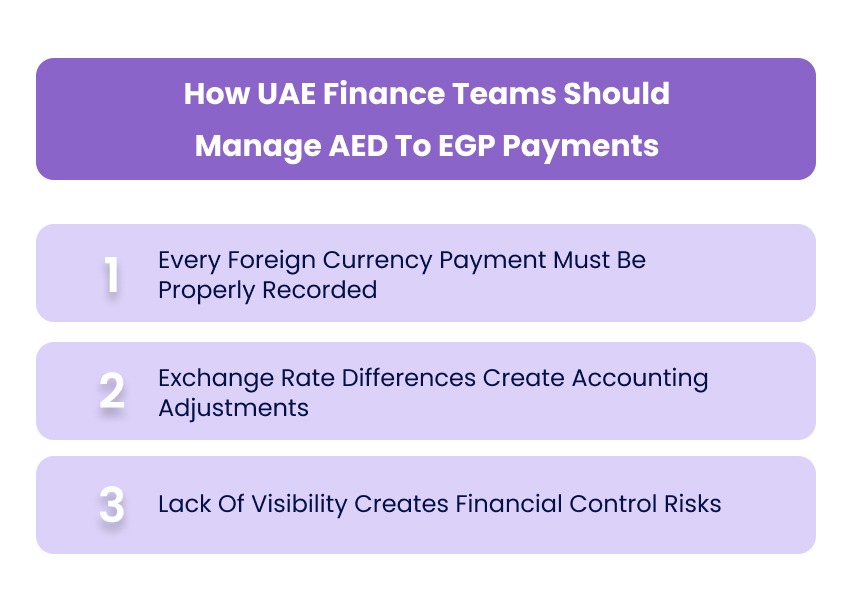
How UAE Finance Teams Should Manage AED To EGP Payments
Making a payment in Egyptian Pounds is only the first step. Finance teams must also ensure the AED value, exchange rate, and supporting documents are recorded correctly.
Without proper expense management, foreign currency payments can create reconciliation delays, accounting errors, and gaps in financial reporting.
Every Foreign Currency Payment Must Be Properly Recorded
Each AED to EGP payment creates a complete accounting workflow that finance teams must follow.
This typically includes:
- Recording the payment: Entering the AED amount, exchange rate, and converted value in the accounting system.
- Collecting the receipt or invoice: Ensuring the supplier invoice and payment confirmation are available.
- Categorising the expense: Assigning the correct account category and cost centre.
- Reconciling the transaction: Matching the payment with bank or card statements.
In many businesses, these steps are still handled manually. Payment confirmations, invoices, and exchange details may be stored in different places, which slows reconciliation.
When multiple AED to EGP payments occur each month, this manual process increases finance workload and delays month-end closing.
Exchange Rate Differences Create Accounting Adjustments
Foreign currency payments often result in exchange differences that must be recorded correctly.
An exchange gain or loss occurs when the exchange rate changes between the time an expense is recorded and when the payment is completed. Finance teams must identify this difference and adjust the accounting records to reflect the actual AED cost.
This process requires:
- Calculating the exchange difference
- Recording the adjustment in the financial system
- Ensuring financial statements reflect the correct expense value
Without proper tracking, these adjustments can become difficult to calculate and may affect reporting accuracy.
Lack Of Visibility Creates Financial Control Risks
When AED to EGP payments are not tracked clearly, finance teams face several operational risks.
These include:
- Incorrect financial reporting: Expenses may be recorded at the wrong value.
- Missing expenses or documentation: Incomplete records can create gaps in financial statements.
- Delayed month-end closing: Finance teams spend extra time locating information and correcting entries.
These issues reduce financial visibility and make it harder for finance leaders to maintain accurate, reliable records.
Also Read: Guide to Preparing Financial Statements Efficiently
How To Manage Exchange Rate Risk And Improve Payment Efficiency
Managing AED to EGP payments effectively requires more than completing the transfer. Finance teams must also control exchange rate impact, choose efficient payment methods, and maintain clear expense records.
A structured approach helps businesses reduce unexpected costs and keep financial operations running smoothly as payment volumes increase.
Monitor Exchange Rates Before Making Large Payments
Exchange rates between AED and EGP change regularly, which can affect the final cost of supplier and contractor payments. Finance teams often monitor exchange rate trends before making high-value transfers.
This helps businesses:
- Identify favourable exchange rate periods
- Avoid converting currency at less favourable rates
- Maintain more predictable payment costs
Even small timing adjustments can improve cost efficiency when payments are large or recurring.
Choose The Right Payment Method Based On Business Needs
Different payment methods offer different advantages depending on business priorities.
Finance teams typically evaluate payment options based on:
- Cost: Total expense, including fees and exchange rate margin
- Speed: How quickly the supplier receives the funds
- Operational efficiency: How easily the payment can be tracked and reconciled
For example, urgent payments may prioritise speed, while planned supplier payments may prioritise cost efficiency and documentation quality.
Selecting the right method ensures payments support both operational and financial requirements.
Improve Internal Payment Tracking And Expense Visibility
Accurate tracking of AED to EGP payments improves both financial accuracy and operational efficiency.
Clear expense visibility helps finance teams:
- Record expenses correctly
- Reduce reconciliation time
- Maintain reliable financial records
- Improve financial control across the business
We at Alaan help businesses improve visibility and simplify financial workflows by connecting corporate cards, cross-border payments, approvals, and reconciliation in a single platform. By automatically capturing expense data, documentation, and transaction details, we help finance teams maintain organised, reconciliation-ready records for international expenses.
Build A Scalable International Expense Management Process
As businesses grow, the number and value of international payments typically increase. This adds complexity to expense tracking, reconciliation, and financial reporting.
Without a scalable process, finance teams may face:
- Increased manual workload
- Higher risk of accounting errors
- Reduced financial visibility
Building a structured international expense management process ensures that payments remain controlled, recorded, and easy to reconcile. This helps businesses maintain accurate financial records and operate efficiently as cross-border activity expands.
How Alaan Helps UAE Businesses Manage AED To EGP Payment Records
Converting AED to EGP for supplier and service payments creates accounting responsibilities beyond the currency conversion itself. Finance teams must track the AED amount paid, the exchange rate applied, the final EGP value, and the supporting invoice.
At Alaan, we provide an expense management platform with corporate cards and cross-border transfer capabilities through Super Pay. Businesses can use Alaan to pay international suppliers and service providers, while maintaining full visibility, control, and documentation of AED to EGP and other foreign currency payments. Our platform helps finance teams manage global expenses, track exchange rates, and reconcile international transactions accurately within a single system.
We support AED to EGP expense management in several practical ways:
- Clear visibility into foreign currency expenses: Each transaction is recorded instantly, allowing finance teams to see the AED amount, currency, and payment details in one place.
- Centralised invoice and receipt storage: Supplier invoices and supporting documents can be attached directly to the transaction, ensuring records remain complete and accessible.
- Accurate, exportable expense reports: Finance teams can generate detailed reports showing international expense values, helping ensure financial statements reflect the correct AED cost.
- Faster reconciliation and month-end closing: Because expense data is captured at the time of payment, finance teams do not need to manually reconstruct foreign currency transactions later.
By helping businesses maintain organised, reconciliation-ready records, we at Alaan improve financial visibility, reduce manual effort, and support accurate management of AED to EGP business expenses.
Also Read: Accounts Payable Automation and Invoice Management Software
Conclusion
The AED to EGP exchange rate plays a direct role in determining how much UAE businesses pay and how those expenses are recorded. Exchange rate margins, timing differences, and incomplete documentation can all affect the final AED cost and create additional accounting work. Without proper tracking, foreign currency payments can reduce cost visibility and delay financial reconciliation.
The key is to monitor exchange rates, maintain complete payment records, and ensure every foreign currency expense is accurately captured. At Alaan, we help finance teams maintain real-time visibility, organised documentation, and reconciliation-ready records for international expenses.
To see how your team can manage AED to EGP expenses more efficiently, schedule a free demo with Alaan!
FAQs
1. How Should Businesses Record The Exchange Rate For AED To EGP Payments?
Businesses should record the exact exchange rate applied at the time of the transaction, as provided by the bank or payment provider. This ensures the AED value in the accounting records matches the actual payment. Accurate recording helps prevent reconciliation differences later.
2. Where Can Businesses Check The Current AED To EGP Exchange Rate?
Finance teams can check the current AED to EGP exchange rate on bank websites, financial platforms, or currency tracking tools. However, the actual rate applied may differ from the live rate. It is important to confirm the final rate with the payment provider before completing the transaction.
3. How Do Exchange Rate Changes Affect Financial Statements?
Exchange rate changes can create gains or losses when foreign currency payments are settled. These differences must be recorded to reflect the true AED cost. This ensures financial statements remain accurate and compliant with accounting standards.
4. How Should Partial Payments In Foreign Currency Be Managed?
Partial payments should be recorded using the exchange rate applied to each individual transaction. Finance teams must track each payment separately and reconcile them against the original invoice. This ensures the remaining balance and total expense are accurate.
5. Why Should Finance Teams Keep Proof Of The Exchange Rate Applied?
Proof of the exchange rate helps verify the converted amount and supports financial reporting. It also provides documentation required for audit and reconciliation. Keeping this record ensures transparency and accuracy in foreign currency expense management.
Gain control over business expenses with Alaan corporate cards
Invygo earned AED 100,000 in cashback using Alaan cards
Personalise approval workflows to align with your business needs with Alaan's Spend Management platform
Discover the power of automated expense tracking and smarter spend control with Alaan
Turn data into actionable insights with Alaan's spend management tools
Stay Tax Compliant with UAE's #1 Corporate Card and Spend Management Platform
Customisable corporate card policy template
Know how much Corporate Tax you have to pay this fiscal year
Easily integrate Alaan with your ERP for accurate, real-time expense tracking
Close books faster with Alaan's AI-powered accounting automation
Reconcile your books in minutes instead of hours, every single month.
Keep petty cash organized with Alaan corporate cards and automated expense management