.avif)


UAE businesses are operating in a fast-growing labour market. The UAE Labour Market Observatory reported 12.4% workforce growth in 2025 and 7.8% establishment growth in 2025, based on its January 2026 review.
As teams grow, informal HR practices become harder to manage. Leave approvals, attendance rules, salary timelines, reimbursements, disciplinary steps, and employee spending policies need to be applied consistently across managers and departments.
An HR policy in the UAE should therefore do more than restate legal requirements. It should translate private-sector labour rules into practical procedures that employees, managers, HR teams, and finance teams can follow without ambiguity.
In this blog, we will break down what an HR policy in the UAE actually means for private-sector businesses, what a practical HR procedures and policies manual should include, and how these policies connect to approvals, payroll, and employee-related spending.
TL;DR / Key Takeaways
- An HR policy in the UAE should align with private-sector employment requirements while also defining how the company applies those rules internally.
- Legal compliance is only the baseline; businesses still need clear procedures for leave, attendance, payroll, discipline, grievances, and exits.
- A practical HR manual should separate high-level policy from day-to-day procedures so managers apply rules consistently.
- Employee-related spending, including reimbursements, travel, entertainment, and corporate card use, should be governed within HR and finance policy.
- Strong HR policies reduce disputes, approval confusion, payroll issues, and inconsistent treatment across teams.
What HR Policy In UAE Means In Practice
In a UAE private-sector business, HR policy refers to the set of internal rules and procedures that define how employees are managed across their lifecycle. This includes hiring, attendance, leave, payroll, conduct, disciplinary action, and exit processes.
These policies sit on top of legal requirements. Labour law sets the minimum framework, but businesses still need to define how those rules are applied internally. For example, while the law may define leave entitlements, the company must still decide how leave is requested, approved, tracked, and carried forward.
A practical HR policy manual ensures that these decisions are documented clearly. It helps managers apply rules consistently and gives employees clarity on what to expect in different situations.
Why A UAE HR Policy Manual Should Start With Private Sector Labour Law
Any HR policy in the UAE must be aligned with the legal framework governing private-sector employment. This framework defines key aspects such as working hours, leave entitlements, wage payment, probation, termination, and employee rights.
Starting with this legal baseline ensures that internal policies do not conflict with regulatory requirements. It also helps businesses avoid common issues such as incorrect leave handling, unclear notice periods, or inconsistent disciplinary practices.
At the same time, labour law does not define how every process should work internally. It sets boundaries, but businesses still need to create operational clarity. That is why a strong HR manual combines legal alignment with practical procedures that reflect how the organisation operates.
The Core Policies Every UAE HR Manual Should Cover
A well-structured HR policy manual brings together the key areas that define how employees interact with the organisation. Each policy should provide both clarity and consistency, ensuring that similar situations are handled in the same way across teams.
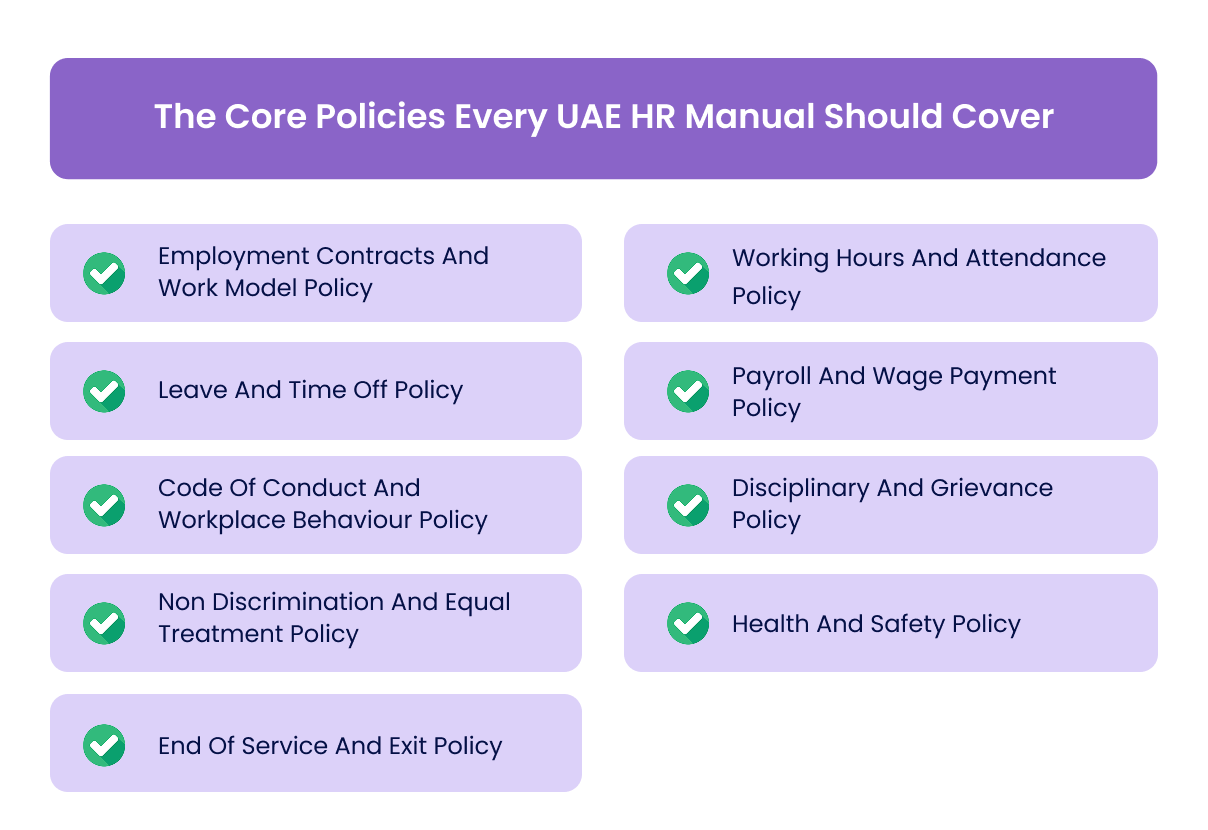
1. Employment Contracts And Work Model Policy
This policy defines how employment relationships are structured. It includes contract types, probation periods, working arrangements, and expectations around remote or hybrid work where applicable.
Clarity at this stage helps prevent misunderstandings later, especially around role expectations and employment terms.
2. Working Hours And Attendance Policy
This policy outlines standard working hours, attendance expectations, break timings, overtime handling, and any variations such as reduced hours during Ramadan.
It also defines how attendance is tracked and how exceptions are handled, which is important for both compliance and operational planning.
3. Leave And Time Off Policy
Leave policies cover annual leave, sick leave, maternity or parental leave, and any additional company-specific leave categories. They should also define how leave is requested, approved, and recorded.
Without clear rules, leave management often becomes inconsistent, leading to disputes or operational disruption.
4. Payroll And Wage Payment Policy
This policy outlines salary cycles, payment methods, deductions, and final settlement procedures, providing clarity to employees on payment timelines and structure.
The Ministry of Human Resources and Emiratisation (MoHRE) reports that the UAE Wage Protection System covers over 99% of private-sector workers, with monthly salary transfers exceeding AED 35 billion, making payroll accuracy and timeliness a critical compliance requirement.
For finance teams, the policy establishes a structured approach to payroll processing, ensuring accuracy, consistency, and regulatory alignment.
5. Code Of Conduct And Workplace Behaviour Policy
This policy sets expectations for professional behaviour, confidentiality, use of company resources, and conflict of interest.
It provides a clear standard for workplace conduct and supports a consistent organisational culture.
6. Disciplinary And Grievance Policy
This policy defines how issues are reported, investigated, and resolved. It includes disciplinary steps, escalation processes, and documentation requirements.
A structured approach reduces ambiguity and ensures that actions are fair and consistent.
7. Non Discrimination And Equal Treatment Policy
This policy outlines the organisation’s commitment to fair treatment and equal opportunity. It also reinforces legal requirements around non-discrimination.
Clear documentation helps ensure that these principles are applied consistently across the organisation.
8. Health And Safety Policy
This policy covers workplace safety expectations, incident reporting, and employee responsibilities. It is particularly important for businesses with physical operations or field-based roles.
9. End Of Service And Exit Policy
This policy defines notice periods, resignation procedures, termination handling, and final settlement processes. It ensures that exits are managed smoothly and consistently.
What Usually Belongs In HR Procedures Rather Than In High Level Policy
An HR policy defines the rules. HR procedures define how those rules are applied in day-to-day operations. Many UAE businesses combine both into one document, but separating them clearly improves usability and consistency.
Policies should remain stable and principle-driven. Procedures can be more detailed and adaptable, especially as systems, teams, or workflows evolve.
Typical areas that belong in procedures rather than high-level policy include:
- Leave Request Workflow
Steps for applying, approving, and recording leave, including system usage and escalation paths. - Attendance And Absence Reporting
How employees report lateness or absence, and how managers document and respond. - Payroll Cut Off And Processing Timeline
Deadlines for submitting payroll inputs, approvals, and adjustments before salary runs. - Disciplinary Process Steps
Investigation stages, documentation requirements, and approval hierarchy for actions taken. - Onboarding And Documentation Requirements
Visa processing steps, document submission, and employee onboarding checklists.
Clear procedures ensure that policies are not interpreted differently by each manager. They reduce dependency on informal guidance and make the HR manual more practical to use.
Where UAE HR Policies Often Break Down In Practice
Even when policies exist, they often fail at the point of execution. The issue is rarely the absence of documentation. It is inconsistency in how that documentation is applied.
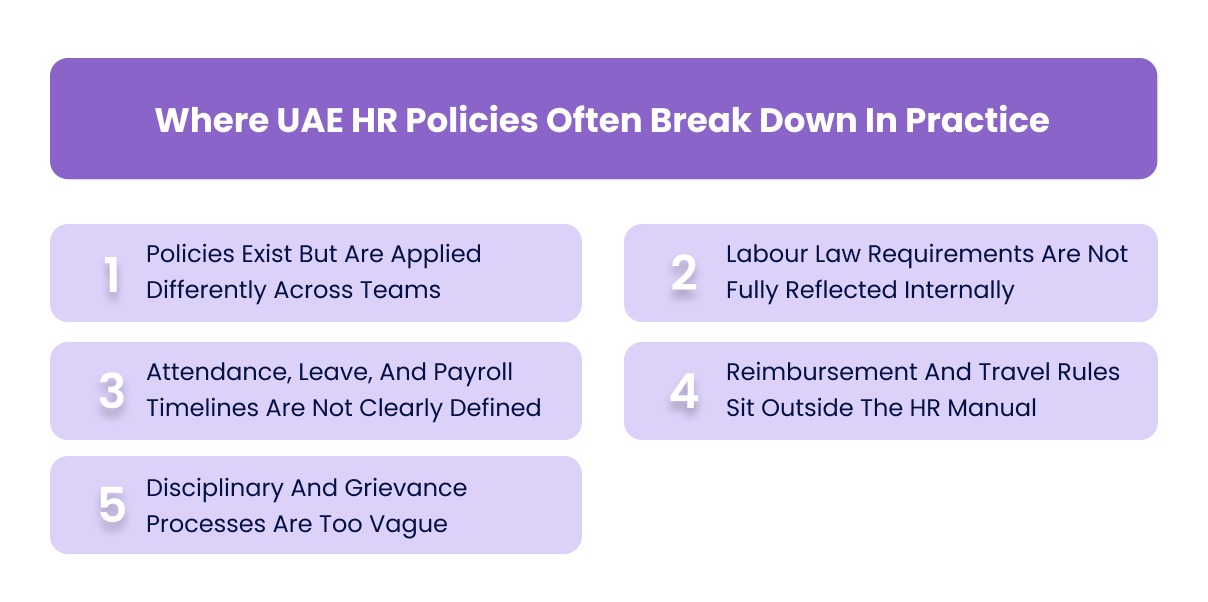
1. Policies Exist But Are Applied Differently Across Teams
Managers may interpret the same policy in different ways. This leads to inconsistent handling of leave, attendance, and disciplinary matters.
2. Labour Law Requirements Are Not Fully Reflected Internally
Policies may reference legal requirements, but internal processes do not always align. This creates gaps between compliance on paper and actual practice.
3. Attendance, Leave, And Payroll Timelines Are Not Clearly Defined
Without clear timelines, delays and confusion become common. Employees may not know when to submit requests, and managers may not know when approvals are required.
4. Reimbursement And Travel Rules Sit Outside The HR Manual
Employee-related spend is often governed informally or through separate documents. This creates gaps in approval, documentation, and consistency.
5. Disciplinary And Grievance Processes Are Too Vague
Policies may outline principles but fail to define steps. This makes it difficult to handle issues consistently and increases the risk of disputes.
How HR Policy Intersects With Finance And Spend Control
HR policy is not limited to employee conduct and leave. It also influences how employee-related spending is managed across the business.
Policies often define:
- Who can incur expenses on behalf of the company
- What types of expenses are allowed
- How reimbursements are processed
- How travel and entertainment spending is controlled
- How corporate cards should be used
When these areas are not clearly documented, finance teams face challenges such as unclear approvals, inconsistent expense claims, and incomplete supporting documentation.

A well-structured HR policy helps align employee behaviour with financial controls. It ensures that spending decisions follow defined rules and that documentation is consistent across teams.
Also Read:
- Travel Entertainment Policy Best Practices
- Small Business Expense Reimbursement Best Practices
- Corporate Credit Card Personal Expenses Policy
How Alaan Supports Policy Enforcement Beyond The HR Manual
Defining policies is only part of the process. The real challenge is ensuring that those policies are followed consistently in day-to-day operations.
At Alaan, we support the execution layer by helping businesses enforce spend-related policies through structured workflows and real-time visibility.
- Corporate Cards With Built In Controls
Businesses can issue cards with limits and merchant restrictions, ensuring that employee spending stays within defined boundaries. - Approval Workflows Before Spend Happens
Expenses can be routed through approval flows, so decisions are reviewed before transactions are completed. - Real Time Visibility Into Employee Spend
Finance teams can track expenses as they occur, reducing reliance on delayed reporting. - Centralised Receipt And Invoice Capture
All supporting documents are linked to transactions, improving accuracy and traceability. - Seamless Accounting Integration
Integrations with systems like Xero, QuickBooks, NetSuite, and Microsoft Dynamics ensure that expense data flows directly into accounting.
This approach ensures that HR policies related to employee spending are not just documented, but actively enforced.
Related:
- Automate Expense Management Approvals
- Control Employee Expenses Improve Spending Management
- Understanding Spend Visibility Business Benefits
Conclusion
A well-defined HR policy in the UAE goes beyond compliance. It creates clarity in how employees are managed, how decisions are made, and how processes are applied across the organisation.
The most effective HR manuals combine legal alignment with practical procedures. They ensure that rules around leave, attendance, payroll, discipline, and employee spending are clearly defined and consistently applied.
When these policies are supported by structured workflows and real-time visibility, businesses can reduce inconsistency, improve control, and create a more predictable operating environment.
If you want to strengthen how employee-related spending is managed and aligned with your policies, you can explore how Alaan helps finance teams maintain visibility, enforce approvals, and keep documentation consistent from transaction to reconciliation. Book a Demo Today!
Frequently Asked Questions
1. What Should Be Included In An HR Policy Manual In The UAE
An HR policy manual should include employment terms, working hours, leave policies, payroll processes, code of conduct, disciplinary procedures, and health and safety guidelines, along with company-specific rules.
2. Are HR Policies Mandatory For Private Companies In The UAE
While not all policies are legally mandated, companies must comply with UAE labour law. Having documented HR policies helps ensure consistent application of those requirements.
3. What Is The Difference Between HR Policy And HR Procedure
HR policies define the rules and principles, while HR procedures outline the steps required to implement those rules in practice.
4. How Often Should HR Policies Be Updated
HR policies should be reviewed regularly, especially when there are changes in labour law, company structure, or operational processes.
5. Should Expense And Reimbursement Rules Be Part Of HR Policy
Yes, employee-related spending, including reimbursements and travel expenses, should be governed by clear policies to ensure consistency and control.
6. Can Small Businesses Use A Simplified HR Policy Manual
Yes, smaller businesses can start with a simplified HR policy manual covering essential areas and expand it as the organisation grows.
Gain control over business expenses with Alaan corporate cards
Invygo earned AED 100,000 in cashback using Alaan cards
Personalise approval workflows to align with your business needs with Alaan's Spend Management platform
Discover the power of automated expense tracking and smarter spend control with Alaan
Turn data into actionable insights with Alaan's spend management tools
Stay Tax Compliant with UAE's #1 Corporate Card and Spend Management Platform
Customisable corporate card policy template
Know how much Corporate Tax you have to pay this fiscal year
Easily integrate Alaan with your ERP for accurate, real-time expense tracking
Close books faster with Alaan's AI-powered accounting automation
Reconcile your books in minutes instead of hours, every single month.
Keep petty cash organized with Alaan corporate cards and automated expense management