.avif)


Advertising spend is one of the hardest costs for finance teams to manage because it moves faster than most financial controls. Budgets are consumed daily across platforms, often automatically, and decisions are made by algorithms long before invoices reach accounting systems.
In many UAE businesses, advertising spend sits at the intersection of finance and growth. Marketing teams optimise for performance and scale, while finance teams are responsible for predictability, cash flow, and control. When visibility is delayed or fragmented, this tension results in overspend, reactive budget freezes, and strained internal alignment.
Managing advertising spend is not about cutting budgets or questioning performance outcomes. It is about ensuring that spend is visible early, owned clearly, and controlled while campaigns are still running. Without that, finance teams are left explaining numbers instead of managing them.
In this blog, we explain why advertising spend is difficult for finance teams to control, where visibility breaks down, and how businesses can manage ad budgets without slowing growth.
Key Takeaways
Advertising spend breaks traditional finance controls because it moves continuously, not transactionally. Daily budget burn and algorithm-driven scaling mean finance teams cannot rely on invoice-based reviews or month-end checks.
- Advertising spend breaks traditional finance controls because it moves continuously, not transactionally. Daily budget burn and algorithm-driven scaling mean finance teams cannot rely on invoice-based reviews or month-end checks.
- The real risk is spend velocity, not total spend. Budgets rarely fail because they are too large. They fail because finance teams do not see how quickly they are being consumed while campaigns are live.
- • Overspend usually comes from delayed visibility, not poor performance decisions. Marketing teams often scale campaigns correctly from a performance perspective, but without real-time guardrails, spend exceeds financial tolerance before finance can intervene.
- • Shared payment methods destroy accountability. When multiple platforms, campaigns, or agencies charge the same card or account, ownership blurs and budget overruns become difficult to trace or correct.
- •Effective ad spend management depends on upfront controls, not retrospective explanations. Finance teams gain leverage when limits, alerts, and ownership are set before campaigns launch, not after results are reviewed.
-
How Advertising Spend Behaves Differently From Other Business Costs
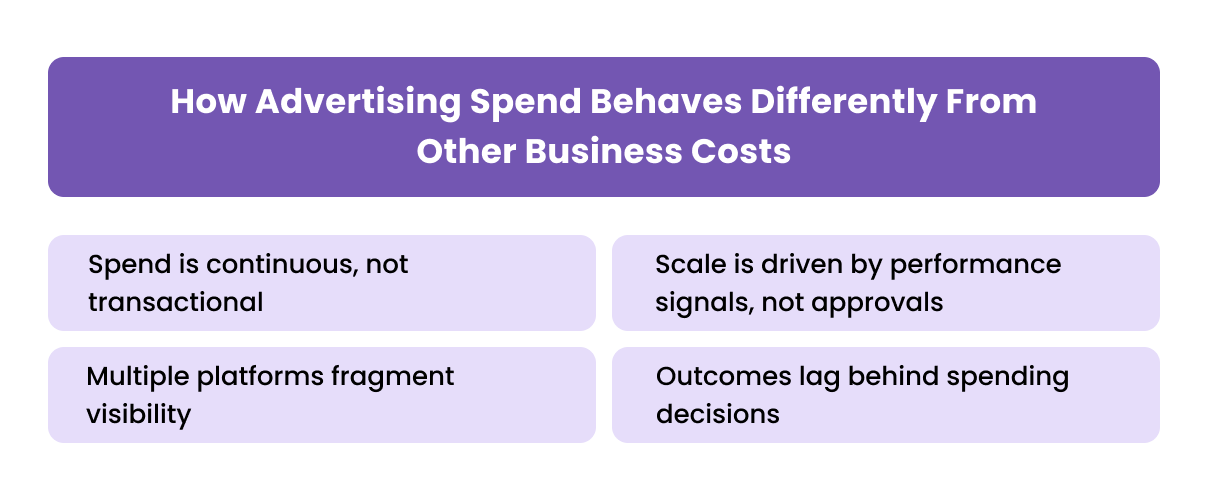
Advertising spend does not behave like most operational expenses. Treating it the same way leads to gaps in control and delayed intervention.
1. Spend is continuous, not transactional
Advertising budgets are consumed every day across platforms rather than through one-time purchases. Once a campaign is live, spend accumulates automatically.
2. Scale is driven by performance signals, not approvals
Algorithms increase budgets when campaigns perform well. Spend can spike without a corresponding finance review if controls are not set upfront.
2. Multiple platforms fragment visibility
Google, Meta, LinkedIn, agencies, SaaS tools, and third-party vendors all contribute to ad spend. No single platform shows the full picture.
3. Outcomes lag behind spending decisions
ROI is evaluated after money has already been spent. Finance teams cannot reverse decisions once performance data is available.
Also Read: Guide To Manage Overall Spending
Where Ad Spend Management Breaks Down In Most Organisations
Ad spend issues rarely come from poor intent. They come from structural gaps between how advertising runs and how finance teams monitor costs.
1. Budgets are reviewed monthly while spend happens daily
By the time finance reviews ad spend, the budget has already been consumed or exceeded.
2. Ad platforms operate outside finance systems
Spend lives in marketing dashboards that finance teams do not monitor in real time. Accounting only sees totals after the fact.
3. Shared cards blur accountability
Multiple platforms, campaigns, and agencies charged to the same card make it difficult to assign ownership or trace overruns.
4. Agency invoices arrive after budgets are spent
Invoices confirm what has already happened instead of acting as a control mechanism.
5. ROI discussions replace spend discipline
Performance explanations are used to justify overspend instead of preventing it through upfront controls.
Also Read: Control Employee Expenses Improve Spending Management
The Financial Risk Of Poorly Managed Advertising Spend
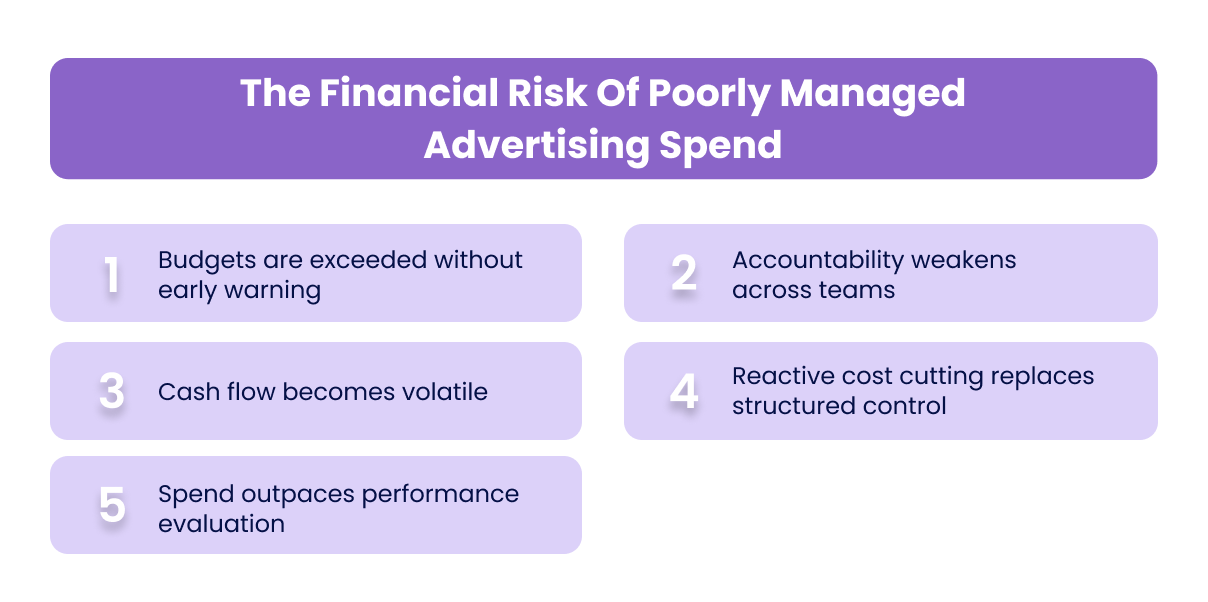
When advertising spend is not actively managed, the risk does not appear as a single failure. It shows up as recurring instability in budgets, cash flow, and internal trust between finance and marketing.
1. Budgets are exceeded without early warning
Advertising platforms can consume allocated budgets faster than anticipated, especially during high-performing periods. Finance teams often learn about the overrun only after it has already occurred.
2. Cash flow becomes volatile
Sudden increases in ad spend create short-term liquidity pressure. Without visibility into daily spend velocity, finance teams struggle to forecast cash requirements accurately.
3. Spend outpaces performance evaluation
Money is spent long before results are fully analysed. This gap makes it difficult to adjust budgets in time or to pause underperforming campaigns early.
4. Accountability weakens across teams
When ownership of spend is unclear, responsibility shifts between marketing, agencies, and finance. This slows decision-making and creates friction during budget reviews.
5. Reactive cost cutting replaces structured control
Overspend often leads to abrupt budget freezes or broad cuts. These actions protect cash in the short term but can damage long-term growth and campaign momentum.
Also Read: Cash Flow Optimisation Strategies And Techniques
What Good Ad Spend Management Looks Like In Practice
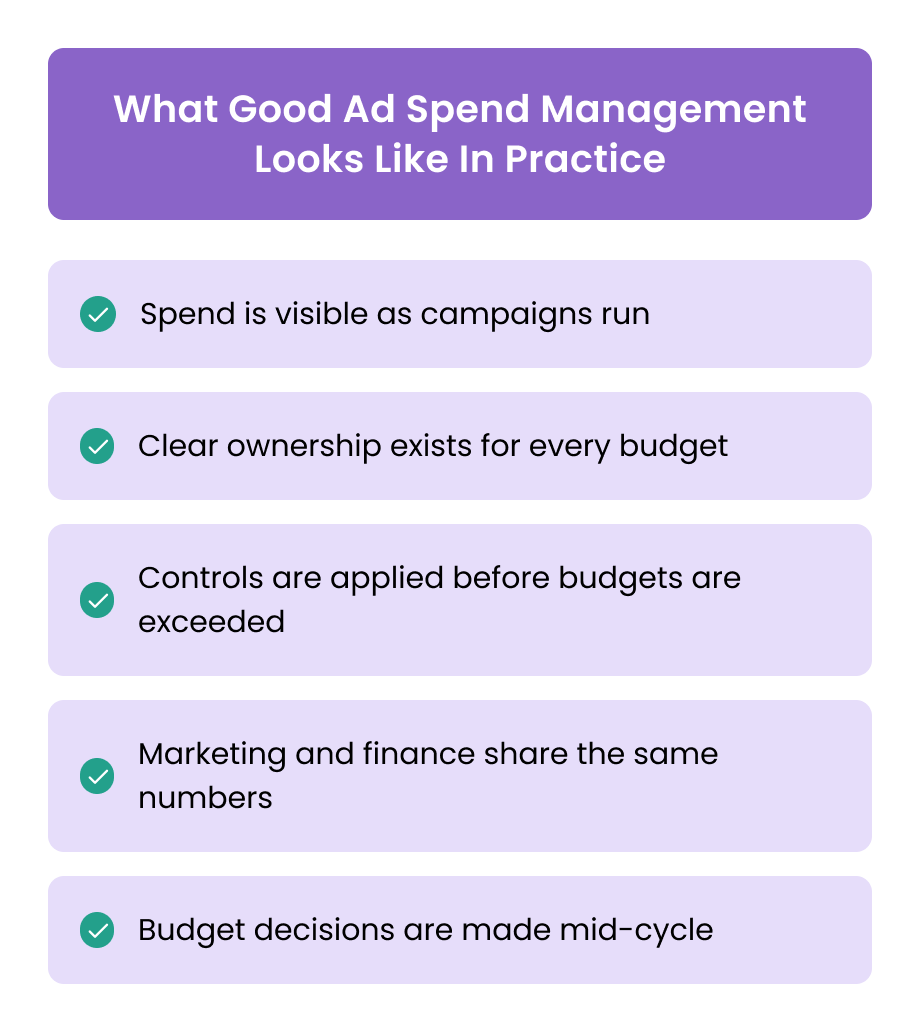
Effective ad spend management is not about limiting marketing activity. It is about giving finance teams the tools to guide spend while campaigns are running, not after they end.
1. Spend is visible as campaigns run
Finance teams can see how much is being spent each day across platforms, rather than waiting for invoices or end-of-month summaries.
2. Clear ownership exists for every budget
Each platform, campaign, or vendor has an accountable owner. Overspend is traceable to a decision, not absorbed silently.
3. Controls are applied before budgets are exceeded
Spend limits, alerts, and thresholds operate during the spend cycle, preventing runaway costs instead of correcting them later.
4. Marketing and finance share the same numbers
Both teams work from a single source of truth. Budget conversations focus on adjustments, not reconciliation disputes.
5. Budget decisions are made mid-cycle
Funds are reallocated toward high-performing campaigns and away from underperforming ones before the budget is fully consumed.
Also Read: Understanding Spend Visibility And Business Benefits
Practical Ways To Manage Advertising Spend More Effectively
Managing advertising spend requires operational discipline, not complex financial modelling. The steps below address the most common gaps seen in high-growth organisations.
1. Separate advertising spend from general marketing expenses
Dedicated cards or accounts for advertising platforms make spend easier to track and reconcile.
2. Set platform-level and campaign-level budgets
Daily and monthly caps prevent overspend while still allowing performance-driven scaling.
3. Monitor spend velocity, not just totals
How quickly budgets are consumed is often a better signal than how much has been spent so far.
4. Align approval thresholds with risk
Higher-risk or experimental campaigns should require tighter controls than stable, proven ones.
5. Review ad spend weekly, not monthly
Finance review cycles should match the pace of advertising platforms to remain effective.

How Finance And Marketing Teams Should Work Together On Ad Spend
Ad spend becomes difficult to manage when finance and marketing operate on different timelines and different data. Alignment does not require finance to micromanage campaigns or marketing to justify every decision. It requires shared guardrails and a common operating rhythm.
1. Agree upfront on what constitutes overspend
Performance alone should not override budget discipline. Both teams need a shared definition of acceptable variance and escalation thresholds.
2. Set guardrails before campaigns go live
Budgets, daily caps, stop-loss limits, and escalation paths should be agreed before spend begins, not negotiated after issues arise.
3. Use shared dashboards, not screenshots or reports
Finance and marketing should rely on the same real-time numbers. This removes reconciliation debates and speeds up decision-making.
4. Review spend cadence based on risk, not hierarchy
Experimental or high-growth campaigns need more frequent review than stable, mature ones. Oversight should scale with exposure.
5. Shift conversations from justification to adjustment
Faster feedback loops allow teams to reallocate budgets mid-cycle instead of defending outcomes after the fact.
Also Read: Improving Internal Control Financial Reporting
How Alaan Supports Advertising Spend Management Without Slowing Growth
Fast-moving advertising spend often sits outside structured finance workflows. Marketing teams execute campaigns across multiple platforms, while finance only sees aggregated card statements or delayed invoices. This fragmentation creates blind spots around ownership, spend velocity, and budget exposure.
Alaan helps close that gap by bringing advertising spend into the same governed environment used for broader business spend, allowing finance teams to maintain oversight without interrupting campaign execution.
- Dedicated Payment Control for Advertising Channels
Separate corporate cards can be issued for each platform, agency, or campaign owner. This removes spend mixing, improves accountability, and makes budget tracking straightforward without requiring marketing teams to change workflows. - Real-Time Visibility Into Spend Behaviour
Transactions appear immediately as they occur. Finance teams gain insight into daily spend patterns and budget burn while campaigns are active, enabling earlier intervention if exposure exceeds tolerance. - Guardrails That Operate During Spend
Configurable limits, controls, and approval logic allow organisations to define boundaries before campaigns run. This supports growth-oriented experimentation while preventing unexpected overspend events. - Clear Ownership and Auditability
Each card, transaction, and budget line is tied to a responsible owner or team. This simplifies internal reviews, reduces ambiguity during budget discussions, and strengthens governance across marketing-finance collaboration. - Accounting Continuity and Reconciliation Efficiency
Advertising transactions sync directly into accounting workflows with structured categorisation. This reduces manual effort at month end and improves forecasting accuracy by shortening the gap between spend and financial visibility.

Rather than slowing marketing execution, structured visibility allows finance teams to support growth confidently. By embedding control and transparency into the payment layer itself, organisations can scale advertising activity without sacrificing predictability or discipline.
Also Read: Expense Management Software Business Spend Tracking
Conclusion
Managing advertising spend is not a marketing exercise. It is a finance discipline that becomes critical as businesses scale. When spend moves faster than visibility, control breaks down and growth becomes volatile.
Finance teams that manage advertising spend effectively do not restrict performance. They enable it by ensuring budgets are visible, ownership is clear, and decisions can be adjusted while campaigns are still running. The result is growth that is repeatable, predictable, and aligned with financial reality.
At Alaan, we help finance teams manage fast-moving spend categories like advertising by providing real-time visibility, clear ownership, and spend controls that operate while campaigns are live. This allows businesses to scale marketing activity without losing financial discipline.
Book a demo to see how finance teams manage ad spend without slowing growth.
Frequently Asked Questions (FAQs)
1. Why Is Advertising Spend So Hard For Finance Teams To Control?
Advertising spend operates in real time and scales automatically based on performance signals. Unlike procurement or travel expenses, there is often no approval checkpoint before money is spent. Finance teams usually see the impact only after budgets are already consumed.
2. What Is The Biggest Cause Of Advertising Budget Overruns?
Delayed visibility is the most common cause. When spend data lives only in marketing dashboards and reaches finance at month end, overspend is discovered too late. By that point, decisions cannot be reversed.
3. How Often Should Finance Review Advertising Spend?
Monthly reviews are too slow for advertising. In high-growth environments, weekly reviews are more effective, especially during launches, promotions, or scaling phases. Review cadence should match spend velocity.
4. How Do Corporate Cards Help With Advertising Spend Management?
Dedicated corporate cards for advertising platforms separate ad spend from other marketing costs. This improves ownership, enables platform-level limits, simplifies reconciliation, and gives finance teams real-time visibility into spend.
5. What Metrics Should Finance Track For Advertising Spend?
Beyond total spend, finance teams should track daily spend velocity, budget utilisation by platform, variance against planned spend, and exposure by campaign or vendor. These indicators surface risk earlier than ROI reports.
Gain control over business expenses with Alaan corporate cards
Invygo earned AED 100,000 in cashback using Alaan cards
Personalise approval workflows to align with your business needs with Alaan's Spend Management platform
Discover the power of automated expense tracking and smarter spend control with Alaan
Turn data into actionable insights with Alaan's spend management tools
Stay Tax Compliant with UAE's #1 Corporate Card and Spend Management Platform
Customisable corporate card policy template
Know how much Corporate Tax you have to pay this fiscal year
Easily integrate Alaan with your ERP for accurate, real-time expense tracking
Close books faster with Alaan's AI-powered accounting automation
Reconcile your books in minutes instead of hours, every single month.
Keep petty cash organized with Alaan corporate cards and automated expense management


%2520(1).avif)