.avif)


Procurement becomes “strategic” in most companies long before the underlying process is actually under control. Supplier decisions may look deliberate on paper, but approvals still happen over chat, category ownership stays unclear, off-contract buying continues, and finance only sees the full picture after the money has already been spent.
That gap is exactly why procurement strategy matters. A good strategy is not just a sourcing plan or a negotiation playbook. It is the structure that connects business priorities to supplier choices, category decisions, risk management, internal policy, and spend execution. CIPS frames procurement strategy as a process aligned to the organisation’s wider corporate strategy, while IBM describes it as a structured plan for guiding purchasing in line with business needs, supplier management, records, and risk control.
For finance leaders, procurement leaders, founders, and operations heads, that distinction matters because procurement outcomes are rarely lost at the point of supplier selection alone. They are usually lost later, when strategy is not matched by approval discipline, documentation standards, payment control, and clear visibility into where spend is actually going.
TL;DR / Key Takeaways
- Procurement Strategies Should Be Built Around Business Priorities, Supplier Risk, And Spend Control, Not Just Unit Price.
- Strong Procurement Strategy Development Improves Supplier Quality, Compliance, Cost Discipline, And Operational Visibility At The Same Time.
- A Practical Procurement Strategy Framework Should Link Category Choices To Stakeholders, Risk Controls, Approval Design, And Execution Workflows.
- Procurement Strategies In Supply Chain Management Need To Balance Cost, Resilience, Speed, And Supplier Dependence Rather Than Optimising For One Goal Alone.
- Alaan Supports Procurement Execution After Strategy Decisions Through Corporate Cards, Approval Workflows, Documentation Capture, And Cleaner Reconciliation.
What Procurement Strategies Actually Cover
A procurement strategy defines how a business plans to buy, from whom it will buy, how supplier decisions will be governed, and what trade-offs it is willing to make across cost, quality, risk, speed, and compliance.
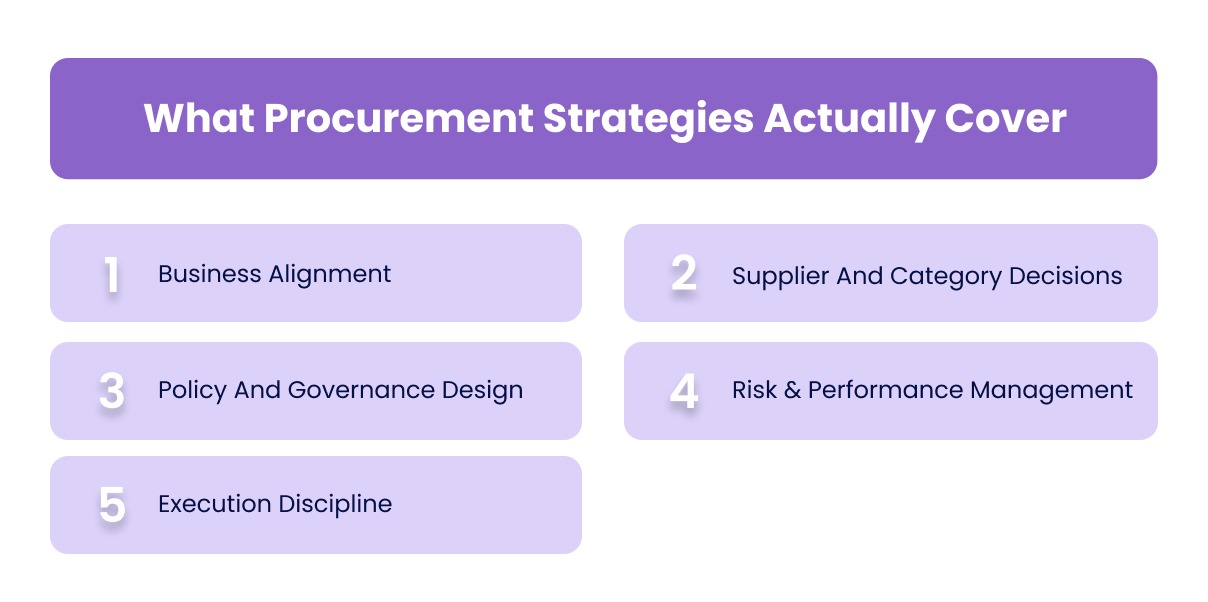
That sounds broad because it is. In practice, procurement strategy usually covers five connected areas.
1. Business Alignment
Procurement should reflect what the business is trying to achieve commercially. A company focused on cost containment will not design procurement the same way as one focused on speed, service quality, or supply resilience. CIPS places alignment to organisational strategy at the centre of procurement strategy for exactly this reason.
2. Supplier And Category Decisions
A procurement strategy also determines how the business approaches categories and suppliers. That includes whether categories should be consolidated, where competition should be increased, which suppliers should be treated as strategic partners, and where the company is accepting concentration risk in exchange for leverage or simplicity.
3. Policy And Governance Design
This is the part many teams underweight. A strategy is not complete when sourcing decisions are made. It also needs clear approval thresholds, preferred-vendor rules, exception paths, contract compliance expectations, and documentation standards. Without that, the business ends up with strategic sourcing decisions and tactical spend leakage at the same time.
4. Risk And Performance Management
A serious procurement strategy must define how supplier risk, operational dependency, service performance, and commercial outcomes will be monitored. IBM’s procurement strategy framework explicitly includes current-state assessment, supplier management, stakeholder engagement, and measurable objectives tied to risk and performance.
5. Execution Discipline
Procurement strategy is ultimately tested in execution. That means the strategy has to survive real purchase requests, urgent exceptions, budget constraints, scattered documentation, and payment workflows. If the operating model cannot hold up under normal business pressure, the strategy is incomplete.
That is why procurement strategy should be treated as more than a sourcing exercise. It is the bridge between commercial intent and controlled spend execution.
Also Read: Procure To Pay Systems Process Steps
Why Procurement Strategy Matters More Than Ever
Procurement strategy has become more important as cost, risk, and operational complexity have increased across supplier ecosystems. It is no longer just about negotiating better prices. It is about ensuring that sourcing decisions are consistent, controlled, and aligned with how the business actually operates.
The following factors explain why procurement strategy now plays a more central role in business performance:
1. Cost Pressure No Longer Sits In Price Alone
Procurement savings are often discussed as if negotiation is the main lever. In reality, cost pressure now sits across supplier fragmentation, poor demand planning, weak policy adherence, contract leakage, and uncontrolled exceptions as much as it sits in headline price. A business can negotiate well and still lose value through weak execution.
That is one reason procurement strategy development matters. It forces the business to look beyond quoted rates and address how procurement decisions actually flow through approvals, suppliers, and payments.
2. Supplier Risk Has Become A Strategic Issue
Supplier concentration, service dependency, disruption risk, and operational resilience all sit much higher on the procurement agenda than they did in simpler buying environments. Strategic procurement is valuable partly because it gives businesses a more deliberate way to identify risk, reduce unnecessary supplier complexity, and strengthen long-term supplier management.
This matters even more in categories where service continuity is more important than headline savings.
3. Stakeholder Sprawl Weakens Buying Discipline
As companies grow, procurement decisions spread across departments. Marketing wants speed, operations wants continuity, finance wants control, and business units often want flexibility. Without a defined procurement strategy framework, each function starts solving for its own priority. The result is usually fragmented sourcing, duplicate vendors, inconsistent approvals, and poor category ownership.
A strong strategy creates shared rules before those tensions turn into uncontrolled spend.
4. Manual Workflows Undermine Procurement Outcomes
Even the best supplier strategy weakens when execution stays manual. If purchase decisions live in email threads, invoices arrive without context, and finance has to reconstruct the audit trail after payment, procurement loses a large part of the value it was supposed to create.

That is why strong procurement strategies need to extend into operating workflows. Strategy without execution control is usually where procurement value starts leaking out.
Related: Cost Reduction Strategies Procurement
Procurement Strategy Development That Holds Up In Practice
A lot of procurement strategy work looks polished in workshops and weak in day-to-day execution. That usually happens because the business jumps too quickly to supplier tactics before it has defined what it is actually trying to fix.

A stronger procurement strategy development process usually follows a more grounded sequence.
1. Start With Current Spend And Process Reality
Before setting a new strategy, the business needs to understand how it is buying today. That means looking at supplier concentration, category fragmentation, exception patterns, off-contract spend, approval delays, and where documentation quality breaks down.
IBM’s procurement strategy guidance starts with current-state analysis and spend analysis for this reason. Without that baseline, the strategy risks solving the wrong problem.
2. Define Business Priorities Before Category Tactics
Not every procurement strategy should optimise for the same outcome. Some businesses need lower costs. Others need speed, supplier resilience, standardisation, or better compliance. Until those priorities are clear, category decisions tend to become reactive and inconsistent.
3. Segment Suppliers And Categories Properly
A growing business should not manage all suppliers the same way. Strategic vendors, operational vendors, low-value routine suppliers, and high-risk specialist suppliers each need different levels of control, review, and relationship management. Segmentation is what turns procurement from general administration into deliberate category management.
4. Align Internal Stakeholders Early
Procurement strategy fails quickly when finance, operations, department heads, and procurement are not aligned on priorities and trade-offs. CIPS explicitly highlights stakeholder engagement as part of procurement strategy design because supplier decisions only hold up when the wider business accepts how they will work in practice.
5. Set Clear Measures For Cost Risk And Compliance
A procurement strategy should define what success looks like. That can include savings quality, approval-cycle efficiency, contract compliance, supplier-performance measures, risk exposure, or documentation completeness. If success is vague, strategy reviews become subjective.
6. Design The Execution Model Before Rollout
This is where many strategies fail. It is not enough to choose preferred suppliers or define category principles. The business also needs to decide how requests will be approved, how spend will be controlled, what documents will be required, and how procurement activity will flow into finance and audit review.
That is the difference between a procurement strategy that sounds strong and one that actually changes spend behaviour.
Also Read: Procurement Automation Software Solution
A Procurement Strategy Framework For Modern Teams
A procurement strategy becomes usable when it is structured clearly enough for teams to apply it consistently. Without a framework, strategy tends to stay conceptual and breaks down under real purchasing pressure.
A practical procurement strategy framework should connect business priorities to execution in a structured way.
1. Business Alignment With Clear Priorities
Every procurement decision reflects a trade-off. Some categories prioritise cost efficiency, others prioritise speed, quality, or resilience. The framework should define these priorities clearly so teams are not making inconsistent decisions across departments.
For example, cost-led procurement may prioritise supplier consolidation, while resilience-led procurement may prioritise diversification.
2. Category Prioritisation And Spend Focus
Not all categories deserve the same level of attention. A strong framework identifies high-impact categories where procurement strategy can drive the most value, whether through savings, risk reduction, or operational efficiency.
Low-value categories can often be standardised, while high-value categories need closer supplier management and tighter controls.
3. Supplier And Risk Design
This part of the framework defines how the business approaches supplier relationships.
- Which suppliers are strategic
- Where single sourcing is acceptable
- Where diversification is required
- How supplier performance and risk are monitored
This is where procurement moves from transactional buying to long-term supplier management.
4. Process And Policy Design
A procurement strategy only works if the process supports it. This includes:
- Approval thresholds
- Preferred vendor rules
- Exception handling paths
- Contract compliance expectations
Without this layer, teams may continue buying outside the intended strategy even when supplier decisions are already defined.
5. Data Visibility And Performance Tracking
A framework should define what procurement data is tracked and reviewed. That includes spend by category, supplier concentration, contract usage, and approval patterns.
Without visibility, strategy cannot be measured or improved.
6. Execution Controls And Continuous Review
Finally, the framework must define how procurement activity is controlled in real time and how it is reviewed over time.
That includes approval workflows, documentation standards, audit trails, and periodic strategy reviews. Procurement is not static. It needs continuous adjustment based on business growth, supplier performance, and market conditions.
Also Read: Enterprise Spend Management Software Solutions
Procurement Strategy Example For A Growing Business
A practical procurement strategy example is often more useful than a list of principles. Consider a mid-sized company dealing with fragmented indirect spend.

Initial Situation
- Multiple suppliers for the same categories
- No clear category ownership
- Purchases approved inconsistently across teams
- Off-contract buying is common
- Finance spends time chasing invoices and receipts after payment
In this setup, procurement exists, but it is not strategic. Costs may not be optimised, and control is weak.
Strategic Changes Introduced
The business defines a procurement strategy with a few focused changes:
- Consolidates suppliers in key categories to improve leverage
- Defines preferred vendors for recurring spend
- Introduces approval thresholds based on spend levels
- Assigns category ownership to specific stakeholders
- Sets documentation requirements before payment
Operational Impact
- Supplier base becomes more manageable
- Spend visibility improves across categories
- Approval decisions become more consistent
- Off-contract purchases reduce significantly
- Finance receives cleaner documentation earlier
Outcome
The company does not just reduce costs. It improves control, reduces operational friction, and creates a more predictable procurement process.
This example highlights an important point: procurement strategy is not only about sourcing better suppliers. It is about making the entire purchasing process more structured and reliable.
Also Read: Automated Procurement Processes Workflows
Procurement Strategies In Supply Chain Management
Procurement strategies also play a central role in supply chain management, where decisions affect cost, resilience, speed, and supplier dependence.
1. Single Sourcing Strategy
A single sourcing approach focuses on one supplier for a category. This can improve pricing leverage, simplify management, and strengthen supplier relationships.
However, it increases dependency risk. If the supplier fails, the business has limited alternatives.
2. Multiple Sourcing Strategy
Multiple sourcing spreads procurement across several suppliers. This improves resilience and reduces dependency but may reduce negotiation leverage and increase coordination complexity.
This approach is common in categories where supply continuity is critical.
3. Strategic Supplier Partnerships
Some suppliers are treated as long-term partners rather than transactional vendors. This approach focuses on collaboration, service quality, and innovation rather than only cost.
It works best in categories where supplier performance directly affects business outcomes.
4. Localisation And Resilience Planning
In certain industries, businesses prioritise local suppliers or geographically diversified suppliers to reduce disruption risk. This approach may increase cost slightly but improves supply stability.
5. Category Consolidation Strategy
Consolidating suppliers within a category can improve pricing and reduce administrative complexity. However, it must be balanced against concentration risk.
6. Demand And Inventory Alignment
Procurement strategy also needs to align with demand planning and inventory management. Over-ordering increases holding costs, while under-ordering creates operational disruption.
A well-aligned strategy ensures procurement supports the broader supply chain rather than working in isolation.
Related: Reduce Logistics Costs Strategies
Common Mistakes Businesses Make With Procurement Strategies
Even well-defined procurement strategies often fail in execution. These issues usually appear when sourcing decisions are not supported by clear approvals, controls, and consistent adoption across teams.

1. Treating Procurement Strategy As A Sourcing Exercise Only
Many businesses equate procurement strategy with supplier selection. Once vendors are chosen, they assume the strategy is complete.
In reality, most value is lost after sourcing, when approvals, policy enforcement, and spend control are weak. Strategy without execution discipline rarely delivers sustained results.
2. Focusing On Cost Savings While Ignoring Spend Leakage
Negotiated savings can be offset quickly by off-contract purchases, duplicate vendors, and uncontrolled exceptions.
If procurement strategy focuses only on price reduction without addressing how purchases actually happen, overall cost control remains weak.
3. Ignoring Stakeholder Adoption Across Teams
Procurement does not operate in isolation. Sales, marketing, operations, and other teams all influence purchasing decisions.
If these stakeholders do not adopt the strategy, they will bypass it. That leads to fragmented procurement behaviour and inconsistent supplier usage.
4. Over-Consolidating Suppliers Without Managing Risk
Supplier consolidation can improve leverage and reduce complexity, but excessive concentration increases dependency risk.
A strong strategy balances efficiency with resilience instead of optimising for one dimension alone.
5. Separating Procurement Design From Payment And Approval Controls
A procurement strategy that defines preferred suppliers but does not control how payments are made will struggle to hold up.
Without approval workflows, spend controls, and documentation requirements, businesses continue making purchases outside the intended framework.
6. Measuring Procurement Activity Instead Of Outcomes
Tracking the number of suppliers reviewed or contracts signed does not indicate success.
Effective procurement strategies measure outcomes such as cost quality, compliance, supplier performance, and spend visibility. Without outcome-based metrics, strategy becomes activity-driven rather than impact-driven.
Also Read: Guide Logistics Spend Analysis
How Finance And Procurement Should Measure Strategy Performance
A procurement strategy is only as strong as the outcomes it delivers. Without clear measurement, teams often default to tracking activity instead of impact, which makes it difficult to understand whether the strategy is actually improving business performance.
A more effective approach focuses on a small set of outcome-driven metrics that reflect cost control, compliance, supplier quality, and operational efficiency.
1. Savings Quality Rather Than Headline Savings
Not all savings are equal. Short-term price reductions can be offset by poor service, hidden costs, or contract leakage. Finance and procurement teams should evaluate whether savings are sustainable and aligned with business priorities rather than focusing only on negotiated price reductions.
2. Contract Compliance Across Categories
A procurement strategy only works if teams actually buy from approved suppliers under agreed terms. High levels of off-contract spend usually indicate that the strategy is not being followed in practice, even if supplier agreements are in place.
3. Supplier Concentration And Risk Exposure
Supplier consolidation can improve efficiency, but it also increases dependency. Monitoring how much spend is concentrated with a small number of suppliers helps teams balance leverage with resilience.
4. Approval Cycle Time And Decision Efficiency
If procurement processes slow down decision-making, stakeholders will bypass them. Measuring approval cycle time helps ensure that control does not come at the cost of operational agility.
5. Purchase And Invoice Match Quality
Clean matching between purchase intent, supplier invoices, and actual payments indicates that procurement and finance processes are aligned. Poor matching often signals weak documentation, inconsistent approvals, or fragmented workflows.
6. Documentation Completeness And Audit Readiness
Every procurement transaction should be supported by clear documentation, including approvals, invoices, and relevant context. Strong documentation improves audit readiness and reduces the time finance teams spend reconstructing transactions later.
Related: Analyse Business Expense Analysis
How Alaan Supports Procurement Execution After Strategy Decisions
Procurement strategy defines how a business intends to buy. The real challenge begins when those decisions need to be executed consistently across teams, suppliers, and transactions.
Alaan operates at this execution layer, helping finance and procurement teams ensure that approved strategies translate into controlled, visible, and well-documented spending.
- Corporate Cards With Spend Controls And Vendor Restrictions
At Alaan, businesses can issue corporate cards with defined limits and merchant controls. This helps keep procurement-related purchases within approved categories and vendor boundaries, reducing off-contract spend. - Structured Approval Workflows Before Spend Happens
Procurement strategies often define preferred suppliers and category rules, but without approval discipline, those rules are easy to bypass. At Alaan, purchases can be routed through configurable approval workflows so decisions are enforced before money leaves the business. - Real-Time Visibility Into Procurement Spend
Procurement teams need visibility across categories, suppliers, and departments. At Alaan, finance and procurement leaders can track spend as it happens, making it easier to identify deviations from strategy early. - Centralised Invoice And Receipt Capture
Invoices and receipts are automatically linked to transactions, ensuring that procurement activity is supported by proper documentation. This reduces fragmented records and improves verification across supplier payments. - Cleaner Reconciliation And Accounting Sync
With integrations into systems like Xero, QuickBooks, NetSuite, and Microsoft Dynamics, procurement spend flows cleanly into accounting. This reduces manual reconciliation gaps and improves accuracy across financial records. - Better Audit Readiness Across Procurement Activity
Each transaction carries a clear trail of approvals, documentation, and categorisation. This improves audit readiness and gives finance teams greater confidence in procurement-related reporting. - SuperPay For Supplier Payment Execution
Where procurement strategy extends into supplier transfers and invoice-based payment workflows, SuperPay adds a connected execution layer through invoice approvals, payment approvals, vendor management, and cleaner reconciliation. That makes it easier for finance teams to enforce strategy not just at sourcing stage, but through the actual payment workflow as well.

Procurement control should not stop at supplier selection. It should extend through approvals, payments, and documentation across the full spend lifecycle.
Also Read: Corporate Card Reconciliation Guide
Conclusion
Procurement strategies are most valuable when they improve how a business actually spends, not just how it negotiates. Supplier selection, category planning, and sourcing decisions matter, but they only deliver value when they are supported by clear policies, structured approvals, and consistent execution.
For finance and procurement leaders, the priority should be simple: ensure that procurement decisions translate into controlled, visible, and compliant spending across the organisation. That requires alignment between strategy, process, and execution, rather than focusing on any one element in isolation.
As businesses scale, this becomes even more important. More suppliers, more stakeholders, and more transactions increase the risk of fragmentation. A strong procurement strategy helps manage that complexity, but only when it is supported by the right operational controls.
If your organisation is looking to strengthen procurement execution, improve spend visibility, and maintain tighter control over supplier-related payments, Book A Demo with Alaan to see how structured workflows and real-time visibility can support your procurement strategy.
FAQs
1. What Is The Difference Between Procurement Strategy And Sourcing Strategy?
Procurement strategy is broader and covers how a business manages suppliers, categories, risk, and spend overall. Sourcing strategy focuses more specifically on how suppliers are selected and negotiated within that broader framework.
2. How Often Should Procurement Strategy Development Be Reviewed?
Procurement strategies should be reviewed regularly, especially when business priorities, supplier markets, or cost structures change. Many businesses revisit strategy annually, with periodic adjustments based on performance data.
3. What Should A Procurement Strategy Framework Include?
A procurement strategy framework should include business alignment, category prioritisation, supplier design, risk management, process and policy rules, and execution controls supported by measurable performance indicators.
4. What Is A Simple Procurement Strategy Example For A Mid Sized Business?
A common example involves consolidating suppliers, defining preferred vendors, introducing approval thresholds, and improving documentation. This typically results in better cost control, reduced supplier fragmentation, and clearer spend visibility.
5. How Do Procurement Strategies In Supply Chain Management Affect Risk?
Procurement strategies directly influence supplier concentration, geographic exposure, and dependency levels. Choices such as single sourcing or diversification can either increase efficiency or improve resilience depending on how they are applied.
6. Why Do Procurement Strategies Fail Even When Sourcing Looks Successful?
Strategies often fail because execution is weak. Without proper approval workflows, spend controls, documentation, and stakeholder adoption, procurement decisions are bypassed and value is lost after supplier selection.
Gain control over business expenses with Alaan corporate cards
Invygo earned AED 100,000 in cashback using Alaan cards
Personalise approval workflows to align with your business needs with Alaan's Spend Management platform
Discover the power of automated expense tracking and smarter spend control with Alaan
Turn data into actionable insights with Alaan's spend management tools
Stay Tax Compliant with UAE's #1 Corporate Card and Spend Management Platform
Customisable corporate card policy template
Know how much Corporate Tax you have to pay this fiscal year
Easily integrate Alaan with your ERP for accurate, real-time expense tracking
Close books faster with Alaan's AI-powered accounting automation
Reconcile your books in minutes instead of hours, every single month.
Keep petty cash organized with Alaan corporate cards and automated expense management