.avif)


Financial markets are no longer evolving only at the interface level. The deeper shift is happening in how markets are structured, connected, and controlled behind the scenes. Execution may be faster and more accessible, but the more meaningful change is in how trades are issued, matched, settled, and monitored across increasingly digital infrastructure.
That shift is already visible in the UAE. The Abu Dhabi Securities Exchange reports that its recent infrastructure upgrade improved trading engine performance by 400%, while also enabling multi-asset post-trade integration and digital bond issuance. That is not just incremental improvement. It signals a structural change in how markets operate at the system level.
In this article, we explain how technology in financial markets is reshaping core infrastructure, including trading, data flows, surveillance, settlement, and risk, along with what that means for finance leaders operating in the UAE.
TL;DR / Key Takeaways
- Technology In Financial Markets Is Reshaping Core Market Infrastructure, Not Just Trading Interfaces
- AI, APIs, Tokenisation, And Post-Trade Automation Are Changing How Markets Function
- Faster Markets Do Not Remove Risk; They Shift Risk Into Data Quality, Models, Controls, And Operational Resilience
- The UAE Is Becoming A Credible Test Market For Digital Market Infrastructure
- At Alaan, We See The Same Direction In Business Finance: More Visibility, Connected Workflows, Predictable Payments, And Tools Built Around UAE Finance Realities
Related: AI Use Cases In Finance Examples Benefits
Technology Is Rewiring Market Infrastructure
Technology in financial markets now affects far more than order execution. It is changing how information travels, how participants interact, how risks are monitored, and how trades move through clearing and settlement. That matters because market quality is shaped as much by infrastructure discipline as by speed. Recent work on financial market infrastructures also points to AI and distributed-ledger applications moving into market operations, collateral workflows, and post-trade efficiency rather than sitting at the edge of the system.
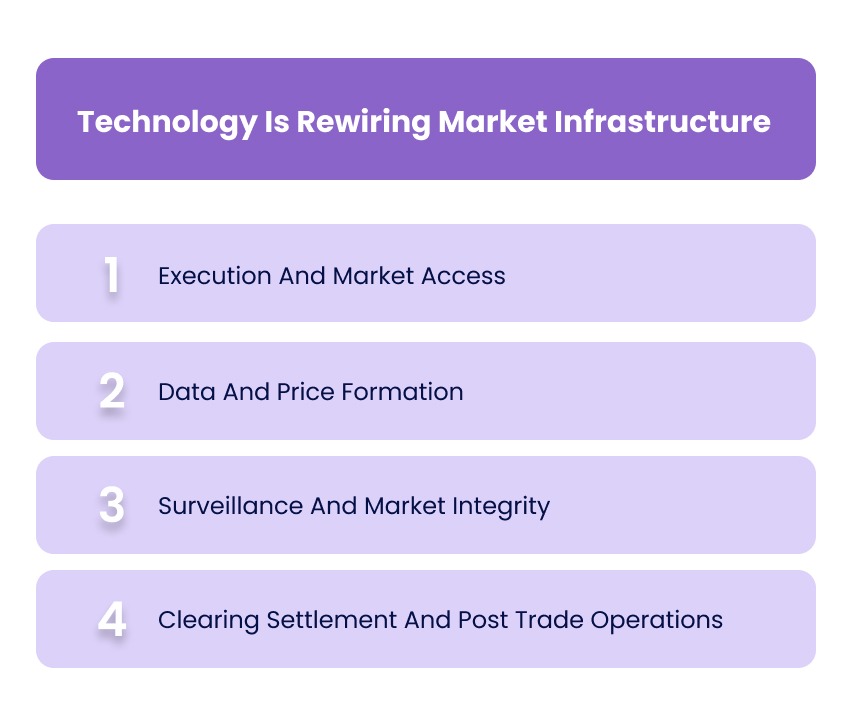
- Execution And Market Access
Market access has become faster, broader, and more automated, but that does not make it simpler. Better execution technology can improve price discovery and participation, yet it also raises the importance of fair access, venue design, and the controls around automated decision-making. - Data And Price Formation
Markets now generate and process much larger volumes of data at much higher speed. That improves visibility, but it also increases dependence on cleaner feeds, better analytics, and stronger governance around how signals are interpreted and acted on. - Surveillance And Market Integrity
As markets become more automated, surveillance has to become more automated as well. Suspicious patterns, unusual order behaviour, and operational anomalies now need to be identified at a pace that matches the market itself, which is why monitoring technology is becoming part of core infrastructure rather than a secondary compliance layer. - Clearing Settlement And Post Trade Operations
Trading may attract the attention, but post-trade systems determine whether a market is operationally strong. When execution becomes faster and products become more digital, settlement, reconciliation, exception handling, and data consistency matter even more.

The Technologies Driving The Biggest Shift
The most important technologies in financial markets are not the ones with the loudest headlines. They are the ones changing how markets function day to day, how participants connect, and how frictions are removed or redistributed across the trade lifecycle.
1. Artificial Intelligence In Market Operations
AI is becoming more relevant where markets generate complexity at scale. That includes surveillance, anomaly detection, forecasting support, liquidity analysis, document handling, and operational prioritisation. The useful question is no longer whether AI appears in financial markets, but where it improves signal quality, reduces manual intervention, or sharpens control without creating new blind spots.
2. Application Programming Interfaces And Market Connectivity
APIs matter because they make markets more connectable. Brokers, custodians, market-data providers, treasury systems, and enterprise tools increasingly depend on structured connectivity rather than file-based or manual handoffs. Better connectivity improves speed and reduces friction, but it also makes markets more dependent on robust standards, stable integrations, and data consistency across systems.
3. Tokenisation And Digital Securities
Tokenisation is one of the more serious structural shifts because it affects how assets are issued, recorded, transferred, and serviced. The real opportunity is not hype around digital assets as a category. It is the possibility of reducing frictions in market processes that have historically been slow, fragmented, or operationally expensive. At the same time, tokenisation can introduce fresh questions around liquidity, concentration, interoperability, and financial stability, which is why it needs to be discussed with more precision than enthusiasm.
4. Cloud Native Post Trade Systems
Post-trade systems are under pressure because modern markets expect more speed, more transparency, and fewer breaks across the lifecycle. Cloud-native architecture can improve scale, resilience, and integration, especially where older market systems rely on fragmented data movement or heavy manual intervention. The benefit is not simply lower cost. It is a cleaner operating model for settlement, reconciliation, and reporting.
5. Cybersecurity And Regtech In Market Operations
More connected markets raise the cost of operational failure. Every improvement in speed or automation increases the importance of access control, resilience testing, data protection, and supervisory traceability. Stronger market technology therefore needs stronger control architecture around it, not just better front-end capability.
Related: Automated Account Reconciliation Benefits Steps
What Changes In Liquidity Price Discovery And Risk
Technology changes markets in second-order ways as well. It affects not only how quickly trades happen, but how liquidity behaves, how signals spread, and how risk accumulates across participants and systems.
- Better Speed Does Not Automatically Mean Better Market Quality
Faster execution can improve responsiveness, but it can also amplify weaker signals, compress decision windows, and increase dependence on automated logic that is only as strong as the assumptions behind it. - Liquidity Can Improve And Fragment At The Same Time
Technology can broaden market participation and increase matching efficiency, but liquidity can still become fragmented across venues, products, and workflows. That means more visible market activity does not always translate into deeper or more stable liquidity. - Model Risk Becomes A Market Issue
Once trading, surveillance, and operational workflows rely more heavily on models, model weakness stops being a local problem. It becomes part of market structure risk, especially when many participants depend on similar signals or automation logic. - Operational Failures Travel Faster In Automated Markets
In slower markets, a process issue may remain local for longer. In more automated markets, the same issue can move across systems, participants, or controls much more quickly. That is why resilience, fallback design, and exception management matter as much as raw processing power.
Also Read: Business Spend Management Tools Importance
Why Settlement And Reconciliation Matter More Now
The faster markets become, the less tolerance they have for weak post-trade discipline. Execution may happen in milliseconds, but value is only realised when records match, obligations settle correctly, and exceptions are resolved without creating wider operational strain. That is why settlement and reconciliation now sit much closer to the centre of market quality than they once did.
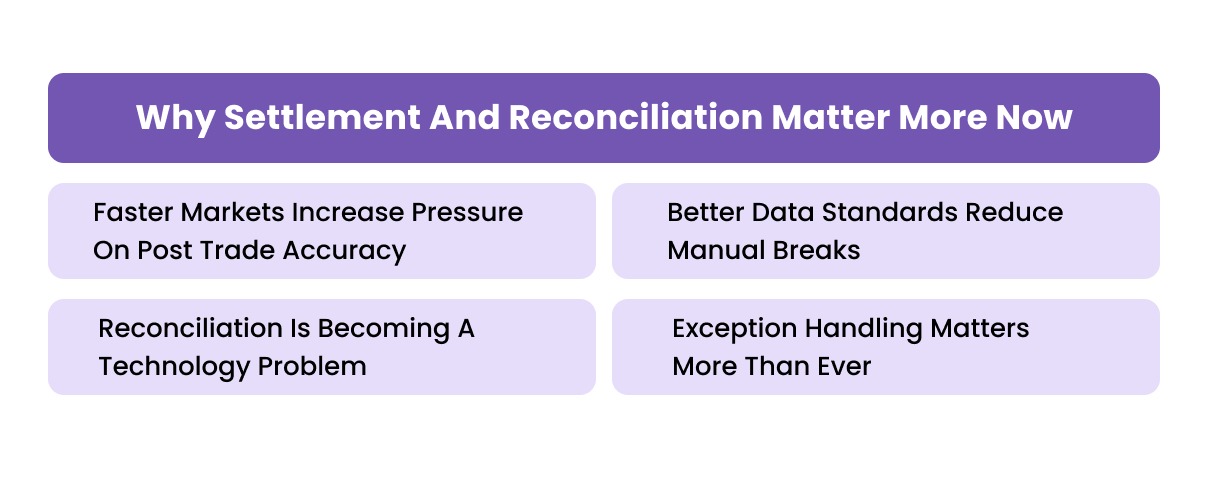
1. Faster Markets Increase Pressure On Post Trade Accuracy
When trading infrastructure becomes faster, the cost of downstream inaccuracy rises. Small breaks in allocation, matching, settlement instructions, or trade enrichment can create much larger operational pressure because the rest of the market is no longer moving at the pace that allows those issues to sit quietly in the background.
2. Better Data Standards Reduce Manual Breaks
Many post-trade problems still begin with inconsistent or incomplete data rather than the trade itself. If transaction details, reference data, identifiers, or counterparty records move poorly across systems, manual breaks multiply quickly. Technology improves post-trade quality most when it reduces those handoff failures rather than simply accelerating the visible front end.
3. Reconciliation Is Becoming A Technology Problem
Reconciliation is no longer just an end-of-day finance task. In more digital and connected markets, it becomes a design issue that affects how systems speak to one another, how records are matched, and how quickly exceptions can be isolated. As tokenisation and digital asset structures evolve, this becomes even more important because the operating model around ownership, transfer, and settlement grows more complex.
4. Exception Handling Matters More Than Ever
Automation removes some routine friction, but it also makes exception quality more important. The stronger systems are not simply the ones that process normal flows quickly. They are the ones that surface anomalies clearly, route them correctly, and resolve them without creating hidden control gaps.
Related: Automated Account Reconciliation Benefits Steps
Why The UAE Matters In This Transition
The UAE matters because this shift is not only being discussed locally. It is being built into real market infrastructure, regulatory architecture, and product experimentation. That makes the country more relevant than markets that talk about financial innovation mainly in abstract terms.
1. Exchanges Are Upgrading Core Infrastructure
Recent exchange upgrades in the UAE show that technology in financial markets is moving beyond interface improvements into deeper operational change. The market story is now about trading engines, post-trade integration, multi-asset support, and digital issuance capability rather than just broader investor participation. ADX’s recent infrastructure and product developments are a strong example of that direction.
2. Digital Asset Regulation Is Moving Into Real Market Structure
A serious market for digital financial infrastructure needs more than appetite for experimentation. It needs regulatory clarity around what can be issued, traded, held, and supervised. The UAE has been building that architecture through structured digital-asset frameworks rather than leaving the space to informal interpretation.
3. Tokenisation Is Moving From Theory To Sandbox
Tokenisation has started to move from conceptual discussion into supervised testing environments. That matters because it gives market participants a route to explore digital securities and tokenised structures under clearer conditions rather than relying on theory alone. It also signals that the discussion is shifting towards workable market design rather than speculative narrative.
4. The UAE Is Becoming A Test Market For Financial Infrastructure
What makes the UAE more interesting is the combination of ambition, execution, and regulatory willingness. Infrastructure upgrades, digital-asset frameworks, and supervised experimentation are all moving in the same direction, which gives the market more credibility as a place where financial-market technology can be tested in practice rather than only promoted.
Also Read: Trade Finance Automation Solution Process
What Finance Leaders Should Watch Closely
Senior finance leaders do not need to become market-structure specialists to care about this shift. The more relevant question is where faster, more connected financial systems create new control expectations for finance teams, treasury teams, and business operators. The logic is familiar: once systems become more automated and more integrated, visibility and discipline matter earlier in the workflow.
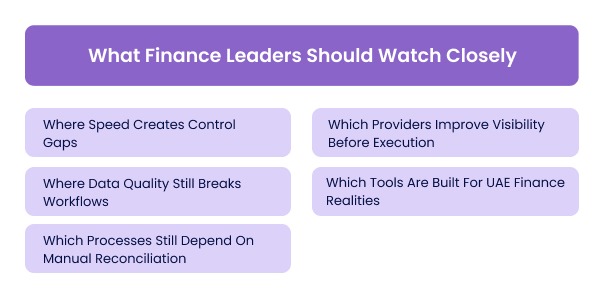
- Where Speed Creates Control Gaps
Faster systems are useful only when approvals, documentation, and exception handling keep pace. If the operating layer stays manual while the transaction layer speeds up, the business often creates new control pressure instead of real efficiency. - Where Data Quality Still Breaks Workflows
Many finance problems still come from inconsistent records, incomplete information, or disconnected systems rather than from the transaction itself. Finance leaders should watch where data still needs manual repair before it can support decision-making properly. - Which Processes Still Depend On Manual Reconciliation
Reconciliation pressure is usually a good signal of where workflow design is still weak. If teams are repeatedly stitching together records across systems after the fact, the underlying process probably needs stronger integration or earlier control logic. - Which Providers Improve Visibility Before Execution
The more useful financial tools are increasingly the ones that show what is happening before money moves, not just after. That includes approval logic, real-time visibility, cleaner documentation, and clearer policy alignment upstream. - Which Tools Are Built For UAE Finance Realities
Market technology is becoming more local in practice. Regulation, payment patterns, compliance expectations, and operational workflows are not identical across regions, so finance leaders should care whether a provider actually fits UAE conditions rather than simply importing a generic model.
Related: Understanding Spend Visibility And Business Benefits
How Alaan Reflects The Same Shift In Business Finance
At Alaan, we focus on the same structural change happening in financial markets: moving control and visibility earlier in the workflow instead of fixing issues after the fact. The value is not in making finance look more digital. It is in making it more predictable, traceable, and easier to manage.
- Corporate Cards With Built-In Spend Controls
Alaan provides corporate cards with pre-set spend limits, merchant controls, and usage restrictions, so businesses can govern transactions at the point of spend rather than relying on post-facto corrections. - Approval Workflows Before Transactions Are Completed
Custom approval flows ensure that purchases and payments are reviewed before execution. This aligns with how modern financial systems are shifting control upstream instead of relying only on reconciliation. - Real-Time Spend Visibility Across Teams And Categories
Finance teams can track transactions instantly by employee, vendor, and category, making it easier to detect anomalies, monitor trends, and maintain control as activity scales. - Receipt Capture And Automated Data Matching
Employees upload receipts through mobile, email, or browser tools. Alaan extracts and matches data automatically, reducing manual validation effort and improving record quality. - Accounting Integrations For Continuous Reconciliation
Direct integrations with systems like Xero, QuickBooks, NetSuite, and Microsoft Dynamics allow transaction data to sync continuously, reducing reconciliation lag and manual entry. - Centralised Audit Trail Across Spend Workflows
Every transaction carries its approval history, supporting documents, and policy context, making it easier to review, audit, and explain financial activity without fragmented follow-up.

In practice, this brings business finance closer to the same direction as modern financial markets: connected systems, earlier control points, and fewer breaks between transaction and reporting.
Also Read: Expense Management Software Business Spend Tracking
Conclusion
Technology in financial markets is not just making trading faster. It is reshaping how markets function across issuance, connectivity, monitoring, settlement, and control. The real shift is structural, not cosmetic.
For finance leaders, the implication is clear. As financial systems become faster and more connected, the tolerance for weak workflows, delayed visibility, and manual reconciliation continues to shrink. The pressure is moving upstream, towards better data, cleaner processes, and stronger control before transactions are completed.
Alaan supports that shift at the business-finance level. By combining corporate cards, approval workflows, real-time visibility, documentation, and accounting integration, it helps finance teams operate with more control, less fragmentation, and fewer surprises. Book a Demo Today!
FAQs
1. Is technology in financial markets mainly about faster trading?
No. Faster execution is the visible part, but the deeper change is in infrastructure. Technology is affecting how markets handle issuance, connectivity, surveillance, settlement, reconciliation, and operational resilience.
2. Why does post-trade technology matter so much if the trade is already done?
Because execution is only one part of the market process. If records do not match, settlement fails, or exceptions are poorly handled, the market still absorbs operational strain. Strong post-trade systems are what turn trading activity into completed market outcomes.
3. Does more automation reduce market risk overall?
Not automatically. It often shifts the risk rather than removing it. As markets automate more, risk moves into areas such as model quality, data integrity, system resilience, exception handling, and dependency on connected infrastructure.
4. What makes tokenisation relevant beyond digital asset hype?
Its real significance is operational. Tokenisation may reduce friction in how assets are issued, transferred, recorded, and serviced. The useful discussion is not whether tokenisation sounds innovative, but whether it improves real market processes without creating new structural weaknesses.
5. Why is the UAE being taken seriously in this area?
Because infrastructure, regulation, and experimentation are moving together. Exchange upgrades, digital asset frameworks, and supervised market testing make the UAE more credible than markets where financial innovation is discussed more than it is implemented.
6. What should finance leaders take from all of this if they are not directly involved in capital markets?
They should pay attention to the direction of travel. Faster, more connected financial systems raise the standard for visibility, approval discipline, data quality, and reconciliation. Even outside capital markets, the same control expectations are moving into business finance workflows.
Gain control over business expenses with Alaan corporate cards
Invygo earned AED 100,000 in cashback using Alaan cards
Personalise approval workflows to align with your business needs with Alaan's Spend Management platform
Discover the power of automated expense tracking and smarter spend control with Alaan
Turn data into actionable insights with Alaan's spend management tools
Stay Tax Compliant with UAE's #1 Corporate Card and Spend Management Platform
Customisable corporate card policy template
Know how much Corporate Tax you have to pay this fiscal year
Easily integrate Alaan with your ERP for accurate, real-time expense tracking
Close books faster with Alaan's AI-powered accounting automation
Reconcile your books in minutes instead of hours, every single month.
Keep petty cash organized with Alaan corporate cards and automated expense management