.avif)


In 2025, the UAE’s shift from guidance to strict VAT enforcement became very real for finance teams. The government introduced mandatory e-invoicing, along with penalties for each non-transmitted or delayed invoice: AED 100 per missed submission, capped at AED 5,000 a month, and additional fines for late adoption.
What most leaders didn’t expect was how sharply this would expose gaps in travel expenses. These are the messiest claims: hotel PDFs without TRNs, ride receipts missing VAT lines, and handwritten meal slips that cannot be used for input VAT recovery.
Under the new system, these aren’t harmless oversights; they’re compliance risks and reimbursement delays waiting to happen.
If you manage HR or finance in the UAE, this is the pressure point you already feel. That’s why this guide focuses on what truly matters in 2026: building a travel expense policy that prevents these failures before they reach audit.
Key Takeaways
- VAT Enforcement Shift: UAE’s 2025 e-invoicing rules impose AED 100 per missed submission (up to AED 5,000/month), making clean, TRN-ready travel receipts essential for compliance and VAT recovery.
- Policy Clarity: A strong travel expense policy must define who can travel, what counts as reimbursable seyaha, documentation standards, and mixed-purpose trip rules to avoid rejected claims.
- Decision-Level Rules: Clear limits for hotels, meals, transport, airfare bands, FX treatment, and pre-approval workflows eliminate ambiguity and prevent reclaim disputes.
- Duty of Care: UAE companies must include safety briefings, emergency contacts, traveller check-ins, and medical preparedness to meet regional duty-of-care expectations.
- Automation Advantage: Real-time spend visibility, automated receipt matching, smart limits, and VAT-ready workflows (as provided by Alaan) make consistent policy enforcement achievable at scale.
What a Travel Expense Policy Covers
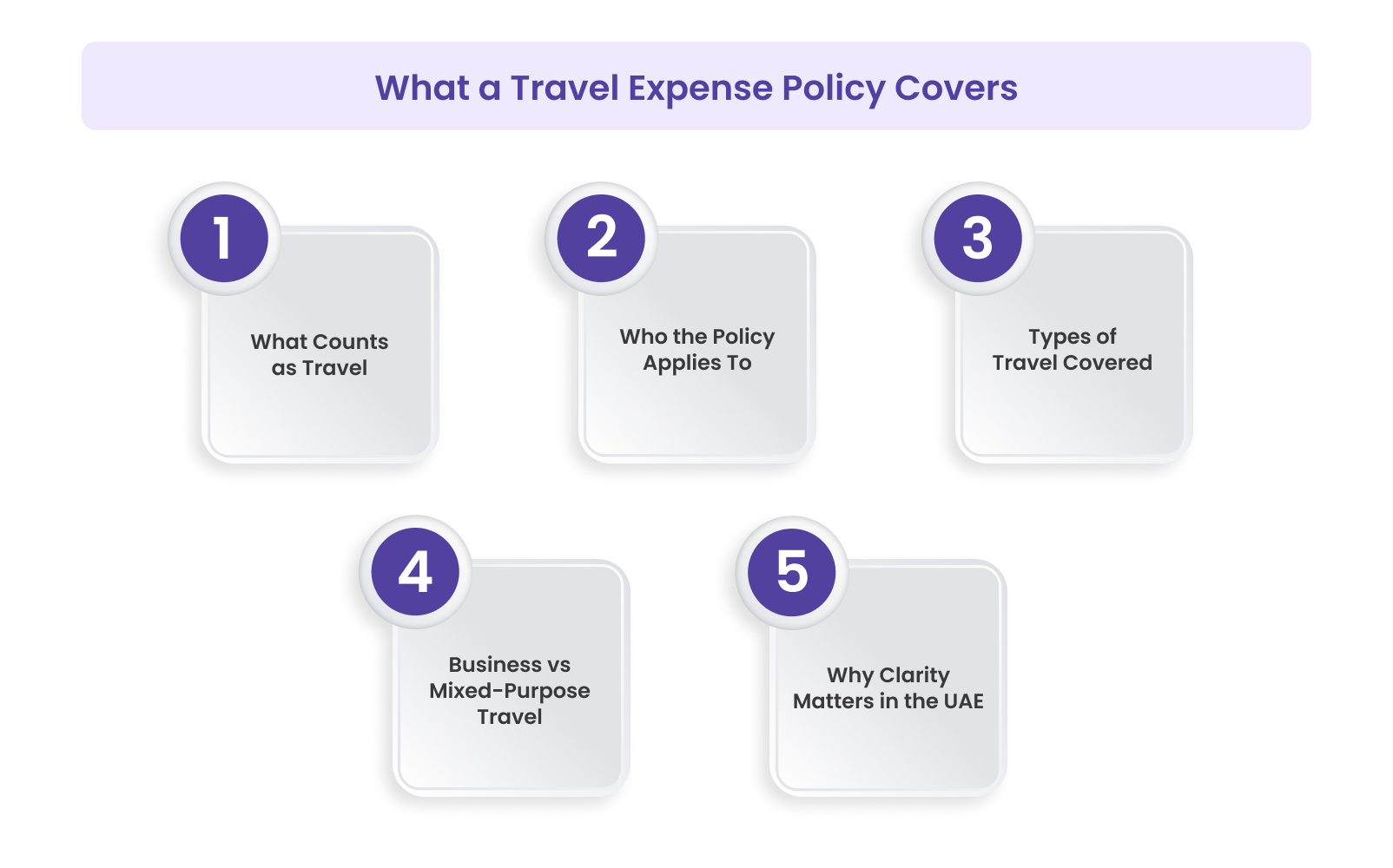
A travel expense policy sets out who can travel, what costs are reimbursable, and the rules that keep claims clean and audit-ready. In the UAE, this clarity is essential. With new e-invoicing and VAT rules from the Wizarat Al-Maliya, even small gaps, missing TRN, unclear receipts, can turn a simple seyaha claim into a compliance issue.
Here’s what your policy must spell out clearly so every claim is processed without back-and-forth or end-of-month surprises.
- What Counts as Travel:
Business travel includes trips made primarily for work, client meetings, conferences, training, project delivery, and site visits, whether within the UAE or abroad.
- Who the Policy Applies To:
Specify inclusion for full-time employees, part-time staff, contractors, consultants, interns, and visiting teams. Clarify if executives follow different bands.
- Types of Travel Covered:
Distinguish between local seyaha within the UAE, GCC trips, and international travel, since limits, receipts, and FX rules differ for each.
- Business vs Mixed-Purpose Travel:
Set criteria for determining the dominant purpose of a trip, and define how to split costs when personal time is added to a business journey.
- Why Clarity Matters in the UAE:
VAT-ready invoices, valid TRNs, and clean line-item descriptions are mandatory. Without these, companies risk losing VAT recovery or triggering penalties under UAE e-invoicing rules.
[cta-1]
Also Read: Why is it a bad idea to use a personal credit card for business expenses?
Once everyone knows who can travel and under what circumstances, the real clarity comes from defining which expenses are actually reimbursable.
Setting Clear Rules for Allowed Expenses
Clear, specific rules stop debates and speed approvals. Rather than broad categories, your policy should list exact reimbursable items, acceptable limits, and required evidence. This is so approvers and travellers know what will pass without back-and-forth. In the UAE context, this must also protect VAT recovery and remove ambiguity around cross-border spend.
Below are the practical, decision-level rules to include in your policy so approvers can act quickly and travellers can comply easily.
| Policy Area | What the Policy Should Clearly Define |
|---|---|
| Pre-Approval Requirements | When pre-approval is mandatory (overnight travel, high-value trips) and the required reference (PO/travel request ID). |
| Airfare Rules | Allowed cabin class by trip length/role (e.g., economy for regional trips; upgrades only with director approval). |
| Hotel Standards | Approved hotel star bands by emirate; requirement for itemised folios with TRN for VAT recovery. |
| Meals & Per Diems | Daily caps or per diem rates by destination; alcohol and gratuity rules. |
| Local Transport | Approved modes (Careem/Uber/taxis/airport transfers); receipt requirements and daily caps. |
| Visa & Entry Costs | Reimbursable visas, travel documents, and fees with proper evidence. |
| Baggage & Seat Fees | Essential baggage allowed; seat upgrades not reimbursable unless pre-approved. |
| Communication Costs | Business-necessary roaming/Wi-Fi reimbursable; rules for corporate eSIM or roaming plans. |
| Corporate Card Usage | Corporate cards as primary payment; advances only when necessary and reconciled within a set timeline. |
| FX & Currency | Reimbursement based on transaction-date FX rate; requires original receipts/statements for foreign currency expenses. |
| Documentation Standards | VAT invoices with TRN, line-item descriptions, boarding passes, hotel folios; rules for missing receipts. |
| Non-Reimbursable Items | Clear exclusions: companion expenses, leisure, minibar, fines, discretionary upgrades. |
| Submission Timelines | Required submission window (e.g., 7–14 days post-travel) and handling of late claims. |
| Exception Process | Who can approve exceptions, required justification, and documentation for audit tracking. |
Also Read: A Guide for VAT Registration in the UAE
With the rules defined, the next step is setting clear spending limits so travellers know exactly what falls within policy before they book.
Spending Limits, Per Diems, and Approvals
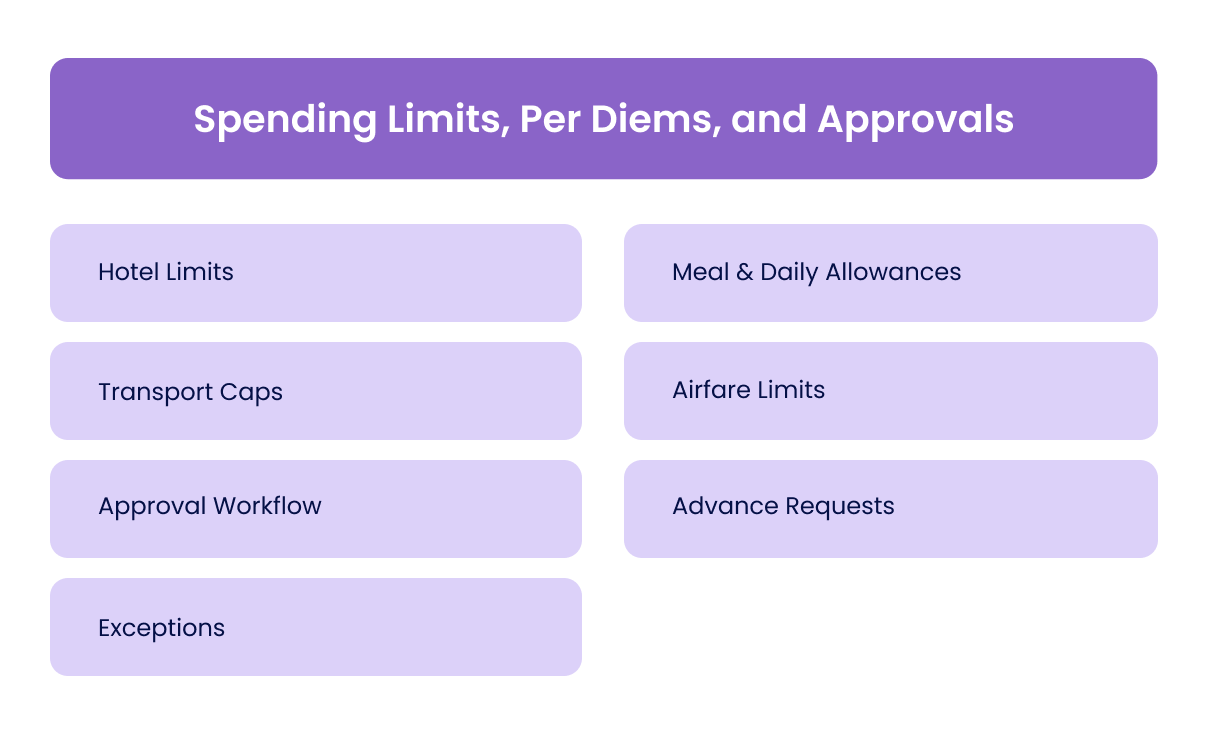
Spending limits only work when they reflect real travel conditions, not generic caps copied from another company. UAE organisations deal with fluctuating hotel rates, peak-season pricing, and large differences between emirates; a 4-star hotel in Ras Al Khaimah is not priced like one in Dubai Marina.
Clear limits protect budgets, but they also prevent awkward reclaim disputes, especially when VAT-compliant receipts are required for every dirham claimed.
Here are the practical rules your policy should define so travellers know their boundaries upfront and approvers can approve requests without delays.
- Hotel Limits:
Set nightly caps by emirate (e.g., higher ceilings for Dubai/Abu Dhabi). Require itemised folios showing TRN for VAT recovery, and specify when rate exceptions are allowed (major events, peak season).
- Meal & Daily Allowances:
Define per diem rates or meal caps by destination. Clarify whether per diems replace receipts or work alongside them, and outline rules for alcohol and gratuities.
- Transport Caps:
Set daily or trip-level limits for taxis, Careem/Uber, and airport transfers. For long inter-emirate travel, allow mileage or higher caps with advance approval.
- Airfare Limits:
Specify allowed fare class by distance and duration (e.g., economy for regional travel; premium economy for long-haul with approval). Clarify whether flexible fares are permitted for last-minute client changes.
- Approval Workflow:
Define a tiered process: employee → line manager → finance, with higher thresholds requiring director sign-off. Include fast-track rules for urgent trips with written approval.
- Advance Requests:
Allow travel advances only where corporate cards aren’t available. Set a reconciliation deadline (e.g., 7–10 days post-trip) tied to receipt submission.
- Exceptions:
Document how exceptions are requested, who approves them, and how they’re logged for audit and quarterly review.
Must Read: What is finance automation?
And none of those limits work unless everyone pays the same way, which is why your policy needs clear rules for payments and FX.
Paying for Travel and Handling FX
Paying for travel should be frictionless, yet inconsistencies in payment methods and FX treatment create the bulk of reconciliation headaches. Clear rules protect VAT recovery, simplify reconciliation, and remove late-stage surprises.
Below are the specific payment and FX controls to include in your policy.
- Corporate Card First: Use for all bookable travel; attach the statement line as proof.
- Advances: Issue only when required; close within 7–10 days with full documentation.
- Personal Cards: Claims must include statement and receipt and match transaction date.
- FX Rules: Use transaction-date FX rate or a company-defined benchmark.
- Bank Charges: Specify whether FX and processing fees are reimbursable.
- Invoice Currency: Prefer vendor billing in their native currency to avoid repeated FX variance.
[cta-4]
With the financial rules defined, the next priority is ensuring every business trip is safe and supported from start to finish.
Travel Safety and Duty of Care
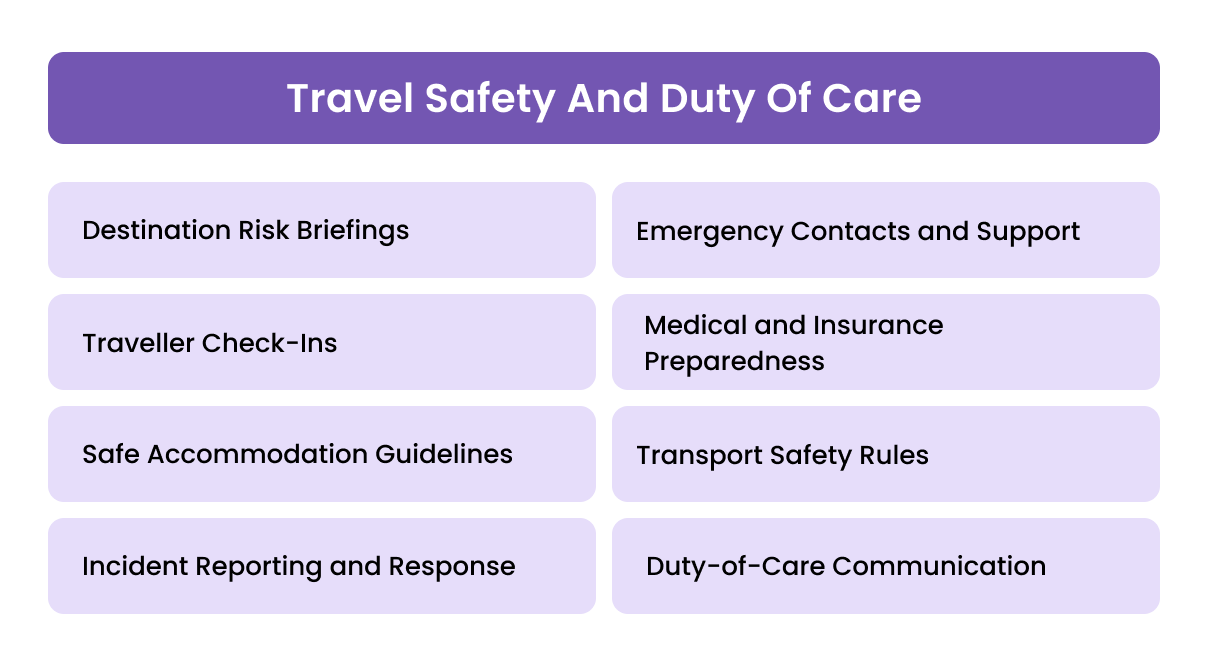
Duty of care in travel isn’t optional for UAE companies. Rapid inter-emirate travel, frequent GCC trips, and shifting local regulations can expose employees to unexpected risks. A clear safety section ensures travellers know what to do, who to contact, and how to respond if plans change or emergencies arise.
Here are the core duty-of-care measures your policy should define to keep travellers safe and supported.
- Destination Risk Briefings:
Provide pre-trip risk information about local laws, cultural norms, weather, and security conditions for UAE, GCC and international destinations. This helps travellers prepare for differences in traffic rules, public behaviour expectations and regional sensitivities.
- Emergency Contacts and Support:
List 24/7 internal contacts (HR or travel desk) and critical external numbers (local emergency services, embassy/consulate). Require travellers to save and test these contacts before departure.
- Traveller Check-Ins:
For higher-risk trips or unfamiliar locations, require scheduled check-ins (arrival confirmation, end-of-day updates). This practice helps monitor well-being and can prompt rapid intervention if someone is unreachable.
- Medical and Insurance Preparedness:
Ensure business travellers have adequate health insurance that covers evacuation, inpatient care, and regional emergencies. Require travellers to carry proof of coverage and necessary medical information.
- Safe Accommodation Guidelines:
Specify approved areas for stays and preferred hotel chains with known security measures. Encourage direct bookings through approved suppliers to ensure consistent safety standards.
- Transport Safety Rules:
Outline expectations for ride services (Careem/Uber), private transfers, and airport pickups, especially for late-night travel. Stress the use of pre-booked, reputable services over ad-hoc options.
- Incident Reporting and Response:
Define how travellers report incidents (accidents, theft, health issues) and how the company escalates support (immediate medical assistance, insurer coordination, family notifications).
- Duty-of-Care Communication:
Communicate safety expectations clearly in policy and team briefings. Reinforce that safety guidance supplements do not replace personal situational awareness.
Policies set expectations, but day-to-day compliance depends on the systems that enforce them. This is where Alaan makes a measurable difference.
How Alaan Supports Travel Expense Control
Managing travel expenses becomes messy when spend, receipts and approvals live in different places. UAE teams struggle with manual reconciliation, missing VAT/TRN documentation, and inconsistent controls.
Alaan centralises corporate spend with real-time visibility, automated receipt matching, and smart limits; helping finance teams enforce policy, cut reconciliation time, and reduce errors across travel claims.
To translate policy into compliant day-to-day behaviour, these are the specific Alaan features that remove manual effort and prevent travel overspend.
- Corporate Cards: Alaan’s smart corporate cards let you issue controlled payment cards for travel with custom spend limits and merchant restrictions, reducing out-of-policy spend.
- Spend Management: Real-time tracking of every transaction gives finance full visibility into travel costs by team, trip, or project.
- Automated Receipt Matching: Capture receipts and match them against travel transactions instantly, ensuring invoices are VAT-compliant before reimbursement.
- Accounting Automation: Direct integration with major accounting tools syncs validated travel expenses into your books, cutting manual reconciliation hours.
- Alaan Intelligence: AI assists with expense categorisation and verification, reducing manual review work for travel claims.
Ready to streamline travel expenses and stay VAT-compliant? Book your personalised Alaan demo and see how easily your team can gain real-time control.
Conclusion
A well-designed travel expense policy only delivers value when it translates into everyday consistency. The teams that succeed in the UAE are the ones that keep travel predictable; clear limits, clean documentation, and fewer end-of-month surprises. The goal is simple: make every claim accurate before it reaches finance.
That’s exactly where Alaan helps. Its real-time controls, automated receipt checks, and VAT-ready workflows give you the structure to enforce policy without extra admin.
If you want travel expenses to run smoothly and stay audit-ready, book a demo with Alaan and see the difference for yourself.
FAQs
1. What makes travel expense policies more complex in the UAE?
UAE policies must account for VAT-compliant invoices, TRN validation, e-invoicing rules, and cross-border GCC travel. These requirements make documentation and approval clarity essential to avoid penalties or VAT loss.
2. Are per diems or actual expenses better for UAE business travel?
Both work, but per diems reduce receipt dependency, while actuals protect VAT recovery. Many UAE companies use a hybrid model: per diems for meals, actuals for hotels and transport.
3. What receipts are required for VAT recovery during travel?
Invoices must include supplier TRN, VAT amount, and itemised descriptions. Hotel folios, ride receipts, and restaurant invoices must follow UAE FTA guidelines to be claimable.
4. How should companies handle mixed business and personal travel?
Your policy should define the dominant purpose of the trip and require travellers to separate personal expenses. Only the business portion, supported by VAT-ready receipts, is reimbursable.
5. How can teams reduce errors in travel expense submissions?
Clear rules, corporate card usage, and real-time verification tools help. Platforms like Alaan automate receipt matching, enforce limits, and check VAT fields, reducing manual errors and back-and-forth.
Gain control over business expenses with Alaan corporate cards
Invygo earned AED 100,000 in cashback using Alaan cards
Personalise approval workflows to align with your business needs with Alaan's Spend Management platform
Discover the power of automated expense tracking and smarter spend control with Alaan
Turn data into actionable insights with Alaan's spend management tools
Stay Tax Compliant with UAE's #1 Corporate Card and Spend Management Platform
Customisable corporate card policy template
Know how much Corporate Tax you have to pay this fiscal year
Easily integrate Alaan with your ERP for accurate, real-time expense tracking
Close books faster with Alaan's AI-powered accounting automation
Reconcile your books in minutes instead of hours, every single month.
Keep petty cash organized with Alaan corporate cards and automated expense management


%2520(1).avif)