.avif)


How hospitality finance leaders can use managed spend benchmarks to spot inefficiencies, budget realistically, and protect thin margins across properties.
- Reference bands give hospitality teams a yardstick, with labour typically running 25% to 40% of revenue, F&B cost of goods 28% to 35% of F&B revenue, utilities 4% to 8%, marketing and distribution 6% to 12%, and admin and general expenses 7% to 10%.
- Benchmark only managed spend, meaning costs you can influence before committing through policy, approvals, and vendor negotiation, rather than fixed leases or purely discretionary guest services.
- Treat benchmarks as ranges rather than single numbers, built from comparable peers, rolling twelve-month data, and figures normalised for one-off events like renovations.
- Benchmarks only pay off when they are built into budgets, turned into department targets, and tracked continuously instead of reviewed at month close.
- Alaan pulls procurement, operational, marketing, and card spend into one place, tags it by property or cost centre, and tracks it against benchmark ranges so deviations show up early.
Hospitality businesses operate with some of the thinnest margins across industries, yet they manage one of the most complex cost structures. Labour fluctuates with occupancy, procurement depends on vendor reliability and volume, utilities vary by season, and marketing spend rises and falls with demand cycles. In this environment, controlling costs is not about cutting spend. It is about understanding whether spend is aligned with what similar businesses achieve under comparable conditions.
This is where benchmarking on managed spend becomes essential. Without benchmarks, finance teams rely on historical budgets and intuition. With benchmarks, they gain a reference point to assess whether costs are structurally high, temporarily elevated, or genuinely optimised. For hospitality groups operating across multiple properties or regions, benchmarking is often the only way to identify which units are performing efficiently and which ones require intervention.
Benchmarking managed spend is not a one-time exercise. It is an ongoing discipline that helps hospitality finance leaders move from reactive cost control to proactive financial management.
In this blog, we explain how hospitality finance teams can use managed spend benchmarks to identify inefficiencies, improve cost discipline, and drive sustainable margin improvement across properties.
Key Takeaways
- Benchmarks turn cost control into a proactive discipline. Without peer reference points, hospitality spend decisions rely too heavily on historical budgets and intuition.
- Managed spend is about influence, not explanation. Only costs that can be controlled before commitment should be benchmarked aggressively.
- Ranges matter more than single numbers. Effective hospitality benchmarks allow flexibility while still setting clear guardrails.
- Benchmarking fails without visibility. Real-time, consistent spend data is a prerequisite for meaningful comparison and early intervention.
- The biggest gains come from operationalising benchmarks. Embedding them into budgets, reviews, and approvals drives lasting margin improvement.
What “Managed Spend” Means In Hospitality Finance
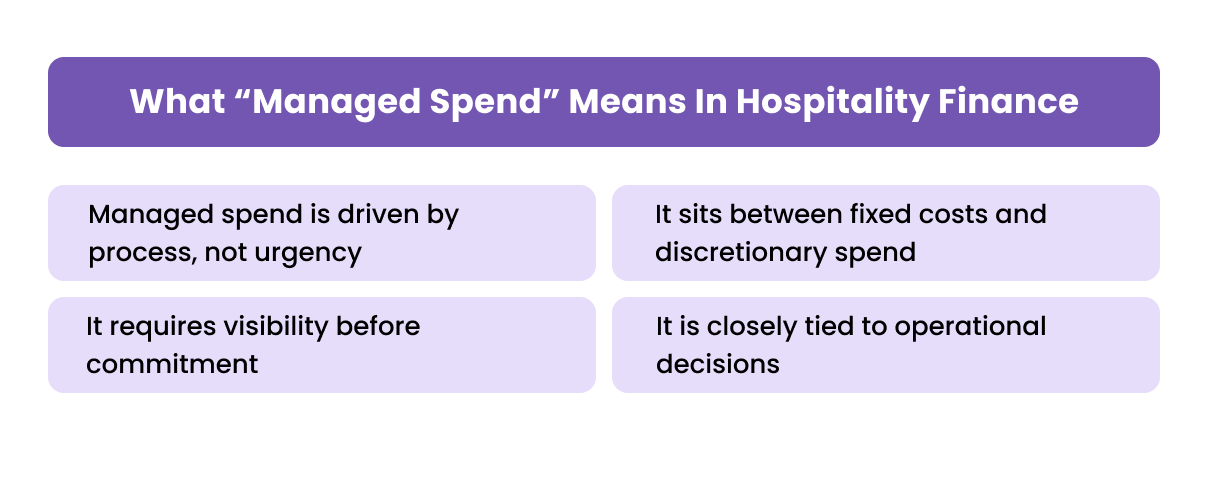
In hospitality, not all costs are equally controllable. Understanding what qualifies as managed spend is the foundation of meaningful benchmarking.
Managed spend refers to expense categories that can be influenced through policy, process, vendor negotiation, and operational discipline. These are costs where finance and operations teams can intervene before money is spent, not just explain it afterwards.
1. Managed spend is driven by process, not urgency
Costs such as procurement, staffing schedules, marketing budgets, and maintenance contracts are planned and governed. They follow approval workflows, budget limits, and defined vendors. When these processes are weak or inconsistent, spend quickly becomes reactive.
2. It sits between fixed costs and discretionary spend
Hospitality businesses have truly fixed costs, such as lease payments, and highly variable costs, such as guest-related services. Managed spend lies in between. Labour rosters, supplier pricing, utilities usage, and marketing budgets can all be adjusted based on demand forecasts and performance benchmarks.
3. It requires visibility before commitment
Spend is only manageable if finance teams can see it early. If costs surface after invoices are issued or after the month closes, they are already sunk. Managed spend relies on early signals, approvals, and real-time tracking.
4. It is closely tied to operational decisions
In hotels and restaurants, spend decisions are often made by operations managers, not finance teams. Managed spend frameworks ensure that these decisions align with financial targets without slowing down day-to-day operations.
Without a clear definition of managed spend, benchmarking efforts tend to fail. Finance teams end up comparing costs that were never intended to be controlled in the first place.
Also Read: Effective Business Spending Policies
Why Benchmarking Managed Spend Matters In Hospitality
Benchmarks give finance leaders context. They answer the question that internal reports cannot: Is this level of spend reasonable for our business model and market?
1. They separate structural issues from short-term variance
A single month of high costs may be driven by seasonality, renovations, or special events. Benchmarks help finance teams identify whether a cost category is consistently above industry norms or only temporarily elevated.
2, They enable realistic budgeting and forecasting
Budgets built purely on last year’s numbers often reinforce inefficiencies. Benchmark-based budgeting allows finance teams to reset expectations based on peer performance rather than internal precedent.
3. They strengthen vendor and supplier negotiations
When finance teams understand industry-standard cost ratios, they enter negotiations with leverage. Benchmarks provide an external reference that strengthens pricing discussions with suppliers and service providers.
4. They improve accountability across properties and departments
For hospitality groups with multiple locations, benchmarking highlights performance gaps clearly. It becomes easier to identify which properties are operating efficiently and which ones need targeted support or process changes.
5. They support long-term margin improvement
Hospitality margins improve incrementally. Benchmarking helps finance teams prioritise the spend categories that offer the highest impact over time rather than pursuing broad, unfocused cost reductions.
Without benchmarking, cost control efforts often rely on intuition or blanket cuts. With benchmarking, finance leaders gain a structured basis for decision-making.
Also Read: Understanding Spend Visibility And Business Benefits
Key Spend Categories To Benchmark In Hospitality
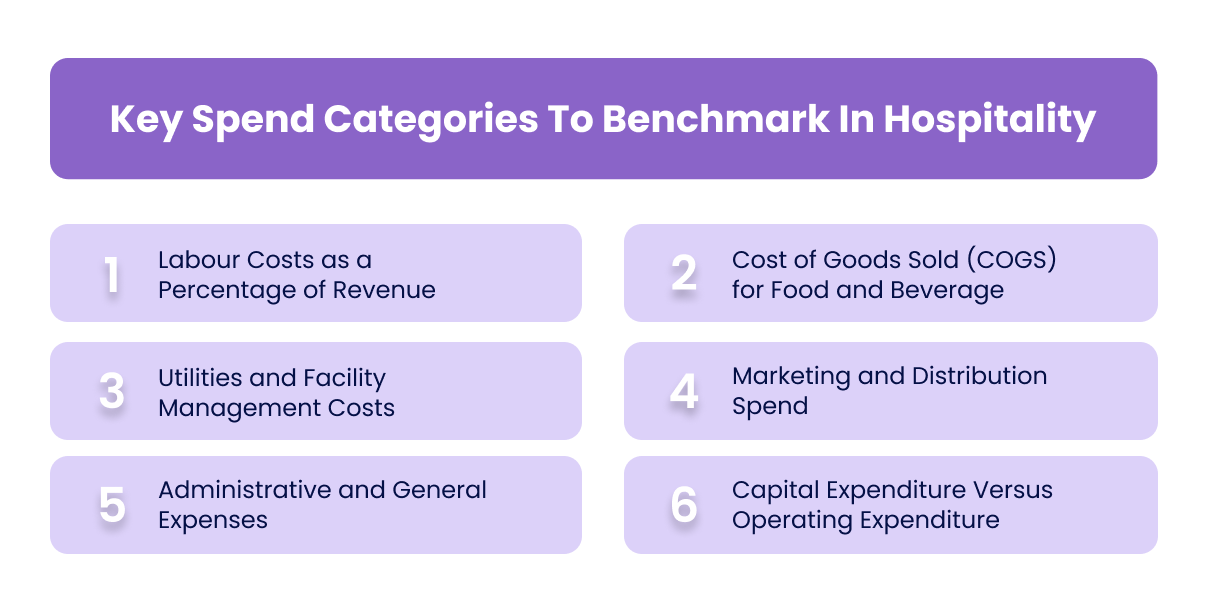
Effective benchmarking in hospitality starts with choosing the right spend categories. Not every cost deserves equal attention. Finance teams should focus on categories that materially impact margins, vary by operational efficiency, and can be influenced through management action.
1. Labour Costs as a Percentage of Revenue
Labour is typically the largest controllable expense in hospitality. Benchmarking labour spend helps finance teams assess whether staffing models are aligned with occupancy and service levels. Persistent variance against benchmarks often signals scheduling inefficiencies, overstaffing during low occupancy, or underinvestment in productivity tools.
Importantly, labour benchmarks should always be reviewed alongside service standards and guest satisfaction scores to avoid false optimisation.
2. Cost of Goods Sold (COGS) for Food and Beverage
For properties with restaurants, bars, or banquet operations, F&B COGS is a critical benchmark. High variance here may reflect poor inventory management, vendor pricing issues, portion control problems, or waste. Finance teams should benchmark COGS not only against revenue, but also across similar outlet types within the same portfolio.
3. Utilities and Facility Management Costs
Energy, water, and maintenance costs often fluctuate due to seasonality and asset age. Benchmarking these costs helps distinguish between structural inefficiencies, such as outdated equipment, and normal seasonal variation. Over time, this data supports capital planning decisions, including energy efficiency investments.
4. Marketing and Distribution Spend
This includes digital advertising, OTA commissions, brand marketing, and loyalty programme costs. Benchmarking marketing spend as a percentage of room revenue or total revenue helps finance teams assess whether customer acquisition costs are aligned with industry norms and expected lifetime value.
5. Administrative and General Expenses
Overheads such as finance systems, licensing, legal, and professional services often grow unnoticed as businesses scale. Benchmarking A&G expenses helps identify cost creep and ensures that back-office growth remains proportional to operational scale.
6. Capital Expenditure Versus Operating Expenditure
Hospitality businesses are asset-heavy. Benchmarking the balance between CapEx and OpEx provides insight into how much is being spent on asset maintenance versus operational fixes. Persistent high OpEx may indicate deferred capital investment.
Selecting the right categories ensures benchmarking efforts remain actionable rather than overwhelming.
Also Read: Enterprise Spend Management Software Solutions
How To Develop Reliable Hospitality Spend Benchmarks
Benchmarking is only as good as the methodology behind it. Poorly constructed benchmarks create misleading conclusions and erode trust in financial insights.
1. Define a Comparable Peer Group
Benchmarks must reflect comparable properties in terms of size, service level, geography, and target customer segment. Comparing a luxury resort to a mid-scale business hotel will produce distorted conclusions. Finance teams should narrow peer groups deliberately.
2. Select Metrics That Reflect Operational Reality
Percentages alone are insufficient. Metrics should link spend to revenue drivers, such as labour cost per occupied room or marketing spend per booking. This ensures benchmarks reflect efficiency, not just scale.
3. Use Rolling Periods Instead of Single Months
Hospitality is seasonal by nature. Benchmarks based on rolling twelve-month data reduce distortion caused by peak and off-peak periods and provide a more stable reference point.
4. Normalise for One-Off Events and Irregular Spend
Renovations, system upgrades, and exceptional events should be adjusted or excluded when building benchmarks. Failing to do so inflates baseline costs and weakens long-term comparisons.
5. Combine Internal and External Data Sources
Internal historical performance provides context, while external industry benchmarks offer perspective. The most reliable benchmarks sit at the intersection of both.
6. Set Target Ranges, Not Single Numbers
Benchmarks should be expressed as acceptable ranges rather than fixed points. This allows flexibility while still providing clear guardrails for management.
A disciplined benchmarking process ensures that insights drive better decisions rather than reactive cost cutting.
Also Read: Analyze Business Expense Analysis
Hospitality Spend Benchmarks: Example Ranges (UAE And MENA Context)
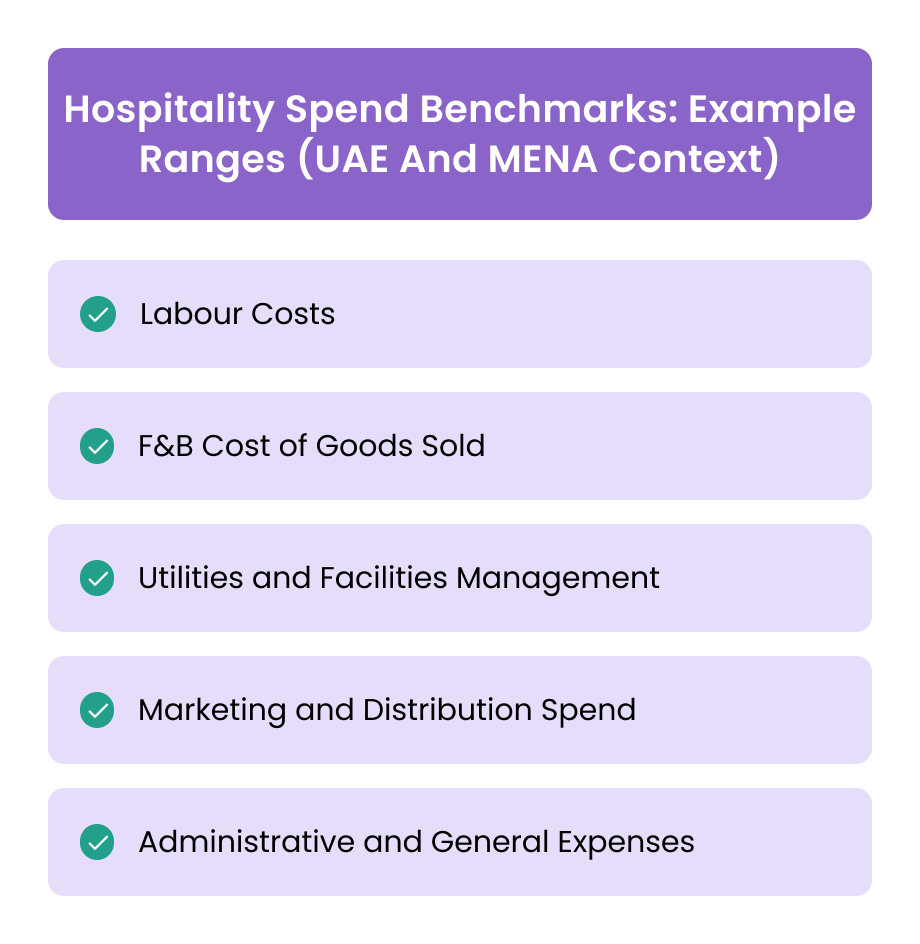
Spend benchmarks in hospitality are most useful when treated as directional ranges rather than absolute targets. Variations in service level, asset age, location, and seasonality all influence where a business should reasonably sit within a range. That said, having reference bands helps finance teams identify when costs are drifting beyond what comparable operators typically achieve.
1. Labour Costs
Labour expenses in hospitality commonly range between 25% and 40% of total revenue, depending on service intensity and property type.
- Limited-service or business hotels tend to sit at the lower end.
- Luxury hotels, resorts, and properties with extensive F&B operations trend higher.
Persistent variance above peer benchmarks often points to inefficient rostering, weak demand forecasting, or limited use of productivity tools.
2. F&B Cost of Goods Sold
F&B COGS typically falls between 28% and 35% of F&B revenue.
Higher ratios may indicate poor inventory controls, supplier pricing issues, or menu inefficiencies. Finance teams should benchmark this separately for different outlets, as banqueting, casual dining, and fine dining each have distinct cost profiles.
3. Utilities and Facilities Management
Utilities and maintenance costs generally account for 4% to 8% of total revenue in the region.
Properties exceeding this range may be affected by aging infrastructure, inefficient energy systems, or reactive maintenance practices. Benchmarking these costs over time supports capital planning and sustainability initiatives.
4. Marketing and Distribution Spend
Combined marketing and distribution costs often range from 6% to 12% of total revenue, depending on brand strength and channel mix.
Properties heavily reliant on OTAs typically sit at the higher end, while strong direct booking strategies reduce long-term acquisition costs.
5. Administrative and General Expenses
A&G expenses usually represent 7% to 10% of total revenue.
Growth without cost discipline often shows up here first, through overlapping systems, vendor sprawl, or duplicated roles across properties.
These ranges should be used as reference points. Finance teams should always interpret them in the context of their specific operating model and strategic priorities.
Also Read: Cash Flow Optimisation Strategies And Techniques
Common Challenges In Applying Spend Benchmarks In Hospitality
Even well-researched benchmarks can fail if applied without care. Hospitality finance teams often encounter recurring challenges that reduce the effectiveness of benchmarking efforts.
1. Inconsistent or Incomplete Data
Fragmented systems and manual processes lead to gaps in spend data. Without reliable inputs, benchmarks lose credibility and are difficult to operationalise.
2. Lack of Comparability Across Properties
Differences in size, service level, and market positioning make direct comparisons challenging. Benchmarks must be adjusted to reflect these structural differences.
3. Seasonality Distorting Short-Term Results
High-season and low-season cost structures differ significantly. Applying static benchmarks without seasonal adjustment can lead to misleading conclusions.
4. Operational Resistance to Benchmark Findings
Benchmarks can be perceived as cost-cutting tools rather than performance insights. Without clear communication, operational teams may resist changes driven by benchmark analysis.
5. Overreliance on External Data
External benchmarks provide context, but internal trends often matter more. Finance teams should balance peer comparisons with their own historical performance.
Addressing these challenges requires not just better data, but also stronger collaboration between finance and operations.
Also Read: Control Employee Expenses Improve Spending Management
Practical Steps To Use Benchmarks To Control Hospitality Spend
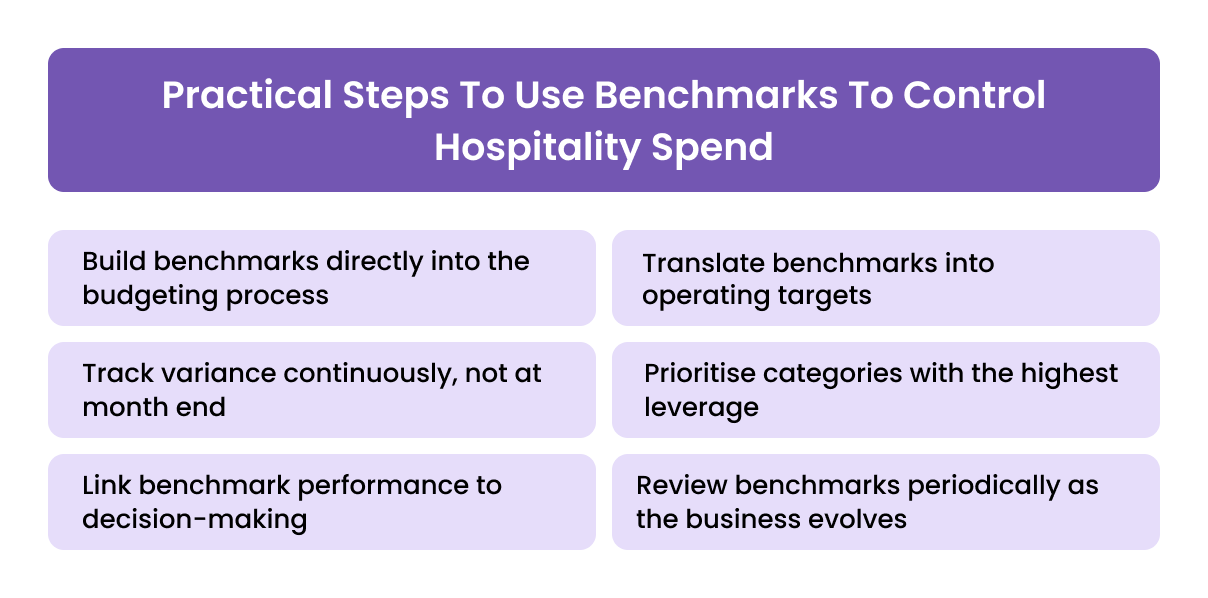
Benchmarks only create value when they are embedded into day-to-day financial operations. Used passively, they become reference material. Used actively, they become control mechanisms.
1. Build benchmarks directly into the budgeting process
Annual and quarterly budgets should be stress-tested against benchmark ranges before approval. If projected labour or marketing spend sits above peer norms, the variance should be intentional and documented, not accidental.
2. Translate benchmarks into operating targets
Benchmarks should not remain finance-only metrics. Translating labour cost ratios or F&B COGS targets into department-level goals improves ownership and accountability across operations teams.
3. Track variance continuously, not at month end
Waiting until month close to review performance removes the ability to intervene. Finance teams should monitor benchmark variance on a rolling basis and flag deviations early.
4. Prioritise categories with the highest leverage
Not all variances require immediate action. Focus should remain on spend categories that materially impact margins, such as labour scheduling, procurement efficiency, and distribution costs.
5. Link benchmark performance to decision-making
Staffing adjustments, vendor renegotiations, or marketing reallocation should be triggered by benchmark data, not anecdotal feedback or isolated performance issues.
6. Review benchmarks periodically as the business evolves
As properties mature, expand, or reposition, benchmark targets must be recalibrated. Static benchmarks quickly lose relevance in a dynamic hospitality environment.
When benchmarks are operationalised this way, they shift cost control from reactive explanations to proactive management.
Also Read: Track Business Spending Simple Steps
How Technology Improves Spend Benchmarking In Hospitality
Manual benchmarking quickly breaks down in hospitality due to volume, complexity, and speed. Technology plays a critical role in making benchmarking accurate, timely, and scalable.
1. Centralised spend visibility across properties
Technology consolidates spend data from multiple locations, departments, and vendors into a single view. This is essential for meaningful portfolio-level benchmarking.
2. Real-time variance tracking against benchmarks
Automated dashboards allow finance teams to see when spend drifts outside acceptable ranges, enabling earlier intervention.
3. Consistent categorisation of expenses
Automated categorisation ensures that costs are classified uniformly across properties, improving comparability and reducing manual reconciliation effort.
4. Integration with accounting and ERP systems
Seamless data flow between spend platforms and accounting systems ensures that benchmark analysis is based on accurate, complete financial data.
5. Scalable reporting for multi-unit operations
As hospitality groups expand, technology enables benchmarking at both property and group levels without multiplying workload.
Without the right systems, benchmarking becomes time-consuming and error-prone. With the right tools, it becomes a continuous management discipline.

Also Read: Expense Management Software Business Spend Tracking
How Alaan Helps Hospitality Teams Benchmark And Manage Spend
For hospitality finance teams, benchmarking only works when spend data is timely, consistent, and reliable. Alaan supports this by turning managed spend into structured, analysable data rather than fragmented transactions.
1. Centralised visibility across hospitality spend categories
Alaan brings procurement, operational expenses, marketing spend, and corporate card usage into a single platform. This allows finance teams to view spend by property, department, or category, which is essential for accurate benchmarking.
2. Real-time tracking against benchmark ranges
Finance teams can monitor spend as it occurs and compare it against defined benchmark thresholds. This enables early identification of deviations rather than post-period explanations.
3. Clear allocation and ownership of spend
Expenses can be tagged by property, outlet, or cost centre, ensuring that benchmark variance can be traced back to specific operational decisions instead of remaining aggregated at a group level.
4. Policy-driven controls aligned to benchmarks
Spend limits and approval workflows can be structured to reflect benchmark targets, helping prevent overspend before it happens rather than correcting it later.
5. Clean integration with accounting and ERP systems
Benchmark analysis relies on accurate financial data. Alaan’s accounting integrations ensure that spend data flows into books consistently, reducing reconciliation gaps and improving reporting confidence.
For hospitality groups managing multiple locations and high transaction volumes, this combination of visibility, structure, and control is what makes benchmarking actionable rather than theoretical.

Conclusion
Benchmarking managed spend is no longer optional for hospitality finance leaders. In an industry defined by high operating leverage, seasonal volatility, and margin pressure, benchmarks provide the reference points needed to separate acceptable variance from structural inefficiency.
When used correctly, benchmarks do more than highlight problems. They inform budgeting, strengthen operational accountability, support vendor negotiations, and guide long-term margin improvement. Most importantly, they allow finance teams to intervene early, when decisions can still be influenced.
For hospitality businesses aiming to scale sustainably, benchmarking managed spend is not a reporting exercise. It is a core financial discipline.
At Alaan, we help hospitality finance teams turn managed spend into structured, real-time data that can actually be benchmarked and acted upon. With consistent visibility and control across properties, benchmarks move from static references to active decision tools.
Book a demo to see how real-time spend visibility supports better benchmarking.
Benchmarks only help when the spend data behind them is clean and consistently tagged, which is the job of a proper spend management system. To put a number on what tighter control could save across your properties, try the Alaan savings calculator.
Frequently Asked Questions (FAQs)
1. What is managed spend in the hospitality industry?
Managed spend refers to cost categories that can be influenced through policy, approvals, vendor management, and operational planning. In hospitality, this typically includes labour, procurement, utilities, marketing, and administrative expenses.
2. Why is benchmarking important for hospitality finance teams?
Benchmarking provides context. It allows finance teams to evaluate whether spend levels are reasonable compared to similar businesses and to identify structural inefficiencies that internal reporting alone cannot reveal.
3. What are typical hospitality spend benchmarks?
While benchmarks vary by property type and market, common reference ranges include labour costs at 25–40% of revenue, F&B COGS at 28–35% of F&B revenue, and marketing and distribution costs at 6–12% of total revenue.
4. How often should hospitality businesses review spend benchmarks?
Benchmarks should be reviewed at least quarterly and recalibrated annually. High-variability categories may require more frequent monitoring, especially during peak and off-peak seasons.
5. What tools help with benchmarking managed spend in hospitality?
Technology platforms that provide real-time spend visibility, consistent categorisation, and integration with accounting systems make benchmarking scalable and reliable, particularly for multi-property operations.
Gain control over business expenses with Alaan corporate cards
Invygo earned AED 100,000 in cashback using Alaan cards
Personalise approval workflows to align with your business needs with Alaan's Spend Management platform
Discover the power of automated expense tracking and smarter spend control with Alaan
Turn data into actionable insights with Alaan's spend management tools
Stay Tax Compliant with UAE's #1 Corporate Card and Spend Management Platform
Customisable corporate card policy template
Know how much Corporate Tax you have to pay this fiscal year
Easily integrate Alaan with your ERP for accurate, real-time expense tracking
Close books faster with Alaan's AI-powered accounting automation
Reconcile your books in minutes instead of hours, every single month.
Keep petty cash organized with Alaan corporate cards and automated expense management