.avif)


A practical guide to budgeting for a small business, covering how to plan revenue, costs, and cash timing together and review the budget against actual spend.
- Start by planning revenue, costs, and cash timing together, because a business can look profitable on paper and still feel the squeeze when payments fall due before collections arrive.
- Split spending into fixed and variable costs and build the operating budget first, since that day-to-day view is more useful than jumping straight into long-range plans.
- A budget only earns its keep once you compare it against actual spend every month, otherwise it quietly becomes a static document nobody uses.
- SMEs contribute as much as 63.5% of the UAE's non-oil GDP, so a working budgeting routine matters more here than a fancy financial model most owners never maintain.
- Alaan helps by tightening spend control with corporate cards, spend limits, approval workflows, real-time visibility, receipt capture, and accounting integrations that feed cleaner budget-versus-actual reviews.
Small businesses rarely struggle because they have no financial plan at all. More often, the problem is that spending decisions move faster than financial discipline. Payroll, software, supplier payments, rent, travel, marketing, and one-off purchases start stacking up, but the business still lacks a working budget that shows what it can realistically earn, spend, and preserve in cash.
That matters in the UAE, where SMEs contribute as much as 63.5% of non-oil GDP, according to the UAE government. For a growing business, budgeting is not just an internal finance task. It is part of how the business protects cash flow, allocates resources, and avoids turning normal operating costs into preventable pressure.
In this article, we explain how to budget for a small business in a practical way, including how to build an operating budget, structure key cost categories, plan for cash timing, and improve control over day-to-day spending.
TL;DR
- Budgeting For A Small Business Means Planning Revenue, Costs, And Cash Timing Together
- A Practical Budget Should Cover Fixed Costs, Variable Costs, And Operating Priorities
- A Budget Becomes Useful Only When It Is Reviewed Against Actual Spend Regularly
- Small Businesses Usually Need A Clearer Budgeting Routine Before They Need A More Complex Model
- Alaan Helps Businesses Budget More effectively By Improving Spend Visibility, Approval Control, And Day-To-Day Expense Tracking
Related: Track Business Spending Simple Steps
What Budgeting Means For A Small Business
A budget for a small business is not just a spreadsheet of expected expenses. It is a planning tool that helps the business decide how much it expects to earn, what it can afford to spend, and where limited cash should go first. That is what makes budgeting useful in practice. It forces trade-offs before spending happens, not after the pressure starts showing up.
For a smaller business, that matters even more because the margin for error is usually tighter. A missed assumption, an underestimated cost category, or a weak review routine can affect payroll planning, supplier timing, or short-term liquidity much faster than it would in a larger business.
- A Budget Is A Decision Tool
It helps the business decide what it can commit to, what needs tighter control, and which costs should be watched more closely. - A Budget Should Link Revenue, Costs, And Cash Use
A business may look profitable on paper but still feel cash pressure if spending happens earlier than cash collections arrive. - A Budget Helps The Business Make Trade-Offs Earlier
It is easier to reduce, delay, or reallocate spend before money goes out than to fix the impact later.
Related: Cash Management Control System UAE
Why Small Businesses Need A Budget
Small businesses need a budget because growth does not automatically create financial control. In many cases, more sales, more customers, or more activity can actually make spending harder to manage if the business does not have a clear view of what it planned to spend and what it is actually spending.
A useful budget gives the business a baseline. It shows whether current spending still fits the original plan, whether costs are rising faster than expected, and whether the business is using cash in a way that supports stability rather than creating avoidable strain. Guidance on budgeting and forecasting consistently points to stronger cash flow management, earlier risk visibility, and better decision-making as some of the main benefits of a working budget.
- It Helps Control Cash Flow
A budget makes it easier to see whether spending commitments are growing faster than available cash can comfortably support. - It Makes Spending Priorities Clearer
The business can decide which costs are essential, which are flexible, and where adjustments can be made if conditions change. - It Reduces Reactive Decision-Making
Without a budget, many spending decisions happen in isolation. With a budget, they can be assessed in the context of the wider plan. - It Helps Spot Pressure Earlier
If payroll, marketing, software, or supplier costs start moving above budget, the business can respond earlier rather than discovering the problem at month-end.
Also Read: Manage Business Cash Flow Effectively
How To Budget For A Small Business
A small business budget works best when it is practical enough to maintain and detailed enough to guide decisions. The goal is not to predict every number perfectly. The goal is to create a financial plan the business can actually use month after month.
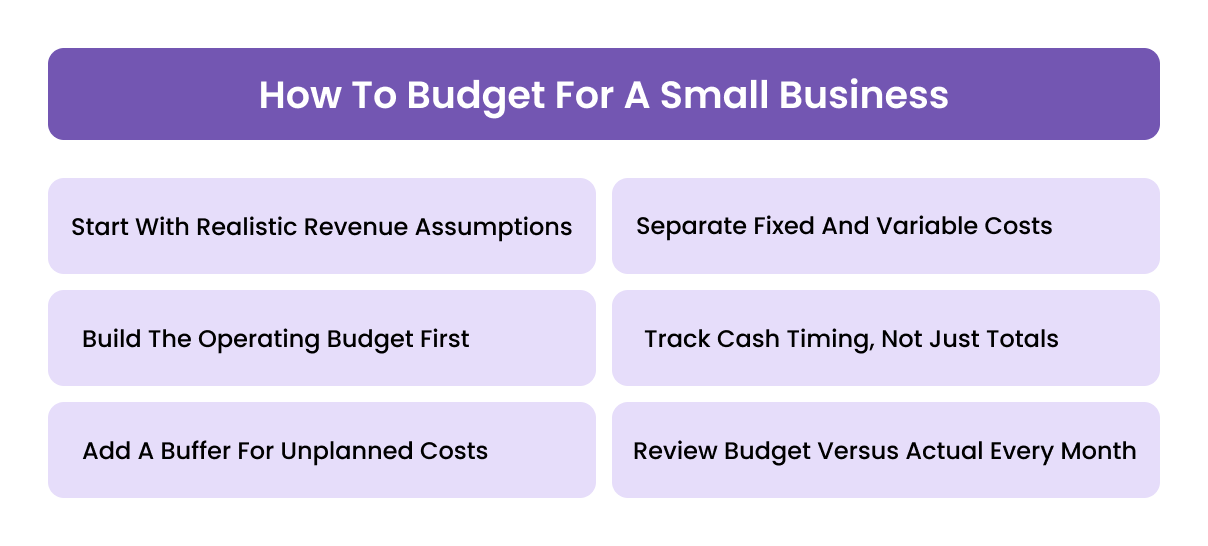
1. Start With Realistic Revenue Assumptions
A budget should begin with realistic sales expectations, not optimistic targets. That means using recent performance, current demand, seasonality, and known business changes to estimate revenue as sensibly as possible. If revenue assumptions are inflated, the rest of the budget becomes weaker from the start.
This matters because many budgeting problems begin on the income side, not the cost side. If the business expects stronger sales than it is likely to achieve, spending decisions may look affordable on paper while creating pressure in reality.
2. Separate Fixed And Variable Costs
The next step is to break spending into fixed and variable categories. Fixed costs usually include items such as rent, salaries, software subscriptions, or insurance, while variable costs may include marketing, logistics, inventory, commissions, utilities, or project-based expenses depending on the business model.
This split matters because fixed costs are harder to reduce quickly, while variable costs tend to move with activity levels or management choices. A clearer small business budget breakdown makes it easier to see which costs are committed and which ones need closer review each month.
3. Build The Operating Budget First
For most small businesses, the operating budget is the most useful place to start. It focuses on the income and day-to-day expenses required to run the business, which makes it more practical than jumping straight into broader long-range financial planning.
An operating budget for small business planning usually includes expected revenue, payroll, rent, utilities, software, inventory or cost of goods sold, marketing, admin costs, and other recurring operating expenses. Once that core view is solid, the business can layer on broader planning more confidently.
4. Include Cash Timing, Not Just Expense Totals
A budget should not only show how much the business expects to spend. It should also reflect when cash is likely to leave the business and when revenue is likely to come in. That timing difference is where a lot of small business pressure begins.
A business can have a budget that looks reasonable in total but still run into cash strain if supplier payments, payroll, and subscriptions fall due before collections arrive. Budgeting becomes more useful when it reflects timing as well as totals.
5. Add A Buffer For Unplanned Costs
Very few small businesses operate in perfectly stable conditions. Prices change, software costs rise, a supplier issue appears, equipment needs replacing, or a one-off compliance cost lands earlier than expected. A budget that leaves no room for that kind of variation becomes fragile very quickly.
That is why a sensible buffer matters. It does not need to be excessive, but it should be enough to absorb smaller surprises without forcing the business into immediate disruption or rushed spending decisions.
6. Review Budget Versus Actual Every Month
A budget becomes genuinely useful when it is compared against actual results regularly. That review shows which assumptions were accurate, which categories are drifting, and where the business may need to change spending decisions for the next period.
Without that step, the budget becomes static. With it, the budget becomes a management tool. Regular budget-versus-actual review is usually where a small business starts turning budgeting from an annual exercise into a working financial habit.
Related: Understanding Cost Management Key Steps Benefits
Small Business Budget Breakdown
A small business budget should be simple enough to maintain, but detailed enough to show where money is actually going. The exact categories will vary by business model, but most operating budgets include a core set of recurring areas that should be planned and reviewed consistently.
A practical small business budget breakdown often includes:
- Revenue
- Payroll And Team Costs
- Rent And Utilities
- Inventory Or Cost Of Goods Sold
- Marketing
- Software And Subscriptions
- Professional Fees
- Travel And Admin
- Taxes And Compliance
- Contingency Or Reserve
This kind of structure helps the business see not just total spend, but the shape of spend. That makes it easier to identify where costs are growing, where assumptions may be weak, and which categories deserve tighter oversight.
Also Read: Types Of Expenses Business Expense Management
Common Small Business Budgeting Mistakes
Small business budgets usually break down for predictable reasons. The issue is not always that the business failed to budget at all. More often, the budget exists, but the assumptions are too optimistic, the categories are too vague, or the review process is too weak to catch drift early enough.
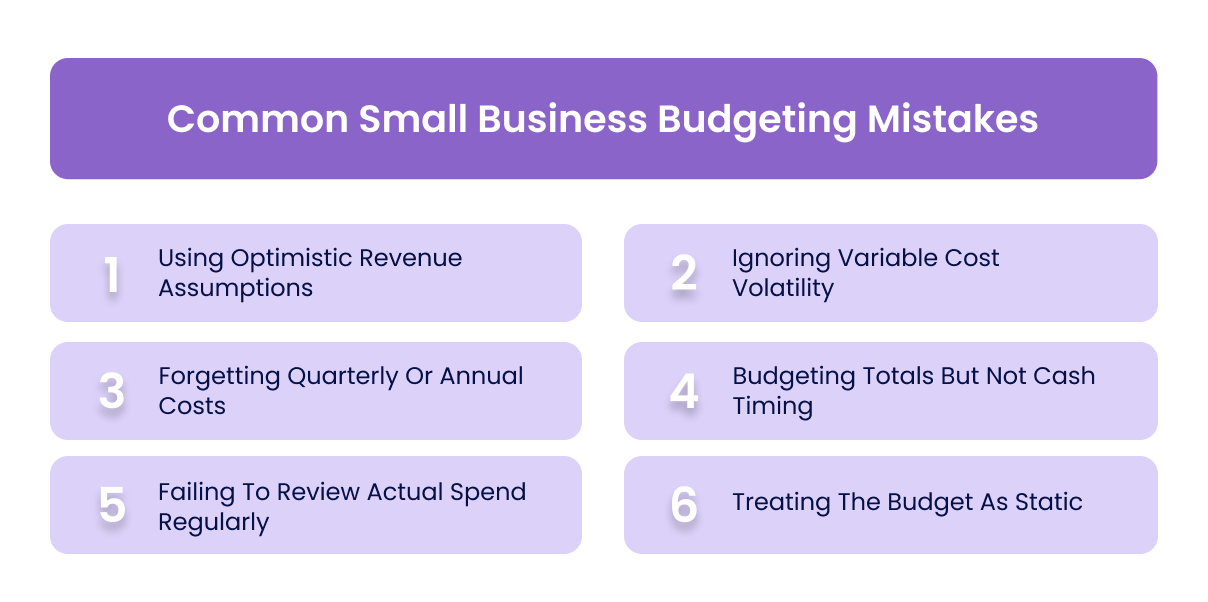
That is why budgeting works best when it is treated as an active management process rather than a document that gets built once and ignored for the rest of the year.
- Using Optimistic Revenue Assumptions
A budget becomes unreliable very quickly when revenue expectations are based on ambition rather than evidence. If projected sales are too high, the business may approve spending that looks affordable on paper but creates pressure once actual collections fall short. - Ignoring Variable Cost Volatility
Some costs do not stay stable month after month. Marketing, logistics, inventory, commissions, utilities, and project-related spending can all move more than expected. If the budget treats them as fixed or predictable when they are not, cost pressure builds quietly. - Forgetting Quarterly Or Annual Costs
Many businesses budget well for monthly expenses but overlook items that land less frequently, such as insurance renewals, licence fees, maintenance, compliance costs, or annual software charges. Those costs can distort the month they appear in if they were never planned properly. - Budgeting Totals But Not Cash Timing
A cost may be budgeted correctly in total but still create strain if the payment falls earlier than expected. This is where many businesses confuse budgeting with cash planning. A budget should help the business understand not just how much it expects to spend, but when cash is likely to move. - Failing To Review Actual Spend Regularly
A budget is only useful when it is compared against actual results. Without that review, overspending can continue for weeks or months before anyone realises the problem is becoming structural rather than temporary. - Treating The Budget As Static
Small businesses change quickly. New hires, delayed revenue, supplier changes, product shifts, or operating expansion can all affect the numbers. A budget should be updated when the business changes meaningfully, not protected as if it were fixed from the start.

Related: Effective Ways Reduce Operating Expenses
Operating Budget For Small Business
For most small businesses, the operating budget is the most useful budgeting format because it focuses on the income and recurring costs involved in running the business. It gives the team a practical view of what the business expects to earn, what it expects to spend, and whether normal operations remain financially workable over a monthly or annual period.
That is what makes the operating budget more useful than a rough annual estimate. It turns budgeting into a working operating view rather than a loose financial target.
- What An Operating Budget Usually Includes
A typical operating budget for small business planning includes expected revenue, payroll, rent, utilities, software, inventory or cost of goods sold, marketing, professional fees, travel, admin costs, and other recurring operating expenses. - Why It Matters In Day To Day Management
The operating budget gives the business a clearer basis for routine decisions. It helps answer whether current hiring plans are affordable, whether marketing spend is still in line with revenue assumptions, and whether fixed costs are becoming too heavy for the current stage of the business. - How It Differs From A Broader Financial Plan
A broader financial plan may include longer-term growth goals, funding strategy, capital expenditure, or multi-year scenarios. The operating budget is narrower and more practical. It focuses on what the business needs to run in the near term without losing control of spending. - Why It Should Be Reviewed Frequently
Because the operating budget sits so close to day-to-day activity, it should be reviewed regularly. A business does not gain much from building an operating budget if it does not use it to compare plan versus actual performance over time.
Also Read: Guide To General And Administrative Expenses Types And Examples
Budget Help For Small Business Owners
Many small business owners do not need a more complicated budget. They need a version they can actually maintain, understand, and review consistently. In practice, that usually means starting with fewer categories, clearer assumptions, and a stronger routine rather than trying to build a model that feels sophisticated but never gets used properly.
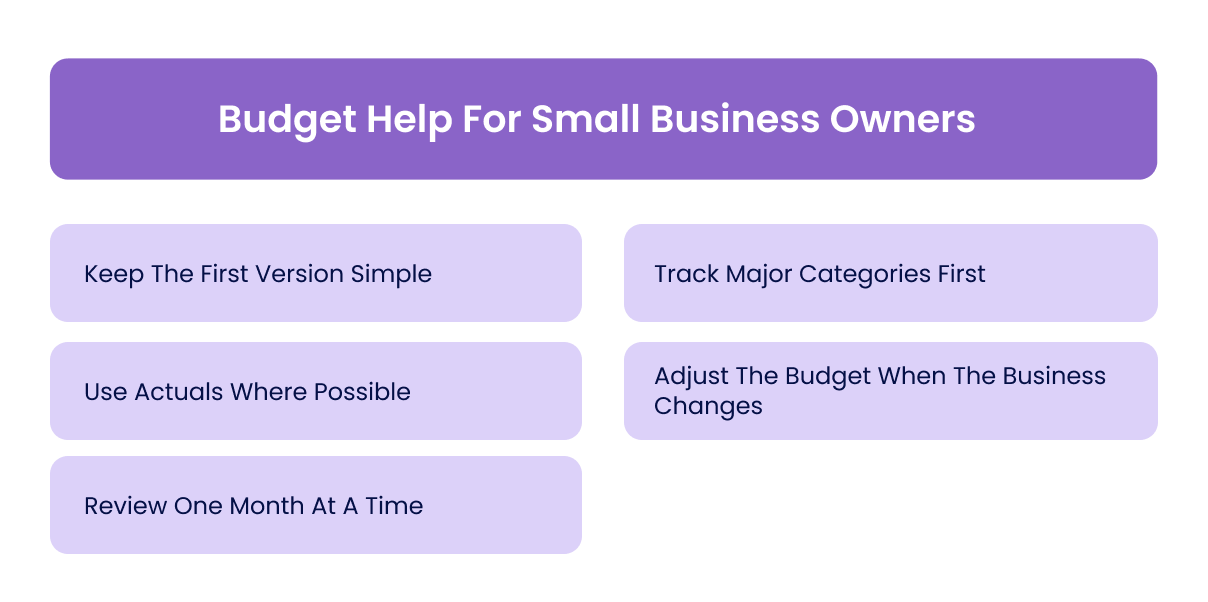
A workable budget is usually better than an impressive one. The goal is not to create a perfect financial forecast. It is to create a planning tool that supports better decisions month after month.
- Keep The First Version Simple
The budget does not need excessive detail at the start. It needs enough structure to show where money is coming from, where it is going, and which categories matter most to the business. - Use Actuals Where Possible
If the business already has six to twelve months of spending history, that is usually a better starting point than guessing from scratch. Actual spending patterns often reveal cost pressure more clearly than assumptions alone. - Review One Month At A Time
A small business budget becomes easier to manage when it is reviewed in regular monthly cycles. That keeps the process manageable and makes it easier to respond before a cost issue grows too large. - Track Major Categories First
Payroll, rent, software, supplier spend, marketing, and operating overhead usually matter more than very minor categories. Strong budgeting starts by controlling the costs that move the business most. - Adjust The Budget When The Business Changes
A budget should reflect the business as it actually operates, not as it operated six months ago. If revenue plans, supplier terms, team size, or operating priorities shift, the budget should move with them.
Also Read: Guide To Manage Overall Spending
How Alaan Helps Businesses Budget With Better Spend Control
A budget only works if the business can compare the plan with what it is actually spending. That is where Alaan is relevant. It helps finance teams manage day-to-day spend through corporate cards, spend controls, approval workflows, receipt capture, AI verification, and accounting integrations, so budgeting is supported by cleaner spend control rather than manual follow-up.
- Corporate Cards With Spend Limits And Vendor Controls
Alaan lets businesses issue corporate cards with spending limits and vendor restrictions. That helps teams control operational spending at the point of purchase instead of only discovering overruns later. - Approval Workflows Before Spend Happens
Alaan supports custom approval workflows, so purchases and expenses can be reviewed before money is committed. That helps businesses apply budget discipline earlier, especially for discretionary or fast-moving spend. - Real-Time Visibility Into Company Spend
Finance teams can see transactions as they happen across employees, teams, vendors, and categories. That makes it easier to spot category overruns, unusual spending patterns, or costs moving ahead of budget before month-end. - Receipt Capture And Supporting Documentation
Employees can upload receipts and invoices through the mobile app, Chrome extension, or email, so each transaction stays linked to supporting records. That makes budget reviews cleaner and reduces admin friction later. - AI Verification And Duplicate Detection
Alaan extracts receipt data, matches it to transactions, and flags inconsistencies or duplicates. That helps finance teams review spend more efficiently and reduce noise in budget-versus-actual analysis. - Accounting Integration For Faster Reconciliation
Alaan integrates with Xero, QuickBooks, NetSuite, and Microsoft Dynamics, allowing expense data to sync in real time. That gives finance a cleaner spend record and reduces manual re-entry during reconciliation.

In practice, that helps businesses turn budgeting into a more active management tool instead of a plan that only gets checked after the money has already gone out.
Conclusion
A small business budget is only useful if it helps the business make better decisions in real time. The goal is not to build the most detailed spreadsheet possible. It is to create a budgeting process that links revenue expectations, operating costs, and cash timing clearly enough to guide spending with more confidence.
The businesses that budget well are usually not the ones with the most complicated models. They are the ones with more realistic assumptions, better review discipline, and stronger visibility into where money is actually going.
Alaan helps businesses strengthen that day-to-day control layer with corporate cards, spend limits, approval workflows, real-time visibility, cleaner documentation, and faster reconciliation. That makes budgeting easier to manage in practice, not just easier to plan on paper. Book a Demo Today!
A budget tells you what you meant to spend, but it won't tell you how long the cash lasts if sales dip for a quarter, so try the free cash flow stress test to find your runway and the date things start to get tight.
FAQs
1. How far ahead should a small business budget?
Most small businesses benefit from a 12-month budget with monthly detail, reviewed regularly. That gives enough forward visibility for planning while still keeping the numbers practical enough to update as conditions change.
2. Should a small business budget monthly or annually?
Both, but for different reasons. The annual view sets direction, while the monthly view is what makes the budget usable in practice. A budget that exists only as a yearly total is usually too blunt to support day-to-day control.
3. What is the difference between a budget and a cash flow forecast?
A budget focuses on planned revenue and expenses. A cash flow forecast focuses on when cash is actually expected to come in and go out. They are connected, but they answer different questions, and a business usually needs both.
4. How detailed should a small business budget be?
Detailed enough to show the major cost drivers clearly, but not so detailed that no one maintains it. Payroll, rent, supplier spend, software, marketing, and operating overhead usually matter more than splitting every minor expense into its own line.
5. How often should a small business update its budget?
A monthly review is usually the most practical baseline. The budget should also be updated when something meaningful changes, such as a hiring decision, supplier cost increase, revenue slowdown, or major shift in operating priorities.
6. What should a business do if actual spend keeps exceeding budget?
First, identify whether the issue is weak assumptions, poor spend control, or a genuine business change. Then adjust the category, tighten approvals, or rework the budget rather than letting overspend continue unchallenged by habit.
Gain control over business expenses with Alaan corporate cards
Invygo earned AED 100,000 in cashback using Alaan cards
Personalise approval workflows to align with your business needs with Alaan's Spend Management platform
Discover the power of automated expense tracking and smarter spend control with Alaan
Turn data into actionable insights with Alaan's spend management tools
Stay Tax Compliant with UAE's #1 Corporate Card and Spend Management Platform
Customisable corporate card policy template
Know how much Corporate Tax you have to pay this fiscal year
Easily integrate Alaan with your ERP for accurate, real-time expense tracking
Close books faster with Alaan's AI-powered accounting automation
Reconcile your books in minutes instead of hours, every single month.
Keep petty cash organized with Alaan corporate cards and automated expense management