.avif)


A practical guide to running small business inventory as a cash flow discipline through better reorder timing, regular stock reviews, and tighter purchasing control.
- Treat inventory as a cash flow decision rather than plain stock counting, and tie each reorder to actual stock movement, supplier lead times, and how much cash the business can spare that month.
- Set clear reorder points with sensible safety buffers so replenishment happens before stock runs out, without tying up cash by buying too early.
- Netstock's 2025 benchmark found 55% of SMBs held at least 20% excess stock and 46% had at least 5% dead stock, so slow movers need a regular review before they trap capital.
- A spreadsheet stops being enough once you have too many SKUs, more than one person ordering, or regular stockouts despite enough stock on paper.
- Alaan helps control inventory-related spend through corporate cards with limits and vendor controls, approval workflows before replenishment, receipt capture, and accounting integrations for cleaner reconciliation.
Inventory problems in a small business rarely begin with a dramatic stock failure. More often, they show up quietly through cash getting tied up in products that move too slowly, reorders happening at the wrong time, or purchasing decisions being made without a clear view of what the business already holds. That is why small business inventory management is not just about avoiding stockouts. It is also about protecting cash flow and improving purchasing discipline.
That pressure is real for smaller businesses. Netstock’s 2025 benchmark found that 55% of SMBs reported holding at least 20% excess stock, while 46% said at least 5% of their inventory was dead stock. For a growing business, that is not just a stock issue. It is a working-capital issue, a purchasing issue, and often a planning issue as well.
In this article, we explain how small business inventory management supports better cash flow, what usually causes inventory problems, which controls matter most, and how businesses can improve stock discipline without overcomplicating the process.
TL;DR
- Small Business Inventory Management Affects Cash Flow As Much As Stock Availability
- Poor Inventory Control Can Lead To Both Stockouts And Excess Stock
- Most Small Businesses Need Better Inventory Discipline Before They Need More Complex Systems
- Reorder Timing, Stock Reviews, And Purchasing Control Usually Matter More Than Generic Advice
- Alaan Helps Businesses Control Inventory-Related Spending Through Better Approvals, Real-Time Visibility, And Cleaner Purchase Tracking
Related: Understanding Spend Visibility And Business Benefits
Why Small Business Inventory Management Matters
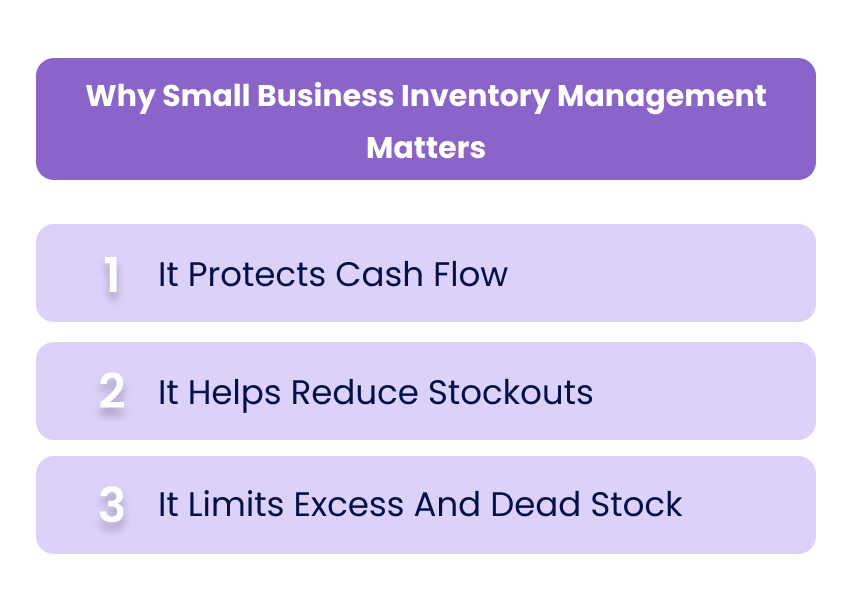
Inventory management matters because inventory can absorb cash quietly while still looking like a normal operating expense. If stock moves too slowly, the business may appear busy on the surface while flexibility keeps shrinking underneath. That is exactly why inventory should be treated as both an operations issue and a finance issue.
1. It Protects Cash Flow
When a small business buys inventory, cash leaves the business before revenue comes back in. If those products sell at the expected pace, that timing is manageable. If they do not, working capital stays locked in stock that is not turning quickly enough, and the pressure shows up elsewhere in the business.
This is why inventory discipline matters beyond the stockroom. Better control over stock levels helps the business preserve liquidity for payroll, supplier payments, growth plans, and day-to-day operating needs instead of committing more cash than necessary to inventory.
2. It Helps Reduce Stockouts
Stockouts create more than a temporary sales problem. For a small business, they can affect delivery reliability, repeat demand, and customer confidence, especially when the business depends on a narrower product mix or a smaller customer base.
Better inventory management reduces that risk by making replenishment more deliberate. Instead of depending on memory or urgency, the business can use a clearer process to decide when stock should be reordered and in what quantity.
3. It Limits Excess And Dead Stock
Excess stock creates costs long before it becomes obsolete. It takes up storage space, slows stock rotation, increases handling effort, and often leads to markdowns or low-priority clearance activity.
Dead stock is the more expensive end of the same problem. The money has already been spent, but the inventory is no longer contributing enough to revenue, which means the business is left carrying both the cost and the missed opportunity of that capital.
Also Read: Manage Business Cash Flow Effectively
What Small Business Inventory Management Actually Covers
Small business inventory management is broader than stock counting. It covers how the business buys, receives, stores, reviews, and replenishes inventory so that stock availability supports sales without weakening purchasing control or cash flow.
It Covers More Than Finished Goods
For many businesses, inventory includes more than products ready for sale. It can also include:
- Raw Materials
- Packaging
- Spare Parts
- Operational Consumables
- Work In Progress Items
The mix depends on the business model, but the control question stays the same. The business needs to know what it is holding, why it is holding it, and how quickly that stock should move before more cash is committed.
It Includes The Full Stock Cycle
Inventory management covers the full movement of stock through the business, not just the final count. That usually includes:
- Ordering Stock
- Receiving It Accurately
- Recording Quantities Properly
- Storing It In A Usable Way
- Monitoring Usage Or Sales
- Reordering At The Right Time
When one of those steps is weak, the whole process starts losing reliability. Stock records become less useful, purchasing decisions become more reactive, and the business ends up correcting avoidable issues later.
It Is Different From Simple Stock Tracking
Tracking tells the business what is physically there or what the system says is available. Inventory management goes further by helping the business decide what should happen next based on movement, lead times, purchasing needs, and cash priorities.
That distinction matters because visibility alone does not solve much. A business can know current stock levels and still reorder too early, ignore slow-moving items, or continue buying without a clear view of what the business actually needs.
Related: Understanding Procure To Payment Process
The Most Common Inventory Problems Small Businesses Face
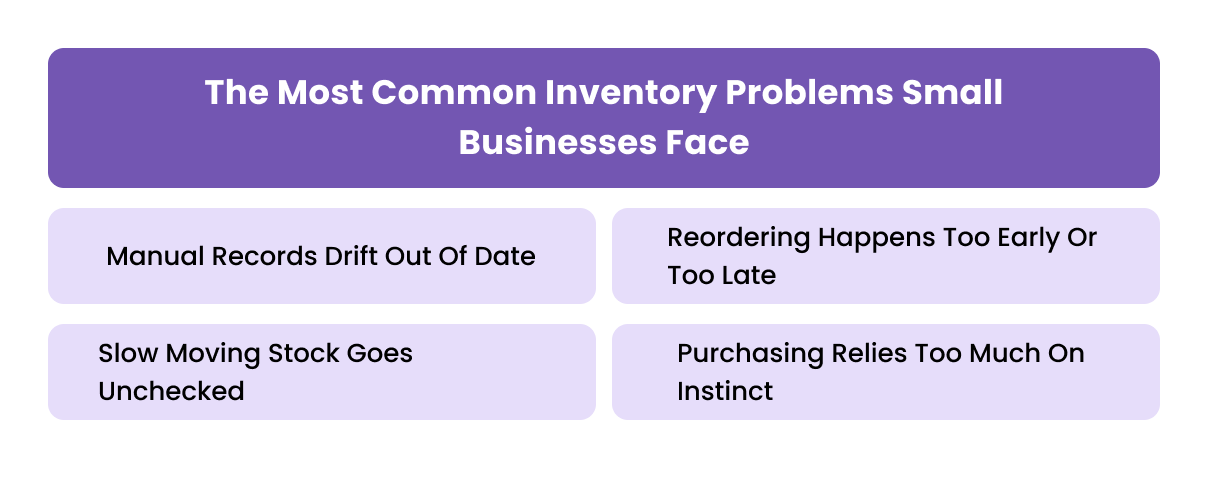
Most inventory problems in small businesses come from an inconsistent process rather than complete neglect. The team is usually checking stock, placing orders, and trying to stay ahead of demand, but the routine is often informal. That makes inventory decisions too dependent on memory, urgency, or habit.
1. Manual Records Drift Out Of Date
Manual tracking can work when the business is smaller and stock movement is limited. The problem begins when sales, returns, receipts, and transfers move faster than the records are updated, because the numbers stop reflecting what is actually available.
Once that gap appears, errors multiply quickly. The business may reorder an item that is already in stock, miss a genuine shortage, or start treating every stock decision as urgent because no one fully trusts the data anymore.
2. Reordering Happens Too Early Or Too Late
Without a clear reorder approach, small businesses usually fall into one of two patterns. They either wait too long and deal with stockouts, or they reorder too early and carry more stock than they need. Both decisions create cost, even if the impact shows up differently.
Late reordering tends to hurt revenue and fulfilment. Early reordering tends to hurt cash flow and storage efficiency. Better inventory management reduces both by linking purchasing decisions to actual stock movement and supplier timing instead of last-minute judgement calls.
3. Slow Moving Stock Goes Unchecked
Fast-selling items usually get attention on their own. Slow-moving stock does not, which is why it often builds quietly in the background until it starts affecting cash and storage more noticeably.
A regular review helps catch that earlier. Without one, the business keeps carrying items that no longer justify the same reorder pattern, and the result is more capital tied up in stock that is not pulling its weight.
4. Purchasing Relies Too Much On Instinct
This is common in growing businesses where stock decisions have historically been made by a founder, buyer, or operations lead who knows the business well. That experience is valuable, but it becomes harder to rely on once product ranges, suppliers, or order volume start increasing.
At that stage, the business needs a more repeatable process. It does not need unnecessary complexity, but it does need a clearer basis for deciding what to buy, when to buy it, and how much to commit each time.
Also Read: Cost Reduction Strategies Procurement
A Practical Small Business Inventory Management Process
A small business usually does not need an overly technical inventory model first. It needs a repeatable process that helps the team buy with more consistency, review stock more deliberately, and avoid letting purchasing decisions drift into habit or urgency.
1. Categorise Inventory Properly
Not every item deserves the same level of attention. Some products drive a high share of revenue, some move steadily with little volatility, and some sit in the background until they start slowing cash down. A better process begins by separating stock according to business importance rather than treating every SKU the same.
A practical way to do that is to review inventory in three broad groups:
- High Value Or Fast Moving Items
These need tighter review because mistakes here affect both revenue and cash more quickly. - Routine Items With Stable Demand
These usually need consistent reorder rules rather than constant manual intervention. - Slow Moving Or Low Priority Items
These need stricter review so they do not keep absorbing cash without enough return.
2. Set Reorder Points And Safety Buffers
Reordering works better when it is based on a defined trigger instead of memory. QuickBooks describes the reorder point as the stock level at which a new order should be placed, and it links that decision to average usage, supplier lead time, and safety stock. That framework matters because it helps a business replenish before stock runs out without reordering too early.
The exact formula does not need to become a maths exercise for every small business. What matters is having a clear point at which the team knows an item should be reordered, and a sensible buffer for items where demand or supplier timing is less predictable.
See the formula behind setting that trigger point correctly, including how lead time and safety stock factor in.
3. Count Stock Regularly
Inventory records stay useful only if they stay close to reality. That is why regular counting matters, even when the business already has a spreadsheet, POS system, or inventory tool in place. If stock is rarely checked, small discrepancies build quietly until they start affecting ordering decisions and customer fulfilment.
A lighter but more practical routine usually works better than waiting for a large annual correction:
- Cycle Counts For High Priority Items
- Spot Checks For Fast Movers
- Monthly Reconciliations For Slower Categories
- Immediate Checks After Large Deliveries Or Promotions
4. Track Supplier Lead Times
Supplier lead times are part of inventory control, not just procurement administration. If the team assumes every supplier will deliver on the same schedule each time, reorder decisions quickly become less reliable. Even a small change in lead time can push an item into shortage if the business is already running close to its minimum stock level.
This is why lead time should be reviewed as a live planning input rather than a fixed assumption. Reorder points work properly only when the business has a realistic view of how long replenishment actually takes in practice.
5. Review Slow Moving And Dead Stock
Slow moving stock should not be left for an occasional clean-up exercise. It needs a regular review because the longer it sits unnoticed, the more likely it is to become a dead-stock problem instead of a temporary demand issue.
A monthly review is usually enough for most small businesses. The goal is not just to identify what is moving slowly, but to decide what action is needed next. Some items may need a lower reorder quantity, some may need promotion or bundling, and some may need to be phased out altogether.
6. Connect Inventory Decisions To Purchasing And Cash Flow
Inventory decisions improve when the team stops treating stock purchase orders as isolated events. Each replenishment order affects working capital, supplier exposure, and the amount of cash still available for the rest of the business. That makes inventory purchasing a finance decision as much as an operating one.
Before placing a replenishment order, it helps to ask three simple questions:
- Is This Item Moving At The Rate We Expected
- Does This Quantity Match Current Demand And Lead Time
- Can The Business Carry This Purchase Comfortably At This Point In The Month
Related: Cost Reduction Strategies Procurement
Which Inventory Method Makes Sense For A Small Business
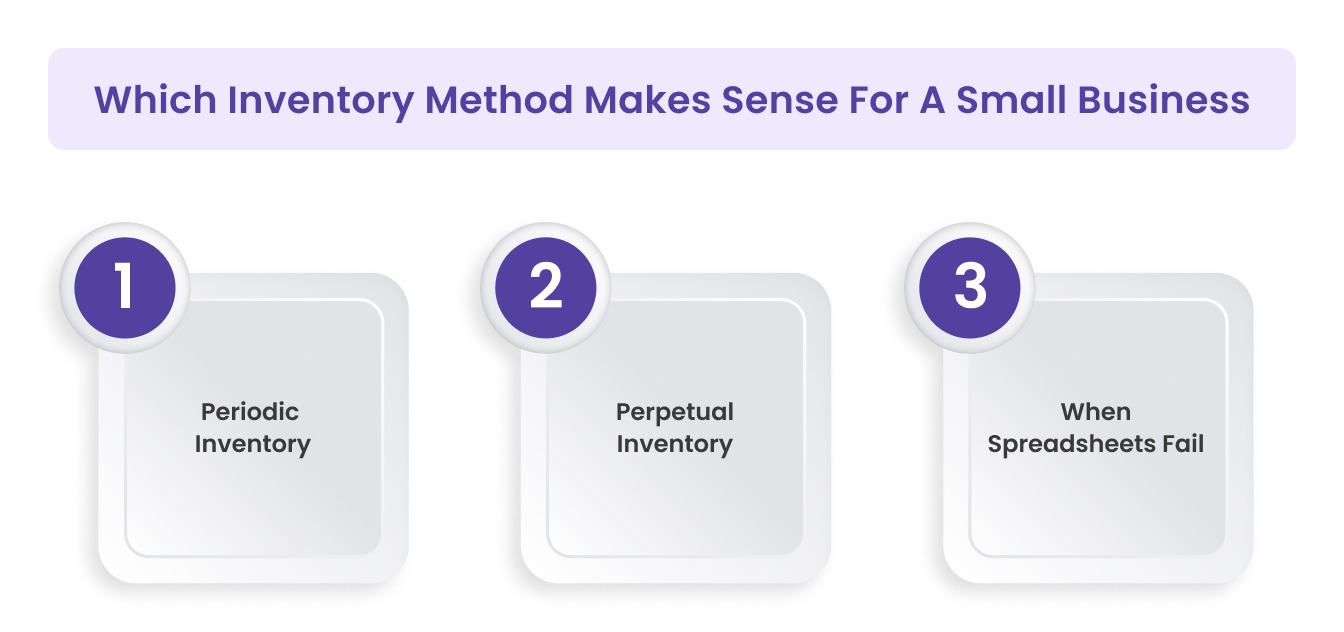
The right inventory method depends less on theory and more on operating reality. What matters is whether the business can maintain reliable stock visibility without creating unnecessary process overhead.
Periodic Inventory
Periodic inventory works best where stock movement is relatively limited and the business does not need constant live visibility. In this method, stock is reviewed at set intervals rather than updated continuously after each movement. That can still work for smaller businesses with fewer SKUs and a slower operating rhythm.
The limitation is that decisions between count dates become less precise. If sales, returns, or stock transfers happen more frequently, the business can spend too much time working with numbers that no longer reflect what is really available.
Perpetual Inventory
Perpetual inventory updates stock records continuously as items are received, sold, used, or transferred. That gives the business a more current view of what is on hand and makes reorder decisions easier to time.
For a growing business, that visibility becomes more useful when multiple people are involved in ordering or when stock moves across channels, stores, or sites. The main benefit is not complexity for its own sake. It is better control at the point where manual tracking starts becoming less trustworthy.
When A Spreadsheet Stops Being Enough
A spreadsheet is not automatically a problem. It becomes one when the business outgrows the discipline needed to keep it accurate. That usually happens before teams admit it, because the spreadsheet still exists, but confidence in it has already started weakening.
The common signs are usually clear:
- Too Many SKUs To Review Comfortably
- Frequent Stock Discrepancies
- More Than One Person Ordering Inventory
- Multiple Sales Channels Or Locations
- Regular Stockouts Despite “Enough” Inventory On Paper
Also Read: Best ERP Software For Small Business
What To Track Every Month
Small business inventory management improves when the review process stays focused. Most businesses do not need a long dashboard full of metrics. They need a short monthly view that helps them spot whether stock is moving well, where cash is getting trapped, and which purchasing assumptions are starting to break down.
The most useful monthly checks usually include:
- Stock Turn
This shows how quickly inventory is moving through the business. A weak stock turn often points to overbuying, slower demand, or both. - Stockout Rate
This helps the business see whether key products are becoming unavailable too often and whether reorder timing needs tightening. - Excess And Dead Stock
This shows how much inventory is sitting without enough movement and where capital may already be tied up unnecessarily. - Reorder Accuracy
This helps assess whether the business is buying in quantities that match actual demand rather than working from guesswork. - Supplier Lead Time Reliability
This shows whether the assumptions behind reorder timing are still reliable or whether supplier variation is creating risk.

Up-to-date reporting and better forecasting are central to reducing both stockouts and costly overstocking, which is why these monthly checks matter even for relatively small businesses.
Related: Essential Guide Spend Mapping Analysis
How Better Spend Controls Support Inventory Management
Inventory systems help a business track stock. But stock control also depends on how purchasing is approved, how supplier spend is monitored, and how well finance can see inventory-related buying before it becomes a month-end problem. That is where Alaan is relevant. It helps businesses manage inventory-related spend through corporate cards, spend controls, approval workflows, receipt capture, AI verification, and accounting integrations, so purchasing becomes easier to control and easier to review.
- Corporate Cards With Spend Limits And Vendor Controls
Alaan lets businesses issue corporate cards with spending limits and vendor restrictions. For inventory-related purchases, that means teams can buy only within defined limits and with approved suppliers or merchant categories, reducing ad hoc buying and off-process orders. - Approval Workflows Before Replenishment Spend Happens
Alaan supports custom approval workflows, so replenishment purchases can be reviewed before money is committed. This helps businesses control who can reorder stock, what thresholds need approval, and when exceptions should be escalated. - Real-Time Visibility Into Supplier Spend
Finance teams can see inventory-related spend as it happens across employees, teams, vendors, and categories. That makes it easier to spot repeat purchases, early reorders, unusual supplier activity, or spending that is moving faster than expected. - Receipt Capture And Supporting Documentation
Employees can upload receipts and invoices through the mobile app, Chrome extension, or email, so purchase documentation stays attached to the transaction. This makes inventory-related spend easier to verify and reduces the admin mess that usually appears later. - AI Verification And Duplicate Detection
Alaan extracts receipt data, matches it to transactions, and flags inconsistencies or duplicates. That helps finance teams review purchasing activity more efficiently and reduces manual checking around supplier spend. - Accounting Integration For Cleaner Reconciliation
Alaan integrates with Xero, QuickBooks, NetSuite, and Microsoft Dynamics, allowing expense data to sync in real time. That gives finance a cleaner record of inventory-related spending and reduces manual re-entry during reconciliation.

In practice, that helps businesses bring more structure to the money flowing into inventory, not just the stock sitting on the shelf.
Conclusion
Small business inventory management works best when it is treated as a control discipline rather than just a stock-counting exercise. The businesses that handle it well are usually not the ones with the most complex systems. They are the ones with clearer reorder logic, better review routines, and tighter links between stock decisions, purchasing, and cash flow.
As inventory purchasing becomes more frequent or more distributed, spend control starts mattering more as well. Businesses need better visibility into what is being bought, who is approving it, and how those decisions affect working capital.
Alaan helps businesses bring more structure to that process through corporate cards, spend controls, approval workflows, real-time visibility, cleaner documentation, and faster reconciliation. That makes inventory-related purchasing easier to control and easier to review as the business grows. Book a Demo Today!
FAQs
1. What is a good inventory turnover rate for a small business?
There is no single ideal turnover rate because it depends on the industry, product type, shelf life, and margin structure. A grocery business, for example, will usually expect a much faster turnover than a furniture seller or an industrial supplier.
What matters more is whether your turnover rate matches the economics of your business. If the stock is moving too slowly, cash stays tied up for longer than planned. If it is moving too fast without enough buffer, stockouts become more likely.
2. How often should a small business count inventory?
That depends on product volume and stock movement. A business with a smaller product range may be able to work with monthly counts, while a business with fast-moving or higher-value stock may need more frequent checks.
A practical approach is to count important items more often than low-risk ones. That usually means regular cycle counts for key inventory and broader reconciliations on a monthly basis.
3. Can a small business manage inventory without inventory software?
Yes, at least for a certain stage. Many small businesses start with spreadsheets, POS tools, or simple stock logs, and those can work if the product range is limited and the process is disciplined.
The issue is not whether software exists. It is whether the current method still gives the team reliable stock visibility. Once records start lagging behind actual stock movement, the business usually needs a stronger system.
4. What usually causes stock discrepancies in small businesses?
Stock discrepancies often come from routine process issues rather than one major mistake. Common causes include delayed record updates, receiving errors, unrecorded returns, damaged stock, internal usage not being logged, or products being stored in the wrong location.
The longer these issues go unchecked, the harder they become to trace. That is why regular counts and a consistent receiving process matter so much.
5. Should small businesses keep safety stock for every item?
Not always. Safety stock makes more sense for products that are high-value, fast-moving, supplier-dependent, or difficult to replace quickly. Applying the same buffer logic to every item can lead to unnecessary overstocking.
A better approach is to reserve stronger safety buffers for the products where stockouts would create the biggest operational or commercial problem.
7. How does inventory management affect purchasing decisions?
Inventory management gives purchasing teams a clearer basis for deciding what to order, when to reorder, and how much to buy. Without that structure, purchasing often becomes reactive and overly dependent on instinct or urgency.
When inventory data is more reliable, purchasing becomes less guess-based and more aligned with actual demand, supplier timing, and cash availability.
Gain control over business expenses with Alaan corporate cards
Invygo earned AED 100,000 in cashback using Alaan cards
Personalise approval workflows to align with your business needs with Alaan's Spend Management platform
Discover the power of automated expense tracking and smarter spend control with Alaan
Turn data into actionable insights with Alaan's spend management tools
Stay Tax Compliant with UAE's #1 Corporate Card and Spend Management Platform
Customisable corporate card policy template
Know how much Corporate Tax you have to pay this fiscal year
Easily integrate Alaan with your ERP for accurate, real-time expense tracking
Close books faster with Alaan's AI-powered accounting automation
Reconcile your books in minutes instead of hours, every single month.
Keep petty cash organized with Alaan corporate cards and automated expense management