.avif)

Most UAE businesses already have a way to make international payments. What many still struggle with is predictability. Payments get approved, funds move, and only later do the questions surface around FX impact, settlement delays, or open balances that refuse to clear from the ledger.
The context in the UAE makes this especially pressing. The Emirates is one of the world’s largest outbound remittance hubs, second only to the United States, reflecting intense cross-border financial flows for business and personal use.
Globally, the scale of business-to-business cross-border payments continues to expand: current estimates put the B2B cross-border payments market at nearly USD 68 trillion (Estimates as of 2024) and growing at over 7% annually, with forecasts pointing to more than USD 120 trillion by 2033.
These trends explain why finance teams are under pressure to minimise surprises, explain cash movement with confidence, and close books without firefighting. Cost visibility often arrives after execution, corridors behave unpredictably, and accounting and payment systems operate in parallel rather than in sync.
This guide helps finance leaders assess where payment gateways fit, where they fall short, and what should be evaluated before committing to any cross-border payment solution.
TL;DR
- A cross-border payment gateway solves execution, not decision-making. Problems usually appear before and after the payment, not during it.
- FX surprises, settlement delays, and reconciliation issues are typically caused by when cost becomes visible, not by the payment rail itself.
- Gateways work best for customer-initiated, standardised payments; supplier and procurement payments require tighter upstream controls.
- UAE finance teams see better outcomes when invoice validation, payment approval, execution, and accounting closure are connected, even if corridor coverage expands gradually.
Related: Guide to Modern Expense Management Practices
What A Cross-Border Payment Gateway Actually Is
A cross-border payment gateway is a system that authorises, routes, and settles payments across countries and currencies. Its core function is orchestration. It connects the payer to banks, card networks, or payout partners, applies currency conversion where required, and returns transaction-level reporting.
Gateways are most commonly used in scenarios such as:
- Card-based international payments
- Recurring digital services and subscriptions
- Marketplace and platform transactions
In these use cases, payment amounts are known upfront, settlement logic is standardised, and reconciliation is relatively clean.
What a gateway does not inherently manage is decision control. It does not validate invoices, assess supplier charges, or determine whether the timing of a payment aligns with treasury priorities. Those decisions sit outside the gateway unless deliberately designed into a broader workflow.
For finance teams, this distinction is critical. A gateway can execute a payment efficiently. It does not, by default, govern whether that payment should happen at that moment or at that cost.
Also read: Understanding the Procure-to-Pay (P2P) Process
Why Gateways Became Popular For International Payments
Gateways gained adoption as businesses expanded globally and digital revenue models scaled. Software subscriptions, online services, and advertising platforms needed a way to accept payments across borders without building bank integrations market by market.
Several factors drove their popularity:
- API-based integration reduced technical effort
- Multi-currency acceptance simplified expansion
- Predictable settlement worked well for customer-initiated payments
In these scenarios, gateways deliver exactly what they are designed for: speed, consistency, and abstraction of payment complexity.
Problems emerge when the same tools are used for supplier and procurement payments. These payments are internally initiated, often higher in value, and sensitive to FX movements and documentation requirements. Execution may be smooth, but the financial impact is only understood after the fact.
This is where finance teams start to feel the gap between transaction execution and financial control.
Related: Accounts Payable Automation and Invoice Management Software
Where Cross-Border Payment Gateways Start To Break Down
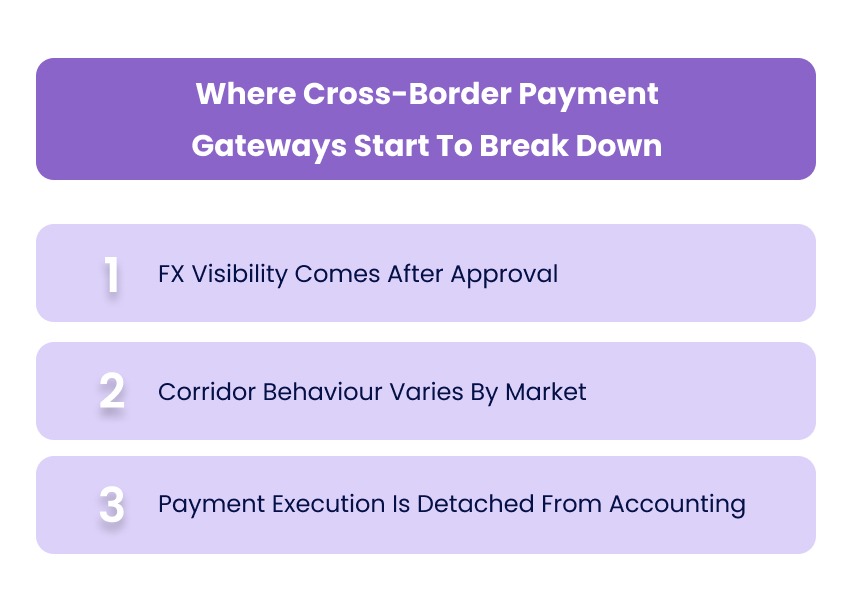
While gateways handle execution reliably, several limitations become visible when they are used for supplier payments. These limitations are operational rather than theoretical, and they tend to surface under volume, value, or audit scrutiny.
1. FX Visibility Comes After Approval
In many gateway-led flows, FX rates and fees are finalised at execution. Approvals happen without a clear view of landed cost. When variances appear, finance teams are left explaining outcomes rather than shaping them.
For low-value transactions, this may be tolerable. For supplier payments that affect margins or forecasts, it introduces avoidable risk.
2. Corridor Behaviour Varies By Market
Gateways perform best on corridors built around card networks or standardised payout rails. Supplier payments often behave differently.
Some corridors require additional documentation, local banking partners, or longer settlement cycles. When these differences are abstracted away, finance teams discover them only when payments slow down or exceptions appear.
This is particularly visible in procurement-heavy businesses operating across multiple regions.
3. Payment Execution Is Detached From Accounting
Gateways focus on moving money. Accounting systems focus on recording it. When the two are loosely connected, reconciliation becomes a manual exercise.
Invoices may be approved in one system, payments executed in another, and accounting entries created later through exports or uploads. Month-end closes carry the accumulated friction of these handoffs.
The issue is not that payments fail. It is that they succeed without closing the loop.
Related: Importance and Steps in Account Reconciliation
How Leading Cross-Border Payment Solutions Differ In Practice
Once finance teams move beyond the umbrella term “cross-border payment gateway,” the landscape becomes more nuanced. In the UAE, businesses typically rely on a combination of banks, exchange houses, card gateways, FX-led fintechs, and workflow-oriented platforms. Each category solves a different problem in the payment lifecycle.
The distinction is not which solution is “better,” but what each solution is designed to control and what responsibility remains with the finance team.
1. Bank-Led And Bank-Backed Payment Rails
Banks continue to anchor cross-border payments for UAE businesses, particularly for high-value transfers, regulated supplier payments, and treasury-led flows.
Examples include traditional SWIFT-based transfers and bank-owned consumer or SME rails such as Emirates NBD’s DirectRemit for specific corridors.
Banks are typically chosen because they offer:
- Broad corridor coverage through correspondent banking networks
- Strong regulatory oversight and audit comfort
- Familiarity for internal and external stakeholders
The trade-offs are equally familiar. FX spreads and intermediary fees are often only known after execution. Settlement timelines vary by corridor. Reconciliation is usually manual, requiring finance teams to match bank statements back to invoices and ERP entries.
Banks prioritise compliance and risk management first. Workflow efficiency and cost transparency tend to come second.
2. Exchange Houses And Remittance-Led Providers
Exchange houses play a significant role in the UAE’s cross-border payment ecosystem, particularly for specific corridors and SME use cases.
Providers such as Al Ansari Exchange are often used for corridor-specific transfers where pricing competitiveness and local familiarity matter.
These providers are typically used when:
- Payments are corridor-specific and repetitive
- FX rates are negotiated rather than automated
- Operational teams manage transfers alongside finance
However, exchange houses generally sit outside the core finance workflow. Invoice approval, accounting integration, and audit trails remain manual, making them difficult to scale cleanly for larger organisations.
3. Global And Regional Card-Based Payment Gateways
This is the category most commonly referred to when people say “payment gateway.”
Global platforms such as Stripe, Checkout.com, 2Checkout, Cybersource, and CCAvenue are widely used for international card acceptance.
In the UAE and wider MENA region, businesses also rely heavily on platforms such as Amazon Payment Services, PayTabs, Telr, HyperPay, Paycaps, and CashU.
These gateways are effective when payments are:
- Customer-initiated
- Card-based
- Predictable in value and settlement logic
Their limitations appear when used for supplier or procurement payments. FX is usually applied at execution. Invoices are validated outside the payment flow. Accounting reconciliation often requires separate integrations or manual handling. Gateways execute transactions efficiently, but they do not usually govern upstream approvals or downstream closure.
4. FX-Focused And Cross-Border Transfer Fintechs
A growing number of UAE businesses use FX-led fintechs for international supplier and service payments.
Providers such as Wise, Airwallex, Payoneer, and Verto focus on improving FX transparency, speed, and corridor efficiency.
These platforms are commonly used where:
- FX predictability matters more than workflow depth
- Payments are repeatable and operationally simple
- Pricing clarity is prioritised over governance
The trade-off is operational control. Invoice approval, accounting entries, and audit documentation usually sit outside these tools, requiring finance teams to coordinate across systems as volumes grow.
5. Workflow-Oriented Payment Platforms
A smaller but increasingly relevant category focuses on connecting invoice intake, approvals, payment execution, and reconciliation into a single workflow.
These platforms are typically adopted by UAE businesses managing frequent supplier payments across multiple corridors, where control before execution matters as much as execution itself.
Rather than optimising one transaction, these solutions focus on:
- Validating spend before payment
- Separating invoice approval from payment timing
- Ensuring payments close cleanly in accounting systems
For finance leaders, this approach aligns more closely with internal governance models, even if corridor coverage expands gradually rather than immediately.
Also read: Best and Cheapest Payment Gateways in UAE 2025
What Finance Teams Should Evaluate Before Choosing Any Cross-Border Payment Solution
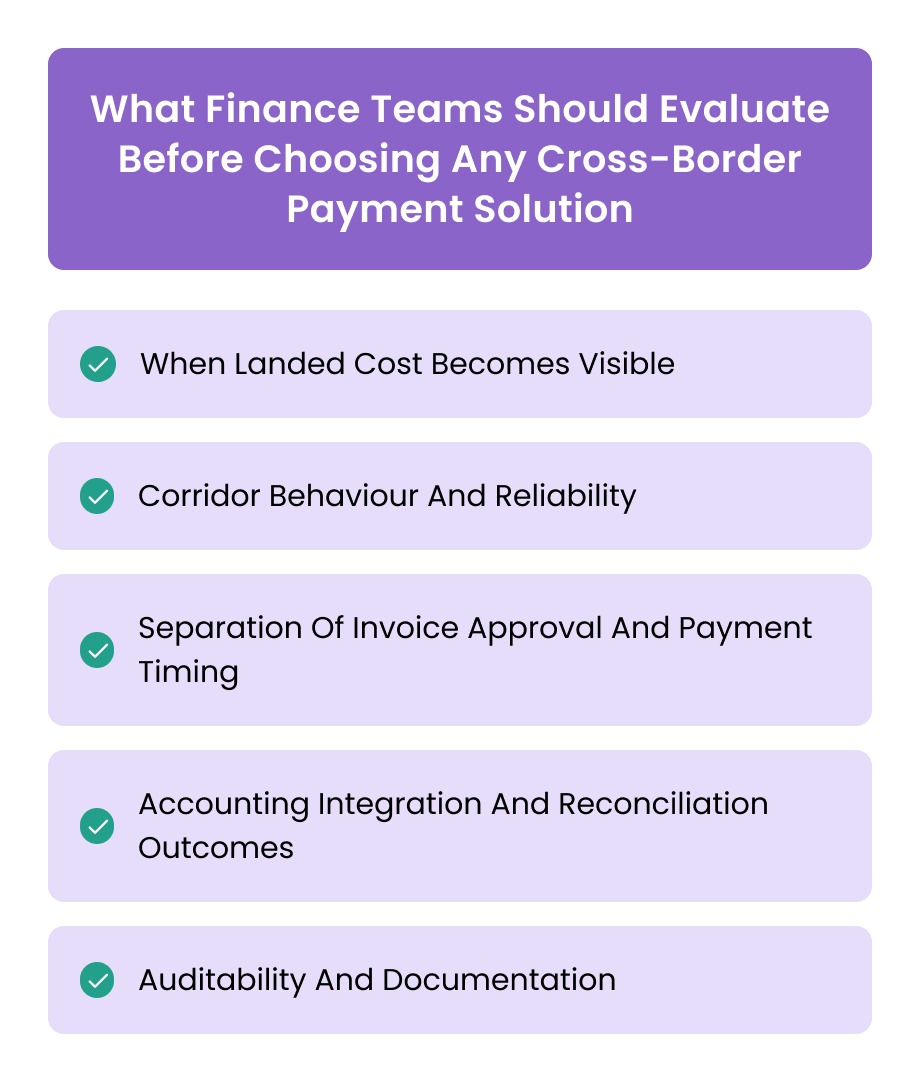
Once the ecosystem is clear, the risk shifts from tool availability to decision quality. Most payment failures in mature finance teams are not execution failures. They are decision failures caused by missing information at the wrong moment.
The following considerations reflect what consistently matters once cross-border payment volumes increase and scrutiny tightens.
1. When Landed Cost Becomes Visible
The most important question is timing. Finance teams should establish whether FX rates, fees, and deductions are visible before payment approval or only at execution.
If the landed cost is confirmed after the funds move, approvals are made without full information. Over time, this turns FX variance into a recurring explanation rather than a controlled outcome. Solutions that surface estimated cost before approval allow payment timing to become deliberate, not reactive.
2. Corridor Behaviour And Reliability
Headline corridor coverage rarely tells the full story. Settlement timelines, intermediary involvement, and exception rates vary significantly by market.
Finance teams should assess how a solution behaves on the specific corridors they use most frequently. Predictability on a small number of high-value corridors is often more valuable than broad but inconsistent coverage.
3. Separation Of Invoice Approval And Payment Timing
Treating invoice approval and payment execution as a single step compresses decision-making and increases risk.
Leading finance teams separate these responsibilities. Invoice approval confirms validity, coding, and compliance. Payment approval determines timing, FX exposure, and payment rail. Solutions that support this separation reduce rushed approvals and improve control without slowing operations.
4. Accounting Integration And Reconciliation Outcomes
A payment is not operationally complete until it is reconciled.
Finance teams should look beyond whether a tool “integrates with the ERP” and ask how reconciliation actually works. Payments should close invoices automatically, post cleanly to the general ledger, and surface exceptions early. When reconciliation depends on exports or manual uploads, workload accumulates quietly until close.
5. Auditability And Documentation
Cross-border payments attract audit and regulatory scrutiny. Approvals, invoices, FX details, and payment confirmations should be accessible in one place.
If payment history needs to be reconstructed across bank portals, emails, and accounting systems, the control environment weakens, and audit preparation becomes unnecessarily complex.
Vendor Due Diligence: Eight Questions Finance Teams Should Insist On
Once the evaluation criteria are clear, vendor discussions become more productive. The goal here is not to compare feature lists, but to expose assumptions and operational boundaries early.
These questions are designed to surface where responsibility sits and what happens when payments do not behave as expected.
1. When is FX and total cost confirmed for a payment?
Ask for a real example showing the pre-approval cost and final settlement.
2. How do payments behave on our primary corridors?
Vendors should explain typical settlement timelines and exception patterns for specific markets, not in general terms.
3. Are invoice approval and payment execution separate steps?
If not, finance teams lose control over timing and liquidity decisions.
4. What happens when a payment is delayed or fails?
Visibility and escalation paths matter more than theoretical success rates.
5. How does reconciliation work in practice?
Ask how invoices are closed, entries are posted, and mismatches are flagged.
6. Where is approval and payment documentation stored?
Audit readiness depends on centralised, accessible records.
7. How does the solution scale across entities and volumes?
Controls should remain consistent as usage grows.
8. What is the fallback when a payment cannot be processed?
Clear alternatives are better than last-minute workarounds.
Also read: Accounts Payable Automation and Invoice Management Software
How Cross-Border Payments Fit Into Alaan’s Broader Spend And Control Layer
At Alaan, cross-border payments delivered through Super Pay are positioned as an extension of spend governance rather than a standalone transfer tool. The objective is to keep decision-making, execution, and reconciliation connected, so finance teams retain control before money moves and clarity after it does.
SuperPay, Alaan’s cross-border payments capability, is built around five core elements:
1. Invoice-first control
Invoices are captured and reviewed before any payment is scheduled. Supplier documentation, VAT treatment, and accounting codes are validated upfront, reducing the risk of incorrect or incomplete payments entering the execution stage.
2. Separated approval stages
Invoice approval and payment approval are handled as distinct decisions. This allows finance teams to validate spend independently of payment timing, and to assess liquidity, FX exposure, and corridor behaviour before funds are released.
3. Upfront FX and cost visibility
For supported corridors, FX impact and expected payment costs are surfaced before payment approval. This enables finance leaders to make informed timing decisions instead of discovering variances after settlement.
4. Connected payment execution
Payments are executed only once approvals are complete. Corridor availability and behaviour are explicit, reducing last-minute workarounds when transfers behave differently from expectations.
5. Accounting closure is built into the flow
Payment outcomes sync into accounting systems, so invoices close automatically. Exceptions are identified early, limiting reconciliation effort and reducing month-end pressure.

The intent is not to replace banks, payment gateways, or FX providers. It is to provide a structured control layer where invoices, approvals, payments, and accounting outcomes remain linked throughout the lifecycle.
Conclusion
Cross-border payment gateways are not inherently good or bad. They are purpose-built tools that work well within specific boundaries. Problems emerge when they are expected to govern decisions they were never designed to control.
For UAE finance teams, the real question is not which payment solution moves money fastest, but which setup provides clarity before money moves and closure after it does. Predictable cash flow, defensible cost assumptions, and clean month-end outcomes all depend on that sequencing.
Teams that connect invoice validation, payment approval, execution, and accounting reconciliation into a single flow reduce surprises and spend less time explaining outcomes. Over time, that operational clarity compounds into stronger financial control.
If you want to assess how your current payment setup behaves against these criteria, or explore how Alaan supports cross-border payments within a governed workflow, you can review the approach with our team and compare it directly to your existing process. Book a Free Demo!
When you're comparing providers, the FX pricing calculator shows the exact amount your supplier receives with SuperPay, which tends to settle the argument fairly quickly.
FAQs
1. What is the difference between a cross-border payment gateway and a bank transfer?
A cross-border payment gateway typically routes card-based or digital payments through acquiring banks and payment networks, while bank transfers move funds directly between accounts using correspondent banking or SWIFT rails. Gateways optimise for scale and standardisation; bank transfers optimise for traceability and regulatory coverage.
2. Are cross-border payment gateways suitable for B2B supplier payments?
They can be, but only in limited scenarios. Gateways work well when payment values are predictable and documentation requirements are minimal. For supplier payments that affect margins, cash planning, or audits, finance teams often need additional controls outside the gateway.
3. How do FX costs usually show up in international payments?
In many setups, FX rates and intermediary fees are applied at execution rather than approval. This means the final landed cost becomes visible only after funds move, creating variance explanations later. Solutions that surface FX impact earlier reduce this risk.
4. Do UAE regulations affect how cross-border payments should be structured?
Yes. UAE finance teams must account for VAT documentation, audit trails, and local compliance expectations. Payment tools that sit outside accounting and approval workflows often increase reconciliation and audit effort, even if transfers themselves are compliant.
5. Why do some international payments take longer than expected?
Settlement speed depends on corridor behaviour, intermediary banks, local clearing systems, and documentation requirements. Headline corridor availability does not guarantee predictable settlement, which is why corridor-specific behaviour matters more than broad coverage.
6. When does it make sense to use a workflow-led payments platform instead of a gateway?
Workflow-led platforms make sense when payments are internally initiated, high in value, or frequent enough to affect cash forecasting and close timelines. In these cases, visibility before execution and clean accounting closure matter more than raw transfer speed.
Gain control over business expenses with Alaan corporate cards
Invygo earned AED 100,000 in cashback using Alaan cards
Personalise approval workflows to align with your business needs with Alaan's Spend Management platform
Discover the power of automated expense tracking and smarter spend control with Alaan
Turn data into actionable insights with Alaan's spend management tools
Stay Tax Compliant with UAE's #1 Corporate Card and Spend Management Platform
Customisable corporate card policy template
Know how much Corporate Tax you have to pay this fiscal year
Easily integrate Alaan with your ERP for accurate, real-time expense tracking
Close books faster with Alaan's AI-powered accounting automation
Reconcile your books in minutes instead of hours, every single month.
Keep petty cash organized with Alaan corporate cards and automated expense management