.avif)


What supplier payments are, why they matter for cash flow and vendor trust, the common challenges, and how automation improves them.
- A supplier payment is the process of paying vendors for goods or services after an invoice is received and delivery is verified, and it sits at the heart of accounts payable.
- It is a cash-flow and control function rather than just an admin task, since timing affects liquidity, vendor trust, supply continuity, and your negotiating power on pricing and terms.
- Nearly three out of four companies face B2B payment delays, usually because of fragmented intake, manual approvals, missing invoices, and manual reconciliation.
- The workflow runs from invoice receipt and verification through approval, execution, and reconciliation, and centralising intake, automating matching, and keeping real-time visibility keeps it accurate at scale.
- Alaan brings card and transfer-based supplier payments into one system, shows FX rates and total costs upfront on international transfers, and uses Alaan Intelligence to extract invoice data and flag duplicates.
Late supplier payments remain one of the most common and costly operational challenges for businesses.
Industry research consistently shows that nearly three out of four companies experience delays in B2B payments, putting pressure on cash flow, supplier relationships and day-to-day operations.
For finance teams, supplier payments are not just about settling invoices. They directly affect working capital planning, vendor trust and compliance, especially as transaction volumes grow.
Yet many organisations still rely on manual processes, fragmented approvals and limited visibility, making delays and disputes almost inevitable.
This guide explains what supplier payments are, why they matter, the challenges businesses face, and how modern automation is transforming supplier payment management.
Key Takeaways:
- Supplier payments are a cash-flow and control function, not just an AP task. How and when suppliers are paid directly affects liquidity, reporting accuracy, and operational continuity.
- Late or manual payments weaken vendor relationships and negotiating power. Delays, disputes, and poor visibility reduce supplier trust and limit leverage on pricing and terms.
- Most supplier payment issues stem from fragmented processes. Disconnected invoice intake, approvals, payments, and reconciliation drive delays, errors, and compliance risk.
- Automation is essential as supplier volumes scale. Centralised intake, automated verification, real-time visibility, and auto-reconciliation are critical to maintaining accuracy and speed at scale.
- Integrated spend and payment platforms enable consistency and compliance. Tools like Alaan combine controlled payments, VAT validation, visibility, and accounting sync to turn supplier payments into a structured, auditable workflow rather than a manual bottleneck.
What Is Supplier Payment?
Supplier payment refers to the process of paying vendors, suppliers, or service providers for goods or services delivered to a business. These payments form a critical part of accounts payable and directly impact operational continuity, financial reporting, and vendor relationships.
Supplier payments typically occur after a business receives an invoice from a vendor and verifies that goods or services have been delivered according to agreed terms. The payment can be made through various methods, including bank transfers, corporate cards, or digital payment platforms.
Beyond simply settling invoices, supplier payments influence several financial functions:
- Procurement efficiency and supplier management
- Cash-flow planning and liquidity control
- Financial reporting and expense tracking
- Regulatory compliance, including VAT documentation
When supplier payments are managed efficiently, businesses maintain stronger vendor partnerships and gain better visibility into their financial commitments.
Why Supplier Payments Are Critical for Business Stability
Supplier payments do far more than settle invoices. They directly shape how smoothly a business operates and how financially stable it remains.
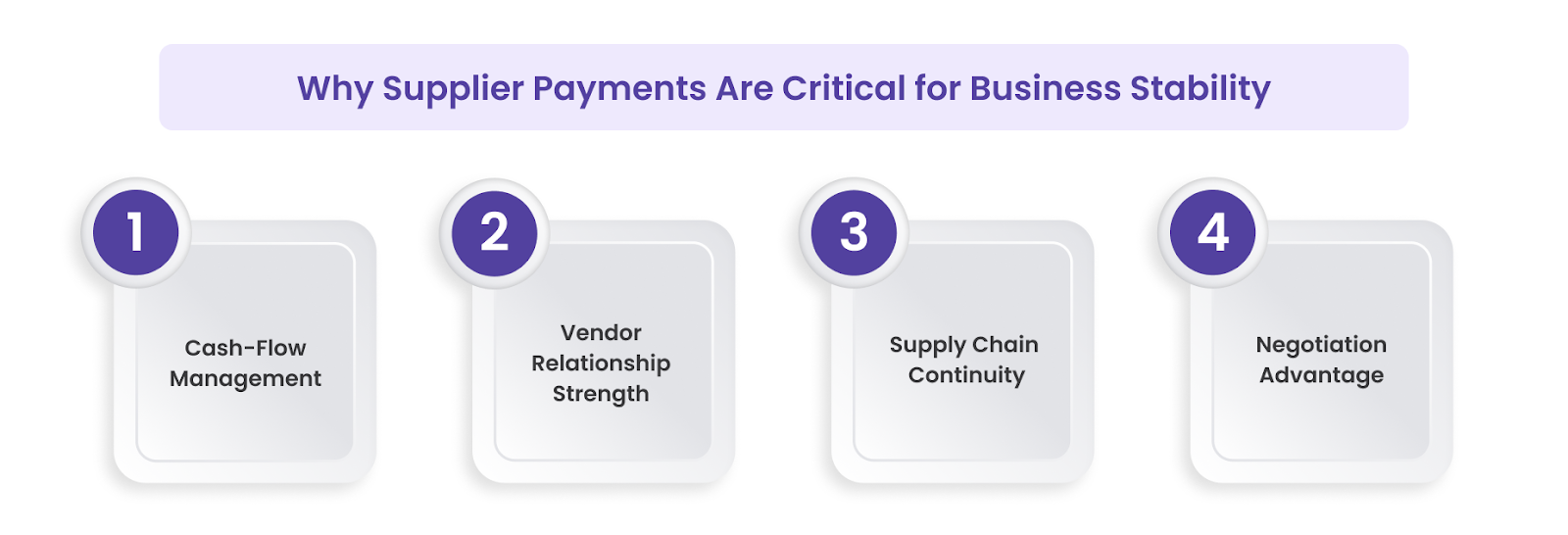
Here’s where they matter most:
1. Cash-Flow Management
Supplier payments represent a significant portion of outgoing cash. If payment schedules are poorly managed, businesses may experience liquidity pressure or miss opportunities to optimise working capital. Proper supplier payment planning ensures that cash outflows align with incoming revenue and budget priorities.
2. Vendor Relationship Strength
Suppliers are more likely to prioritise businesses that pay consistently and on time. Late payments can lead to strained vendor relationships, supply delays, or less favourable pricing and credit terms.
3. Supply Chain Continuity
Reliable supplier payments help maintain uninterrupted access to goods and services. Payment delays can disrupt production schedules, project timelines, or service delivery.
4. Negotiation Advantage
Businesses that demonstrate payment reliability often gain leverage when negotiating pricing, credit periods, or contract terms. Vendors prefer working with organisations that show financial discipline and transparency.
Also read: Cash Flow Optimisation Strategies for UAE Businesses in 2025
Common Supplier Payment Methods
Businesses use multiple payment methods depending on vendor preferences, payment urgency, and internal financial controls. The most commonly used supplier payment options include:
1. Bank Transfers
Bank transfers remain one of the most widely used supplier payment methods. They offer direct and secure payments, particularly for large invoices. However, they often require manual approval and reconciliation processes.
2. Corporate Cards
Corporate cards allow businesses to pay vendors instantly while maintaining spending controls and transaction visibility. They are particularly useful for recurring vendor payments, subscriptions, and operational expenses.
3. Cheques
Although declining in usage, cheques are still used in some industries for supplier payments. They are slower to process and increase the administrative workload compared to digital payment methods.
4. Digital Wallets and Payment Gateways
Some vendors accept payments through digital wallets or online payment gateways. These methods provide convenience and faster settlement but may require integration with accounting systems for reconciliation.
5. Automated Payment Platforms
Modern payment platforms automate invoice verification, approvals, and payment execution. They improve efficiency and reduce manual errors while providing better visibility into payment schedules.
How Supplier Payments Work: A Step-by-Step Process
A well-defined supplier payment process ensures accuracy, timeliness and financial control. Here is how the workflow typically operates.
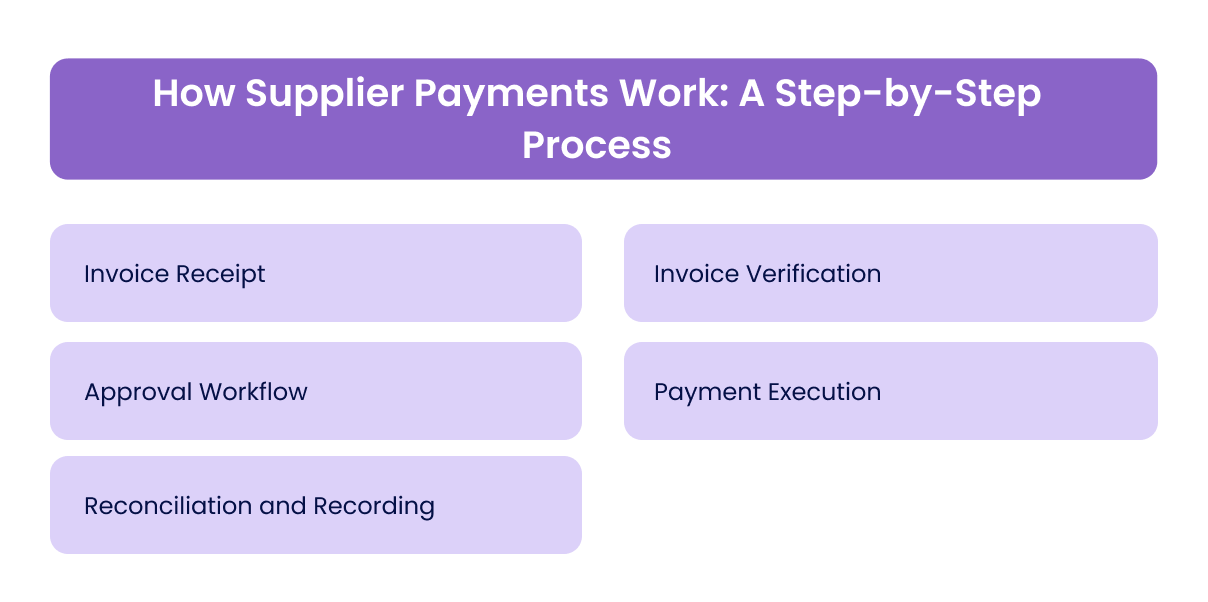
1. Invoice Receipt
The process starts when a supplier issues an invoice after delivering goods or services. Invoices may arrive via email, supplier portals or physical copies.
At this stage, completeness matters. Missing details such as supplier information, invoice numbers, VAT breakdowns or payment terms can delay the entire process and increase follow-up effort.
A structured intake process ensures invoices are logged, tracked and not lost before review begins.
2. Invoice Verification
Once received, invoices must be verified against supporting documents such as purchase orders, contracts or delivery confirmations.
This step confirms:
- The goods or services were actually received
- The amounts and pricing are correct
- VAT details are accurate and compliant
- The invoice is not a duplicate
Verification is critical for preventing overpayments, fraud and VAT errors that can surface later during audits.
3. Approval Workflow
After verification, invoices move through approval workflows based on company policy. Approvals confirm that:
- The spend is legitimate and budgeted
- The supplier and expense category are authorised
- Payment aligns with the agreed terms
Clear approval rules help maintain accountability and prevent unauthorised or off-policy payments, especially in multi-team or multi-entity organisations.
4. Payment Execution
Once approved, the payment is scheduled and executed using the chosen method, such as bank transfer or corporate card.
Payment timing plays a direct role in:
- Cash flow planning
- Capturing early payment discounts
- Avoiding late fees or strained supplier relationships
Well-managed execution ensures payments are neither rushed nor delayed unnecessarily.
5. Reconciliation and Recording
The final step is reconciling the payment with accounting records. Invoices, approvals and payment confirmations are matched to ensure accurate ledger entries.
This step supports:
- Clean month-end close
- Accurate financial reporting
- Strong audit trails
Incomplete or delayed reconciliation often leads to manual corrections, reporting delays and reduced confidence in financial data.

Common Supplier Payment Challenges Businesses Face
Even well-established businesses struggle with supplier payments when processes rely heavily on manual steps or disconnected systems. These challenges impact cash flow, compliance and supplier trust, especially as transaction volumes grow.
1. Late Payments
Delayed approvals, missing invoices or manual processing often result in late supplier payments. Beyond penalties or lost discounts, late payments can strain vendor relationships and disrupt supply chains, making it harder to negotiate favourable terms in the future.
2. Missing or Incomplete Invoices
Invoices that are misplaced, duplicated or submitted with missing details slow down verification and approvals. Finance teams end up spending time chasing documents instead of focusing on higher-value work, while suppliers face uncertainty around payment timelines.
3. VAT Compliance Risk
In regions like the UAE, supplier invoices must meet specific VAT requirements. Incomplete VAT details, incorrect TRNs or missing tax breakdowns can lead to compliance gaps, rejected VAT claims or audit exposure.
4. Manual Reconciliation
Matching invoices, payments and ledger entries manually is time-consuming and error-prone. Manual reconciliation increases the risk of posting errors, duplicate payments and delayed month-end close, especially when payment data is scattered across systems.
5. Lack of Payment Visibility
When supplier payments are managed across emails, spreadsheets and bank portals, finance leaders lose real-time visibility into what has been approved, paid or is still pending. This makes cash flow planning and reporting less reliable.
6. Vendor Disputes
Payment delays, missing documentation, or mismatched amounts often trigger supplier disputes. Resolving these disputes takes time, weakens supplier relationships and diverts finance teams from strategic priorities.
Also read: Understanding the Process of Account Reconciliation in Accounting
Best Practices for Managing Supplier Payments at Scale
As businesses grow, supplier volumes increase, and payment workflows become more complex. What works for a small vendor base quickly breaks down at scale.
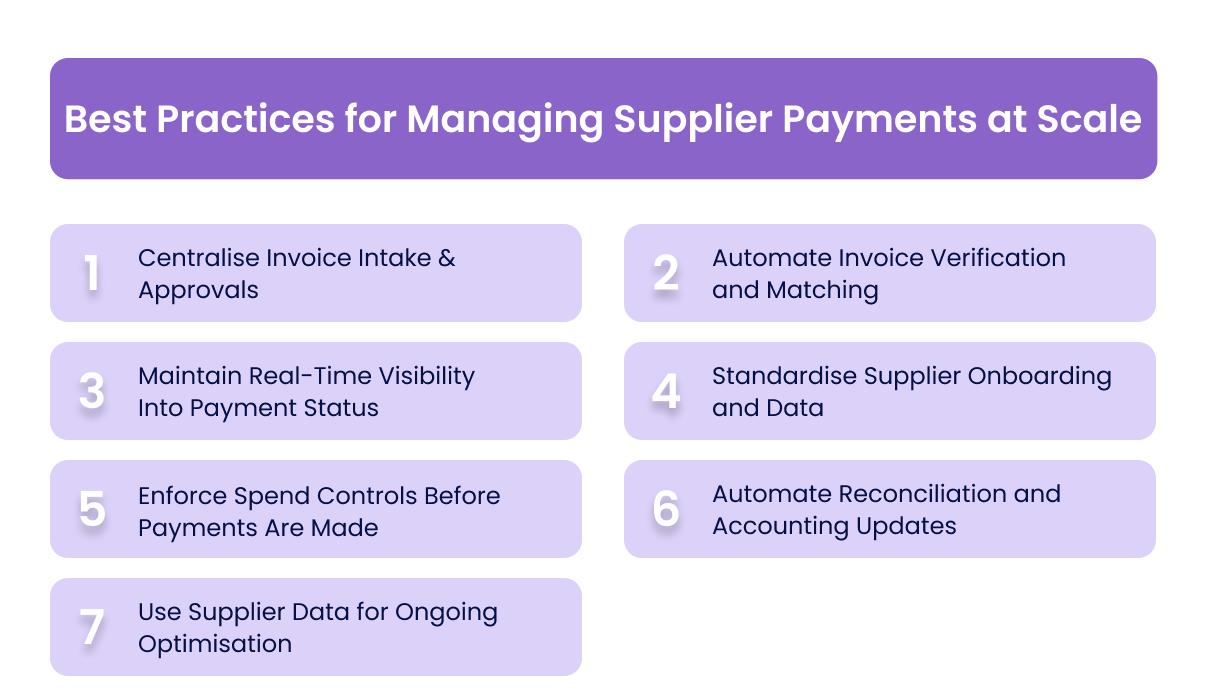
The following best practices help finance teams maintain control, accuracy and efficiency as supplier payments expand.
1. Centralise Invoice Intake and Approvals
All supplier invoices should flow into a single, tracked system rather than scattered across emails or folders. Centralised intake combined with structured approval workflows helps:
- Route invoices to the right approvers
- Reduce approval delays and bottlenecks
- Prevent unauthorised or duplicate payments
2. Automate Invoice Verification and Matching
Manual invoice checks do not scale. Automated verification matches invoices against purchase orders, contracts or delivery confirmations to:
- Catch pricing discrepancies early
- Identify duplicate invoices
- Reduce overpayments and rework
3. Maintain Real-Time Visibility Into Payment Status
Finance teams need live insight into what is pending, approved or paid. Real-time visibility supports:
- More accurate cash flow forecasting
- Clear communication with suppliers
- Fewer last-minute payment surprises
4. Standardise Supplier Onboarding and Data
Consistent onboarding ensures supplier details are captured correctly from the start, including:
- Bank and payment information
- VAT details and compliance data
- Agreed payment terms
Clean supplier data reduces errors and speeds up processing across the payment lifecycle.
5. Enforce Spend Controls Before Payments Are Made
Controls should apply before funds are released, not after. Pre-payment controls help:
- Enforce budgets and approval thresholds
- Prevent out-of-policy spending
- Reduce manual reviews and corrections
6. Automate Reconciliation and Accounting Updates
Invoices, payments and ledger entries should be reconciled automatically to:
- Maintain accurate financial records
- Reduce month-end workload
- Support faster and cleaner closes
7. Use Supplier Data for Ongoing Optimisation
Centralised payment data enables deeper analysis of supplier spend and performance, helping finance teams:
- Identify cost concentration risks
- Negotiate better terms with key vendors
- Improve long-term supplier strategy
As supplier payments scale, these best practices become difficult to sustain with manual tools alone. This is where an integrated spend and payment platform plays a critical role in maintaining consistency and control.
Building Better Supplier Payment Processes with Alaan
Managing supplier payments at scale requires more than faster payments. It requires visibility, control and clean data across every stage of the process. At Alaan, we built an integrated spend management platform that helps finance teams streamline supplier payments while maintaining strong governance.
Key features:
- One platform for card and transfer-based supplier payments: Businesses often use Alaan for part of their spend and switch back to banks, exchange houses or FX apps for international payments. Alaan reduces this fragmentation by enabling teams to manage card payments and supplier transfers from a single system.
- Transparent and predictable international transfers: Traditional international payments are often expensive, opaque and slow, with wide FX spreads and hidden fees. Alaan shows FX rates and total costs upfront, helping finance teams avoid margin erosion and post-payment surprises.
- Designed for businesses paying international suppliers: Alaan is particularly relevant for companies that make frequent or high-value cross-border payments, cannot use cards for procurement, and have margins directly affected by FX. This includes importers, traders, global procurement teams, travel agencies, and construction or manufacturing businesses.
- Built-in approvals and controls: Supplier payments follow structured workflows, with invoice approvals to validate costs before entering the payment queue and payment approvals before funds are released. This maintains accountability and prevents unauthorised payments.
- Vendor management and clean onboarding: Supplier details, payment terms and documentation are captured centrally, reducing errors and simplifying ongoing payment management across currencies and entities.
- Automated reconciliation and ERP integration: Supplier payments sync with accounting systems and ERPs, reducing manual posting, simplifying reconciliation and keeping financial records accurate.
- AI-powered accuracy with Alaan Intelligence: Alaan Intelligence extracts invoice data, detects duplicates, flags missing tax invoices, and reviews transactions on behalf of teams, reducing manual effort and improving data quality.
By bringing supplier payments, including international transfers, into a single, controlled system, Alaan helps finance teams gain predictability, visibility and confidence in their supplier costs.
Wrapping Up
Supplier payments play a critical role in maintaining vendor relationships, managing cash flow, and ensuring operational continuity. However, manual payment processes often create delays, compliance risks, and limited financial visibility.
Modern automation solutions help businesses streamline supplier payment workflows, reduce administrative workload, and improve accuracy across financial reporting.
At Alaan, we simplify supplier payment management through corporate cards, AI-powered automation, and seamless accounting integration. Finance teams gain real-time visibility, stronger compliance, and greater control over every dirham spent.
Schedule a demo to see how Alaan helps businesses manage supplier payments more efficiently while strengthening financial control.
Milestone terms like 30-30-40 are one way of paying later, and deferred payment for UAE finance leaders covers the other arrangements, plus the VAT timing and hidden costs that come with them. For the process side, the guide to AP automation shows how invoices move from capture to payment once the manual steps are gone.
FAQs
1. What is the payment method for suppliers?
Suppliers are commonly paid through bank transfers, corporate cards, cheques or digital payment platforms. The method used typically depends on the supplier agreement, payment terms, transaction value and the level of control or visibility the business requires over the payment.
2. What are the three types of payments?
The three most common types of payments used in business are bank-based payments, card-based payments and cheque or manual payments. Many organisations use a combination of these methods based on supplier preferences, operational efficiency and internal control requirements.
3. How should you reply to a supplier asking for payment?
When responding to a supplier payment request, it is important to be clear and specific. The response should confirm whether the invoice has been received, indicate its approval status and provide an expected payment date. Clear communication helps reduce follow-ups and maintain strong supplier relationships.
4. What are 30-30-40 payment terms?
30-30-40 payment terms divide the total invoice amount into stages, with 30% paid upfront, 30% paid after a defined milestone and the remaining 40% paid upon final delivery or project completion. These terms are often used for project-based work to balance cash flow between the business and the supplier.
Gain control over business expenses with Alaan corporate cards
Invygo earned AED 100,000 in cashback using Alaan cards
Personalise approval workflows to align with your business needs with Alaan's Spend Management platform
Discover the power of automated expense tracking and smarter spend control with Alaan
Turn data into actionable insights with Alaan's spend management tools
Stay Tax Compliant with UAE's #1 Corporate Card and Spend Management Platform
Customisable corporate card policy template
Know how much Corporate Tax you have to pay this fiscal year
Easily integrate Alaan with your ERP for accurate, real-time expense tracking
Close books faster with Alaan's AI-powered accounting automation
Reconcile your books in minutes instead of hours, every single month.
Keep petty cash organized with Alaan corporate cards and automated expense management