.avif)


A practical guide to which business travel costs qualify for VAT recovery in the UAE and how to document them so claims hold up.
- Tie every travel claim to a valid tax invoice showing the supplier's TRN and a clear business purpose, because without that the expense cannot be recovered for VAT.
- Only work-related costs count, so flights, hotels, client meetings, and transport qualify, while weekend hotel extensions, family tickets, and minibar charges make a claim non-compliant.
- VAT treatment varies by category, with accommodation fully deductible, transport partially deductible, and meals reclaimable only when they are directly linked to work.
- Most errors come from process gaps like scattered receipts and unclear approvals rather than overspending, so real-time tracking and set categories catch them before month-end.
- Alaan reads and verifies receipts instantly, checks TRNs automatically, and syncs travel expenses into accounting tools, so finance teams review exceptions instead of reconciling everything.
Travel expenses are among the most frequently disputed line items in corporate finance, not because of the amount, but because of the uncertainty around what qualifies, what is deductible, and what documentation is required.
For finance teams, even small gaps in clarity can lead to bigger inefficiencies: missing receipts delay reconciliations, while non-compliant invoices complicate VAT recovery. Yet, these issues rarely stem from overspending; they stem from inconsistent processes and unclear policies.
As companies in the Middle East expand across markets, business travel has become an operational constant. Flights, hotels, meals, and client meetings are all essential, but not all are treated equally under expense policies or tax rules.
Understanding which costs count as business travel expenses is the first step to managing them accurately and maintaining financial compliance.
Key Takeaways
- Business Travel Rules: Only expenses tied directly to work (flights, hotels, client meetings, etc.) qualify as claimable and VAT-recoverable in the UAE.
- Documentation Standards: Valid tax invoices with TRNs and a clear business purpose are essential for compliance and smooth VAT recovery.
- Small Business Challenges: Errors come from process gaps — scattered receipts, unclear approvals, and inconsistent documentation — not from overspending.
- Smart Expense Management: Real-time tracking, structured categories, and defined policies help finance teams prevent mistakes before they reach month-end.
- Automation Advantage: With tools like Alaan, receipts are verified instantly, TRNs checked automatically, and travel expenses synced straight into accounting systems — replacing manual reconciliation with clean, audit-ready data.
What qualifies as business travel expenses?
Business travel expenses are the costs employees incur when travelling for work purposes, anything from flights and hotel stays to ground transport, and meals during an official trip. In the UAE, such expenses can be deducted and claimed for VAT recovery, provided they are strictly business-related, approved internally, and supported by valid documentation.
Where finance teams often face challenges is not in the spending itself, but in the boundaries. A client dinner or a taxi to a supplier meeting may qualify; a weekend hotel extension or an unverified meal without an invoice does not. Even small personal add-ons like room upgrades, family tickets, or minibar charges can make an otherwise legitimate claim non-compliant.
The same applies to documentation. Under Federal Tax Authority (FTA) rules, receipts must include the supplier’s Tax Registration Number (TRN) and clearly state the business purpose. Without this, the expense cannot be claimed for VAT recovery.
Ultimately, what qualifies as a business travel expense is about whether the expense directly supports business activity and is properly recorded. Clear definitions save time, reduce disputes, and make every reimbursement audit-ready.
Common business travel expense examples
Once the rules are clear, the next step is to translate them into practice. Business travel can include a wide range of costs, and finance teams need clear categories to keep reporting consistently.
For companies in the Middle East, this is especially important because VAT treatment varies by expense type.
The table below highlights typical business travel expenses and how they are generally treated for VAT purposes in the UAE. It’s not an exhaustive list, but it offers a solid baseline for defining what counts and for training teams to record them correctly.
Rather than debating whether each receipt qualifies, finance teams benefit from categorising expenses upfront. This reduces back-and-forth during audits and keeps policy enforcement consistent across departments.
Teams that map their expense categories clearly and link them to automated workflows save hours of manual reconciliation later. Once every transaction fits into a defined category, automation handles the rest: verifying receipts, matching VAT data, and updating accounting entries in real time.
How small businesses can handle travel expenses more effectively
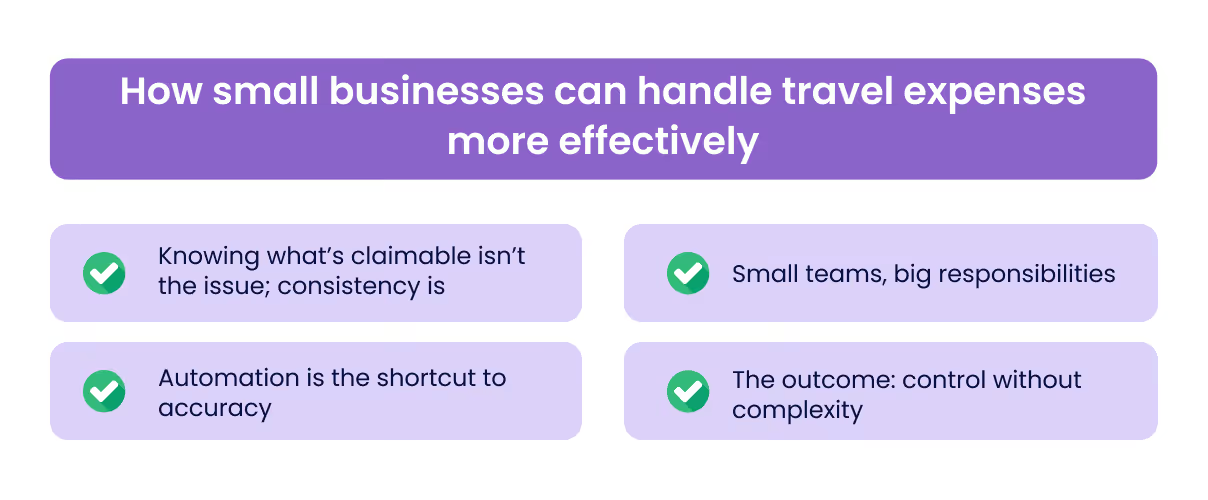
For small businesses, every trip is an investment in clients, suppliers, and opportunities. But when those trips end, finance teams are often left managing receipts, reimbursements, and compliance tasks with limited time and tools. Resulting in small, preventable mistakes that eat into both margins and VAT recoveries.
1. Knowing what’s claimable isn’t the issue; consistency is
Most small finance teams already know what can be expensed.
What makes the process difficult is:
- Manual tracking: receipts scattered across emails and WhatsApp.
- Unclear approvals: who signs off on what and when.
- Missed details: no TRN, vague descriptions, or duplicate entries.
Each of these small gaps can turn legitimate expenses into rejected or unrecoverable claims.
2. Small teams, big responsibilities
Unlike large organisations, SMBs don’t have compliance specialists or layered workflows. Usually, one person, often the finance manager or even the founder, handles it all. When everything depends on human checks, errors are inevitable.
What helps: building a lightweight system that removes friction instead of adding steps.
3. Automation is the shortcut to accuracy
You don’t need a bigger finance team, just smarter tools.
Platforms like Alaan simplify the process by:
- Capturing travel receipts instantly via mobile or web.
- Auto-verifying TRN and VAT details for compliance.
- Syncing all approved expenses with accounting tools in real time.
This keeps every expense visible and compliant, without extra admin work.
4. The outcome: control without complexity
When automation replaces manual checks, small businesses gain:
- Better visibility into where travel budgets go.
- Faster reconciliations at month-end.
- Fewer errors and VAT disputes.
Expense management stops being reactive. It becomes a control point that supports smarter, faster financial decisions.
How to manage and track business travel expenses effectively
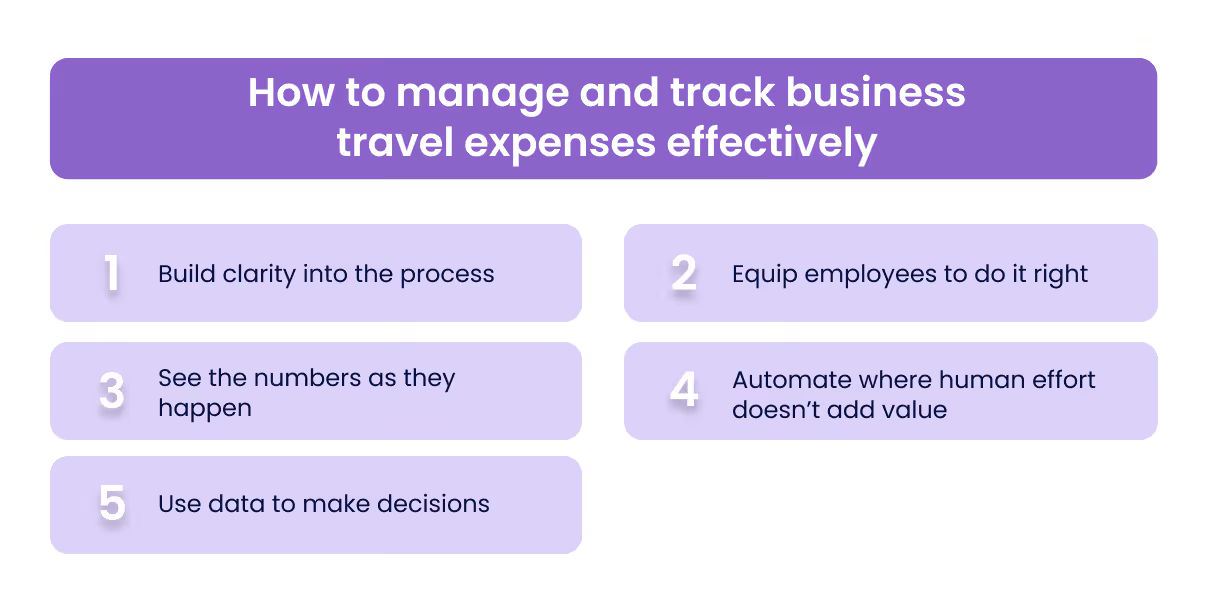
Strong expense management means visibility: knowing how, where, and why company money moves. For finance teams, travel spending is often the hardest to keep consistent. Trips are unpredictable. Invoices arrive late. Even the most organised employees sometimes forget to upload receipts while travelling.
What separates efficient teams from reactive ones is structure. The right process creates order without slowing people down. It gives finance leaders confidence that every trip, transaction, and claim sits inside one reliable system.
1. Build clarity into the process
The best expense systems start before the first booking. Finance leaders should define clear rules around:
- Who can spend, and within what limits?
- What documentation is needed for approval?
- Which expenses require pre-approval?
When these rules are written down, shared, and easy to access, employees make better decisions, and finance teams spend less time correcting them later.
2. Equip employees to do it right
Compliance improves when it’s easy. If submitting an expense takes five steps, people will avoid it.
The fix is simple: make it effortless to log, tag, and submit expenses.
Encourage teams to:
- Upload receipts as soon as they are spent.
- Add short notes explaining each expense.
- Use one digital platform, not scattered spreadsheets or emails.
Small habits like these can save hours in reconciliation at month-end.
3. See the numbers as they happen
Visibility gives finance teams control. When expenses are tracked in real time, spending no longer hides behind month-end reports. Managers can see how budgets are being used, flag irregular claims early, and ensure VAT documentation stays compliant as it’s created.
This live view turns expense management into a proactive system, one that prevents small errors from becoming big reconciliations later.
4. Automate where human effort doesn’t add value
Automation should take over the repetitive work so finance teams can focus on the decisions that move the business forward. They shouldn’t spend hours chasing receipts or validating data that software can check instantly. Their attention belongs to patterns, anomalies, and decisions that actually affect performance.
Automation brings that balance. It keeps compliance consistent in the background while surfacing the insights that matter. When systems like Alaan handle verification and categorisation automatically, finance leaders gain trust in their numbers, apart from saving time.
[cta-10]
5. Use data to make decisions
Expense management doesn’t end at reconciliation. Once the process is digital, every transaction becomes a data point.
Finance leaders can use those insights to:
- Spot trends in travel spending.
- Plan more accurate travel budgets.
- Negotiate better vendor terms using spend data.
Good data turns expense management from a control task into a strategic advantage.
Automating travel expense compliance with AI
Few parts of finance have changed as rapidly as expense compliance. What once depended on manual checks and scattered spreadsheets now happens in real time quietly, accurately, and at scale.
AI fits perfectly into this shift because expense management is built on patterns, data, and repetition, the exact kind of work machines excel at.
That’s what makes Alaan different. Its AI forms the backbone of how expenses are checked, verified, and recorded.
Every receipt uploaded is instantly read, cross-matched with the transaction, and checked for VAT accuracy. If something looks off, a missing TRN, a duplicate, an unusual amount, it’s flagged automatically, long before finance ever sees it.
The result is a workflow that’s both faster and cleaner.
- Finance teams spend their time reviewing exceptions instead of reconciling everything.
- Audits become simple because every transaction already carries its own trail of evidence.
- Compliance stops being an extra step as it gets built into the system from the moment an expense is made.
Across the UAE and Saudi Arabia, where VAT compliance and documentation standards are strict, this precision matters. AI eliminates the small gaps that can cost businesses both time and recoverable tax, while giving finance leaders the confidence that their data is right, every single time.
Ready to see it in action?
Schedule a quick demo to discover how Alaan brings AI-powered accuracy and control to every stage of travel expense management, from receipt to reconciliation.
Conclusion: moving towards intelligent spend management
Business travel will always be part of how companies grow, meeting clients, exploring new markets, and building partnerships. What’s changed is the way finance teams manage those costs. They need systems that can keep up, be accurate, compliant, and fast enough to move with the business.
Alaan brings travel spending, policy control, and compliance together in one place. Every expense is captured and verified automatically, so finance teams always know where company money is going and that it’s going there for the right reasons.
Across the UAE and Saudi Arabia, hundreds of companies use Alaan to replace scattered, manual processes with clear, connected financial control.
The result is fewer bottlenecks, better data, and a smoother close at the end of every month.
Read customer success stories to explore how finance leaders across the UAE and KSA are modernising spend control with Alaan.
Learn more about how Alaan helps you automate expense management
FAQs
1. What counts as a business travel expense?
A business travel expense is any cost incurred while travelling for work — such as flights, accommodation or local transport — and must support business objectives rather than personal purposes.
2. Which travel expenses can employees claim?
Employees can typically claim costs directly tied to the business trip — including air or train fares, hotel stays, local transport, meals during travel and other necessary travel-related costs.
3. What expenses are not considered business travel costs?
Regular commuting to and from the usual workplace, personal entertainment or leisure stays, or expenses withouta proper business purpose or documentation are not eligible as business travel expenses.
4. How should small businesses handle travel expense documentation for VAT or tax purposes?
Small businesses must ensure each travel expense is clearly recorded, backed by a valid tax invoice that includes supplier details (such as TRN in the UAE context), and aligned with the company-approved travel policy in order to qualify for VAT recovery or deduction claims.
5. What’s the benefit of automating travel expense compliance for companies operating in the Middle East?
Automation ensures each travel expense is captured, verified for tax compliance and visible in real time, reducing manual work, improving accuracy and strengthening audit readiness in jurisdictions such as the UAE and Saudi Arabia.
Gain control over business expenses with Alaan corporate cards
Invygo earned AED 100,000 in cashback using Alaan cards
Personalise approval workflows to align with your business needs with Alaan's Spend Management platform
Discover the power of automated expense tracking and smarter spend control with Alaan
Turn data into actionable insights with Alaan's spend management tools
Stay Tax Compliant with UAE's #1 Corporate Card and Spend Management Platform
Customisable corporate card policy template
Know how much Corporate Tax you have to pay this fiscal year
Easily integrate Alaan with your ERP for accurate, real-time expense tracking
Close books faster with Alaan's AI-powered accounting automation
Reconcile your books in minutes instead of hours, every single month.
Keep petty cash organized with Alaan corporate cards and automated expense management