.avif)

The first wave of fintech changed how people accessed financial services. The next wave is changing where financial services sit in the first place: inside business software, payment flows, data layers, and operational workflows. That is why the future of fintech looks less like a better banking app and more like a deeper financial infrastructure shift.
That shift is already visible in the UAE. The local fintech market is projected to grow from USD 3.16 billion (approx. AED 11.6 billion) in 2024 to USD 5.71 billion (approx. AED 21 billion) by 2029, while a large majority of consumers already use digital-first banking services. At the same time, the regulatory stack is evolving through open finance, instant payments, and digital currency initiatives.
In this article, we explain the key trends shaping the future of fintech, including AI, embedded finance, open finance, and real-time payments, and what those shifts mean for UAE businesses.
TL;DR
- The future of fintech is shifting from digital convenience alone to deeper financial infrastructure and embedded workflows.
- AI, open finance, embedded finance, real-time payments, and regulated digital money are shaping the next phase.
- In the UAE, fintech growth is being supported by market demand, regulatory development, and stronger payment rails.
- The stronger fintech platforms are likely to be the ones that combine innovation with trust, interoperability, and real operational value.
- Alaan fits this shift by bringing spend control, approvals, visibility, and payment workflows closer together for finance teams.
Related: AI Use Cases In Finance Examples Benefits
The Future Of Fintech Is Bigger Than Digital Banking
The future of fintech is no longer just about replacing physical banking with digital channels. It is increasingly about how financial capabilities get built into the systems, workflows, and decisions that businesses and consumers already use every day.
- From Better Interfaces To Better Infrastructure
Earlier fintech growth was driven by convenience, speed, and user experience. The next phase is being shaped more by the rails underneath financial activity, such as data access, payments, identity, compliance, and interoperability. - From Standalone Products To Embedded Workflows
Financial services are moving closer to the point where activity actually happens. Instead of sitting in separate apps, they are increasingly being built into commerce platforms, SaaS tools, procurement systems, and day-to-day business operations. - From Innovation Alone To Innovation With Control
The next stage of fintech will not be judged only on novelty. It will be judged on whether products can operate within stronger regulatory expectations, integrate cleanly with existing systems, and support trust at scale.
Also Read: Automation Finance Future Trends
The Trends Shaping The Future Of Fintech
The next phase of fintech is being driven by a handful of structural shifts rather than a long list of disconnected trends. The most important ones are changing how money moves, how financial data is used, and how financial decisions are made inside businesses.
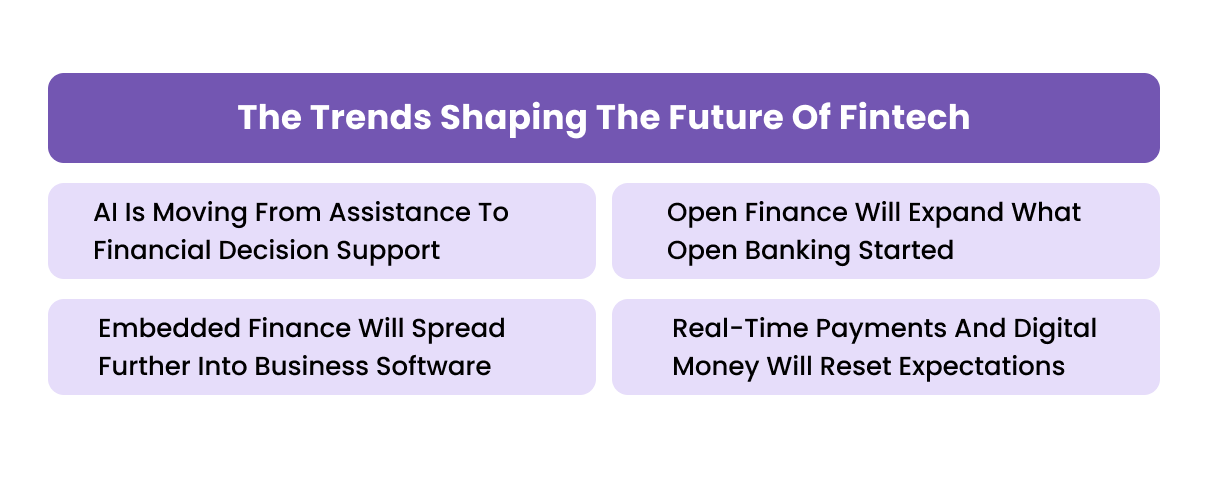
1. AI Is Moving From Assistance To Financial Decision Support
AI is no longer limited to chatbots and front-end personalisation. It is moving deeper into compliance, risk management, fraud monitoring, customer experience, and operating efficiency, which makes it increasingly relevant to how fintech products are built and how finance teams work.
2. Open Finance Will Expand What Open Banking Started
Open finance matters because it makes financial data more portable and usable across providers, with customer consent and a regulated access model. In practical terms, that creates room for better financial products, more competition, and stronger service layers for retail, SME, and corporate users.
3. Embedded Finance Will Spread Further Into Business Software
Embedded finance is moving beyond consumer checkout use cases. The larger opportunity is inside business software, where payments, lending, card controls, expense workflows, and other financial actions are becoming native parts of operational platforms rather than separate destinations. The global embedded finance market is projected to reach $7.2 trillion by 2030, with strong projected growth in MENA as well.
4. Real-Time Payments And Digital Money Will Reset Expectations
Once payment infrastructure becomes faster, always available, and more programmable, user expectations change quickly. In the UAE, instant payments through Aani already support immediate transfers on a 24/7 basis, while the Digital Dirham programme has completed Phase I across retail, wholesale, and cross-border use cases, including pilots built around tokenisation and programmability.
Related: Benefits E Invoicing System Insights
What The Future Of Fintech Means For Businesses
For businesses, the future of fintech is less about watching industry trends from a distance and more about preparing for finance to become more connected to daily operations. Payments, approvals, data, controls, and reporting are all moving closer together, which changes how finance teams should think about systems and workflows.
- Finance Operations Will Become More Connected
Business finance tools will continue moving away from isolated point solutions. The stronger platforms will be the ones that connect payments, approvals, accounting, and reporting into a cleaner operating flow. - Payments And Reconciliation Will Move Closer Together
As real-time payment rails become more established, businesses will expect faster settlement and better visibility into payment status. That should make reconciliation less delayed and less dependent on fragmented follow-up. - Controls Will Matter Earlier In The Workflow
When financial activity becomes more embedded, businesses need stronger controls at the point of spend, approval, and execution rather than only at month-end. The future of fintech will reward systems that make control operational, not retrospective. - System Choice Will Depend More On Interoperability
A good interface will still matter, but it will not be enough on its own. Businesses will increasingly prefer platforms that can exchange data reliably, fit into existing finance architecture, and scale with more complex oversight requirements.

Also Read: Business Spend Management Tools Importance
Why The UAE Is Well Placed To Shape The Future Of Fintech
The UAE has a stronger claim than many markets because growth, regulation, and infrastructure are all moving at the same time. That combination matters more than hype, because fintech ecosystems become more durable when policy, rails, and market demand start reinforcing one another.
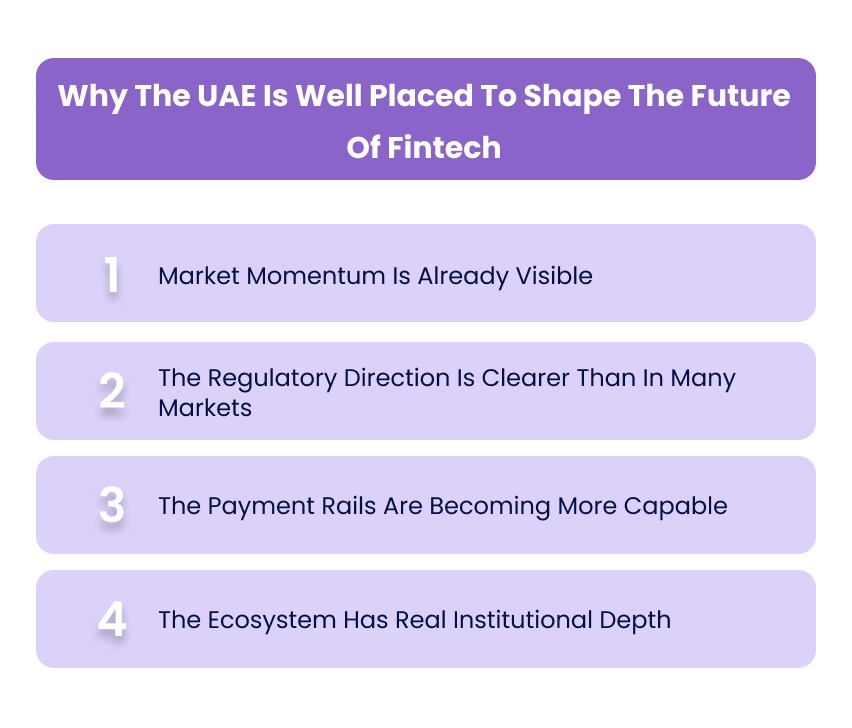
- Market Momentum Is Already Visible
The sector is not waiting for adoption to begin. Projected market growth, strong digital banking usage, and continued startup funding all point to a market that is already operating at meaningful scale rather than testing fintech in a narrow niche. - The Regulatory Direction Is Clearer Than In Many Markets
Open finance now has a formal regulatory structure, while payment-token services also sit within a defined licencing and supervision framework. That gives fintech growth a clearer policy base than markets where innovation is still moving ahead of regulation. - The Payment Rails Are Becoming More Capable
Instant payment infrastructure and newer digital-money initiatives are not side experiments. They point to a broader effort to modernise how value moves, settles, and integrates with the wider payment ecosystem. - The Ecosystem Has Real Institutional Depth
The UAE also benefits from concentrated ecosystem support. Dubai’s innovation infrastructure includes the first and largest financial technology accelerator in the MEASA region, which strengthens the market’s ability to attract founders, partners, and financial institutions into the same ecosystem.
Related: Enterprise Spend Management Software Solutions
What Will Separate Strong Fintech Companies From The Rest
The next phase of fintech will not reward novelty on its own. The market is moving towards AI, interoperability, and open finance, which means the stronger players are likely to be the ones that can combine product speed with trust, integration depth, and operational usefulness.
- Trust And Regulatory Readiness
Fintech products are becoming more embedded in real financial activity, which raises the bar for control, security, governance, and regulatory fit. The companies that build for that reality early are more likely to win enterprise confidence than the ones still optimising mainly for launch velocity. - Interoperability Over Isolation
Standalone tools will keep losing ground where data, payments, approvals, and reporting need to move across systems. The stronger fintech products will be the ones that connect cleanly with banks, finance systems, ERP environments, and payment rails instead of creating another operational silo. - AI With Clear Financial Use Cases
AI will matter less as a branding signal and more as an execution layer. The more credible use cases are the ones that improve fraud controls, decision support, compliance workflows, document handling, reconciliation, and finance productivity rather than just adding conversational features. - Sustainable Economics And Sharper Use Cases
The stronger fintech businesses are likely to be the ones that solve a real operational problem clearly enough to justify adoption, retention, and expansion. In other words, the product has to make finance work better, not just look more modern.
Also Read: Enterprise Spend Management Software Solutions
How Businesses Should Prepare For The Next Phase Of Fintech
Businesses do not need to predict every fintech winner to prepare well. What they do need is a clearer view of where finance workflows are still fragmented, where manual handoffs still create risk, and where system choices will matter more over the next few years.
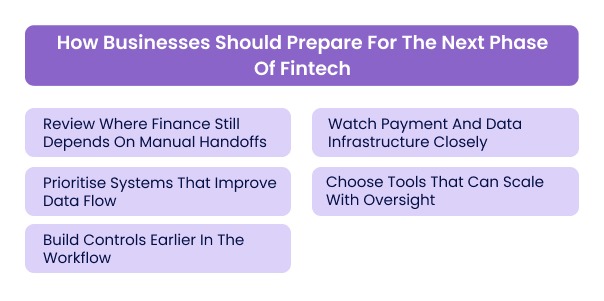
1. Review Where Finance Still Depends On Manual Handoffs
A lot of finance friction still happens between systems rather than inside them. Approvals may sit in email, invoices may arrive through different channels, and payment information may need to be re-entered before it reaches accounting. Those handoffs are often the first place where modern fintech can create measurable value.
2. Prioritise Systems That Improve Data Flow
A polished interface matters, but it is no longer enough on its own. Finance teams should increasingly prefer platforms that improve how data moves between payments, approvals, documentation, accounting, and reporting rather than adding yet another isolated tool to the stack.
3. Build Controls Earlier In The Workflow
As financial activity becomes more embedded, control needs to move upstream. That means approvals, policy checks, document capture, and audit trails should happen before spend or payment is completed, not only after the transaction needs to be explained.
4. Watch Payment And Data Infrastructure Closely
Real-time payments, open finance architecture, and regulated digital-money rails are not abstract industry themes anymore. They are shaping how quickly businesses will be able to move money, access financial data, and build more connected finance operations in practice.
5. Choose Tools That Can Scale With Oversight
As businesses grow, what breaks first is rarely the core transaction itself. It is the approval logic, reconciliation workload, document trail, and visibility around what happened, why it happened, and whether it followed policy. That is why scalable oversight should now be part of the buying decision, not an afterthought.
Related: Understand Procure To Pay Systems Process Steps
How Alaan Supports The Shift Towards Embedded, Connected Finance Workflows
The future of fintech is not just about faster payments or better interfaces. It is about bringing financial activity closer to where business operations actually happen. That includes spend, approvals, payments, documentation, and reconciliation. That is where Alaan fits in.
Alaan helps finance teams manage this shift through corporate cards, spend controls, approval workflows, receipt capture, AI verification, accounting integrations, and expanding payment capabilities, so finance workflows become more connected instead of fragmented.
- Corporate Cards With Built-In Spend Controls
Alaan issues corporate cards with spending limits and merchant controls, so businesses can manage spend at the point of transaction rather than trying to fix it after the fact. - Approvals Embedded Into The Workflow
Alaan supports custom approval workflows, ensuring that expenses and payments are reviewed based on policy before they are completed, not after they show up in reporting. - Connected Flow From Spend To Accounting
Alaan links transactions, approvals, receipts, and accounting sync into one flow. This reduces the need to move between disconnected tools just to understand what was spent and why. - Receipt Capture And Documentation In One Place
Employees can upload receipts via the mobile app, Chrome extension, or email, so every transaction has supporting documentation attached from the start. - AI Verification And Data Extraction
Alaan extracts receipt data, matches it with transactions, and flags inconsistencies or duplicates. This reduces manual work and improves accuracy in expense tracking. - Real-Time Visibility Into Business Spend
Finance teams get live visibility into spend across employees, vendors, and categories, making it easier to monitor usage, spot anomalies, and support better decision-making. - Accounting Integrations For Faster Reconciliation
Alaan integrates with Xero, QuickBooks, NetSuite, and Microsoft Dynamics, allowing data to sync in real time and reducing manual reconciliation effort. - Expanding Into Payments With SuperPay
As Alaan expands into domestic and cross-border payments, the focus is on connecting invoice approvals, payment approvals, vendor management, and reconciliation into one controlled workflow rather than treating payments as a separate step.

In practice, this aligns with where fintech is heading: more embedded, more connected, and more operationally useful for finance teams.
Conclusion
The future of fintech is likely to be shaped less by who makes finance look newer and more by who makes it work better inside real business activity. That means stronger infrastructure, faster payment rails, more usable data, tighter controls, and systems that fit directly into operational workflows.
In the UAE, that future is already taking shape. Growth in the fintech market, combined with open finance frameworks, real-time payments, and digital currency initiatives, is creating a more mature and connected financial ecosystem.
For businesses, the implication is clear. Finance tools will increasingly be judged on how well they connect workflows, improve visibility, and support control, not just on interface or speed alone.
Alaan is built around that shift. By combining corporate cards, spend controls, approval workflows, real-time visibility, and connected payment capabilities, it helps finance teams operate with better control and less fragmentation. Book a Demo Today!
For the backstory, our piece on fintech's origins and use cases traces how we got from credit cards to AI platforms. If capital markets are more your thing, read about how UAE financial markets use technology. And for some light fact-checking, our 2023 outlook on UAE fintech is a fun way to see which predictions actually came true.
FAQs
1. What is the difference between fintech and digital banking?
Digital banking usually refers to banks delivering traditional financial services through digital channels. Fintech is broader. It includes technology-led companies and platforms that improve, replace, support, or embed financial services in new ways.
That means digital banking is one part of fintech, but fintech also covers payments, lending, expense management, open finance, regtech, embedded finance, wealth technology, and more.
2. Is the future of fintech mainly about AI?
AI is an important part of the future of fintech, but it is not the whole story. The larger shift includes how financial data is shared, how payments move in real time, how services become embedded in software, and how regulation shapes digital financial infrastructure.
AI matters most when it improves financial decisions, controls, fraud monitoring, or workflow efficiency, rather than being used only as a front-end feature.
3. What does embedded finance actually mean for businesses?
For businesses, embedded finance means financial actions happening inside the tools they already use rather than through separate systems. That could include payments, expense controls, lending options, invoicing, card issuance, or approvals being built directly into business software.
The value is practical. It reduces friction, shortens workflows, and brings finance closer to operational activity.
4. Will fintech replace traditional banks completely?
That is unlikely. In many markets, the more realistic direction is collaboration, competition, and infrastructure sharing rather than total replacement. Banks still play a major role in regulation, balance sheet capacity, trust, and financial infrastructure.
What is changing is the interface and the workflow layer around them. Fintech companies often improve speed, user experience, and operational flexibility in areas where traditional systems have been slower to adapt.
5. How should businesses evaluate fintech tools in the future?
Businesses should look beyond surface-level convenience. The more useful questions are whether the tool improves workflow efficiency, supports stronger controls, connects well with the existing finance stack, and creates cleaner visibility across approvals, payments, and records.
A fintech product may look modern, but the long-term value usually depends on how well it fits into the business’s actual operating model.
6. Is the UAE a strong market for fintech growth?
Yes, and not only because of startup activity. The UAE stands out because market demand, regulation, payment infrastructure, and ecosystem support are all developing at the same time.
That combination makes the market more credible for long-term fintech growth, especially in areas such as payments, open finance, digital financial infrastructure, and business-finance software.
Gain control over business expenses with Alaan corporate cards
Invygo earned AED 100,000 in cashback using Alaan cards
Personalise approval workflows to align with your business needs with Alaan's Spend Management platform
Discover the power of automated expense tracking and smarter spend control with Alaan
Turn data into actionable insights with Alaan's spend management tools
Stay Tax Compliant with UAE's #1 Corporate Card and Spend Management Platform
Customisable corporate card policy template
Know how much Corporate Tax you have to pay this fiscal year
Easily integrate Alaan with your ERP for accurate, real-time expense tracking
Close books faster with Alaan's AI-powered accounting automation
Reconcile your books in minutes instead of hours, every single month.
Keep petty cash organized with Alaan corporate cards and automated expense management