.avif)


The AED to GBP exchange rate matters for UAE businesses that pay UK suppliers, software vendors, or service providers in pounds. Even modest currency movement can change the dirham cost of a payment, especially when transfers are recurring or high-value.
Public exchange-rate tools are useful for checking the market, but the headline rate is only a reference point. The final rate a business receives may differ once provider spreads, fees, and execution timing are applied.
This guide explains how the AED to GBP rate works, what affects it, and what UAE businesses should keep in mind when making GBP payments.
TL;DR
- AED to GBP matters when businesses have real sterling exposure, such as UK supplier payments or recurring GBP-denominated costs.
- Public exchange rates are benchmarks, not guaranteed transfer rates, because providers may apply spreads and fees.
- The AED’s peg to the US dollar means GBP movements against USD are the main driver of AED to GBP changes.
- Small FX movements can still create budget variance, especially when payment values are large or recurring.
- Better payment planning and visibility help reduce avoidable FX surprises.
Current AED To GBP Exchange Rate
At recent public mid-market levels, 1 AED is worth about 0.203 GBP. That means:
1. 10 AED is about 2.03 GBP
2. 61 AED is about 12.38 GBP
3. 100 AED is about 20.30 GBP
4. 1,000 AED is about 203.00 GBP
These are reference conversions based on recent public mid-market pricing, not guaranteed execution rates. Xe currently shows 1 AED = 0.2030 GBP, while Wise’s recent weekly data also sits broadly in the same zone, with a weekly range between 0.201856 and 0.204948 in early March 2026.
For businesses, the practical point is simple: use the headline market rate as a reference, but do not assume it is the final rate your provider will deliver.
AED To GBP Conversion Examples
Using a recent reference rate of around 0.203 GBP per AED, here is what common conversions look like:
1. 1 AED To GBP
Around 0.203 GBP
2. 10 AED To GBP
Around 2.03 GBP
3. 61 AED To GBP
Around 12.38 GBP
4. 100 AED To GBP
Around 20.30 GBP
5. 1,000 AED To GBP
Around 203.00 GBP
These figures are useful for quick budgeting, but live rates move, and provider spreads can change the final outcome. A rate seen at approval may not be the same rate applied when the transfer is executed.
AED To GBP Rate History And Recent Trend
The AED to GBP exchange rate has moved within a relatively narrow band recently, but even modest moves can matter once payment values get larger.
Wise’s public history page shows that over the past week, the AED/GBP rate fluctuated between a low of 0.201856 on 1 March 2026 and a high of 0.204948 on 3 March 2026. It also reports that the largest 24-hour move in that period was a 0.465% decrease on 1 March 2026.
That may look small on a screen, but small FX changes scale quickly:
1. On a small reimbursement, the difference may be negligible.
2. On a monthly supplier payment, the variance becomes more visible.
3. On a large one-off international transfer, even a modest shift in rate can materially affect cost.
For UAE businesses, that is the important lens. The exchange rate aed to gbp does not need to swing wildly to create budgeting noise. It just needs to move enough between invoice approval and settlement.
What Affects The AED To GBP Exchange Rate
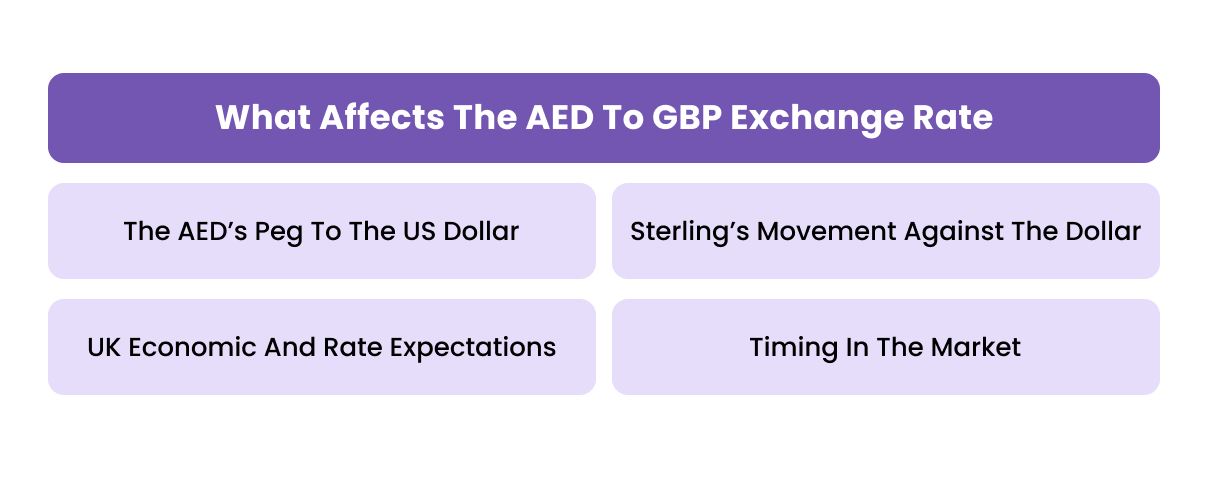
Several factors influence the AED to GBP exchange rate, but they do not all carry equal weight.
1. The AED’s Peg To The US Dollar
The UAE dirham is pegged to the US dollar, and the Central Bank of the UAE has said it maintains the stability of that peg through foreign exchange operations. That means AED does not move like a freely floating currency.
2. Sterling’s Movement Against The Dollar
Because AED is effectively anchored to USD, the fx rate AED to GBP is shaped largely by how sterling moves against the dollar. When GBP strengthens against USD, each dirham usually buys fewer pounds. When GBP weakens against USD, each dirham usually buys more pounds. The Bank of England publishes daily market exchange rate data against sterling, reflecting those market moves.
3. UK Economic And Rate Expectations
Sterling is also influenced by UK inflation data, growth expectations, interest-rate expectations, and broader market sentiment. Those factors affect how investors price the pound, which then feeds into the aed gbp fx rate through the dollar cross.
4. Timing In The Market
Exchange rates move throughout the day. Public rate pages are timestamped, which means the number seen at one moment may not be the same a few hours later. That matters for businesses approving payments in one window and executing them in another.
Why The Rate You Get May Be Different
One of the easiest mistakes to make is assuming the public exchange rate AED to GBP is the same as the rate your business will actually receive. In many cases, it is not.
1. Public Tools Usually Show A Mid-Market Rate
Online currency converters often use the mid-market rate for informational purposes and that users will not necessarily receive that exact rate when sending money. That makes the quoted number useful as a benchmark, but not as a guaranteed execution rate.
2. Providers May Add A Spread
Banks and payment providers often price transfers by applying a margin to the reference rate. So even if the public aed to gbp exchange rate looks attractive, the actual offered rate may be less favourable once provider pricing is applied.
3. Fees Can Change The Effective Cost
The final cost of a GBP payment may also include transfer fees or intermediary charges, depending on the provider and payment route. That means the effective cost is not always visible from the quoted FX rate alone.
4. Timing Can Create Extra Variance
Even when the pricing method is clear, the rate can still move between invoice approval, treasury review, and final execution. For finance teams, that timing gap is one of the simplest ways small FX variances creep into budgets.
Why AED To GBP Matters For UAE Businesses
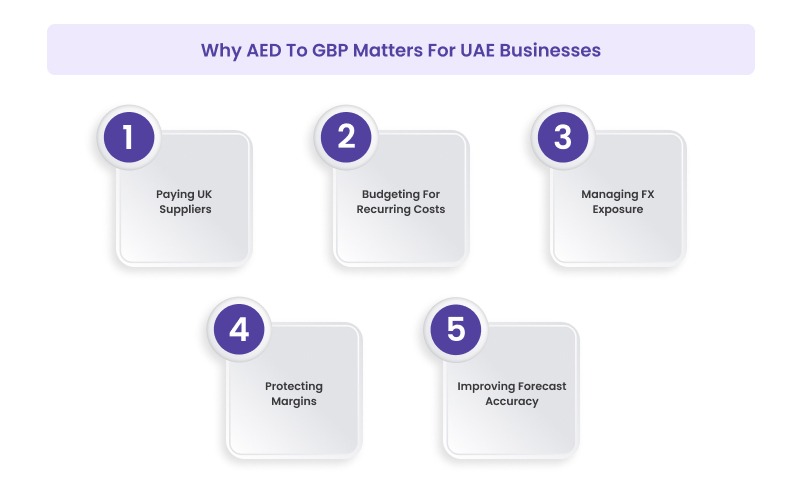
For UAE businesses, the fx rate aed to gbp matters most when there is a real operating exposure to sterling.
1. Paying UK Suppliers
If supplier invoices are denominated in GBP, changes in the aed gbp fx rate directly affect how much the business pays in dirhams.
2. Budgeting For Recurring Costs
Businesses often pay for UK-based software, consulting, subscriptions, or outsourced services in pounds. When those costs are recurring, even modest exchange-rate movements can distort budget accuracy over time.
3. Managing FX Exposure
If a company has regular GBP outflows, exchange-rate movement becomes an operational issue rather than a one-off conversion question. That makes rate monitoring and payment timing more important.
4. Protecting Margins
When a business cannot easily pass on FX-driven cost changes, adverse movement in the exchange rate aed to gbp can reduce margins. That is especially relevant for companies operating on tighter cost controls or fixed customer pricing.
5. Improving Forecast Accuracy
A more disciplined approach to AED/GBP payments helps finance teams forecast cash outflows more accurately and reduce surprises between planned and actual payment values.
How UAE Businesses Can Manage AED To GBP FX Risk Better
Businesses do not need a full treasury desk to manage AED/GBP exposure more sensibly. In many cases, a few disciplined habits make the biggest difference.
1. Compare The Effective Rate, Not Just The Headline Rate
A public converter gives you a reference point, not the full cost of the transaction. The better comparison is the total outcome after:
1. FX Spread
2. Transfer Fees
3. Intermediary Charges
4. Settlement Timing
That is the number finance teams should compare when evaluating providers.
2. Avoid Treating Every Payment As A Last-Minute Transfer
When GBP payments are made only when an invoice becomes urgent, the business gives up control over timing. That increases the chance of converting at an unfavourable rate simply because the payment has to go out immediately.
A more disciplined payment process helps finance teams review upcoming obligations and reduce unnecessary timing pressure.
3. Track Recurring GBP Exposure
If your business pays UK vendors regularly, the issue is not one isolated aed to gbp exchange rate check. It is a recurring FX exposure. Tracking the size, timing, and frequency of GBP payments makes it easier to budget and to spot where small rate differences are adding up.
4. Build A Reasonable FX Buffer Into Budgets
For recurring international costs, forecasting at one exact spot rate can create false precision. A small FX buffer gives finance teams a more realistic planning range, especially when sterling moves over the month.
5. Improve Approval And Payment Visibility
A long approval chain can create a gap between when a payment is expected and when it is actually executed. In fast-moving markets, that delay can affect the final rate. Better visibility into approvals and payment timing helps reduce avoidable slippage.

How Alaan And SuperPay Help UAE Businesses Manage GBP Payments Better
Watching the AED to GBP exchange rate is only part of the job. The harder part is managing the workflow around international payments properly, including invoice review, approvals, payment timing, cost visibility, and reconciliation. That is where Alaan(Superpay) comes:
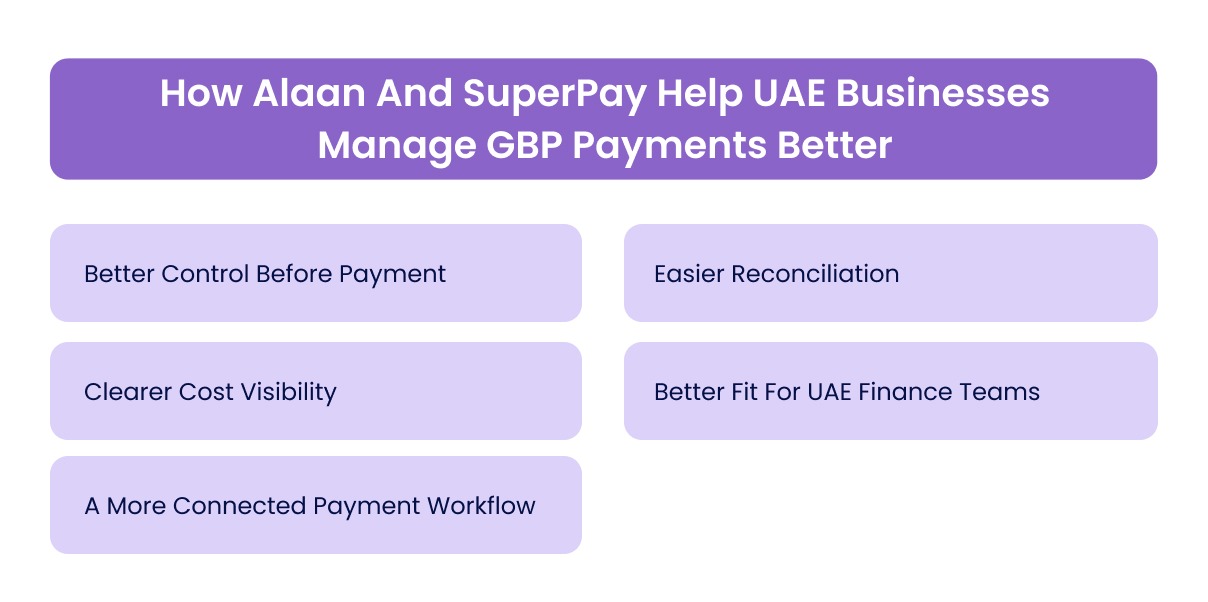
- Better Control Before Payment
SuperPay helps finance teams move control upstream by connecting payments to invoice review and approval workflows before money moves. That makes GBP payments easier to manage and reduces last-minute execution pressure. - Clearer Cost Visibility
For GBP payments, the real concern is not just the headline rate. It is the final cost after pricing, timing, and payment execution. SuperPay helps teams review payment context more clearly before approval, which supports better forecasting and fewer surprises. - A More Connected Payment Workflow
International payments often become messy when invoices, approvals, and reconciliation are handled across different tools. SuperPay helps bring those steps into a more connected workflow, making supplier payments easier to track from start to finish. - Easier Reconciliation
Alaan helps finance teams keep supporting records, approvals, and payment-related information more organised. That reduces manual follow-up and makes the month-end review easier when international payments are involved. - Better Fit For UAE Finance Teams
Alaan and SuperPay are built around the needs of finance teams that want stronger approval control, better spend visibility, and cleaner international payment workflows rather than just a basic transfer tool.
In practice, that means businesses can manage GBP payments with better control, better visibility, and less operational friction. Alaan and SuperPay do not remove FX movement, but they can make the workflow around international payments far easier to manage.
Conclusion
The AED to GBP exchange rate matters whenever a UAE business has real sterling exposure, whether through UK suppliers, recurring subscriptions, or service payments. The market rate is a useful benchmark, but the actual business outcome depends on more than the number shown on a public converter. Timing, provider pricing, and payment workflow all affect the final dirham cost.
That is why stronger payment discipline matters. Businesses that track recurring GBP exposure, compare total cost properly, and tighten approval and payment workflows are usually in a better position to reduce avoidable FX surprises.
Alaan helps UAE finance teams bring more structure to that process. With better approval control, clearer payment visibility, and cleaner reconciliation, businesses can manage GBP payments in a way that is more predictable and easier to review. Book a Demo Today!
Sterling is probably only one of the currencies your suppliers invoice in, and our guide to cross-border payments from the UAE covers routing, FX costs, compliance and how to pick a provider for all of them.
FAQs
1. What Is The Current Exchange Rate AED To GBP?
At recent public mid-market levels, 1 AED is worth about 0.203 GBP, but live rates move continuously, and provider rates may differ from public reference rates. Xe currently shows about 1 AED = 0.2030 GBP.
2. Why does the AED to GBP rate matter for UAE businesses?
It affects the dirham cost of paying UK suppliers, software subscriptions, consulting fees, and other GBP-denominated expenses. If the rate moves, the AED amount needed for the same payment also changes.
3. Why is my provider’s rate different from the public exchange rate?
Public tools usually show a mid-market rate for reference. Banks and payment providers often apply their own pricing spread, fees, or routing charges, which can make the final rate less favourable.
4. What affects the AED to GBP exchange rate?
The AED is pegged to the US dollar, so the main driver is usually how the pound moves against the dollar. UK economic data, interest-rate expectations, and market sentiment can all influence sterling.
5. How can businesses reduce FX surprises on GBP payments?
They can compare the effective rate across providers, track recurring GBP exposure, plan payments earlier, and avoid leaving large transfers until the last minute.
6. Should businesses rely only on the headline exchange rate when budgeting?
No. The headline rate is useful as a benchmark, but budgeting should also account for provider spreads, transfer fees, and possible timing differences between approval and execution.
Gain control over business expenses with Alaan corporate cards
Invygo earned AED 100,000 in cashback using Alaan cards
Personalise approval workflows to align with your business needs with Alaan's Spend Management platform
Discover the power of automated expense tracking and smarter spend control with Alaan
Turn data into actionable insights with Alaan's spend management tools
Stay Tax Compliant with UAE's #1 Corporate Card and Spend Management Platform
Customisable corporate card policy template
Know how much Corporate Tax you have to pay this fiscal year
Easily integrate Alaan with your ERP for accurate, real-time expense tracking
Close books faster with Alaan's AI-powered accounting automation
Reconcile your books in minutes instead of hours, every single month.
Keep petty cash organized with Alaan corporate cards and automated expense management