.avif)


A one-percentage-point drop in gross margin can undo months of pricing and cost-management efforts, especially when input costs rise, and VAT obligations shift at the same time.
In the UAE, where logistics costs fluctuate, supplier prices change quickly, and VAT compliance is closely monitored, gross profit shapes pricing, supplier negotiations, and investment planning.
Yet many finance teams review margins only after COGS have increased and prices are already set. With 58 % of SME invoices overdue, delayed payments further restrict cash flow and growth. Without real-time insight into costs and tax impacts, margins can slip silently, leaving little room to respond.
This blog goes beyond the basic formula to show how UAE businesses can protect margins through disciplined COGS tracking, VAT-aware pricing, and structured financial controls, helping teams make faster, more confident decisions.
TL;DR
- Gross Profit Formula & Financial Control: Gross profit, calculated as revenue minus COGS, directly informs pricing, supplier negotiations, and capital allocation decisions.
- Industry Benchmarks in the UAE: Margins vary by sector, with SaaS often at 70–80%, e-commerce at 30–50%, real estate at 20–30%, and manufacturing at 15–25%.
- VAT Impact on Profitability: Accurate VAT treatment on pricing and procurement ensures compliance while preventing silent margin erosion.
- Pricing Strategy Backed by Margin Data: Using gross profit margin for minimum pricing, tiered models, and demand-based adjustments supports sustainable profitability.
- Cost Visibility & Structured Controls Protect Margins: Real-time expense tracking, VAT-validated cost capture, and structured spend controls help detect cost pressures early, maintain accurate COGS, and protect gross profit.
How Gross Profit Influences Decisions & Financial Management in UAE Businesses?
Gross profit directly shapes business strategy and overall financial health. In the UAE, understanding your gross profit helps you make smarter decisions on pricing, cost control, and resource allocation.
Here’s how gross profit influences decisions and financial management in UAE businesses:
Key Decisions Driven by Gross Profit
- Pricing Strategy: Gross profit shows whether your current pricing delivers the margins you expect. If margins fall short, you can adjust pricing to improve profitability while still protecting your market position.
- Vendor Negotiations: When you closely track gross profit, you can spot where supplier costs reduce the margins. Finance teams can then renegotiate contracts or look for more cost-effective sourcing options.
- Cost Control: Gross profit data highlights inefficiencies in production or operations. You can act on this insight and reduce specific costs without affecting product or service quality.
Gross Profit and Financial Management
- Real-Time Monitoring: Consistently monitoring gross profit enables you to detect declining margins early. Finance teams can respond quickly by increasing sales efforts, cutting unnecessary costs, or adjusting pricing.
- Optimising Resource Allocation: Accurate gross profit figures help you channel resources into areas that generate stronger returns. For instance, prioritising high-margin products or services ensures you use capital more effectively.
- Investment and Budgeting Decisions: Gross profit plays a key role in planning expansion or new investments. It helps you confirm that growth plans align with your profitability levels and that you allocate funds to protect margins.
Understanding how gross profit shapes financial decisions also helps put it in perspective alongside other key financial metrics.
Suggested Read: Zero-Based Budgeting: A CFO’s Framework for Smarter Spend
Gross Profit vs. Other Key Financial Metrics: What You Should Know
Gross profit gives you a quick view of how efficiently your business delivers goods or services, but it shows only part of the picture. To understand your company’s financial performance, you need to review gross profit together with other important financial metrics.
Below is a comparison of the gross profit formula with other key financial metrics.
| Financial Metric | Focus | Key Insight |
|---|---|---|
| Gross Profit | Revenue minus cost of goods sold (COGS) | Shows how efficiently the company produces and sells goods. |
| Operating Profit | Revenue minus COGS and operating expenses | Reflects the company's performance after direct costs and operating expenses. |
| EBITDA | Earnings before interest, taxes, depreciation, and amortisation | Measures cash flow from operations before non-cash expenses. |
| Net Profit | Revenue minus all expenses (including taxes, interest, etc.) | Indicates the company’s overall profitability after all costs. |
| Return on Assets (ROA) | Profit generated from company assets | Shows how effectively assets are used to generate profit. |
| Return on Equity (ROE) | Profit generated from shareholders’ equity | Measures how well profit is generated for equity investors. |
| Cost of Goods Sold (COGS) | Direct costs involved in producing goods or services | Impacts gross profit; controlling COGS helps maintain healthy margins. |
Comparing gross profit with other financial metrics also makes it important to see how it measures up against industry benchmarks.
Gross Profit Benchmarks: What’s Ideal for Your Industry?
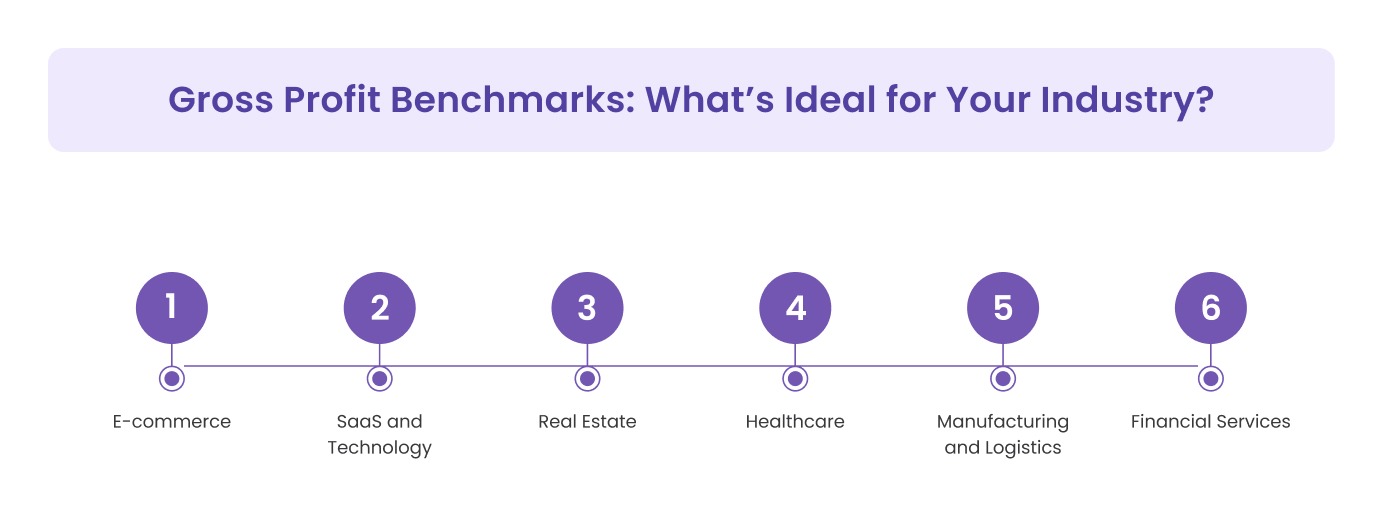
Knowing the gross profit benchmarks for your industry helps you understand how efficiently your business is operating and how profitable it really is.
These benchmarks give you a reference point to compare your performance with industry standards, so you can spot where to control costs, adjust pricing, and improve your margins.
1. E-commerce
In the e-commerce sector, businesses often manage fluctuating costs for inventory, shipping, and marketing. Gross profit benchmarks in e-commerce typically range from 30% to 50%, depending on the product mix, customer acquisition costs, and operational efficiency at scale.
Key Insight: E-commerce businesses with higher gross profit margins can better withstand rising digital marketing and logistics costs while still investing in growth.
2. SaaS and Technology
For SaaS (Software as a Service) and technology companies, gross profit margins are usually high because variable costs stay low after product development. Most SaaS companies target gross profit margins of 70% to 80% or higher, since their main costs are for development, infrastructure, and customer support.
Key Insight: A high gross profit margin indicates that the SaaS business runs efficiently and scales easily, as adding new customers does not significantly increase costs.
3. Real Estate
In real estate, gross profit margins are usually lower than in SaaS or e-commerce because projects require significant investment and entail high, project-specific costs. Most real estate businesses operate with a gross profit margin of 20% to 30%.
Key Insight: Profitability depends heavily on how well you control construction costs, manage timelines, and handle vendor relationships.
4. Healthcare
The healthcare industry shows a wide range of gross profit margins because business models differ across hospitals, clinics, pharmaceutical companies, and medical device providers. In most cases, margins fall between 40% and 60%.
Key Insight: Healthcare providers improve margins by efficiently managing supply chains and optimising care delivery, though labour and compliance costs can reduce profitability.
Also Read: Hospital Accounts Receivable: A Practical Guide For Healthcare Finance Leaders
5. Manufacturing and Logistics
Manufacturing and logistics businesses face high production costs, so gross profit margins typically range from 15% to 25%, depending on operational scale and complexity. Raw materials, machinery, and maintenance costs directly affect profitability.
Key Insight: Changes in material prices and labour costs can quickly affect margins, making efficient supply chain management essential.
6. Financial Services
In financial services, such as banking, insurance, and investment firms, gross profit margins vary widely by business model. Investment firms may see margins between 40% and 60%, while insurance companies may operate with lower margins due to claims costs.
Key Insight: Profitability depends on fee structures, risk management, and overall investment performance, even when direct operating costs are lower.
Knowing your industry's gross profit benchmark also helps you understand how it affects VAT rates in the UAE.
How Gross Profit Helps You Navigate VAT Rates in the UAE?
Managing VAT is not only about compliance. It also directly affects your profitability. As VAT rates shift, you need to track gross profit closely so your margins do not quietly shrink.
When you understand how gross profit connects with VAT, you can price smarter, report taxes correctly, and protect long-term financial stability.
Gross Profit Shapes How You Manage VAT
1. Gross Profit and VAT Pricing
VAT applies to the final selling price of your product or service. If you do not factor VAT properly into your gross profit calculations, your pricing can quickly become unrealistic.
You should use gross profit data to fine-tune pricing so VAT does not reduce core profitability. For example, if you sell a product for AED 100 with a 40% gross margin, adding 5% VAT changes the effective price. So, adjust the pricing carefully to maintain the same margin.
2. VAT Impact on Cost Structures
COGS plays a major role in gross profit. In the UAE, businesses must properly account for VAT paid on procurement costs, such as raw materials and logistics services. Recoverable input VAT should be tracked correctly to ensure accurate cost reporting and compliance.
When you accurately track VAT on input costs, you get a clearer view of your true cost base. You can then reflect those costs correctly in the final selling price and protect margins.
VAT Compliance Improves with Gross Profit Insights
1. Gross Profit as a Checkpoint for VAT Reporting
Accurate gross profit data helps you cross-check VAT reporting against actual earnings. The Federal Tax Authority requires businesses to correctly report VAT input and output.
When you analyse gross profit regularly, you can validate VAT claims on expenses and ensure compliance without harming your margins.
2. Tracking for VAT Compliance
When finance teams track cost and expense data in real time, they can quickly detect VAT mismatches and maintain accurate financial reporting.
For example, if VAT paid or collected does not align with reported margins, your team can fix the issue immediately. This approach keeps you compliant and ensures accurate month-end profit reporting during audits.
At Alaan, we validate tax invoice details and extract VAT data automatically before syncing with your accounting system. This reduces VAT errors that can distort cost allocation and affect gross margin reporting.

Must Read: What is a VAT Compliance Health Check and How to Stay Audit-Ready in the UAE
Gross Profit Helps Adjust to VAT Rate Changes
1. Responding to VAT Changes
When VAT rates change, your gross profit data becomes even more important. Any shift in VAT directly affects final prices. Without close tracking, you may underestimate the impact of tax adjustments on profitability.
Gross profit insights help you decide whether to increase prices or rework cost allocations to maintain margins.
2. Forecasting VAT Impact
By consistently reviewing gross profit margins, you can forecast how future VAT changes might affect profitability. This allows you to adjust pricing or cost structures in advance, rather than reacting after margins tighten.
Understanding how gross profit connects to VAT also helps you use gross profit margin more effectively for smarter pricing decisions in the UAE.
5 Strategies to Use Gross Profit Margin for Smart Pricing in the UAE
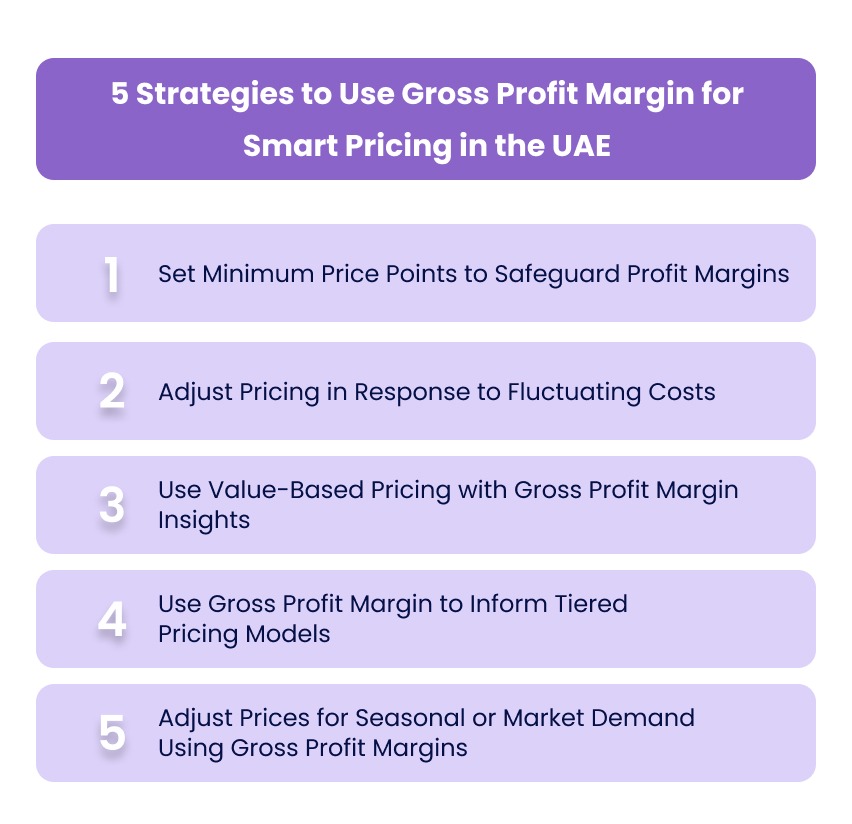
In the UAE’s competitive market, finance leaders use gross profit margin wisely when setting prices. The goal is simple: to stay profitable while remaining competitive.
Here are five practical ways to use gross profit margin for smart pricing in the UAE.
1. Set Minimum Price Points to Safeguard Profit Margins
Understanding your gross profit margin lets you see the lowest price you can charge without hurting profitability. This helps you avoid underpricing and keeps your business sustainable, even in competitive markets.
How to Implement:
- Calculate your gross profit margin using COGS and revenue.
- Set the minimum price to cover all direct costs and still leave room for your target profit margin.
- Revise prices whenever production costs increase or market conditions begin to affect margins.
2. Adjust Pricing in Response to Fluctuating Costs
Raw material prices, labour costs, and logistics expenses often change. Gross profit margin helps you respond to these shifts quickly. When you understand these cost movements, you can adjust prices in real time and maintain steady margins despite rising expenses.
How to Implement:
- Track changes in COGS caused by higher raw material prices, supply chain disruptions, or labour rate adjustments.
- Update your pricing model to reflect increased costs while protecting your target profit margin.
- Use real-time cost data to make proactive pricing changes rather than react late.
At Alaan, we provide real-time expense visibility through automated categorisation and accounting sync, helping finance teams maintain accurate, up-to-date cost data that supports COGS tracking and reporting. This helps you detect cost spikes early and protect gross profit before margins tighten.

3. Use Value-Based Pricing with Gross Profit Margin Insights
Value-based pricing focuses on what customers believe your product or service is worth. When you combine this approach with gross profit margin data, you can set prices that reflect both your cost structure and the value customers receive, helping you maximise profitability.
How to Implement:
- Use gross profit margin data to identify the minimum price required, then factor in the value delivered to customers.
- Charge premium prices for products that offer strong differentiation or unique benefits, while keeping customer expectations in mind.
- Gather customer feedback regularly and adjust pricing based on perceived value.
4. Use Gross Profit Margin to Inform Tiered Pricing Models
Tiered pricing lets you set different pricing levels based on customer segments, product features, or service packages. When you align each tier with your gross profit targets, you ensure that every level remains profitable while serving different customer needs.
How to Implement:
- Segment customers based on spending capacity, buying behaviour, and perceived value.
- Set price tiers that align with the gross profit margin you aim to achieve from each segment.
- Add extra features or service benefits to higher-priced tiers to increase perceived value.
5. Adjust Prices for Seasonal or Market Demand Using Gross Profit Margins
During peak seasons or high-demand periods, you can increase prices. Gross profit margin helps you determine how much flexibility you have to raise prices while still maintaining healthy margins.
How to Implement:
- Use historical sales data and demand forecasts to identify peak periods.
- Calculate how much you can increase prices while protecting your gross profit margin and staying within customer expectations.
- Apply flexible pricing strategies during seasonal demand shifts to maintain consistent margins.
How Alaan Helps UAE Businesses Improve Cost Control That Supports Gross Profit?
Many UAE finance teams calculate gross profit at month-end, after costs have already been incurred and pricing decisions have been made. While revenue is usually visible, COGS is often scattered across procurement emails, card statements, vendor invoices, and disconnected systems, creating fragmented cost visibility.
At Alaan, we help finance teams gain early, structured insight into operational costs, enabling them to identify cost pressures sooner and respond before financial reporting cycles are complete.
What Alaan Offers Beyond Basic Expense Tracking
Alaan strengthens the expense management and cost-control layer that directly influences gross profit accuracy and operational discipline.
1. Real-Time Visibility Into Cost Drivers
Finance teams can track procurement spend, subscriptions, logistics payments, and operational costs as they happen, not just at month-end.
With automated expense categorisation and integration with your accounting system, teams can detect cost spikes or unusual spending patterns early, enabling timely interventions that protect margins.
2. Structured Approval Workflows for Cost Discipline
We provide multi-level approval workflows that enforce budget limits, review vendor payments, and ensure cost commitments are reviewed and approved before being incurred. This helps maintain spending discipline across departments and projects.
3. Centralised Vendor and Procurement Visibility
Alaan centralises vendor data, transaction history, and documentation on a single dashboard. This gives finance teams clearer visibility into supplier spending, helping support more informed vendor and budgeting decisions.
4. Integrated Spend Controls
We offer a complete operational layer to manage costs proactively, such as:
- Pre-funded corporate cards for controlled operational spend
- Automated expense categorisation and reconciliation
- Invoice capture and email forwarding
- Duplicate detection and VAT invoice validation
This integrated approach helps reduce errors and ensures costs are properly tracked and approved before posting.
5. Cleaner Reconciliation and Accounting Sync
Alaan links spending data with documentation and syncs it with your accounting system, making reconciliation faster and more accurate. This ensures your financial reports reflect validated, up-to-date cost information.
What Alaan Is (And Is Not)
Alaan does not replace your ERP, general ledger, or accounting software and does not calculate gross profit or COGS directly. Instead, we strengthen the quality and structure of your cost data to improve downstream gross profit reporting.
Final Thoughts
Gross profit pressure is a reality for UAE businesses as input costs, labor, and compliance requirements rise. Margin erosion often arises from delayed visibility and fragmented cost controls that obscure spending and slow decision-making.
Finance teams that benchmark margins, track costs in real time, and enforce disciplined spending controls can protect profitability and maintain healthy cash flow. As markets tighten and compliance expectations grow, the advantage goes to teams that combine clear oversight with strong financial governance.
At Alaan, we support this process by providing real-time expense visibility, automated cost categorisation, and structured spending controls. By reducing manual effort and improving transparency, finance teams can identify cost concentrations earlier, enforce policies consistently, and strengthen cost discipline without increasing workload.
Schedule a free demo to see how Alaan helps UAE finance teams improve cost visibility and strengthen financial control.
Healthy margins don't help much if the cash arrives late, so our eight steps to cash flow management is the logical follow-up. To see what a margin squeeze would do to your runway, try the free cash flow stress test.
FAQs
Q1. How can UAE businesses calculate gross profit effectively?
A1. UAE businesses can calculate gross profit by subtracting the cost of goods sold (COGS) from total revenue. This shows how efficiently your business produces and sells its products or services, helping finance teams make informed decisions on pricing and cost control.
Q2. What is the difference between gross profit growth and gross profit margin?
A2. Gross profit growth measures how much your gross profit increases in absolute value over time. Gross profit margin, on the other hand, shows the percentage of revenue left after deducting COGS. Both are important, but the margin gives a clearer view of how efficiently revenue is converted into profit.
Q3. What is a good net profit margin, and how can a business improve it?
A3. A good net profit margin depends on the industry, but many UAE businesses typically aim for a range of 10% to 20%. Businesses can improve this by reducing operating costs, refining pricing strategies, and strengthening overall cost management.
Q4. How do fixed and variable costs impact gross profit?
A4. Fixed costs, such as rent and salaries, remain constant regardless of production levels, while variable costs increase or decrease with output. Higher variable costs can reduce gross profit, so carefully managing both fixed and variable costs is important to maintaining healthy margins.
Q5. What are the limitations of using gross profit?
A5. Gross profit excludes operating expenses such as marketing, administration, and taxes, so it does not provide a complete financial picture. To fully understand business performance, it should be analysed alongside other metrics such as net profit margin and EBITDA.
Gain control over business expenses with Alaan corporate cards
Invygo earned AED 100,000 in cashback using Alaan cards
Personalise approval workflows to align with your business needs with Alaan's Spend Management platform
Discover the power of automated expense tracking and smarter spend control with Alaan
Turn data into actionable insights with Alaan's spend management tools
Stay Tax Compliant with UAE's #1 Corporate Card and Spend Management Platform
Customisable corporate card policy template
Know how much Corporate Tax you have to pay this fiscal year
Easily integrate Alaan with your ERP for accurate, real-time expense tracking
Close books faster with Alaan's AI-powered accounting automation
Reconcile your books in minutes instead of hours, every single month.
Keep petty cash organized with Alaan corporate cards and automated expense management