.avif)


How UAE finance teams use IRR, alongside WACC, NPV, and scenario testing, to judge whether long-term investments are worth the capital.
- IRR is the discount rate at which a project's future cash flows equal its initial investment, so it tells UAE finance teams whether long-term projects earn enough to justify the capital they tie up.
- A project only creates real value when its IRR beats the company's cost of capital, so a 12% IRR against an 8% WACC points to a project worth funding.
- IRR is only as good as the numbers behind it, which is why reliable cash flow projections, sensible reinvestment logic, and scenario testing matter as much as the final figure.
- Pairing IRR with NPV, ROI, and payback period gives a fuller risk-return picture, since discount rate shifts, currency swings, and long project horizons can quietly distort IRR on their own.
- Alaan feeds cleaner cost data into those models with real-time spend visibility, structured approvals, and accounting sync, though it doesn't calculate IRR or replace your financial modelling tools.
A project might promise double-digit returns, but once financing costs, timing gaps, and reinvestment are factored in, the real value can be smaller than expected.
For UAE finance teams, capital allocation requires aligning expected returns with funding sources, cost of capital, market fluctuations, and cash flow needs.
In the first half of 2025, the UAE recorded 613 FDI projects worth USD 5.42 billion (AED 19.90 billion). This highlights the competitive nature of capital allocation and the importance of careful IRR analysis before committing funds.
Reviewing IRR without testing assumptions like discount rates, cash flow timing, and market volatility can make seemingly attractive projects quietly strain your balance sheet.
In this blog, you'll explore how IRR works in real UAE investment scenarios, how it interacts with WACC, and how scenario planning and other metrics give a clearer, more realistic view of potential returns.
TL;DR
- Capital Allocation Discipline: IRR helps UAE finance teams assess whether long-term projects generate returns that justify capital deployment.
- Realistic Assumptions Matter: Reliable cash flow projections, reinvestment logic, and scenario testing are essential for meaningful IRR analysis.
- IRR vs WACC: A project creates financial value only when its IRR exceeds the company’s cost of capital.
- Use with Other Metrics: Combining IRR with NPV, ROI, payback period, and sensitivity analysis provides a fuller risk-return view.
- Know the Limitations: Discount rate shifts, market volatility, and long project horizons can distort IRR if not carefully stress-tested.
How IRR Improves Financial Forecasting for UAE Businesses?
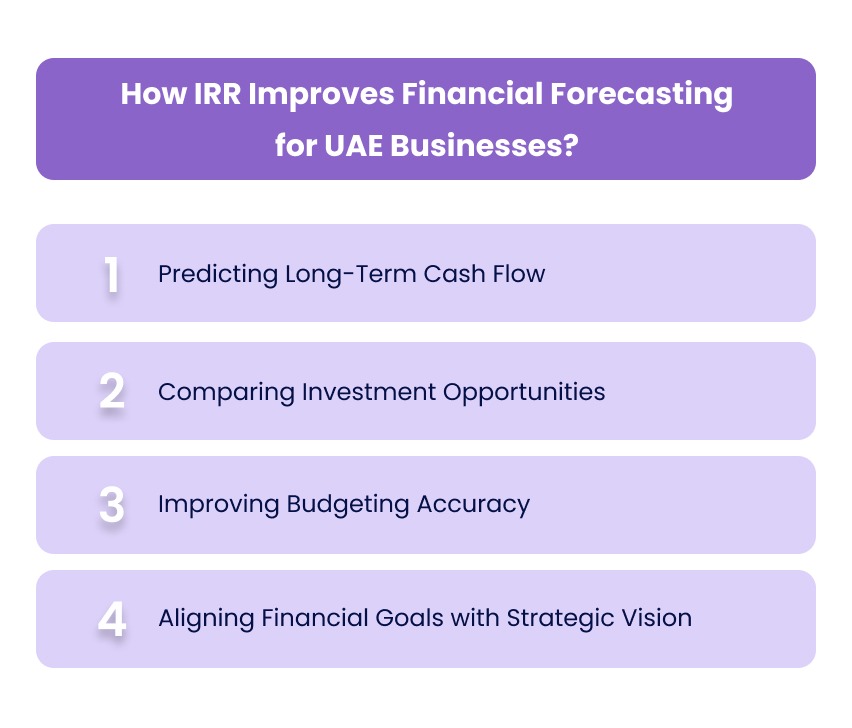
In the UAE, finance teams are expected to deliver precise forecasts that support profitable investment decisions. By applying IRR, companies gain a clearer view of projected returns, enabling more confident capital allocation and stronger long-term financial planning.
Here’s how IRR improves financial forecasting for UAE businesses:
1. Predicting Long-Term Cash Flow
IRR evaluates a project’s potential return based on its projected cash flows, providing insight to plan capital requirements and refine assumptions over time. Understanding this rate helps you allocate capital more effectively, prioritise projects, and adjust assumptions as financial conditions change.
2. Comparing Investment Opportunities
When multiple investment options are on the table, IRR provides a consistent basis for comparison. It enables you to assess the relative attractiveness of each opportunity using a single, performance-focused metric.
For instance, a UAE real estate firm can use IRR to evaluate whether developing a new commercial property will deliver stronger returns than expanding an existing asset portfolio.
3. Improving Budgeting Accuracy
Strong budgeting discipline prevents cost overruns and maintains financial control. Integrating IRR into the budgeting process allows you to estimate expected returns in advance and adjust allocations to maximise performance.
At Alaan, we provide real-time visibility into company-wide spending with structured approval controls that prevent budget drift before it affects project returns. This strengthens the cost assumptions behind your IRR models and supports disciplined capital allocation.
Suggested Read: Zero-Based Budgeting: A CFO’s Framework for Smarter Spend
4. Aligning Financial Goals with Strategic Vision
IRR improves forecasting by connecting investment analysis directly to strategic priorities. Finance teams in the UAE can use IRR to ensure capital is deployed in ways that support broader objectives, whether that involves increasing market share, diversifying into new sectors, or scaling operations.
Understanding the impact of IRR on forecasting becomes more useful when you know how to calculate it properly.
3 Steps Finance Leaders Take to Calculate IRR Accurately
In the UAE, calculating the Internal Rate of Return (IRR) plays a direct role in helping you judge whether an investment is truly worth it.
Since many projects in these sectors run for years and involve large sums of money, using the right approach to calculate IRR matters. It helps you allocate capital wisely, reduce financial risk, and ensure returns support your long-term strategy.
Here's how finance leaders calculate IRR accurately:
1. Gather Accurate Cash Flow Data
Before you calculate IRR, you need reliable cash flow projections. This step serves as the foundation for your entire calculation.
For a real estate company in the UAE, this means including land purchase costs, construction expenses, and the rental income or property sale revenue expected over the life of the project.
Make sure you include every type of cash flow:
- Initial Investment (Outflow): The capital you invest at the beginning of the project.
- Annual Cash Inflows: The revenue or operating income you expect to receive each year.
- Terminal Value: The final cash inflow, such as the sale value of the property or long-term asset income.
2. Understand the Formula
IRR comes from the Net Present Value (NPV) formula. In simple terms, IRR is the discount rate that equates the present value of future cash flows to the initial investment.
The formula is:
NPV = ∑ (C_t / (1 + r)^t) − I = 0
Where:
- C_t = Cash inflow during period t
- r = Discount rate (IRR)
- t = Time period
- I = Initial investment
Your goal is to find the IRR at which NPV equals zero. Calculating this manually can be difficult, especially when cash flows change every year.
3. Use a Financial Calculator or Software
Although you can calculate IRR manually, the process is time-consuming and error-prone. Most finance teams in the UAE use tools like Excel, Google Sheets, or ERP-connected platforms such as NetSuite to speed up and improve accuracy.
Excel IRR Function: Excel has a built-in IRR formula. You just enter your cash flows in order, and Excel calculates the IRR automatically.
Example: For a real estate project, you enter the initial investment as a negative number and future returns as positive numbers. Excel then gives you the IRR based on those values.
Once IRR is calculated correctly, it becomes easier to compare it with WACC to support better investment decisions.
How IRR Works with WACC for UAE Businesses?
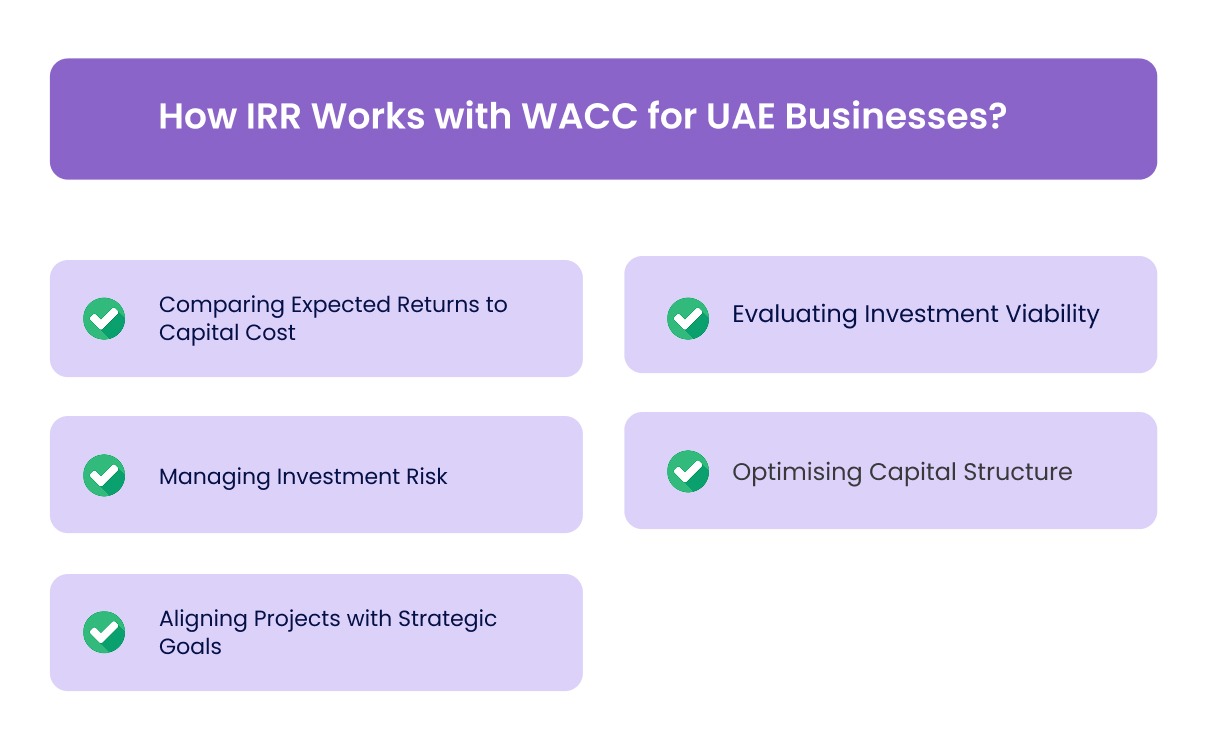
Weighted Average Cost of Capital (WACC) represents the average rate a company pays to finance its assets, based on its capital structure mix of debt and equity.
IRR and WACC both play an important role in evaluating whether a project makes financial sense. They help you understand whether an investment can generate enough profit to cover its costs.
Here’s how IRR and WACC interact:
1. Comparing Expected Returns to Capital Cost
IRR shows the expected return on an investment, while WACC shows the cost of funding it.
If IRR > WACC, the project is likely profitable because its returns exceed the cost of capital.
Example: If a real estate project in Dubai has an IRR of 12% and a WACC of 8%, it is expected to generate returns above its financing cost.
2. Evaluating Investment Viability
For large projects such as real estate or infrastructure, finance leaders use IRR and WACC to decide if the returns justify the investment.
If IRR < WACC, the project may not generate sufficient returns to cover its costs, leading to possible losses.
Example: A UAE logistics company may evaluate a new fleet investment. If the IRR is lower than the WACC, the company may delay or rethink the decision.
3. Managing Investment Risk
IRR helps finance leaders understand risk by comparing expected returns with the cost of capital. When IRR is higher than WACC, it suggests the project is more likely to be profitable and financially sound.
In the UAE real estate market, where returns can fluctuate, this comparison helps businesses make safer long-term decisions.
4. Optimising Capital Structure
Comparing IRR with WACC also helps businesses make better financing decisions. If IRR is consistently higher than WACC, companies may choose to use more debt to improve returns.
For UAE startups, this helps finance teams decide whether to raise equity or use debt to support growth without putting too much pressure on finances.
5. Aligning Projects with Strategic Goals
IRR and WACC help ensure that major investments support business goals. By comparing returns with capital costs, companies can choose projects that create real value.
For UAE construction firms, this approach helps ensure infrastructure projects support long-term growth and deliver strong financial returns.
Evaluating IRR alongside WACC is valuable, and adding other financial metrics helps create a fuller understanding of investment performance.
Integrating IRR with Other Metrics for Comprehensive Investment Analysis
In the UAE, relying only on IRR may not give a complete picture, especially for large, capital-intensive projects. Using IRR alongside other metrics helps you understand the full financial impact of an investment.
This combined approach makes it easier to evaluate true profitability, compare different options, and choose projects that support long-term business goals.
| Metric | Purpose | How IRR Works with This Metric | How to Integrate IRR |
|---|---|---|---|
| NPV (Net Present Value) | Measures the total value of future cash flows. | IRR shows return rate; NPV shows overall value. | Use NPV to confirm that IRR-generated returns exceed costs and create value. |
| ROI (Return on Investment) | Compares return to investment. | IRR gives the rate of return, while ROI shows profitability. | Use ROI for quick assessments and IRR for deeper long-term analysis. High IRR and ROI mean a profitable project. |
| Payback Period | Calculates time to recover initial investment. | IRR shows long-term returns; Payback Period shows recovery time. | Use Payback Period for short-term liquidity, and IRR for long-term profitability. |
| MIRR (Modified IRR) | Adjusts for reinvestment rates. | MIRR accounts for different reinvestment rates than IRR. | Use MIRR when reinvestment assumptions differ from IRR to get a more realistic return estimate. |
Looking at IRR alongside other metrics also helps highlight the practical challenges businesses in the UAE may face when using it.
5 Challenges of Using IRR in the UAE and How to Handle Them
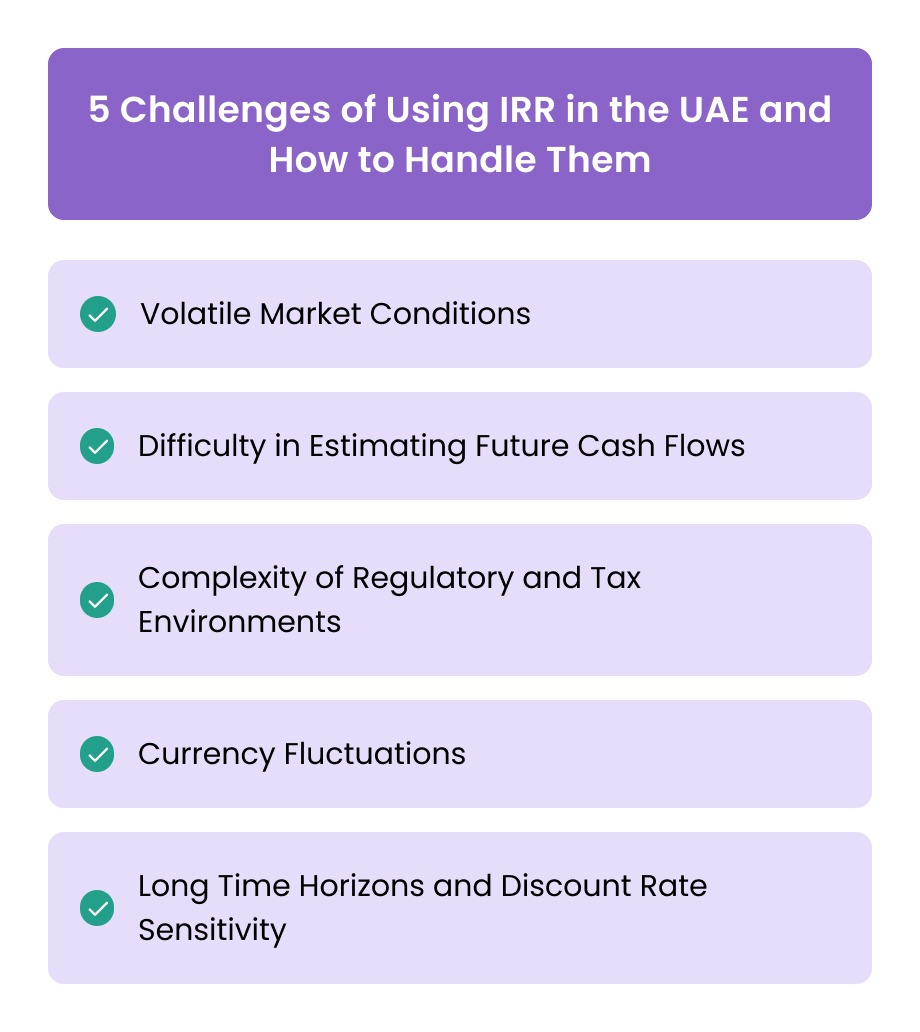
Internal Rate of Return (IRR) is a widely used metric for assessing investment opportunities, particularly in sectors such as real estate, logistics, and e-commerce. While it offers valuable insight into potential returns, relying on IRR for decision-making also presents certain limitations that must be carefully considered.
1. Volatile Market Conditions
The UAE market is heavily influenced by global factors like oil prices, political developments, and international trade trends. These fluctuations can create unpredictable cash flows, making it harder to rely solely on IRR for long-term investment decisions.
How to Handle It:
- Scenario analysis: Build multiple IRR scenarios, such as best-case, worst-case, and most likely outcomes, to understand the range of possible returns and reduce uncertainty.
- Regular reviews: Update cash flow projections frequently to reflect market changes, keeping investment decisions aligned with current conditions.
2. Difficulty in Estimating Future Cash Flows
Industries such as real estate development and infrastructure often struggle to accurately predict cash flows. Changes in demand, government policies, or market dynamics can make revenue forecasts uncertain.
How to Handle It:
- Data-driven forecasting: Leverage historical data and forecasting tools to improve accuracy, combining market trends with real-time inputs.
- Sensitivity analysis: Test variations in key factors such as sales prices, occupancy rates, or construction costs to see how assumptions affect IRR.
Also Read: Cash Forecasting Methods CFOs Trust for Accurate Liquidity
3. Complexity of Regulatory and Tax Environments
UAE regulations, including VAT and other taxes, can influence project costs and returns. Ignoring these factors may distort IRR calculations, especially for international or cross-border investments.
How to Handle It:
- Stay compliant: Regularly update IRR models to include the latest UAE Federal Tax Authority (FTA) guidelines and VAT rules.
- Consult tax experts: Work with advisors to ensure the IRR reflects tax implications, including VAT recovery, incentives, and legislative changes.
At Alaan, we automate VAT validation and sync expense data with accounting systems, reducing the risk of tax-related classification errors and helping ensure cost data used in IRR analysis remains accurate and compliant.

Must Read: What is a VAT Compliance Health Check and How to Stay Audit-Ready in the UAE
4. Currency Fluctuations
For UAE businesses engaged in international investments or foreign revenue, currency fluctuations can affect project profitability. This can be especially challenging for long-term forecasts in global markets.
How to Handle It:
- Hedge currency risk: Use hedging strategies to protect against exchange rate volatility.
- Adjust IRR models: Incorporate potential currency shifts into IRR calculations using real-time exchange rates and revised forecasts.
5. Long Time Horizons and Discount Rate Sensitivity
Many UAE projects, particularly in construction and real estate, span several years, making IRR sensitive to even small changes in the discount rate. A minor adjustment can significantly alter the calculated return.
How to Handle It:
- Use multiple discount rates: Apply different rates based on varying market conditions or risk profiles to assess IRR sensitivity.
- Complement with other metrics: Combine IRR with metrics like Net Present Value (NPV) to get a more complete picture of a project’s financial viability.
How Alaan Helps Finance Teams Strengthen IRR Analysis?
Many finance teams in the UAE calculate IRR using Excel models or ERP dashboards, but the underlying cost data often sits across disconnected systems.
When operational spending, vendor invoices, and approvals are fragmented, it becomes harder to maintain complete and up-to-date cost inputs for investment analysis.
At Alaan, we centralise company-wide spend visibility, structured approvals, and accounting sync into one platform. This helps improve the quality, completeness, and timeliness of the cost data that feeds your IRR models, while working alongside your existing financial planning tools.
What Alaan Supports Beyond Investment Analysis
Alaan strengthens the financial data foundation that supports IRR analysis by improving cost visibility, control, and accuracy.
1. Real-Time Visibility Into Capital-Linked Spending
Finance teams can track operational and project-related expenses in real time and compare actual outflows against budgeted assumptions. This helps identify potential cost variances early and maintain more accurate cost data for financial analysis, including IRR models.
2. Structured Approval Workflows for Budget Control
We provide multi-level approval workflows that let finance leaders review and approve high-value transactions before they are incurred. This supports stronger budget governance and cost control.
3. Centralised Vendor and Commitment Management
We centralise vendor data, transaction history, and documentation in a single dashboard. This improves visibility into project-related spending and helps ensure the cost data used in financial analysis remains complete and up to date.
4. Integrated Spend Controls
We support:
- Pre-funded corporate cards for controlled operational spend
- Automated expense categorisation
- Invoice capture and documentation validation
- Accounting system sync
This helps ensure that cost data used in IRR and capital planning models is structured, up to date, and accurately recorded.
5. Cleaner Reconciliation Improves Forecast Reliability
By linking transaction data, approvals, and documentation and syncing them with accounting systems, Alaan reduces reconciliation friction. This helps finance teams maintain more complete and up-to-date financial records for investment and performance analysis.
6. Continuous Accounting and ERP Sync
Approved invoices and expenses sync automatically with connected accounting systems. Coding, cost centre allocation, and tax treatment stay aligned, reducing reconciliation work and helping maintain accurate financial records for analysis.
7. Integrated Domestic and International Payment Execution
Through structured workflows, including domestic and supported international supplier payments via Super Pay, finance teams apply the same approval and FX controls to cross-border costs as they do to local spend.
This keeps project outflows aligned with IRR assumptions and helps ensure capital allocation decisions are based on complete and accurate financial data.
What Alaan Is (And Is Not)
Alaan is not a capital budgeting system and doesn't calculate IRR or replace financial modelling tools.
Instead, we provide the financial control infrastructure, real-time spend visibility, and structured approval workflows that improve the quality and completeness of the cost data used in IRR and investment analysis.
Final Thoughts
Internal Rate of Return (IRR) remains a key tool for finance leaders to evaluate the potential of large, long-term projects. In the UAE’s competitive investment market, IRR decisions must be based on real financing costs, cash flow projections, market volatility, and regulatory considerations.
Finance teams that combine IRR analysis with WACC, NPV, and scenario testing can make more disciplined allocation decisions and avoid unnecessary balance sheet strain.
At Alaan, we support this process by providing real-time spend visibility, budget controls, and accurate cost tracking, helping ensure the financial inputs used in IRR calculations remain complete and up to date.
Schedule a free demo to see how Alaan helps UAE finance teams maintain accurate cost visibility and stronger financial control across operational and project spending.
IRR assumes the cash flows actually turn up on time, so it's worth testing that with our cash flow stress test before you commit capital. Day to day, an Alaan business account pays profit on parked funds, which at least gives idle cash a modest return of its own.
FAQs
Q1. What is the difference between IRR and CAGR for UAE investments?
A1. IRR considers multiple staged cash flows, making it more suitable for capital-intensive projects in the UAE, such as real estate developments or phased infrastructure investments. CAGR assumes steady growth and works best for single-outlay equity investments without interim cash movements.
Q2. How does a change in the discount rate affect IRR-based decisions?
A2. When funding costs rise due to higher borrowing rates or increased risk premiums, the hurdle rate rises, leading to fewer projects meeting the IRR threshold for board approval.
Q3. How does the discount rate affect NPV and IRR differently?
A3. NPV changes directly with shifts in discount rates, showing how sensitive a project’s value is to capital costs. Since IRR is constant, it must be compared with the updated cost of capital to reassess project viability.
Q4. What is the difference between IRR and ROI for investment evaluation?
A4. IRR reflects annualised returns and the timing of cash flows, making it more reliable for long-term capital planning. ROI provides a simpler profitability snapshot, which may overlook the effects of duration and liquidity.
Q5. How is IRR different from the required rate of return or discount rate?
A5. IRR represents projected project performance, while the required rate of return reflects capital structure risk and financing costs. Investment approval typically requires IRR to exceed WACC to ensure shareholder value creation.
Gain control over business expenses with Alaan corporate cards
Invygo earned AED 100,000 in cashback using Alaan cards
Personalise approval workflows to align with your business needs with Alaan's Spend Management platform
Discover the power of automated expense tracking and smarter spend control with Alaan
Turn data into actionable insights with Alaan's spend management tools
Stay Tax Compliant with UAE's #1 Corporate Card and Spend Management Platform
Customisable corporate card policy template
Know how much Corporate Tax you have to pay this fiscal year
Easily integrate Alaan with your ERP for accurate, real-time expense tracking
Close books faster with Alaan's AI-powered accounting automation
Reconcile your books in minutes instead of hours, every single month.
Keep petty cash organized with Alaan corporate cards and automated expense management