.avif)

A practical look at opportunity cost as a decision tool for ranking business alternatives when capital, time and talent are scarce.
- Every business choice quietly forgoes the next best use of the same money, time or people, and that hidden trade-off never shows up in the financial statements even though it shapes real growth.
- Opportunity cost is a decision tool rather than an accounting entry: it measures the value of the best alternative you passed on, so the real risk is usually misallocation, not overspending.
- The formula is simple, the return of the best forgone option minus the return of the option you chose, so a system upgrade saving AED 80,000 a year over a revenue project worth AED 120,000 carries a AED 40,000 opportunity cost.
- McKinsey found a third of companies shift only about 1% of capital year to year against an average of around 8%, which leaves static allocators with a persistent value gap.
- With Alaan, teams get centralised spend visibility and approval discipline before money goes out, so leaders can compare alternatives on cleaner, more timely data.
Every business decision has a shadow decision: what you didn’t do with the same money, time, or team capacity. That shadow rarely appears in financial statements, but it quietly shapes growth, efficiency, and long-term value creation.
That’s why opportunity cost matters for business leaders. In practice, many organisations under-weight it, McKinsey research found that a third of companies reallocate only about 1% of capital from year to year, while the average reallocation is around 8%, creating a persistent value gap between “static” and “dynamic” allocators.
This article explains what opportunity cost actually means, how to apply it in real operating decisions, and a practical way to calculate it when you’re comparing alternatives under uncertainty.
TL;DR
- Opportunity cost is a decision-quality tool, not an accounting concept. It measures the value of the best alternative you didn’t choose, useful for prioritisation even when there’s no direct cash outflow.
- The real “cost” in business is usually misallocation, not overspending. Two options can both be affordable; opportunity cost tells you which one is more valuable given scarce capital, time, or talent.
- Treat opportunity cost as a ranking method. Compare alternatives using a consistent “return” definition (profit, risk reduction, time saved, strategic impact), then force explicit trade-offs instead of letting them happen implicitly.
- Most opportunity-cost mistakes come from bad assumptions, not bad math. Use ranges, scenarios, and sensitivity checks so decisions don’t hinge on a single fragile forecast.
- Opportunity-cost thinking improves dramatically when spend data is visible early. With Alaan, teams can centralise spend visibility and enforce approval discipline so leadership can compare alternatives with cleaner inputs before committing resources.
Opportunity Cost Meaning And Definition
Opportunity cost refers to the value of the next best alternative that is given up when a decision is made. Because resources such as capital, time, and labour are limited, choosing one course of action means foregoing another potentially beneficial option.
In economic decision-making, opportunity cost reflects the “price” of selecting one option over another. It represents the benefit that could have been realised if resources had been deployed differently.
This differs from accounting cost. Accounting cost records actual financial outflows such as expenses or depreciation. Opportunity cost, by contrast, captures forgone benefits and is therefore not recorded in financial statements. It exists as an analytical concept used to improve decision quality rather than as a bookkeeping entry.
For organisations, the concept becomes particularly important when evaluating investments, allocating budgets, or setting strategic priorities where the alternatives carry measurable financial consequences.
Also Read: What Is Direct Cost? How It Differs from Other Expenses in Your Business
What Is Opportunity Cost In Practical Terms
The concept is often introduced theoretically, but its value lies in how it informs real decisions across different contexts.
Individual Decision Context
At a personal level, opportunity cost appears whenever a resource is allocated between alternatives. Choosing to invest funds in a fixed-return product instead of equity exposure means sacrificing potential higher returns. Selecting additional training instead of immediate employment income similarly involves trade-offs between short-term earnings and long-term earning potential.
While these decisions may not always be quantified precisely, recognising the existence of the foregone benefit improves clarity in evaluating outcomes.
Business Decision Context
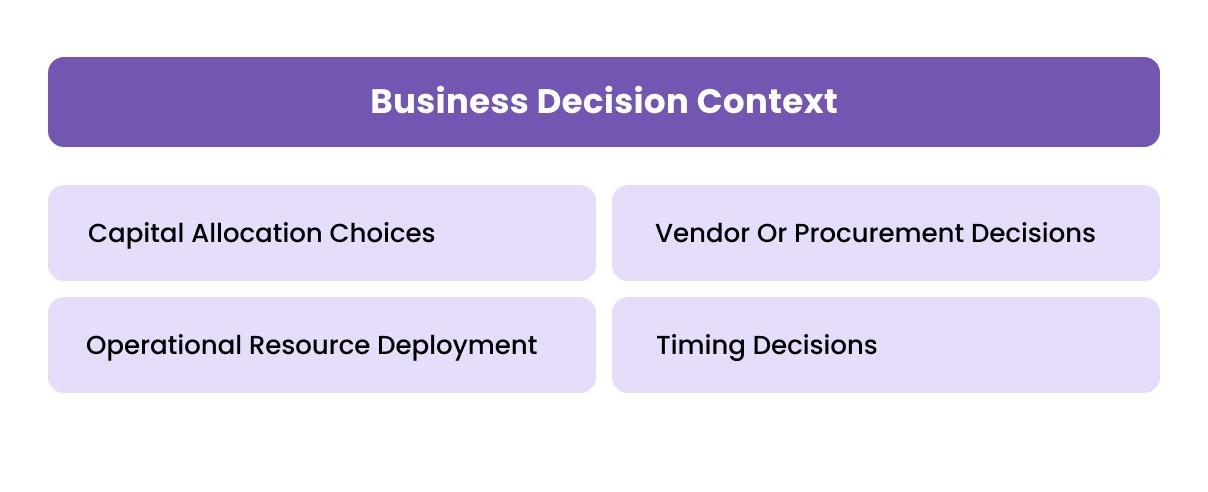
In organisational settings, opportunity cost becomes more structured and measurable. Common examples include:
- Capital Allocation Choices
Funding one project prevents those funds from generating returns elsewhere. - Operational Resource Deployment
Assigning teams to one initiative limits their availability for others that may offer greater impact. - Vendor Or Procurement Decisions
Selecting one supplier arrangement may sacrifice flexibility, pricing advantages, or service levels available from alternatives. - Timing Decisions
Delaying investment or expansion may result in lost market share or revenue opportunities.
Recognising these trade-offs allows finance teams to move beyond evaluating absolute cost and instead assess comparative value creation.
Also Read: Spend Mapping and Analysis: A Complete Guide for UAE Businesses
Opportunity Cost Formula
Opportunity cost does not always require complex modelling, but having a structured method for comparison improves decision clarity when evaluating alternatives.
Core Formula
The standard analytical expression is:
Opportunity Cost = Return Of Best Foregone Option − Return Of Chosen Option
The formula compares outcomes rather than cash outflows. “Return” may refer to profit, revenue growth, efficiency gains, or any measurable benefit relevant to the decision context.
Understanding The Components
- Return Of Best Foregone Option
The value expected from the most beneficial alternative not selected. - Return Of Chosen Option
The value expected from the option actually implemented.
If the chosen option delivers higher value, opportunity cost may be zero or negative. If it delivers lower value, the difference reflects lost potential benefit.
Practical Numerical Illustration
Consider a simplified capital allocation decision.
A company allocates AED 500,000 to upgrade internal systems, expected to generate productivity savings valued at AED 80,000 annually.
An alternative investment in a revenue initiative could have generated AED 120,000 annually.
Opportunity Cost = 120,000 − 80,000
Opportunity Cost = AED 40,000 per year
This does not mean the system investment was incorrect. It indicates the foregone alternative would have produced a higher measurable financial return under those assumptions.
Also Read: Cost Management in UAE: Key Steps, Benefits & Proven Strategies for 2025
Opportunity Cost Examples In Business
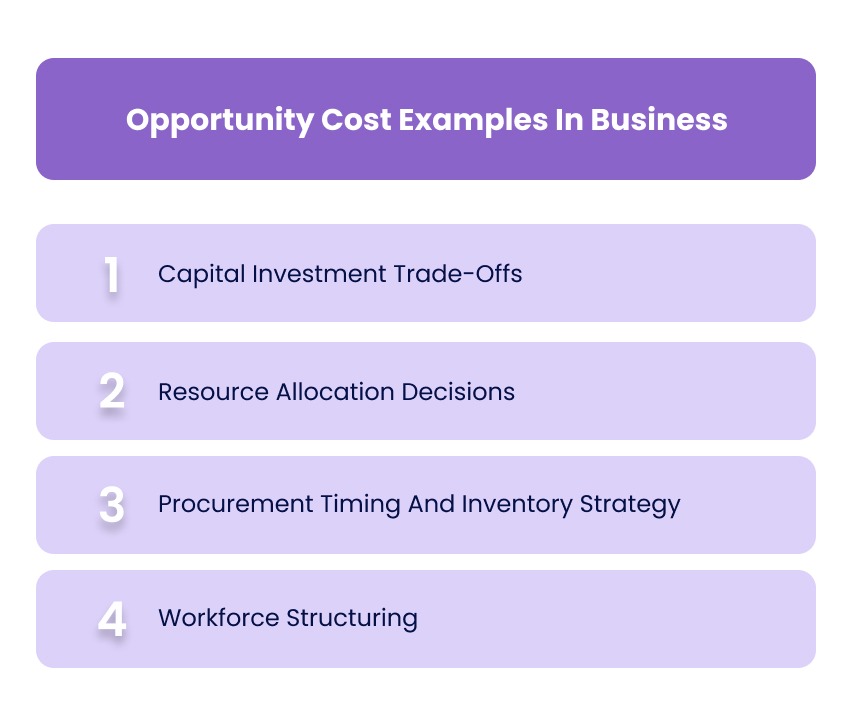
Opportunity cost influences decisions across operational and strategic contexts. These examples reflect typical organisational scenarios.
1. Capital Investment Trade-Offs
Choosing between expanding production capacity and investing in product development requires evaluating not just cost but relative return potential. Allocating funds to one direction delays or prevents value creation in the other.
2. Resource Allocation Decisions
Deploying staff toward internal optimisation initiatives may limit their availability for revenue-generating activities. The foregone revenue potential represents opportunity cost.
3. Procurement Timing And Inventory Strategy
Bulk purchasing at a discount locks capital into inventory. That capital could alternatively fund marketing, technology, or debt reduction. The value of those alternative uses represents the opportunity cost of inventory accumulation.
4. Workforce Structuring
Hiring full-time specialists instead of outsourcing may improve control, but it eliminates flexibility and cost scalability. Conversely, outsourcing may sacrifice institutional knowledge. Each direction carries opportunity costs tied to organisational priorities.

Why Opportunity Cost Matters For Financial Decision Making
Opportunity cost is not simply an academic concept. It directly strengthens financial discipline by improving comparative evaluation between alternatives.
Improved Capital Allocation
Considering forgone returns encourages structured investment prioritisation rather than reactive spending decisions. This supports higher long-term return consistency.
Strategic Prioritisation
Businesses face simultaneous initiatives competing for limited resources. Opportunity cost introduces a framework for ranking initiatives based on relative impact.
Budget Governance
Evaluating what is sacrificed when funds are allocated encourages more rigorous justification and approval processes.
Risk Awareness
Opportunity cost highlights potential downside exposure from delayed action, missed innovation, or underinvestment in growth initiatives.
Also Read: Understanding the Importance of Business Spend Management and Its Tools
Common Misunderstandings About Opportunity Cost
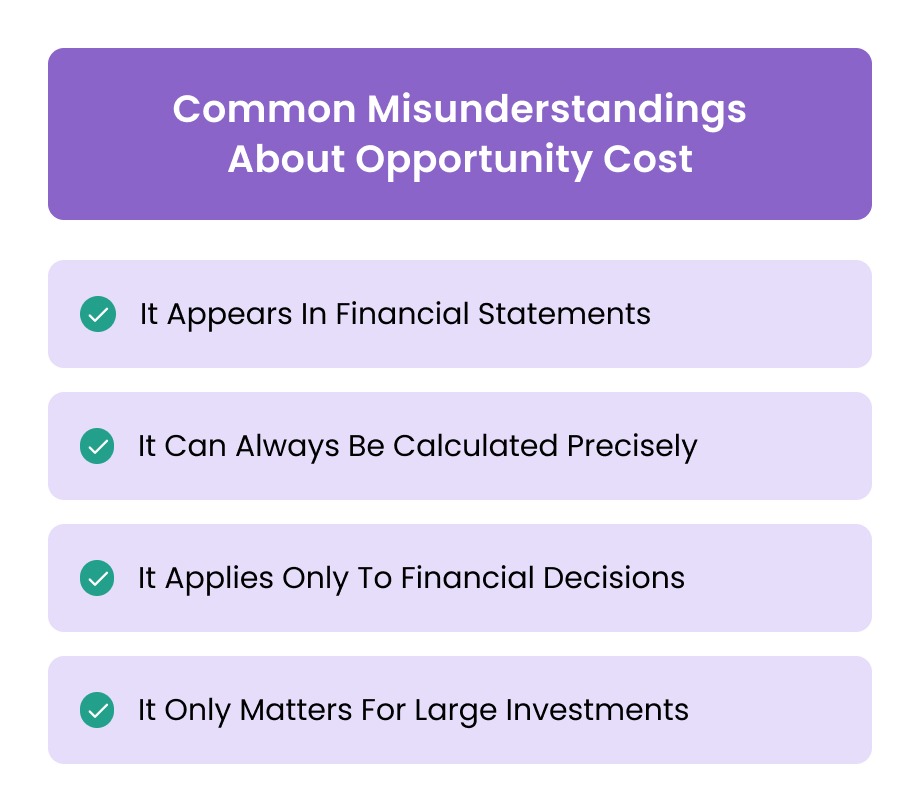
Despite being widely referenced, opportunity cost is often misapplied or misunderstood in operational decision-making.
1. It Appears In Financial Statements
Opportunity cost is not recorded in accounting books. Financial statements capture realised transactions, whereas opportunity cost represents hypothetical alternatives used for analysis.
2. It Can Always Be Calculated Precisely
In many decisions, especially strategic or long-term ones, alternative outcomes cannot be forecast with complete accuracy. Opportunity cost often relies on informed estimation rather than exact measurement.
3. It Applies Only To Financial Decisions
Time allocation, workforce deployment, and strategic focus also carry opportunity costs even when outcomes are not directly monetary. The concept applies to any scarce resource.
4. It Only Matters For Large Investments
Daily operational decisions accumulate significant impact. Procurement timing, project prioritisation, and vendor selection all involve trade-offs that influence long-term value creation.
Also Read: How to Manage Overall Business Spending in the UAE and GCC
Where Spend Visibility Tools Support Better Decisions
Opportunity cost analysis is only as reliable as the information used to compare alternatives. When spending data is dispersed across multiple systems or becomes visible only after transactions are completed, organisations often evaluate trade-offs using incomplete inputs. This reduces decision quality and makes resource allocation reactive rather than deliberate.
At Alaan, we support businesses by connecting spend execution, approvals, and reconciliation within a single environment so decision-makers can assess alternatives with a clearer operational context before committing resources.
- Centralised Visibility Into Spend Allocation
We provide corporate cards and real-time expense capture that consolidate organisational spending into a unified view. Finance leaders gain immediate insight into where capital is being deployed, allowing them to identify allocation patterns, concentration risks, or areas where funds could be reassigned to higher-impact initiatives. Earlier visibility improves prioritisation rather than relying on retrospective analysis. - Approval Discipline Before Commitment
Our approval workflows ensure invoices and payments are evaluated before execution. Structured approval chains introduce accountability into how resources are allocated and encourage explicit comparison of alternatives at the point of decision. This strengthens governance and supports more consistent prioritisation aligned with strategic objectives. - Contextual Data For Comparative Evaluation
Transaction categorisation, receipt verification, and analytics provide context around vendor performance, usage trends, and cost behaviour. This enables organisations to compare procurement options, operational initiatives, or supplier arrangements using informed data rather than nominal pricing alone. Decisions can therefore be assessed based on overall value rather than isolated cost points. - Connected Financial Workflow
Because expense capture, accounting synchronisation, and payment processes operate in a connected workflow, financial data remains consistent across decision stages. This reduces reconciliation delays and improves confidence in the inputs used for evaluating trade-offs. Reliable data strengthens opportunity cost assessments by ensuring comparisons are grounded in accurate and timely information.

Conclusion
Opportunity cost provides a framework for evaluating trade-offs that exist behind every allocation of time, capital, or labour. While it is not recorded in accounting systems, its influence shapes investment decisions, operational prioritisation, and long-term value creation.
For businesses operating in dynamic environments, recognising forgone alternatives strengthens governance and improves resource deployment outcomes. Decision quality improves when alternatives are compared explicitly rather than assumed implicitly.
At Alaan, we help organisations gain visibility into spending patterns, strengthen approval discipline, and connect financial workflows so leadership teams can make allocation decisions with greater clarity and confidence. Book a Demo Today!
Opportunity cost gets much easier to argue when the finance team already has clean numbers and clear ownership, and our finance department best practices cover how teams set that up at each stage of growth.
FAQs
1) How do you estimate opportunity cost when returns are uncertain?
Use scenarios and ranges rather than a single forecast. Estimate best/base/worst outcomes (or P10/P50/P90), then compare expected value and risk (variance). The goal isn’t precision, it’s preventing decisions driven by default assumptions.
2) How do I use opportunity cost in budgeting without overcomplicating it?
Add a simple rule to approvals: “What’s the best alternative use of this budget right now?” If the requester can’t name one, the decision is probably not being compared properly. For major items, require a short alternatives section.
3) How does opportunity cost apply to hiring decisions?
Hiring isn’t just salary cost; it’s what that budget displaces: tooling, marketing, debt reduction, or another hire. Compare hires by impact per constrained resource (e.g., revenue unlocked, cycle time reduced, risk reduced) rather than role title.
4) Can opportunity cost be applied to time, not money?
Yes, often it’s more important. Leadership time is scarce and non-scalable. Evaluate meetings, supplier escalations, or internal projects by what they crowd out (customer time, product work, controls improvement).
5) How should businesses handle opportunity cost in procurement choices?
Procurement decisions often trade price vs. flexibility vs. risk. Opportunity cost shows up when a “cheaper” supplier increases rework, delays, or quality risk. Compare suppliers by landed outcome: total cost, failure risk, and operational drag.
6) How do you communicate opportunity cost to stakeholders who want a simple yes/no?
Use a one-slide comparison: Chosen option vs. best alternative, with (1) expected upside, (2) key risks, (3) what’s being postponed or cancelled. People accept trade-offs faster when they’re made explicit.
Gain control over business expenses with Alaan corporate cards
Invygo earned AED 100,000 in cashback using Alaan cards
Personalise approval workflows to align with your business needs with Alaan's Spend Management platform
Discover the power of automated expense tracking and smarter spend control with Alaan
Turn data into actionable insights with Alaan's spend management tools
Stay Tax Compliant with UAE's #1 Corporate Card and Spend Management Platform
Customisable corporate card policy template
Know how much Corporate Tax you have to pay this fiscal year
Easily integrate Alaan with your ERP for accurate, real-time expense tracking
Close books faster with Alaan's AI-powered accounting automation
Reconcile your books in minutes instead of hours, every single month.
Keep petty cash organized with Alaan corporate cards and automated expense management