.avif)
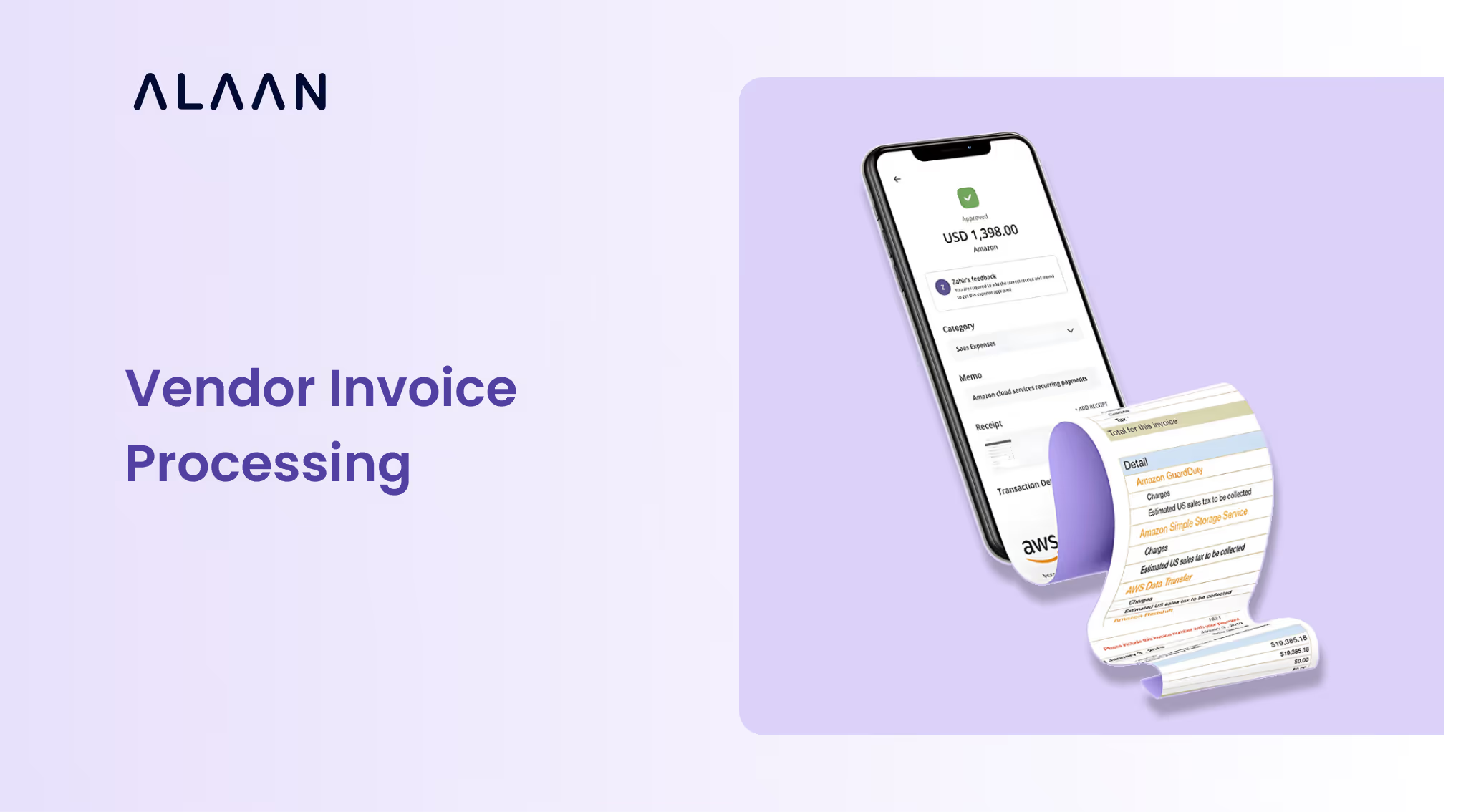

A look at the five stages of vendor invoice processing, where it breaks down at scale, and how automation restores control, compliance, and cash visibility for UAE finance teams.
- UAE businesses are expected to cut invoice processing costs by more than 60% as e-invoicing becomes compulsory in 2026.
- Invoice processing tends to break as volume grows, with invoices arriving through scattered channels, approvals buried in email threads, and VAT checks done too late to catch problems.
- Most errors, duplicate invoices, and VAT gaps surface because validation happens during month-end recovery rather than when the invoice first arrives.
- Automation works when structure comes first, so centralised intake, early data extraction, pre-approval policy checks, and real-time status tracking reduce rework without slowing decisions.
- Alaan brings invoice capture, VAT validation, approvals, payment including Super Pay for cross-border transfers, and accounting sync into one workflow while integrating with your existing ERP.
In the UAE, businesses are expected to save over 60% in processing costs as e‑invoicing becomes compulsory in 2026. This highlights how manual and fragmented workflows can slow operations and increase risk.
As invoice volumes grow across departments, vendors, and locations, and as cross-border payments increase, vendor invoice processing gradually becomes a control issue. Invoices arrive through scattered channels, approvals span long email threads, VAT checks are done too late, and month-end often becomes a recovery exercise.
What begins as an operational challenge soon affects cash visibility, compliance confidence, and decision-making. For finance teams, the pressure is even greater due to strict VAT requirements, audit expectations, and faster payment cycles.
So, in this blog, you'll explore where vendor invoice processing typically breaks at scale, how automation can simplify the flow without compromising control, and how modern finance teams are restoring visibility, predictability, and confidence.
TL; DR
- Invoice Processing Breaks Down as Scale Grows: Fragmented intake, manual entry, weak approvals, and late VAT checks turn routine invoices into control and compliance risks.
- Most Issues Arise From Timing: Errors, duplicate invoices, and VAT gaps usually surface because validation happens too late, often during month-end recovery.
- Automation Works When Structure Comes First: Centralised intake, automated validation, pre-approval checks, and structured workflows reduce rework without slowing decisions.
- Real-Time Visibility Improves Cash Planning and Control: When invoice status, liabilities, and exceptions are visible early, finance teams can forecast cash flow better and avoid last-minute surprises.
- Mature Teams Treat Invoices as Governance: They use exceptions, cycle time, and ownership clarity to maintain control, improve compliance, and prevent recurring issues.
5 Stages of Vendor Invoice Processing for Finance Teams in the UAE
In growing UAE businesses, vendor invoice processing directly affects cash flow visibility, approval velocity, supplier relationships, and cross-border payment timing. For most finance teams, the workflow appears structured on paper, but in practice, it often runs across email threads, shared drives, ERP entries, and banking portals.
Here’s how it typically works in practice in five stages:
1. Invoice Intake and Recording
Invoices usually arrive via email (PDF attachments), vendor portals, or occasionally through procurement systems.
Finance teams need to:
- Verify vendor details
- Confirm tax information (including VAT compliance)
- Log the invoice into the accounting or ERP system
- Assign the correct cost center or department
2. Internal Verification and Matching
Before approval, finance teams typically validate:
- Contract terms
- Purchase order references (if available)
- Delivery confirmation or service completion
- Agreed pricing and currency
3. Approval Workflows
Invoices are routed to budget owners, department heads, or finance controllers for sign-off. This stage determines how quickly cash leaves the business.
Common friction points include:
- Approvers traveling or unavailable
- Lack of clarity on spend ownership
- Approvals happening over email without audit trails
- Escalations when invoices age
4. Payment Scheduling and Execution
Once approved, the invoice moves to payment scheduling. Finance teams decide:
- Which payment method to use (bank transfer, card, FX provider, platform)
- When to release funds based on cash flow forecasts
- How to manage FX timing for foreign currency invoices
For cross-border payments, this stage introduces added complexity, such as:
- FX rate confirmation
- Bank cut-off times
- Intermediary fees
- Settlement uncertainty
5. Reconciliation and Reporting
After payment, finance teams reconcile:
- Bank statements
- FX adjustments
- Payment confirmations
- Ledger entries
Seeing how vendor invoice processing works in UAE finance teams also helps explain the common challenges encountered in daily operations.
6 Common Challenges in Vendor Invoice Processing
Vendor invoice processing gets harder when scale grows faster than structure. The real challenge is handling volume, approvals, compliance, and visibility simultaneously without slowing the business.

These challenges often start quietly, then become clear during month-end closes, audits, and vendor follow-ups.
1. Fragmented Invoice Intake Across Teams and Vendors
Invoices come in through many channels, often without a consistent intake process. Email attachments, supplier portals, PDFs, and scanned copies sit across different departments.
This fragmentation creates day-to-day friction as:
- Finance teams spend time hunting for invoices instead of reviewing them
- Duplicate invoices become harder to catch early
- Invoice status tracking relies on manual follow-ups
2. Manual Data Entry Introduces Compounding Errors
Many finance teams still enter invoice data by hand. Amounts, vendor details, tax values, and reference numbers are keyed in repeatedly across systems. For international payments, this manual handling of FX rates and bank details further compounds the risk of discrepancies.
Over time, this leads to:
- Inconsistent records between invoices and accounting entries
- Corrections pushed into reconciliation cycles
- Lower confidence in interim financial reports
3. Approval Workflows Create Bottlenecks or Gaps
Approval processes often grow without a clear structure. What starts as a simple sign-off turns into email threads, reminders, and exceptions. For cross-border payments, additional approval steps, such as FX rate verification, vendor legitimacy checks, and compliance review, can further slow down the process.
This usually results in two outcomes:
- Approvals delay vendor payments
- Teams bypass controls just to keep things moving
4. VAT Validation Happens Too Late in the Process
In the UAE and KSA environments, VAT accuracy depends on invoice-level details. TRNs, invoice formats, and tax calculations need checks before posting.
When teams delay validation:
- They find missing or non-compliant tax invoices late
- Recoverable VAT gets delayed or lost
- Audit preparation becomes more complicated than it needs to be
Suggested Read: How to Manage VAT in QuickBooks for UAE and KSA
5. Month-End Becomes a Recovery Exercise
Instead of confirming numbers, finance teams spend close cycles fixing them. This is even more prevalent with cross-border payments, where FX variances, intermediary fees, and delayed payment confirmations can lead to even greater discrepancies.
Common patterns include:
- Chasing down missing invoices
- Correcting coding and tax treatment
- Reconciling mismatches across systems
6. Existing Processes Break Under Scale
Processes that work at low invoice volumes often fall apart as businesses grow. New vendors, departments, and locations add layers of complexity that manual workflows cannot handle.
As volume rises:
- Coordination grows faster than control
- Finance teams spend more time managing exceptions
- Invoice processing turns into a structural risk
Addressing these common challenges shows how you can benefit from automating vendor invoice processing.
How Finance Teams Benefit from Automated Vendor Invoice Processing?
Automated vendor invoice processing delivers real value when it reshapes how finance teams work day to day. The impact shows up in time saved, lower risk, and stronger confidence across finance operations.
As invoice volumes rise, these gains become even more meaningful. Here’s how finance teams benefit from automated vendor invoice processing:
1. Predictable Control Over Payables
Automation adds structure to invoice intake, approvals, and posting, providing predictable control over both local and cross-border payments. This helps reduce FX rate errors, minimise late payments, and maintain cash flow visibility across all payment types.
At Alaan, automation adds structure across intake, validation, and approvals so you can clearly track invoice status. This improves visibility and supports more reliable short-term cash planning.
2. Improved Accuracy in Accounting Records
Invoice data is entered into accounting systems in a structured, consistent format. Teams catch errors early, before they affect reporting. This leads to fewer adjustments at close and higher confidence in interim numbers.
3. Stronger Compliance With Local Tax Requirements
Invoice-level validation strengthens how teams manage tax data by bringing VAT checks earlier in the process, when corrections are simpler and faster.
As a result, fewer non-compliant invoices reach posting, audit documentation improves, and the risk of missing recoverable VAT is significantly reduced.
Understanding the benefits of automated vendor invoice processing makes it easier to know how it actually works.
Also Read: What is a VAT Compliance Health Check and How to Stay Audit-Ready in the UAE
How Does Automated Vendor Invoice Processing Work?
The real value of automated vendor invoice processing comes from predictability, control, and timing. The process works best when each stage removes friction without weakening governance.
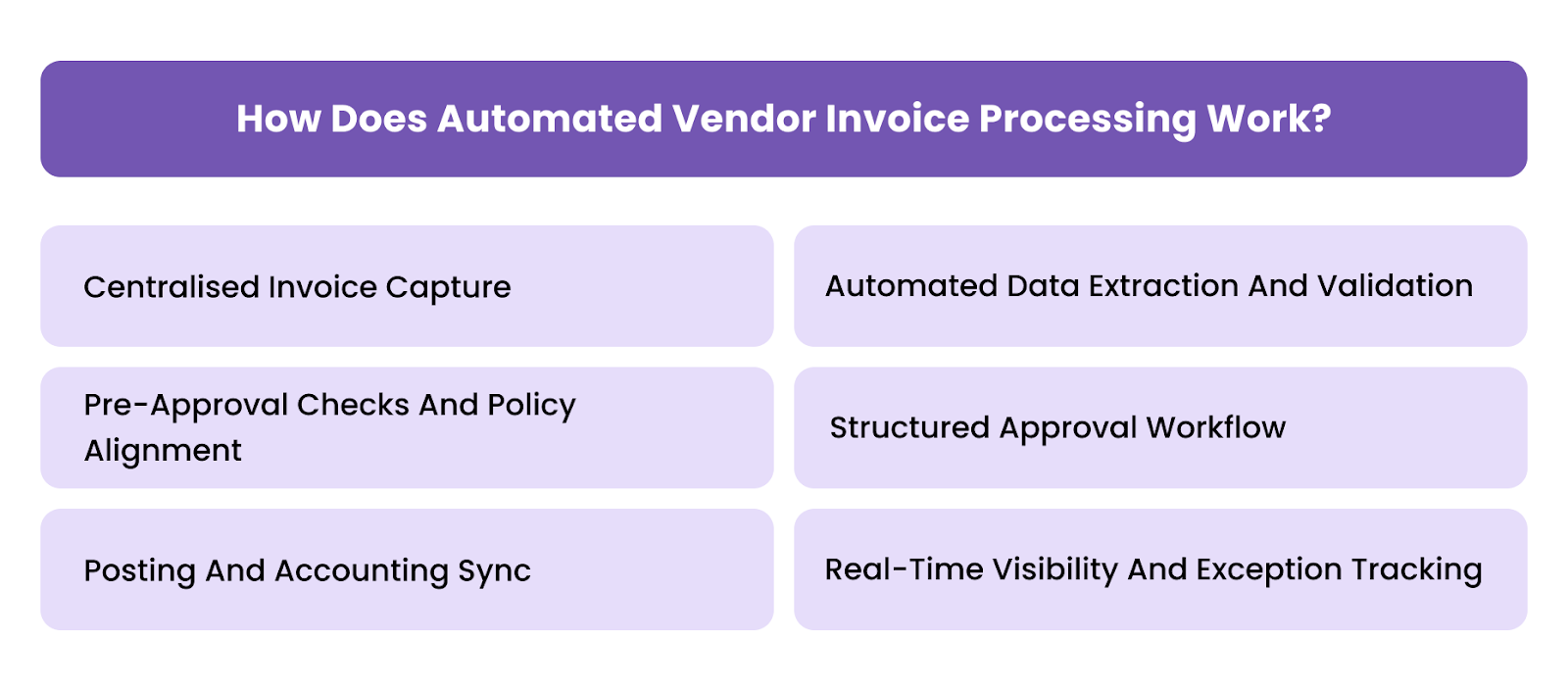
Here’s how automated invoice processing works in practice for finance teams handling volume, compliance, and approvals.
1. Centralised Invoice Capture
Automation starts by standardising how invoices are entered into the system. Instead of relying on scattered emails and uploads, invoices flow into one central intake.
This immediately improves control as:
- All invoices are recorded the moment they arrive
- Duplicates become visible earlier
- Ownership and status stay clear from day one
At Alaan, we centralise invoice intake across email, uploads, and card-linked spend, so invoices can be logged as soon as they enter the system. This reduces ambiguity around ownership, status, and potential duplication.
2. Automated Data Extraction And Validation
Once captured, the system automatically pulls invoice data. It identifies key fields and validates them before approvals or posting begins.
At this stage, the system checks:
- Vendor name and invoice number
- Amounts, dates, and line items
- Tax values and invoice structure
Early validation reduces later corrections and helps you focus on review rather than rework.
3. Pre-Approval Checks And Policy Alignment
Before invoices reach approvers, automation runs predefined checks based on finance policies. These usually cover:
- Spend limits and approval rules
- Vendor matching against approved lists
- Basic tax and compliance checks
Invoices that pass move forward. The system clearly flags exceptions, so teams spend time where it matters most.
4. Structured Approval Workflow
Invoices then move through a defined approval path based on amount, department, or vendor type. Approvers see complete, validated information instead of partial data.
This leads to better outcomes, such as:
- Faster approvals without repeated clarification
- Fewer back-and-forth questions
- A consistent audit trail across departments
5. Posting And Accounting Sync
After approval, invoices are posted immediately. Data flows into the accounting or ERP system in the right format.
This usually includes:
- Chart of accounts mapping
- Cost centre and department allocation
- Tax coding aligned with local rules

6. Real-Time Visibility And Exception Tracking
Throughout the process, you see invoice status and liabilities in real time. The system highlights exceptions early and tracks them until they are resolved.
This helps finance leaders:
- Monitor outstanding payables accurately
- Plan cash needs ahead of time
- Step in before issues grow
As the process becomes clearer, consistent management practices help ensure it runs accurately, efficiently, and without unnecessary delays.
6 Best Practices for Managing Vendor Invoice Processing in the UAE
Best practices in vendor invoice processing are less about perfect frameworks and more about practical sequencing. What really counts is addressing the right problems first, then strengthening control as volume and complexity grow.
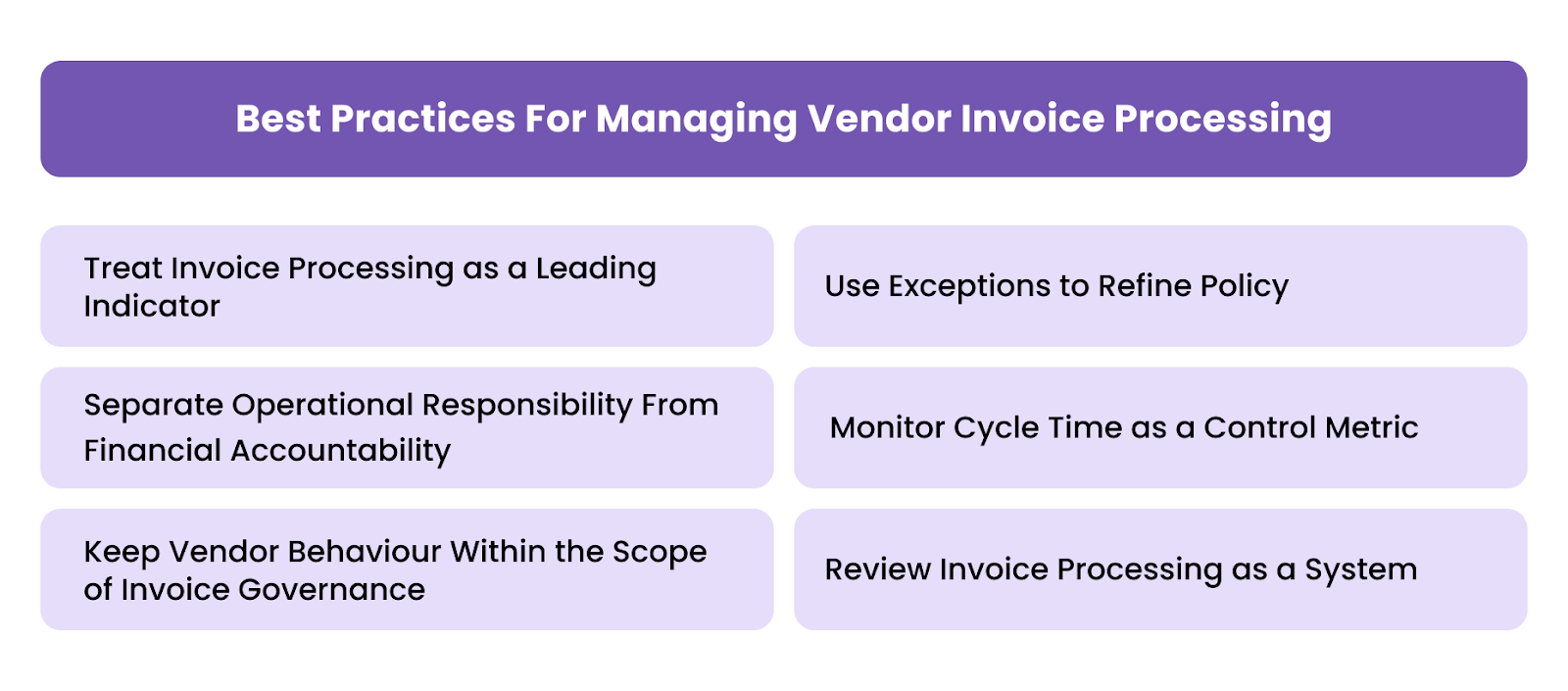
The practices below reflect how experienced finance teams steady their invoice workflows without disrupting daily work.
1. Treat Invoice Processing as a Leading Indicator
Invoices often reveal issues before they appear in financial reports. Patterns such as repeated delays, corrections, or exceptions often indicate upstream issues in procurement, vendor management, or budget ownership.
How to Implement:
- Identify high-exception departments: Track which teams consistently generate exceptions to target process improvements.
- Spot friction-causing vendors: Flag vendors whose invoices frequently require corrections or additional follow-ups.
- Detect early spend leakage: Use recurring invoice anomalies to uncover unauthorised spending or overlooked approvals.
2. Use Exceptions to Refine Policy
Recurring exceptions signal that existing policies may no longer align with operational reality. Treat exceptions as feedback to continuously improve invoice workflows rather than as isolated errors.
How to Implement:
- Regularly review exception trends: Analyse data weekly or monthly to identify patterns.
- Adjust thresholds and rules: Update approval limits, vendor-specific rules, or category policies to reflect actual business conditions.
- Simplify governance without compromise: Reduce unnecessary manual checks while maintaining control over high-risk transactions.
3. Separate Operational Responsibility From Financial Accountability
Confusion over ownership slows approvals and increases errors. Operational teams verify the legitimacy of purchases, while finance ensures compliance with policies, taxes, and structural requirements.
How to Implement:
- Assign operational owners: Ensure teams responsible for the purchase confirm delivery, quantity, and quality.
- Define finance accountability: Finance validates invoice structure, tax treatment, and policy alignment.
- Keep accountability transparent: Document responsibilities so handoffs are clear and avoid duplicated effort.
4. Monitor Cycle Time as a Control Metric
Invoice cycle time reflects the efficiency of coordination, data quality, and approval workflows. Delays often signal control gaps rather than just high workload.
How to Implement:
- Track total cycle time: Measure the time from invoice receipt to final approval.
- Identify bottlenecks: Highlight where delays consistently occur, whether within departments, at approval levels, or with vendors.
- Link delays to control gaps: Determine if slow approvals indicate missing policies, unclear thresholds, or inconsistent data.
5. Keep Vendor Behaviour Within the Scope of Invoice Governance
Vendor invoice quality affects financial efficiency. Repeated errors, missing information, or inconsistent formats create extra work for internal teams.
How to Implement:
- Set invoice standards: Include format, required fields, and submission guidelines in contracts and onboarding.
- Hold vendors accountable: Escalate or restrict vendors that consistently fail to meet standards.
- Reduce downstream friction: Use automated validation rules to catch common errors before they enter finance workflows.
Must Read: 10 Proven Vendor Management Strategies for UAE Companies
6. Review Invoice Processing as a System
Mature finance teams treat invoice processing as a connected system across procurement, accounting, compliance, and cash management. Isolated fixes often shift effort elsewhere instead of solving the root problem.
How to Implement:
- Map end-to-end workflow: Visualise all steps from purchase request to payment and reconciliation.
- Identify hidden handoffs: Spot where effort disappears or redundancies occur between teams.
- Balance speed and control: Optimise the system to reduce delays without compromising approvals or compliance.
How Alaan Helps Finance Teams Automate Vendor Invoice Processing?
Many finance teams in the UAE handle vendor invoices across disconnected tools. Invoices arrive by email, via uploads, or via shared folders; approvals happen in parallel threads; and VAT checks often sit outside the main workflow. As volumes grow, this fragmentation leads to rework, posting delays, and weaker control.
At Alaan, we bring invoice intake, validation, approvals, and accounting sync into one seamless workflow. This helps you process invoices consistently and with full visibility, while helping reduce manual reconciliation work without changing your existing accounting setup.
What Alaan Covers Across the Invoice Lifecycle
Vendor invoice processing creates risk at multiple stages. At Alaan, we strengthen each stage so issues are caught early, rather than being fixed at month-end.
1. Centralised Invoice Capture From Day One
We centralise invoice intake from email forwarding, uploads, and card-linked spend. Every invoice is recorded as soon as it enters the system, making ownership clear and helping teams catch duplicates early.
2. Early Data Extraction and VAT Validation
Invoice data is captured and prepared for validation before approvals. Vendor details, amounts, and VAT fields are captured and made available for review upfront, so errors are caught before they become complex to fix.
3. Pre-Approval Checks Aligned With Finance Policy
Policy checks can be applied before invoices reach approvers. Spend limits, vendor rules, and compliance requirements can be reviewed upfront, with clear exception flags to focus attention where it’s needed most.
4. Structured Approvals With Full Context
Invoices follow approval workflows based on amount, department, or vendor type. Approvers see validated data and supporting documents, reducing back-and-forth and keeping a clean audit trail. Corporate cards are also available for SaaS, advertising, and employee spend.
5. Payment Execution, Including Super Pay for International Transfers
Once approved, invoices move into structured payment workflows. This includes domestic transfers and Super Pay for eligible cross-border payments from the UAE, while maintaining FX visibility, approvals, and execution within a single connected system.
6. Continuous Accounting and ERP Sync
Approved invoices sync automatically with connected accounting systems. Coding, cost centre allocation, and tax treatment stay aligned, reducing reconciliation work and supporting faster close cycles.
7. Real-Time Visibility Into Invoice Status and Liabilities
You can track invoice status, exceptions, and outstanding payables with real-time visibility. This improves cash planning and lets teams intervene before issues escalate.
What Alaan Is (And Is Not)
Alaan is not accounting software and doesn’t replace your ERP.
Instead, we integrate with your existing systems to strengthen invoice processing upstream. This helps you improve accuracy, compliance, and control, without changing your core financial setup.
Final Thoughts
Vendor invoice processing is a fact of life for growing finance teams, but constant recovery work doesn’t have to be. Most issues, like missing invoices, late VAT checks, approval delays, and reconciliation headaches, come from fragmented intake and late validation.
Finance teams that centralise invoice capture, validate data early, and align approvals with risk regain control over payables and cash visibility. As invoice volumes grow and compliance demands increase in the UAE, the advantage goes to teams that treat invoice processing as financial governance.
At Alaan, we help teams make this shift by bringing invoice intake, validation, approvals, and accounting sync into one controlled workflow. This reduces rework, supports VAT compliance, improves visibility into payables, and helps simplify operations.
Schedule a free demo to see how Alaan helps UAE finance teams simplify vendor invoice processing and improve compliance.
When the stages above still involve copying numbers from PDFs into a spreadsheet, our explainer on what AP automation does covers what changes once capture, matching and approval run on their own, and what it won't fix.
FAQs
Q1. How does vendor invoice processing affect internal trust between finance and operations?
A1. Delays and repeated corrections often create tension between finance and operational teams. Clear ownership and visible invoice status cut down on blame and back-and-forth. Over time, this promotes better cooperation instead of turning invoice review into a negotiation.
Q2. What signals indicate that invoice processing is becoming a risk?
A2. Frequent overrides, late postings, and repeated tax corrections are early warning signs. When these patterns show up regularly, they usually point to gaps in control rather than just heavy workloads. Ignoring them can raise audit and compliance risks.
Q3. How should finance teams handle invoices linked to partially delivered services?
A3. Invoices tied to milestones or partial deliveries usually require additional checks before approval. Finance teams often wait for operational confirmation before releasing payment. Handling these invoices differently helps avoid disputes and premature payments.
Q4. How does invoice processing design influence short-term cash management?
A4. Limited visibility into approved but unpaid invoices can throw off cash forecasts. When invoice status and timing are clear, finance can plan outflows more confidently. This reduces last-minute payments that can disrupt liquidity.
Q5. What role should procurement play in improving invoice quality?
A5. Procurement sets clear expectations with vendors during onboarding and contracting, which helps reduce errors before invoices reach finance. When this coordination happens upstream, downstream invoice processing becomes faster and more predictable.
Gain control over business expenses with Alaan corporate cards
Invygo earned AED 100,000 in cashback using Alaan cards
Personalise approval workflows to align with your business needs with Alaan's Spend Management platform
Discover the power of automated expense tracking and smarter spend control with Alaan
Turn data into actionable insights with Alaan's spend management tools
Stay Tax Compliant with UAE's #1 Corporate Card and Spend Management Platform
Customisable corporate card policy template
Know how much Corporate Tax you have to pay this fiscal year
Easily integrate Alaan with your ERP for accurate, real-time expense tracking
Close books faster with Alaan's AI-powered accounting automation
Reconcile your books in minutes instead of hours, every single month.
Keep petty cash organized with Alaan corporate cards and automated expense management