.avif)


Accounts receivable financing lets businesses access cash tied up in unpaid invoices early to cover short-term working capital gaps, with clear trade-offs in cost and control.
- A B2B supplier sitting on a AED 500,000 invoice with 60-day terms can be profitable and still short on cash for payroll, which is exactly the timing gap receivables financing is built to close.
- It lets you draw a portion of an unpaid invoice upfront, so it changes when cash arrives without creating any new revenue.
- The common structures are invoice financing, factoring, and receivables-backed credit lines, and each one trades cost, control, and customer contact differently.
- It works best as a short-term tool rather than a permanent fix, since leaning on it too hard can hide weak billing and slow collections.
- Alaan works on the other side of the cash cycle with approval workflows, corporate card limits, and spend visibility, so tighter control over money going out reduces the pressure to keep borrowing against invoices.
A business can be profitable on paper and still struggle to pay salaries, suppliers, or operating expenses on time. The reason is simple: revenue does not always translate into immediate cash. When customers pay on 30, 60, or even 90-day terms, cash remains tied up in receivables.
This is where accounts receivable financing becomes relevant. It allows businesses to access a portion of the cash locked in unpaid invoices before customers actually pay.
For founders, finance leaders, and operators, the key question is not just what it is, but when it makes sense and what trade-offs it involves.
TL;DR
- Accounts Receivable Financing Helps Businesses Access Cash From Unpaid Invoices Before Customers Pay.
- It Is Primarily Used To Manage Short-Term Working Capital Gaps, Not Long-Term Financing Needs.
- Common Structures Include Invoice Financing, Factoring, And Receivables-Backed Credit Lines.
- The Main Benefit Is Faster Liquidity, But Costs And Control Trade-Offs Must Be Evaluated Carefully.
- Stronger Billing, Collections, And Cash Flow Discipline Reduce Overreliance On Financing.
What Is Accounts Receivable Financing
Accounts receivable financing is a form of short-term funding where a business uses its unpaid customer invoices to access cash earlier than the actual payment date.
Instead of waiting for customers to settle invoices, the business receives a portion of the invoice value upfront from a financing provider. The remaining balance is settled later, after deducting fees or interest, once the customer pays.
In simple terms:
- A business sells goods or services and raises an invoice
- The invoice becomes an accounts receivable asset
- That asset is used to obtain early cash from a financer
For more on how these receivables are managed and analysed as assets, see a broader look at trade receivables and the key concepts behind them.
This does not create new revenue. It simply changes the timing of when cash is received.
Because receivables are tied to actual sales, this type of financing can be more accessible or flexible than some traditional short-term borrowing options, especially for growing businesses with strong customers but slower payment cycles.
Also Read: What Is Accounts Receivable And How It Works
How Accounts Receivable Financing Works
The mechanics of financing accounts receivable are relatively straightforward, but understanding the flow is important to evaluate whether it fits your business.
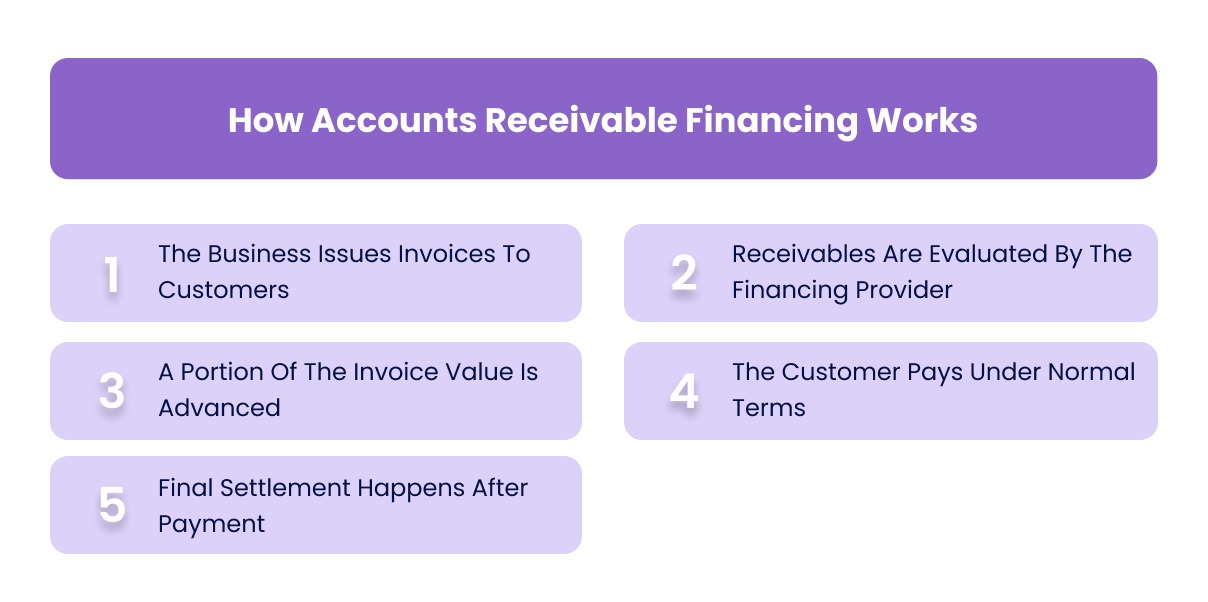
1. The Business Issues Invoices To Customers
The process starts with normal operations. The business delivers goods or services and raises invoices with agreed payment terms.
These unpaid invoices become receivables.
2. Receivables Are Evaluated By The Financing Provider
The financing provider reviews:
- Customer creditworthiness
- Invoice validity
- Payment history
- Concentration of receivables
This step determines how much funding the business can access.
3. A Portion Of The Invoice Value Is Advanced
The financer typically provides an advance, often a percentage of the invoice value, rather than the full amount.
This gives the business immediate liquidity.
4. The Customer Pays Under Normal Terms
The customer continues to pay based on the original invoice terms. In some cases, the customer may not even be aware of the financing arrangement, depending on the structure.
5. Final Settlement Happens After Payment
Once the customer pays:
- The financer deducts fees or interest
- The remaining balance is released to the business
This completes the transaction cycle.
Related: Cash Conversion Cycle Explained
Why Businesses Use Financing Accounts Receivable
Businesses do not use account receivable financing because they lack revenue. They use it because of timing gaps between earning revenue and receiving cash.

1. To Cover Working Capital Gaps
When operating expenses such as payroll, rent, or supplier payments fall due before customer payments are received, financing helps bridge that gap.
2. To Manage Long Customer Payment Cycles
Industries with standard 60 or 90-day payment terms often rely on receivables financing to maintain liquidity.
3. To Support Growth Without Waiting For Collections
As businesses grow, they generate more invoices. However, that also means more cash is tied up in receivables. Financing allows growth without waiting for full payment cycles.
4. To Reduce Pressure On Short-Term Cash
Instead of relying entirely on reserves or overdrafts, businesses can use receivables as a source of liquidity.
5. To Handle Seasonal Or Contract-Based Demand
Businesses with seasonal demand or large contracts often face uneven cash flow. Receivables financing helps smooth these fluctuations.
Also Read: Cash Flow Forecasting Guide
Accounts Receivable Financing Vs Factoring
One of the most common areas of confusion is the difference between accounts receivable financing and factoring. While they are related, they are not identical.
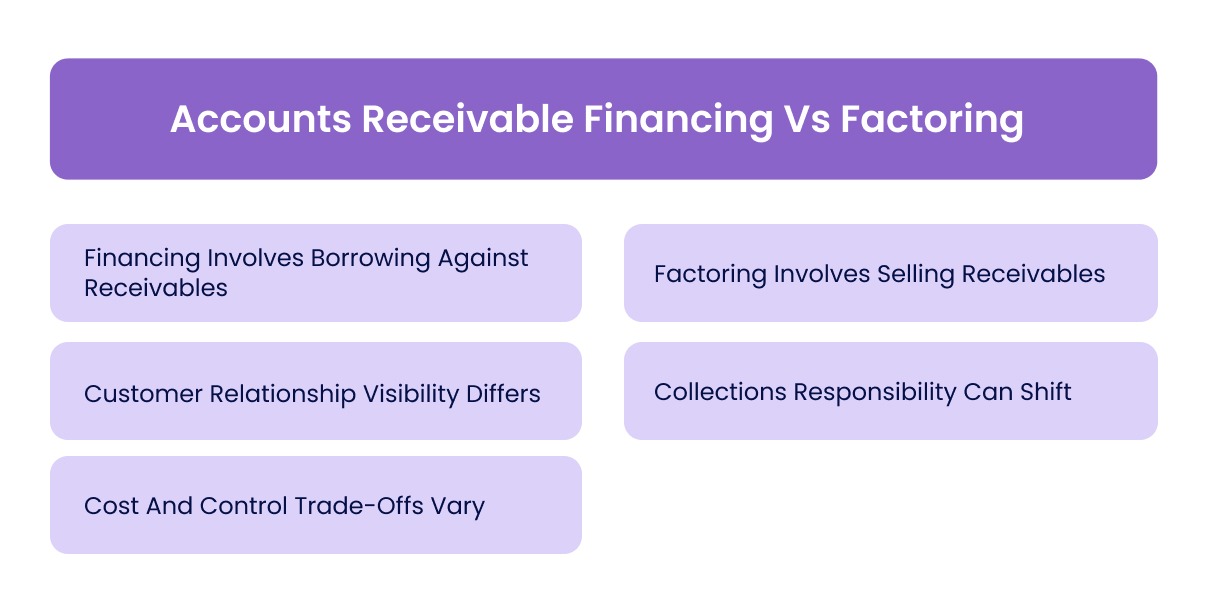
1. Financing Involves Borrowing Against Receivables
In most receivables financing structures, the business retains ownership of the invoices and borrows against them. The receivables act as collateral.
2. Factoring Involves Selling Receivables
In factoring, the business sells its invoices to a third party (the factor). The factor then collects payment directly from customers.
3. Customer Relationship Visibility Differs
With financing, customer relationships usually remain unchanged. With factoring, customers may interact directly with the factor for payment.
4. Collections Responsibility Can Shift
In financing, the business typically handles collections. In factoring, the factor often takes over this responsibility.
5. Cost And Control Trade-Offs Vary
Factoring may provide more immediate liquidity but can come with higher costs or reduced control over customer interactions. Financing offers more control but may require stronger credit profiles. For a closer look at what factoring actually costs, see how factoring fees and discount rates typically break down.
Related: Trade Finance Basics For Businesses
Account Receivable Financing Structures Businesses Commonly See
There is no single way to structure accounts receivable financing. The model varies depending on how much control the business wants to retain, how quickly it needs cash, and the quality of its receivables.
1. Invoice Financing
This is one of the most common forms. The business borrows against specific invoices and receives an advance based on their value.
- The business retains ownership of receivables
- The financer provides a percentage upfront
- The business collects from customers and repays the financer
This structure offers flexibility and maintains customer relationships.
2. Factoring
In factoring, the business sells its receivables to a third party (the factor).
- The factor pays most of the invoice value upfront
- The factor collects payment from the customer
- The remaining balance is settled after fees
This provides faster liquidity but reduces control over collections.
3. Receivables-Backed Credit Lines
Some businesses use receivables as collateral for a revolving credit facility.
- Borrowing limits are based on receivables value
- Funds can be drawn as needed
- Repayment depends on collections
This works well for businesses with consistent receivables and ongoing working capital needs.
4. Selective Invoice Financing
Instead of financing all receivables, businesses choose specific invoices.
- Useful for managing occasional cash gaps
- Provides flexibility without long-term commitment
This is often used for large or delayed invoices.
5. Export Or Trade Receivables Financing
For businesses dealing with international customers, receivables financing may be tied to export transactions.
- Helps manage longer payment cycles
- May include additional risk assessment for cross-border transactions
This structure supports global trade where payment timelines are extended.
Also Read: Business Financing Options Explained
Accounts Receivable Financing Example
A practical example helps clarify how financing accounts receivable works in real situations.
Consider a B2B supplier that issues an invoice of AED 500,000 with 60-day payment terms.
- The business needs cash immediately to cover payroll and supplier costs
- Instead of waiting 60 days, it uses receivables financing
- The financer advances a portion of the invoice value upfront
- The customer pays after 60 days as usual
- The financer deducts fees and releases the remaining balance
The business improves its cash flow timing without changing its customer payment terms.
This is the core benefit: turning future cash into present liquidity.
Related: Cash Flow Vs Profit Explained
Advantages Of Accounts Receivable Financing
The advantages of accounts receivable financing are primarily tied to liquidity and flexibility rather than long-term capital.
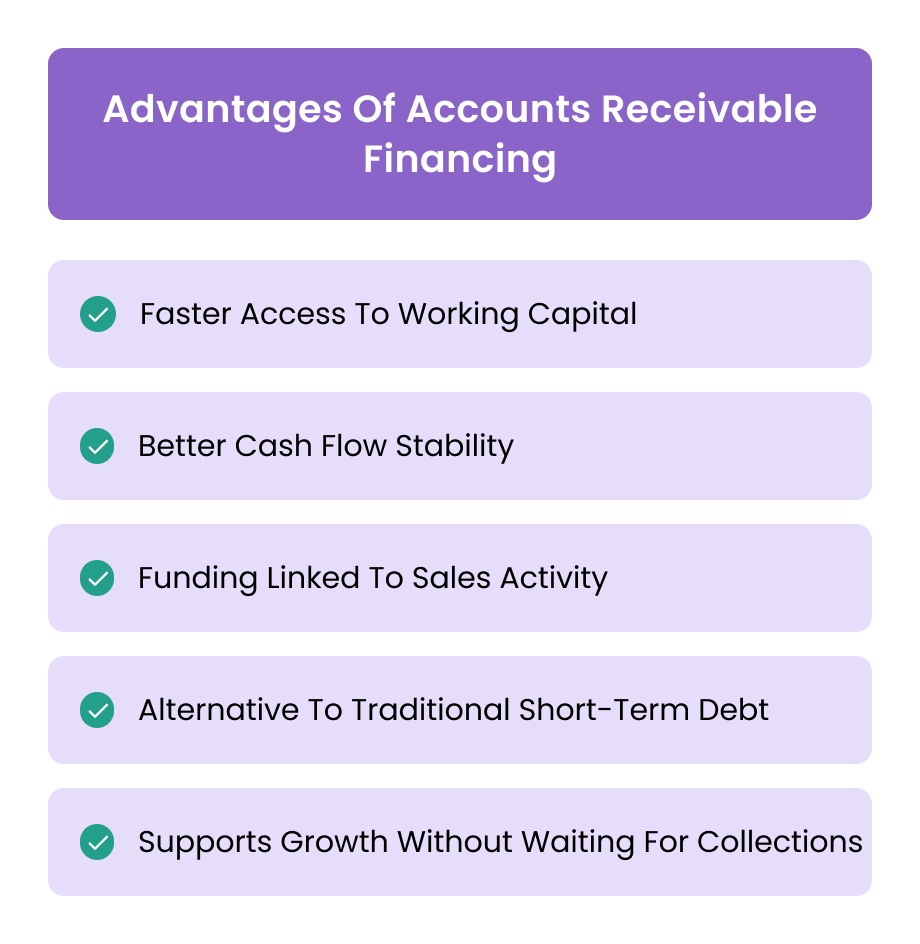
1. Faster Access To Working Capital
Instead of waiting for customers to pay, businesses can access cash soon after issuing invoices. This improves liquidity significantly.
2. Better Cash Flow Stability
Receivables financing smooths out fluctuations caused by delayed payments, helping businesses maintain consistent operations.
3. Funding Linked To Sales Activity
Unlike fixed loans, financing capacity grows with sales. Higher receivables mean more available funding.
4. Alternative To Traditional Short-Term Debt
For businesses that may not qualify for conventional loans, receivables financing can provide a more accessible option.
5. Supports Growth Without Waiting For Collections
Growing businesses often face increasing receivables. Financing allows them to scale without being constrained by cash flow timing.
Also Read: Working Capital Formula Explained
Risks And Drawbacks Businesses Should Understand
While useful, accounts receivables financing comes with trade-offs that need to be evaluated carefully.
1. Financing Costs Can Reduce Margins
Fees and interest reduce the overall value of invoices. Over time, this can impact profitability, especially if used frequently.
2. Dependence Can Mask Weak Collections
Relying too heavily on financing can hide underlying issues such as slow collections, poor credit control, or inefficient billing processes.
3. Not All Receivables Qualify
Financers typically evaluate customer credit quality and invoice validity. Weak or high-risk receivables may not be eligible for financing.
4. Customer Relationship Impact In Some Structures
In factoring arrangements, customers may interact directly with the financer. This can affect the customer experience if not managed properly.
5. Complexity In Terms And Agreements
Different providers have varying structures, fees, and conditions. Businesses need to understand:
- Advance rates
- Fee structures
- Repayment terms
- Recourse conditions
Misunderstanding these terms can lead to unexpected costs.
When Accounts Receivable Financing Makes Sense
Accounts receivable financing is not a universal solution. It works best in specific operating conditions where the timing gap between revenue and cash creates pressure.
1. The Business Has Strong Customers But Slow Payments
If customers are reliable but operate on long payment terms, receivables financing can unlock cash without increasing credit risk significantly.
2. Growth Is Outpacing Cash Flow
Fast-growing businesses often generate more invoices but also face higher upfront costs. Financing helps bridge this gap without slowing expansion.
3. Working Capital Is Tied Up In Operations
When a large portion of cash is locked in receivables, it limits the ability to invest in inventory, hiring, or operations. Financing releases that constraint.
4. Seasonal Or Project-Based Demand Creates Timing Pressure
Businesses with uneven revenue cycles may experience periods where expenses come before collections. Receivables financing smooths these fluctuations.
5. The Business Wants To Avoid Larger Debt Or Equity Dilution
Compared to long-term loans or equity funding, receivables financing can provide targeted liquidity without changing ownership or taking on significant long-term obligations.
Also Read: Cash Flow Management Strategies
Common Mistakes Businesses Make With Accounts Receivable Financing
Accounts receivable financing can improve liquidity, but it can also create avoidable costs and dependency if the business uses it without enough discipline. Most mistakes happen when companies treat it as a permanent fix for operational cash flow weakness rather than a short-term tool that should sit alongside strong billing, collections, and working capital control.
1. Using Financing To Cover Weak Billing Or Collections Processes
Receivables financing should not replace strong billing discipline. Delays in invoicing or poor follow-up on collections reduce the effectiveness of financing.
2. Focusing Only On Advance Rates
A higher advance percentage may seem attractive, but total cost matters more. Fees, interest, and settlement terms should be evaluated together.
3. Ignoring Customer Concentration Risk
If most receivables come from a small number of customers, financing risk increases. A single delayed payment can affect liquidity significantly.
4. Overlooking The Impact On Margins
Frequent use of receivables financing can reduce profit margins over time. Businesses should assess whether the liquidity benefit justifies the cost.
5. Choosing The Wrong Structure For Their Needs
Invoice financing, factoring, and credit lines have different implications for control and customer interaction. Selecting the wrong structure can create operational friction.
6. Treating It As A Long-Term Cash Flow Strategy
Receivables financing is best used as a tactical tool. Overreliance can prevent businesses from improving underlying cash flow processes.
Related: Common Cash Flow Mistakes
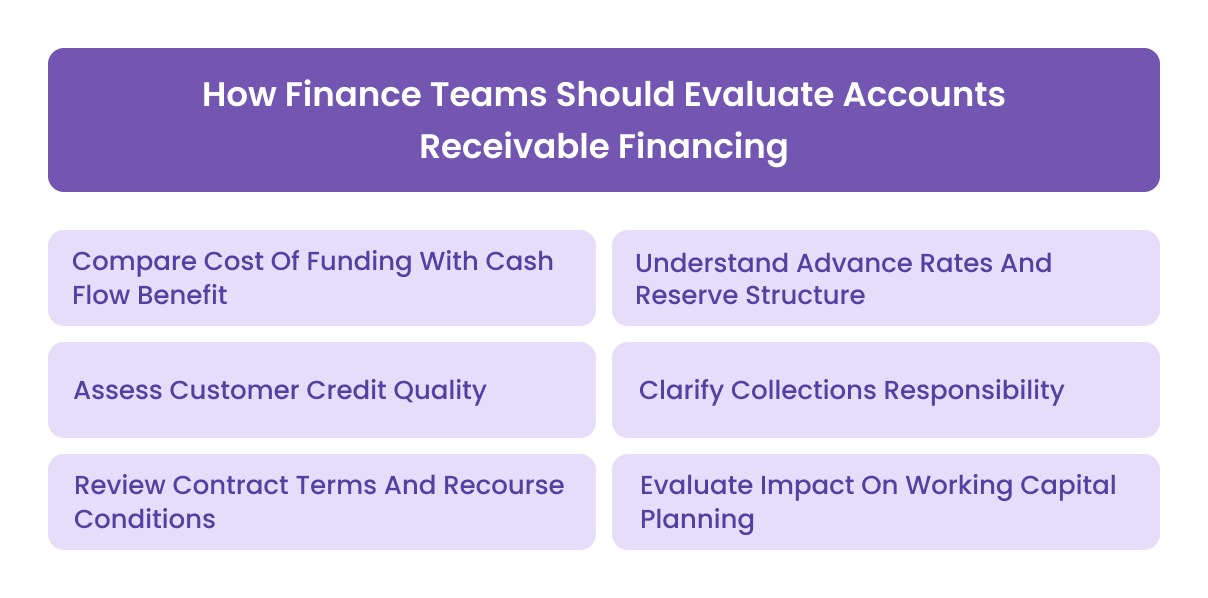
How Finance Teams Should Evaluate Accounts Receivable Financing
Before adopting accounts receivable financing, finance teams should assess both cost and operational impact.
1. Compare Cost Of Funding With Cash Flow Benefit
Evaluate whether the cost of financing is justified by the improvement in liquidity and operational flexibility.
2. Understand Advance Rates And Reserve Structure
Know how much cash is received upfront and how much is held back until customer payment.
3. Assess Customer Credit Quality
Financing depends heavily on the reliability of customers. Stronger customer profiles improve access and terms.
4. Clarify Collections Responsibility
Determine whether the business or the financer handles collections. This affects both control and customer relationships.
5. Review Contract Terms And Recourse Conditions
Understand whether the business remains liable if the customer fails to pay. Recourse terms can significantly affect risk exposure.
6. Evaluate Impact On Working Capital Planning
Receivables financing should fit into broader cash flow and working capital strategies, not operate in isolation.
Also Read: Financial Planning And Analysis Guide
How Alaan Helps Reduce Operational Cash Flow Friction
Accounts receivable financing improves the timing of cash inflows. However, maintaining strong cash flow also depends on how well the business controls outgoing payments, approvals, and documentation.
Alaan helps businesses strengthen that control layer through structured approvals, spend visibility, and cleaner reconciliation across everyday company spending. And where finance teams also need tighter oversight on supplier and transfer-based payments, SuperPay extends that control further by helping businesses review payment impact, approval flow, and reconciliation before money moves.
- Structured Approval Workflows Before Spend Happens
Alaan ensures that expenses are reviewed and approved before money is spent. This prevents unnecessary or unplanned outflows. - Corporate Cards With Spend Controls
Businesses can issue corporate cards with defined limits and usage restrictions, ensuring better control over operational spending. - Real-Time Visibility Into Company Spend
Finance teams gain immediate insight into where money is being spent, improving decision-making and cash flow planning. - Centralised Receipt And Invoice Capture
All supporting documents are linked to transactions, making it easier to track, verify, and reconcile expenses. - Cleaner Reconciliation And Accounting Sync
With integrations into systems like Xero, QuickBooks, NetSuite, and Microsoft Dynamics, financial data flows smoothly into accounting, reducing manual effort. - Better Control Over Short-Term Cash Outflows
By improving visibility and control, businesses can better manage liquidity and reduce unnecessary reliance on external financing.

Receivables financing improves inflows, but controlling outflows is equally critical for maintaining financial stability.
Also Read: Expense Management Software Business Spend Tracking
Conclusion
Accounts receivable financing is a practical tool for improving cash flow timing, especially for businesses dealing with long customer payment cycles. It allows companies to access liquidity tied up in receivables without waiting for full payment.
However, it is not a substitute for strong financial discipline. Businesses still need effective billing, collections, and cash flow management processes to operate efficiently.
The most effective approach is balanced. Use receivables financing where it makes sense, but combine it with better visibility into spending, tighter approval controls, and structured financial workflows.
If your organisation is looking to improve cash flow visibility, control operational spending, and strengthen financial discipline, Book A Demo to see how Alaan can support your finance processes.
Receivables financing fixes a timing gap, so it's worth checking whether better forecasting and collections could close that gap first, which our cash flow management steps cover. The cash flow stress test shows how many months of runway you have under a few rough scenarios, which helps you decide if you need financing at all. If most of your revenue comes through card sales, how merchant cash advances work is worth reading too, since the costs are easy to underestimate. And when the money does land, Alaan's AI-native business account keeps bills, cards and approvals in one place and pays profit on the cash you park there.
FAQs
1. What Is Accounts Receivable Financing In Simple Terms
It is a way for businesses to access cash from unpaid invoices before customers make payments.
2. Is Accounts Receivable Financing The Same As Factoring
No, financing typically involves borrowing against receivables, while factoring involves selling them to a third party.
3. How Does Accounts Receivable Financing Affect Cash Flow
It improves short-term cash flow by providing earlier access to funds tied up in receivables.
4. When Should A Business Use Receivables Financing
It is most useful when there are delays in customer payments but immediate cash needs for operations.
5. What Are The Main Risks Of Accounts Receivables Financing
Key risks include cost, dependence, customer concentration, and potential impact on margins.
6. How Is Accounts Receivable Financing Different From A Business Loan
It is tied to receivables and short-term liquidity, whereas business loans are typically broader and longer-term financing solutions.
Gain control over business expenses with Alaan corporate cards
Invygo earned AED 100,000 in cashback using Alaan cards
Personalise approval workflows to align with your business needs with Alaan's Spend Management platform
Discover the power of automated expense tracking and smarter spend control with Alaan
Turn data into actionable insights with Alaan's spend management tools
Stay Tax Compliant with UAE's #1 Corporate Card and Spend Management Platform
Customisable corporate card policy template
Know how much Corporate Tax you have to pay this fiscal year
Easily integrate Alaan with your ERP for accurate, real-time expense tracking
Close books faster with Alaan's AI-powered accounting automation
Reconcile your books in minutes instead of hours, every single month.
Keep petty cash organized with Alaan corporate cards and automated expense management