.avif)


Purchasing failures rarely reveal themselves at the point of payment. By then, the underlying control weakness has usually been in motion for weeks: a request raised without enough detail, an approval routed too loosely, a vendor added without proper review, or a purchase order created after the commercial commitment had already been made. An audit of purchases matters because it tests whether spend moved through the business in a way that was authorised, documented, and defensible, not merely whether it was recorded. In the UAE federal procurement bylaws, authority limits, segregation of duties, periodic review, and the prohibition on splitting requests to bypass approval thresholds are treated as core control requirements, not optional process hygiene.
In mature finance teams, a purchase audit is not a backward-looking paperwork exercise. It is one of the clearest ways to test whether procurement discipline actually holds under operating pressure. If requests, approvals, supplier decisions, invoices, and payments cannot be traced cleanly from start to finish, the weakness is rarely isolated to one transaction. It usually points to a broader control issue across the purchasing cycle.
This article breaks down what an audit of purchases should really test, where control failures usually appear first, and which records matter when finance wants confidence in procurement integrity rather than assumptions.
TL;DR
- An audit of purchases should test the full control chain, not just invoices and payments at the end of the process.
- The most important weaknesses usually appear upstream in request quality, approval logic, vendor control, PO timing, and audit-trail integrity.
- A strong procurement audit checklist should focus on authority, segregation, documentary alignment, and end-to-end traceability.
- A useful procurement audit programme is designed to catch repeat failure patterns such as threshold gaming, unsupported exceptions, and fragmented records.
- Alaan helps finance teams make purchase activity easier to approve, document, reconcile, and audit through connected spend controls, approvals, and transaction records.
The Real Objective Of An Audit Of Purchases
A serious purchase audit is trying to prove more than the existence of a transaction. It is testing whether a purchase moved through the business on a valid business basis, through the right approval path, with a supportable supplier decision, and with enough documentary integrity to survive scrutiny later.
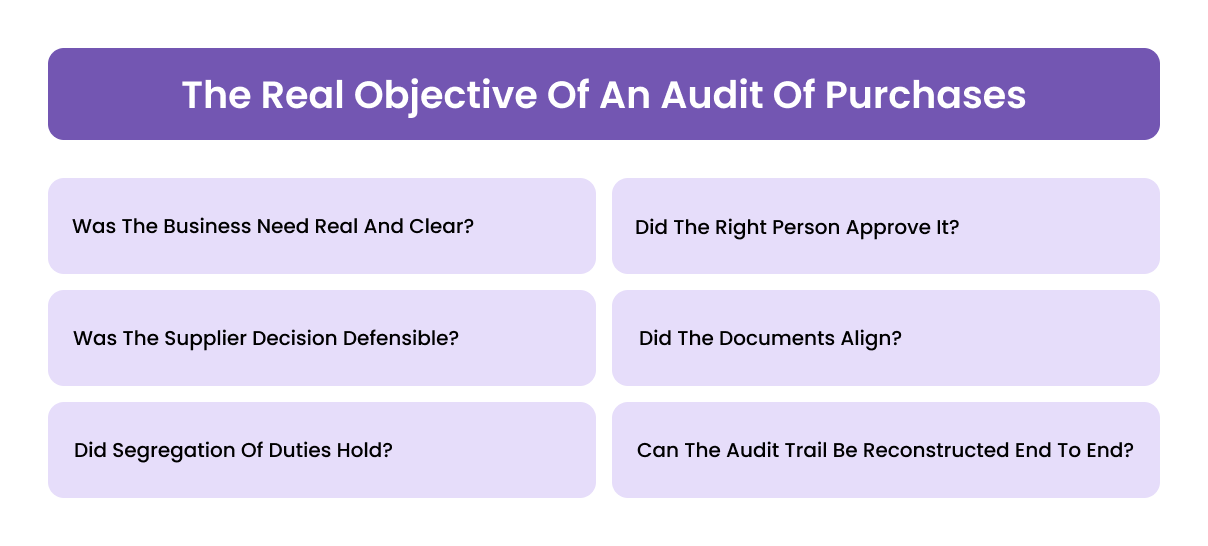
That usually comes down to six questions.
1. Was The Business Need Real And Clear?
A purchase should begin with a clear requirement, not a vague operational request that gets justified after the fact. If the underlying need is weak, every document created later becomes harder to rely on.
2. Did The Right Person Approve It?
An approval only matters if it came from the correct authority level and happened before the business was commercially committed. Late approvals and threshold workarounds are not administrative oversights. They are control failures. The UAE federal procurement bylaws are explicit that requests should not be split into lower values to avoid approval limits, and that the same person should not both initiate and approve the activity.
3. Was The Supplier Decision Defensible?
A clean transaction still becomes risky if the supplier basis is weak. An audit of purchases should be able to explain why that vendor was used, whether the record was complete, and whether the commercial basis was documented well enough to withstand challenge.
4. Did The Documents Align?
Purchase requests, quotations, purchase orders, receipts, invoices, and payment records should tell one coherent story. If the amount, timing, scope, or supplier details shift across documents without clear support, the transaction is already weaker than it appears.
5. Did Segregation Of Duties Hold?
The more one person can request, approve, receive, and influence payment, the less reliable the process becomes. Strong audit outcomes depend on role separation holding in practice, not only in policy.
6. Can The Audit Trail Be Reconstructed End To End?
This is the final test. A purchase should be traceable from request to payment without rebuilding half the history from inboxes, chats, and memory. Purchase orders, invoices, and related records are part of the core document set auditors rely on during review.
Related: Improving internal control over financial reporting
Where Purchase Controls Usually Break
Purchase-control failures are rarely random. They cluster around a few predictable pressure points, and those pressure points usually appear well before payment.
Approval Logic Breaks First
The approval matrix may look clean on paper and still fail in reality. Requests get routed to the wrong approver, approvals are applied after commitment, or teams start shaping transaction values around authority thresholds rather than business need. Once that starts, the audit is no longer reviewing a clean process with occasional exceptions. It is reviewing a system that invites circumvention.
Request Quality Is Too Thin
Weak requests create weak purchasing discipline. When the business need is poorly stated, urgency is unsupported, or the category is vague, procurement and finance are forced to validate a transaction that should have been better defined at source.
Vendor Setup Is Not Audit-Ready
Many purchasing issues that show up in finance are actually vendor-control issues in disguise. Duplicate suppliers, incomplete vendor files, and poorly documented onboarding weaken the transaction before a PO is even raised.
Purchase Orders Do Not Reflect The Real Commitment
A purchase order should capture the approved commercial position. When it is raised after the supplier has already started work, or when it does not reflect the agreed scope, price, or timing, it stops acting as a control document and becomes a record-keeping patch.
Matching Breaks Under Pressure
Invoice mismatches often look like AP problems. In practice, they usually begin upstream. The PO was weak, receipt confirmation was informal, or the invoice is being forced to fit a transaction that was never documented properly in the first place.
The Audit Trail Is Fragmented
This is where the review becomes expensive. The request exists in one place, the approval in another, supplier communication somewhere else, and receipt evidence is incomplete or informal. The problem is no longer efficiency. It is traceability.
Also read: Corporate card reconciliation guide
What Auditors Actually Reconstruct During A Purchasing Audit
A purchasing audit is essentially a reconstruction exercise. The goal is to determine whether the transaction still holds together when every assumption is tested.

1. The Request Origin
Who raised the purchase, for what purpose, and against which business requirement or budget? If the transaction cannot be anchored to a clear origin, later documentation becomes much less persuasive.
2. The Approval Path
Was the purchase reviewed at the right level, in the right sequence, and before the business was committed? Timing matters here. An approval added after the fact may complete the file, but it does not repair the control failure.
3. The Supplier Basis
Why this vendor? Was there an existing approved supplier? Was the selection logic documented? Even where the answer is commercially reasonable, the audit still needs enough evidence to show that the choice was controlled rather than improvised.
4. The Commercial Commitment
Was a purchase order raised where required, and did it reflect the actual commitment? Purchase orders remain one of the core records auditors expect to review because they link authorisation to transaction execution.
5. The Receipt And Invoice Chain
Did the business actually receive what it paid for, and did the invoice match the commitment? Delivery notes, service confirmations, invoices, and payment records should line up without forcing explanations into the file later.
6. The Payment Basis
Was payment released on proper evidence, under the right authority, and against a retrievable record set? If the payment file cannot stand on its own, the control weakness is already material from an audit perspective.
Related: Audit procedures and assertions for accounts payable
The Documents That Make Or Break A Purchase Audit
The strength of a purchase audit depends heavily on evidence quality. In most problem cases, the issue is not that no document exists. It is that the documents do not connect cleanly enough to prove the transaction end to end.
The records that usually matter most are:
- Purchase Requests
- Approval Records
- Vendor Master Files
- Quotations Or Bid Comparisons
- Purchase Orders
- Contracts Or Commercial Terms
- Goods Received Notes, Delivery Notes, Or Service Confirmations
- Invoices
- Payment Records
- Exception Approvals
- Supporting Correspondence For Material Changes
Purchase orders and invoices sit firmly inside the standard audit evidence set, alongside the broader financial and supporting records auditors review during fieldwork.
What matters is not only retention. It is linkage. If those records exist but do not connect into one coherent transaction history, the audit will still find weakness.
Also read: Receipt scanning methods for efficiency
A Better Testing Sequence For Purchase Audits
The most effective purchase audits do not begin with the biggest spreadsheet or the widest sample. They begin with the transactions most likely to expose whether the control environment actually works.
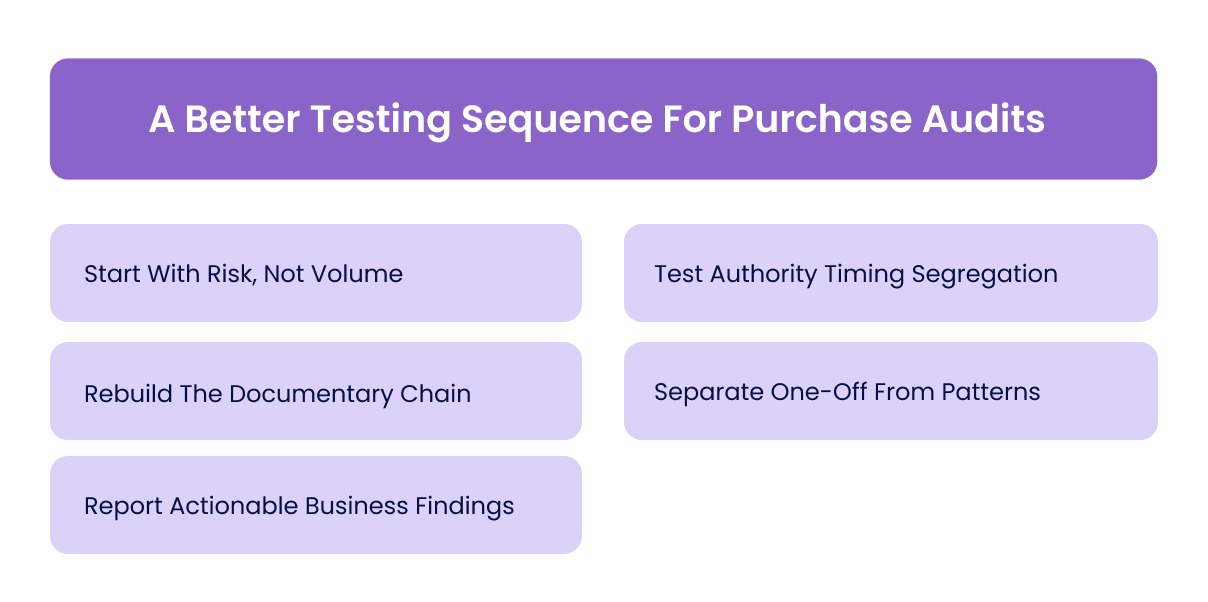
1. Start With Risk, Not Volume
A low-value transaction with a clean workflow tells you very little. A rushed purchase near an approval threshold, a new vendor with limited history, or a transaction processed under “urgent” conditions tells you much more.
The strongest audit samples usually come from:
- Threshold-Edge Purchases
- Emergency Or Exception Spend
- New Or Recently Activated Vendors
- High-Value Transactions
- Categories With Repeated Documentation Gaps
- Purchases Processed Close To Period-End
This is where a procurement audit programme becomes useful. It gives finance teams a repeatable way to test the transactions most likely to reveal structural weaknesses rather than random noise.
2. Test Authority, Timing, And Segregation Together
It is not enough to see an approval in the file. The review should test whether:
- The Approver Had The Right Authority
- The Approval Happened Before Commitment
- The Same Person Did Not Control Conflicting Steps
A transaction can appear compliant on paper and still fail the real control test if authority was applied late or segregation collapsed under operational pressure.
3. Rebuild The Documentary Chain
Each sampled purchase should be reconstructed from start to finish:
- Request
- Approval
- Supplier Basis
- Purchase Order
- Receipt Or Service Confirmation
- Invoice
- Payment
If one of those points is missing, inconsistent, or supported only informally, the issue should not be treated as a filing gap by default. In many cases, it points to a deeper weakness in how the purchase was actually managed.
4. Separate One-Off Errors From Repeat Patterns
A missing delivery note on one transaction matters. The same issue appearing across multiple teams or categories matters much more.
The review should distinguish between:
- Isolated Documentation Errors
- Recurring Process Weaknesses
- Control Design Problems
- Deliberate Workarounds
That distinction is important because the remediation is different. A filing issue needs cleanup. A control pattern needs redesign.
5. Report Findings In A Way The Business Can Act On
A good purchasing audit does not end with “documents missing” or “approval weak”. Findings should show:
- What Failed
- Why It Failed
- Where It Failed In The Purchase Lifecycle
- Who Should Fix It
- What Control Change Is Needed
That is what turns the audit of purchases into a control-improvement tool rather than a backward-looking exception log.
Also read: Understanding the procure-to-pay process
Procurement Audit Checklist
A useful procurement audit checklist should test whether a purchase can stand up to review from request to payment, not just whether a few documents exist in the file.
The most practical checklist questions are:
- Was The Purchase Raised For A Clear Business Need?
- Was The Request Raised By An Authorised Person?
- Was The Correct Approval Threshold Applied?
- Did Approval Happen Before Commercial Commitment?
- Was The Request Split To Avoid Approval Limits?
- Did Segregation Of Duties Hold?
- Was The Vendor Properly Approved And Active?
- Was The Commercial Basis Documented?
- Was A Purchase Order Raised Where Required?
- Did The PO Reflect Approved Terms?
- Was Receipt Of Goods Or Services Confirmed?
- Did The Invoice Match The PO And Receipt?
- Was Payment Released On Valid Support?
- Are The Supporting Documents Complete And Retrievable?
- Can The Transaction Be Traced End To End?
In practice, a procurement audit checklist is most useful when it is applied consistently across sampled transactions, then reviewed for repeat failures rather than isolated misses.
Related: Effective business spending policies
What A Procurement Audit Programme Should Be Designed To Catch
A procurement audit programme should not exist only to confirm that paperwork was completed. It should be designed to catch the failure patterns that actually weaken purchasing control.

The most important ones are:
Threshold Gaming
Transactions are structured around authority limits rather than business need. That includes split purchases, staged commitments, or repeated requests just below escalation bands.
Weak Segregation
The same individual controls too many stages of the purchase lifecycle, whether formally or informally. Even where no misconduct exists, that weakens the credibility of the process.
Vendor Record Weakness
Supplier files are incomplete, duplicated, or activated without enough support. That creates downstream risk in approvals, invoice processing, and payment accuracy.
PO And Invoice Drift
The PO does not reflect the actual commitment, the invoice arrives before formal ordering, or the final commercial terms differ from what was approved.
Unsupported Exceptions
Emergency purchases, manual overrides, and urgent supplier activations happen without enough support to explain why standard controls were bypassed.
Audit-Trail Failure
The documents exist, but they cannot be reconstructed into one reliable chain. That is often the point where a routine purchasing audit becomes a broader internal-control concern.
A strong procurement audit programme is therefore not about running the same test forever. It is about repeatedly targeting the areas where purchasing control is most likely to erode under real operational pressure.
Also read: Improving internal control over financial reporting
Red Flags That Escalate A Purchase Review Quickly
Some audit findings stay contained. Others immediately suggest that the issue is not administrative but structural.
The red flags that usually escalate a purchase review fastest include:
- Purchase Requests Repeatedly Just Below Approval Thresholds
- Approvals Timestamped After The Order Or Commitment
- POs Raised After Goods Or Services Were Already Received
- Multiple Vendor Records For The Same Supplier
- Repeated Missing Delivery Evidence
- Invoices Processed Without Clear Matching Support
- Emergency Purchases With Thin Justification
- Same Categories Generating The Same Exceptions Every Quarter
- Same Person Requesting And Approving In Practice
- Manual Workarounds Used More Often Than Standard Workflow
These patterns matter because they point to system behaviour, not one bad file. Once that happens, the audit of purchases stops being about transaction cleanliness and starts becoming a test of control credibility.
Related: Corporate card reconciliation guide
What Good Purchase Audit Readiness Looks Like
Strong purchase audit readiness does not mean the business never has exceptions. It means the transaction chain still holds together when exceptions happen.
In practice, that usually means:
- Authority Is Clear And Enforced
Approval thresholds are understood, applied consistently, and not worked around through transaction design. - Vendor Files Can Stand Up To Review
Supplier records are complete enough to support onboarding, approvals, and payment readiness. - Purchase Orders Reflect Real Commitments
POs are timely, accurate, and aligned to approved commercial terms. - Matching Works Without Manual Rescue
Receipt, invoice, and payment records connect naturally rather than being patched together later. - Supporting Documents Are Easy To Retrieve
The business can produce the full record set without chasing files across multiple channels. - Exceptions Are Visible And Explainable
Urgent purchases and manual overrides exist, but they are documented and authorised clearly. - The Audit Trail Holds Together End To End
A reviewer can follow the transaction from request to payment without guesswork.
This is the standard mature finance teams should aim for. Not perfection, but defensibility.
Also read: Modern expense management guide
How Alaan Helps Make Purchase Controls Easier To Audit
An audit of purchases becomes harder when approvals sit in email, receipts sit in chats, transactions happen on disconnected payment methods, and reconciliation happens after the fact. The problem is not only workload. It is that the control chain becomes fragmented before audit work even begins.
Alaan helps reduce that fragmentation by bringing spend controls, approval workflows, transaction visibility, documentation capture, and accounting sync into one operating layer. That makes purchase activity easier to trace and easier to review when finance needs a cleaner audit trail.
- Approval Workflows Before Spend Happens
Configurable approval workflows help ensure transactions are reviewed before money moves. That reduces the number of purchases that need to be justified retrospectively and strengthens the authority trail attached to each spend event. - Controlled Corporate Card Spend
Corporate cards with spend controls make it easier to keep business purchases within defined boundaries instead of relying on loosely managed payment methods. That matters when finance wants clearer policy enforcement at transaction level. - Real-Time Visibility Into Business Purchases
Live visibility into company spend makes it easier to identify category spikes, unusual supplier usage, and purchases that appear outside expected workflow patterns. That improves control monitoring well before an audit begins. - Receipt And Invoice Capture
Receipts and invoices can be captured and matched to transactions within the same workflow, reducing fragmented documentation and improving record quality across the purchase lifecycle. - Accounting Integrations For Cleaner Reconciliation
Integrations with systems such as Xero, QuickBooks, Oracle NetSuite, and Microsoft Dynamics help transactions flow into accounting more cleanly, reducing manual handling and making audit follow-through easier. - Clearer Transaction-Level Audit Trail
When approvals, transactions, and supporting documents stay connected, finance teams have a much stronger basis for review. The result is not only better efficiency but a more defensible purchase record when audit testing begins.

Related: Expense management software for business spend tracking
Conclusion
A strong audit of purchases tests far more than whether invoices were paid correctly. It tests whether the business can defend the full transaction chain: the request, the approval, the supplier decision, the commercial commitment, the receipt, the invoice, and the payment basis.
That is why purchase audits are so valuable. They show whether procurement controls are actually holding under day-to-day operating pressure or whether the business is relying on paperwork to cover process weakness after the fact.
The strongest finance teams use purchasing audit work to do more than close findings. They use it to strengthen authority logic, tighten vendor control, improve audit-trail quality, and reduce the number of transactions that need manual rescue later.
And when the business wants those controls to hold more consistently, execution systems matter. Alaan helps finance teams make purchase activity easier to approve, easier to document, and easier to audit across the full spend workflow. Book a demo to see how Alaan helps turn purchase controls into cleaner, more traceable business spend.
FAQs
1. What Is Included In An Audit Of Purchases?
An audit of purchases usually reviews the full purchasing chain, including purchase requests, approvals, vendor records, quotations or selection support, purchase orders, receipt confirmation, invoices, payments, and the overall audit trail.
2. What Is The Difference Between A Purchasing Audit And A Procurement Audit?
A purchasing audit usually focuses more narrowly on transaction flow and control integrity around purchase activity. A procurement audit can be broader and may also review sourcing practices, vendor management, policy design, and procurement performance.
3. What Documents Do Auditors Review In A Purchase Audit?
The core records usually include purchase requests, approvals, vendor files, quotations, POs, contracts, delivery or service confirmations, invoices, payment records, and any exception approvals or supporting correspondence.
4. Why Do Purchase Orders Matter So Much In Audit Testing?
Purchase orders link approval to execution. They help show what was authorised, on which terms, and before which commitment. When POs are missing, late, or inconsistent, the control chain becomes much harder to defend.
5. What Are The Biggest Red Flags In A Procurement Audit?
Common red flags include split purchases around approval limits, approvals added after commitment, duplicate vendors, late POs, weak receipt evidence, unsupported emergency purchases, and fragmented document trails.
6. How Often Should Finance Teams Review Purchasing Controls?
That depends on spend complexity and risk, but most finance teams benefit from regular review rather than waiting for year-end testing. Quarterly reviews, targeted sample audits, and category-specific checks usually surface issues earlier and make remediation easier.
Gain control over business expenses with Alaan corporate cards
Invygo earned AED 100,000 in cashback using Alaan cards
Personalise approval workflows to align with your business needs with Alaan's Spend Management platform
Discover the power of automated expense tracking and smarter spend control with Alaan
Turn data into actionable insights with Alaan's spend management tools
Stay Tax Compliant with UAE's #1 Corporate Card and Spend Management Platform
Customisable corporate card policy template
Know how much Corporate Tax you have to pay this fiscal year
Easily integrate Alaan with your ERP for accurate, real-time expense tracking
Close books faster with Alaan's AI-powered accounting automation
Reconcile your books in minutes instead of hours, every single month.
Keep petty cash organized with Alaan corporate cards and automated expense management