.avif)


If you manage finance in a UAE company, you know budgeting rarely breaks because forecasts are wrong. It breaks when real costs start moving: licence renewals, visa fees, vendor contracts, tax payments, and project spending often shift faster than expected.
The broader environment also demands tighter financial discipline. The UAE’s 2025 federal budget stands at AED 71.5 billion, with 39% allocated to social development and 35.7% to government affairs, signalling continued economic stability alongside stronger policy oversight.
For finance teams, this means planning must account for compliance costs, supplier payments, and operational spending with greater precision.
So the real challenge is not creating a budget; it is building one that actually holds through the year. This article explains how finance teams structure business budgets that remain practical, controlled, and aligned with the realities of operating in the UAE.
Key Takeaways:
- Budgets Must Reflect UAE Costs:
A business budget should include local costs such as trade licence renewals, visa expenses, rent, and regulatory obligations, along with tax provisions like 5% VAT and 9% corporate tax on profits above AED 375,000. - Finance Teams Follow A Structured Process:
Most companies build budgets through a structured nine-step process that links financial objectives with historical data, revenue forecasts, operating costs, and monthly monitoring. - Tax Planning Is Critical In 2026:
UAE VAT rules introduce a five-year limit for claiming VAT credits, with a transition window until 31 December 2026, making tax timing an important part of budgeting. - Regular Monitoring Prevents Cost Drift:
Monthly budget reviews and department-level spending limits help finance teams detect unusual spending patterns before they affect cash flow or profitability. - Technology Strengthens Budget Control:
Platforms like Alaan support budgeting with corporate cards, real-time spend dashboards, automated receipt capture, and supplier payment tools that keep spending within approved limits.
What Is a Business Budget and Why It Matters?
A business budget is a structured financial plan that estimates a company’s expected income, expenses, and cash flow over a defined period, typically 12 months. It acts as a financial roadmap that helps businesses allocate resources, control spending, and track actual performance against projections.
In the UAE, budgeting has become more critical in 2026 as new VAT rules, corporate tax obligations, and digital compliance requirements influence how companies plan costs and protect cash flow. These regulatory changes mean financial planning must be more disciplined and forward-looking.
A well-structured budget helps businesses anticipate financial pressure early and adjust spending before risks escalate.
| Key Factor | Why It Matters |
|---|---|
| Regulatory Changes | UAE VAT rules now impose a five-year limit on claiming VAT credits, with a transitional deadline until 31 December 2026, making tax planning part of budgeting. |
| Corporate Tax Deadlines | Corporate tax returns must be filed within nine months after the tax period, meaning businesses must forecast tax payments into cash-flow planning. |
| Compliance Environment | The UAE federal budget for 2026 stands at AED 92.4 billion, reflecting increased focus on regulation, documentation, and fiscal discipline. |
| Cash-Flow Stability | Financial advisers increasingly emphasise budgeting to protect liquidity and extend operational runway for SMEs. |
| Investor Confidence | Lenders and investors often review business budgets to assess whether a company can manage growth, debt, and regulatory costs. |

Also Read: Simplify travel expense management with corporate cards
Key Components of a Business Budget
A business budget is built from several financial components that together provide a complete picture of the company’s financial position. In the UAE, these components must also reflect local regulatory obligations, tax structures, and operational costs.
When structured correctly, these elements help finance teams forecast profitability, monitor expenses, and maintain compliance while supporting growth.
Below are the core components every UAE business budget should include.
- Revenue projections: Sales forecasts based on products or services, sales channels, and expected market demand across locations such as the mainland and free zones.
- Operating expenses (OPEX): Recurring costs required to run the business, including salaries, office rent, utilities, software subscriptions, insurance, and operational services.
- UAE regulatory and compliance costs: Expenses such as trade licence renewals, visa and work permit fees, PRO services, and other government-related charges.
- VAT and corporate tax obligations: Budgeting for 5% VAT on taxable supplies, input VAT recovery timelines, and corporate tax payments aligned with filing deadlines.
- Capital expenditure (CAPEX): Planned investments in equipment, technology, fit-outs, vehicles, or digital systems required for operations and regulatory compliance.
- Cash-flow forecasts: Month-by-month projections of inflows such as customer payments and VAT refunds, and outflows such as payroll, supplier payments, rent, and taxes.
- Profit and loss projections: A budgeted income statement showing expected revenue, costs, operating profit, and net profit after tax.
- Balance sheet planning: Forecasting receivables, payables, inventory levels, loans, and equity to understand the company’s financial position at key points in the year.
- Contingency and cash reserves: Setting aside 5–10% of operating expenses to manage unexpected costs, regulatory changes, or revenue fluctuations.

Also Read: Why your business needs a detailed expense policy?
Once these elements are defined, finance teams can move to the practical process of building and managing a business budget.
9 Steps on How Finance Teams Create a Business Budget
Finance teams do not treat budgeting as a one-time exercise. They follow a structured process that connects financial goals with operational spending, tax obligations, and cash flow planning. In the UAE, this approach is especially important because budgets must account for VAT reporting, corporate tax provisions, licence renewals, and supplier payments across departments.
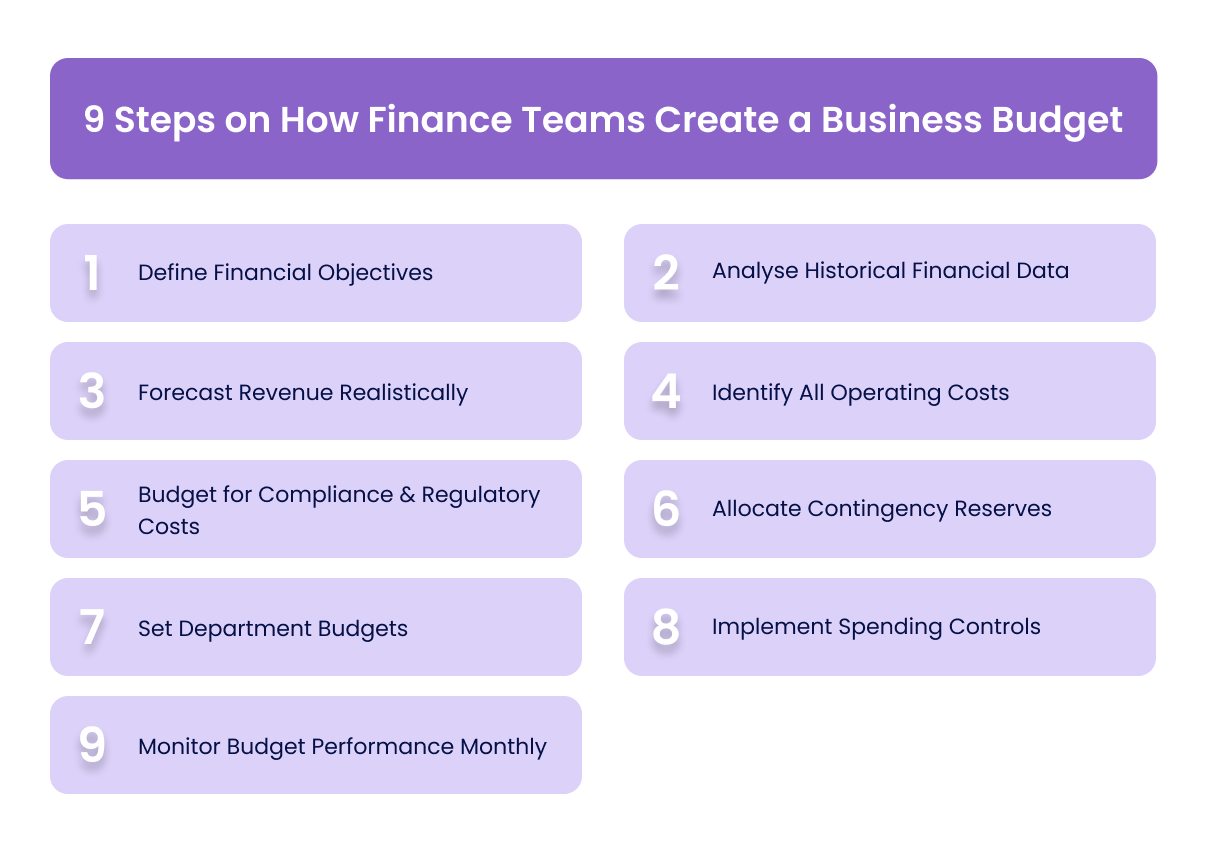
The nine steps below outline how finance teams translate strategy into a working budget that can be monitored and adjusted throughout the year.
Step 1: Define Financial Objectives
Budgeting starts with clear financial objectives aligned with business strategy. In the UAE, this often includes revenue growth, cost discipline, and planning for tax obligations under evolving VAT and corporate tax frameworks.
How To Implement
- Set revenue and profit targets linked to expansion plans or market demand.
- Align objectives with upcoming VAT and corporate tax payment timelines.
- Define cost-reduction or efficiency targets where operational spending is rising.
- Ensure leadership agreement on growth versus cash-preservation priorities.
Also Read: Guide to Modern Expense Management Practices
Step 2: Analyse Historical Financial Data
Finance teams analyse previous financial performance to identify spending patterns, revenue cycles, and cost drivers. In the UAE, this review often includes licence renewals, rent changes, and tax liabilities recorded in accounting or tax platforms.
How To Implement
- Review prior P&L statements, balance sheets, and cash-flow reports.
- Identify trends in rent, payroll, supplier costs, and licence fees.
- Examine VAT credits carefully, considering the five-year VAT refund limitation that takes effect in 2026.
- Benchmark historical spending against projected operational growth.
Step 3: Forecast Revenue Realistically
Revenue forecasts estimate the income a business expects to generate across products, markets, or sales channels. These projections should reflect sector demand, pricing conditions, and expectations for economic growth.
How To Implement
- Forecast revenue by product line, geography, or sales channel.
- Incorporate industry growth assumptions and UAE economic trends.
- Adjust pricing projections for corporate tax and VAT cost impacts.
- Stress-test projections against optimistic and conservative scenarios.
Step 4: Identify All Operating Costs
Operating costs represent the recurring expenses required to run the business. In the UAE, budgeting must include regulatory costs such as trade licences, visas, and compliance requirements.
How To Implement
- List fixed costs such as rent, salaries, insurance, and software subscriptions.
- Include UAE-specific expenses such as trade licences, visas, and PRO services.
- Estimate variable costs, including logistics, marketing, and payment processing fees.
- Account for digital compliance costs such as e-invoicing and reporting systems.
Also Read: A Complete Guide to Corporate Card Policy
Step 5: Budget for Compliance and Regulatory Costs
Compliance costs are a significant part of the UAE's budget. Businesses must plan for VAT obligations and corporate tax payments to avoid unexpected cash-flow pressure.
How To Implement
- Budget for 5% VAT on taxable supplies and input VAT recovery.
- Estimate corporate tax liabilities of 9% on profits exceeding AED 375,000.
- Schedule tax payments around the nine-month corporate tax filing deadline.
- Allocate quarterly tax provisions to avoid liquidity disruptions.

Step 6: Allocate Contingency Reserves
Contingency reserves protect the business from financial shocks such as delayed customer payments, tax adjustments, or unexpected operational costs.
How To Implement
- Allocate 5–10% of operating expenses as contingency funding.
- Maintain cash buffers for delayed VAT refunds or tax adjustments.
- Reserve additional funds for regulatory penalties or compliance upgrades.
- Review contingency levels during quarterly financial reviews.
Step 7: Set Department Budgets
Department budgets allocate financial resources across key functions such as sales, marketing, operations, and administration. This helps maintain accountability and ensures spending aligns with business priorities.
How To Implement
- Allocate funds according to each department’s strategic role.
- Apply zero-based budgeting to justify major expenses annually.
- Align budgets with performance targets such as sales growth or efficiency gains.
- Monitor department spending through monthly reporting.
Step 8: Implement Spending Controls
Spending controls ensure budgets are followed in practice. Finance teams implement approval workflows, procurement policies, and monitoring systems to prevent unauthorised expenses.
How To Implement
- Introduce multi-level approval workflows for vendor payments.
- Require VAT-compliant invoices and documentation before payment approval.
- Integrate ERP or expense management tools to track spend in real time.
- Establish clear procurement policies for vendor purchases.
Step 9: Monitor Budget Performance Monthly
Budgeting is not a one-time exercise. Finance teams must monitor performance regularly to identify cost variances and adjust spending plans when conditions change.
How To Implement
- Compare actual spending versus budget forecasts every month.
- Use dashboards to track revenue, operating costs, and tax provisions.
- Adjust budgets mid-quarter when revenue or cost assumptions change.
- Align financial reviews with VAT filings and EmaraTax reporting cycles.

Also Read: Understanding Corporate T&E Policy and Expense Management
Creating a business budget is only the first step. Maintaining visibility and control over spending is what ensures the budget actually works.
How Alaan Helps Finance Teams Maintain Budget Discipline
Maintaining budget discipline becomes difficult when spending happens across employees, vendors, and international suppliers. Finance teams often struggle with delayed visibility, manual reconciliation, and fragmented payment systems.
Alaan addresses this by combining corporate cards, automated expense management, and supplier payment workflows into one platform. This gives finance teams real-time visibility, stronger spending controls, and automated documentation aligned with UAE tax requirements.
Core Capabilities That Help Enforce Budget Discipline:
- Instant Corporate Card Issuance:
Finance teams can issue unlimited virtual or physical corporate cards to employees with predefined spending limits and merchant restrictions. This prevents off-policy purchases before they occur. - Custom Spend Controls:
Cards can be configured with daily or monthly limits, vendor locks, or department-level budgets so spending aligns with approved financial plans. - Real-Time Expense Visibility:
Every transaction appears immediately in the dashboard, allowing finance teams to track spending across teams, projects, and vendors in one place. - AI-Powered Receipt Matching:
AI automatically extracts data from receipts and matches them with transactions, reducing manual reporting and ensuring accurate records for reconciliation and audits. - Automated Approval Workflows:
Configurable approval rules ensure that large or sensitive expenses require authorisation before payment, improving financial governance and accountability. - Accounting And ERP Integrations:
Direct integrations with systems such as QuickBooks, NetSuite, and Xero allow transactions to sync automatically with accounting records, simplifying month-end reconciliation. - Integrated International Supplier Payments (SuperPay):
With the launch of SuperPay, Alaan now enables businesses to manage cross-border supplier payments on a single platform, combining approvals, invoice processing, and transfers into a single workflow. - Real-Time Alerts And Spend Analytics:
Finance teams receive alerts for unusual or policy-breaking transactions and can analyse spending patterns to detect budget drift early.
Schedule a personalised demo with Alaan to see how your finance team can manage budgets, control spending, and automate expense workflows in one platform.
Conclusion
A clear business budget helps companies plan spending, prepare for tax obligations, and maintain steady cash flow. For UAE businesses, careful budgeting also supports VAT compliance, corporate tax planning, and better control over vendor payments and operating costs.
Alaan supports finance teams with corporate cards, real-time spend visibility, automated receipt tracking, and supplier payment tools on a single platform. This helps teams keep spending within approved budgets while reducing manual work.
Schedule a personalised demo with Alaan to see how your finance team can manage budgets and company spending with greater control.
FAQs
1. What is the difference between a business budget and a financial forecast?
A business budget sets planned limits for revenue and expenses for a specific period. A financial forecast updates those expectations based on actual performance and market changes.
2. How detailed should a business budget be for a growing company?
A business budget should break costs into categories such as payroll, rent, marketing, vendor payments, and taxes. UAE companies should also include licence renewals, visa costs, and VAT obligations.
3. How do finance teams include taxes in a UAE business budget?
Finance teams estimate VAT based on expected sales and purchases, and provision for corporate tax based on projected profits. These liabilities are then scheduled around filing deadlines and payment timelines.
4. Why is cash-flow planning important in a business budget?
Cash-flow planning tracks when money enters and leaves the business. It helps companies ensure they can cover payroll, supplier payments, and taxes even when revenue timing changes.
5. How can companies prevent budget overruns during the year?
Finance teams prevent overruns by setting spending limits, regularly monitoring transactions, and reviewing budget performance monthly. Approval workflows also help keep spending within planned limits.
Gain control over business expenses with Alaan corporate cards
Invygo earned AED 100,000 in cashback using Alaan cards
Personalise approval workflows to align with your business needs with Alaan's Spend Management platform
Discover the power of automated expense tracking and smarter spend control with Alaan
Turn data into actionable insights with Alaan's spend management tools
Stay Tax Compliant with UAE's #1 Corporate Card and Spend Management Platform
Customisable corporate card policy template
Know how much Corporate Tax you have to pay this fiscal year
Easily integrate Alaan with your ERP for accurate, real-time expense tracking
Close books faster with Alaan's AI-powered accounting automation
Reconcile your books in minutes instead of hours, every single month.
Keep petty cash organized with Alaan corporate cards and automated expense management