.avif)


Mileage reimbursement is one of the most common employee expense categories, yet it is also one of the easiest for organisations to mismanage. On average, the amount spent monthly by UAE companies on fuel reimbursements for their staff increased by 38% between January and June 2022. Without a structured approach to tracking business kilometres, setting consistent rates and controlling approvals, finance teams may struggle to distinguish legitimate business travel from routine commuting.
In this blog we will explain how to expense mileage correctly, how to calculate mileage expense, build a clear mileage policy, document employee travel and ensure UAE-specific compliance.
Key Takeaways
- Mileage reimbursement must rely on recorded business kilometres, not estimates, supported by proper logs or digital tracking.
- UAE companies typically use a fixed rate per kilometre; the rate should reflect local fuel costs, vehicle type and internal budgeting needs.
- Clear mileage policies define eligibility, documentation rules, reimbursement cycles and approval workflows to prevent inconsistent claims.
- Mileage reimbursements are deductible when they relate to business travel and are supported by evidence that distinguishes business from personal use.
What Is Mileage Expense and Why It Matters for Businesses
Mileage expense refers to the cost an organisation reimburses employees for using their personal vehicles for business purposes. This often includes client visits, site inspections, bank runs, operational errands and inter-office travel. Mileage reimbursement matters because it forms part of an employee’s out-of-pocket business costs and should be treated consistently across departments.
For finance teams, mileage expense affects:
- the fairness of employee reimbursements
- cost control and budget accuracy
- internal audit readiness
- compliance with UAE tax and accounting standards
- month-end reconciliation timelines
Business vs personal mileage
Only business-related travel qualifies for reimbursement. Travel from home to the office is treated as personal use. Finance teams must enforce this distinction, especially when employees mix multiple stops in the same trip.
How mileage fits into broader expense categories
Mileage sits within travel and operational expenses, but it requires separate treatment because the reimbursement is distance-based rather than receipt-based.
Also read: Types of Expenses in Business Expense Management
How to Calculate Mileage Expense
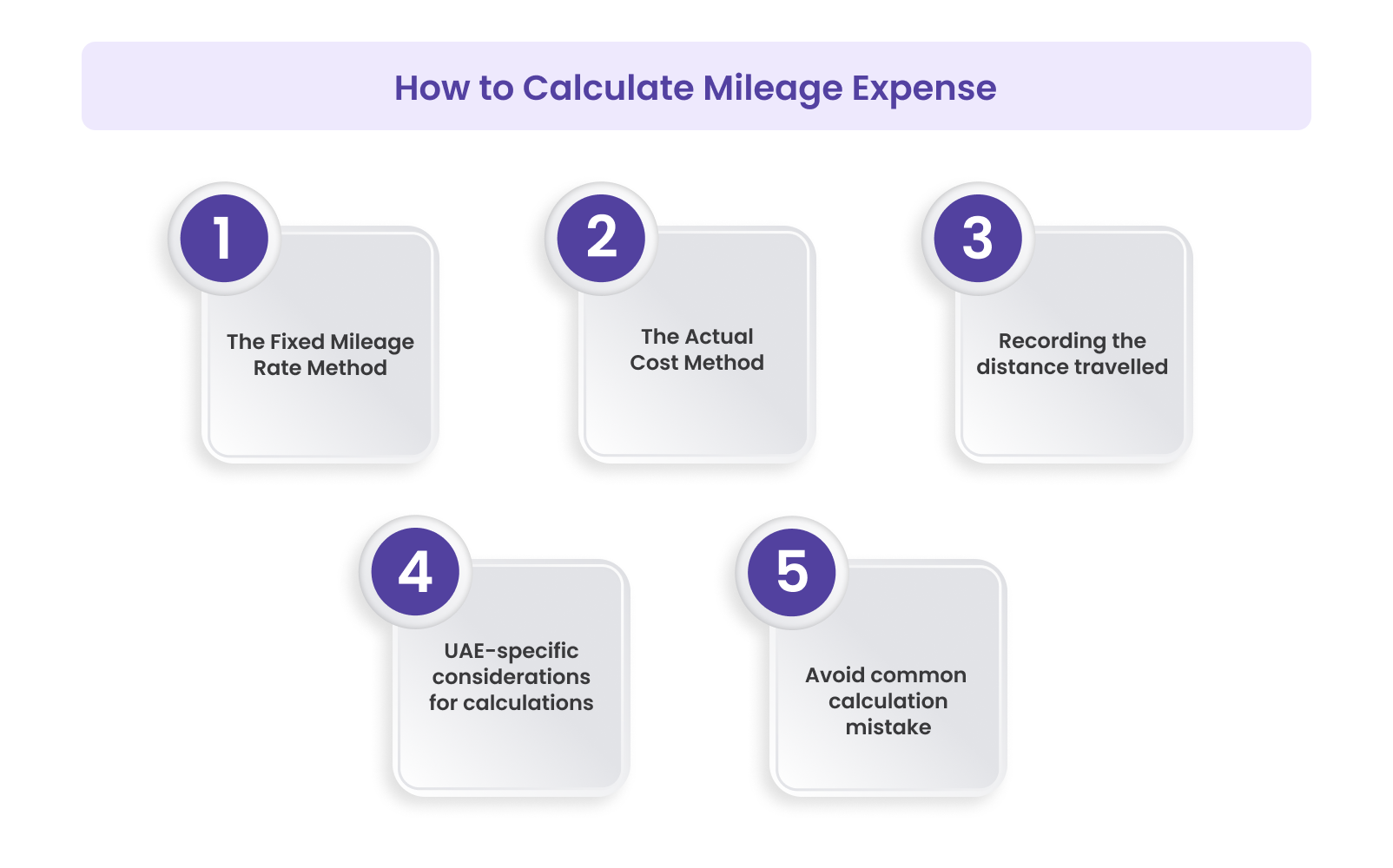
Mileage reimbursement can be calculated in two primary ways. The method you choose should be clearly stated in your internal policy and communicated to all employees to avoid inconsistent claims. Each approach has different implications for budgeting, documentation and fairness.
1. The Fixed Mileage Rate Method
This is the most common method used by UAE organisations. Employees are reimbursed based on a standard per-kilometre rate set by the company. The rate typically covers fuel, wear and tear, maintenance and insurance.
A company-defined rate ensures consistency and simplifies reimbursement.
Basic formula:
Mileage expense = Total business kilometres travelled × Approved rate per km
Example:
If an employee travels 120 km for business and the approved rate is AED 1.80 per km:
120 × 1.80 = AED 216 reimbursable mileage expense
When setting this rate, companies often benchmark:
- average fuel prices in the UAE
- vehicle categories commonly used by employees
- industry norms within their sector
- internal cost control requirements
2. The Actual Cost Method
Some organisations prefer reimbursing fuel and mileage based on actual costs. Employees submit fuel receipts and vehicle logs showing distance travelled specifically for business use.
This method is less common because:
- it requires more documentation
- it demands closer scrutiny of receipts
- it increases processing time
- cost patterns fluctuate month to month
However, companies with uniform vehicle types or predictable travel routes sometimes use this method for control purposes.
3. Recording the distance travelled
Accurate mileage recording is essential regardless of the method used. Employees can document mileage using:
- odometer readings at the start and end of each trip
- digital logs from expense apps
- GPS-based trip tracking tools
- verified mileage sheets approved by line managers
4. UAE-specific considerations for mileage calculations
While there is no government-mandated rate in the UAE for private-vehicle business use, organisations should factor in:
- higher temperatures affecting vehicle efficiency
- variable traffic conditions across emirates
- longer inter-emirate commuting distances
- differences between sedan, SUV and commercial vehicle fuel usage
Companies often set separate rates for different vehicle categories to ensure fairness across employees.
5. Common calculation mistakes to avoid
- using estimated mileage instead of actual trip records
- reimbursing personal errands included in the same trip
- approving claims without supporting evidence
- inconsistent rates across departments
- not updating mileage rates when fuel prices change
Clear calculations help organisations forecast travel costs more accurately and avoid disputes with employees during month-end close.
Also read: Track and Manage Business Expenses
Setting a Mileage Expense Policy for Your Organisation
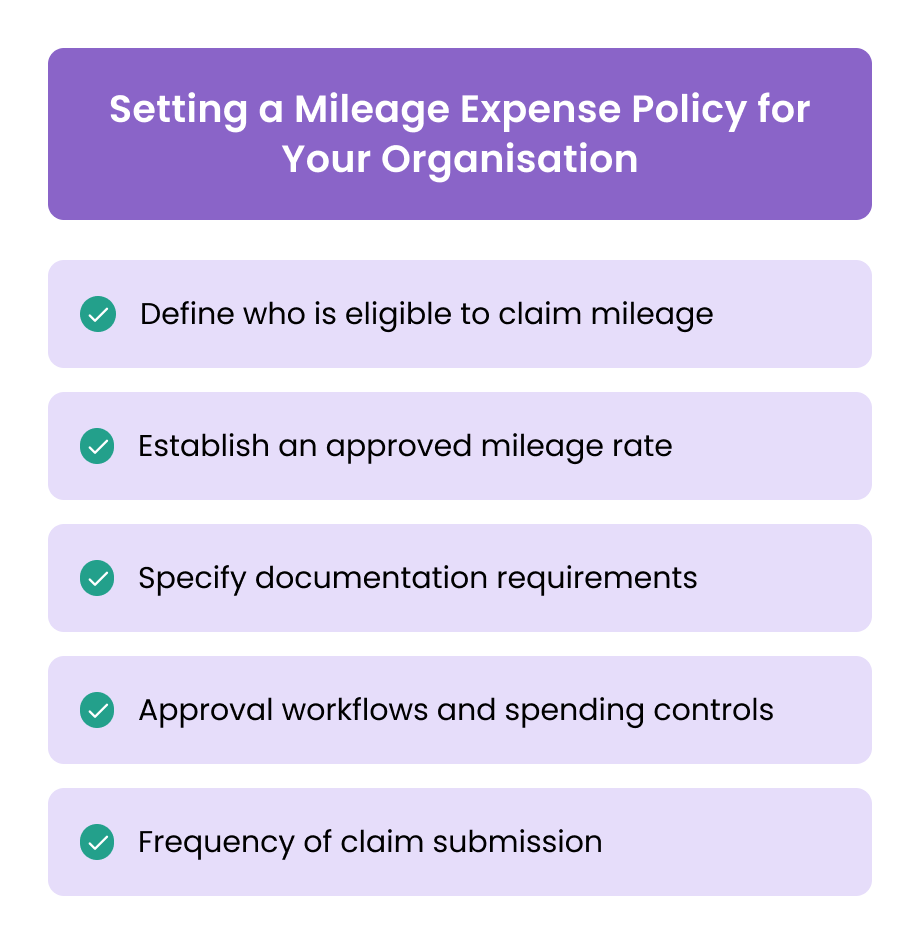
A clear mileage expense policy ensures that travel claims are consistent, auditable and aligned with the organisation’s cost control objectives. Without a structured policy, finance teams often receive incomplete logs, inflated claims or inconsistent reimbursement requests. A policy also removes ambiguity for employees and reduces back-and-forth during approval.
1. Define who is eligible to claim mileage
Your policy should specify:
- which roles or departments frequently travel for business
- whether mileage is allowed only when company vehicles are unavailable
- if certain functions require pre-approved travel before claims are made
Eligibility clarity prevents misuse and ensures fairness across teams.
2. Establish an approved mileage rate
The rate should reflect actual local fuel prices and typical operating costs. Some organisations set different rates for:
- sedans vs SUVs
- petrol vs hybrid vehicles
- infrequent travel vs high-volume field roles
Regular reviews ensure the rate remains aligned with market conditions and internal budgets.
3. Specify documentation requirements
To maintain audit readiness, your policy should outline what employees must submit with mileage claims. This usually includes:
- date of travel
- start and end points
- purpose of trip
- kilometres travelled
- odometer readings or digital log evidence n
- manager approval where required
A properly documented claim protects the organisation during internal and external reviews.
4. Approval workflows and spending controls
Policies should define:
- who approves mileage claims
- when manager sign-off is required
- maximum daily or monthly mileage thresholds
- circumstances where additional approval is needed
Clear approval layers prevent inflated or duplicated claims.
[cta-3]
5. Frequency of claim submission
Organisations often require mileage submissions:
- weekly
- fortnightly
- or monthly before close
Shorter cycles reduce errors, improve accuracy in provisions and avoid year-end accumulation of outdated claims.
For companies creating broader spending rules across all employee expenses, many finance teams refer to effective business spending policies to bring consistency across categories.
Documenting and Complying With Mileage Expenses in the UAE
Mileage reimbursement is straightforward only when documentation is consistent and evidence is complete. For UAE organisations, this becomes even more important because reimbursement accuracy affects internal controls, audit readiness and corporate tax treatment. A structured documentation process also prevents disputes between employees and finance teams.
1. Maintain clear and verifiable trip logs
Trip logs are the foundation of mileage reimbursement. Each log should include:
- date of travel
- starting point and destination
- business purpose of the trip
- total kilometres travelled
- supporting odometer readings or automated tracking data
Digital logs are strongly preferred because they minimise manual entry errors and allow finance teams to verify data more quickly.
[cta-4]
2. Use digital tools for real-time mileage tracking
Digital tracking through expense apps or GPS-based tools improves the accuracy of mileage records. These tools allow employees to:
- log trips automatically
- attach notes directly to each journey
- upload supporting documentation immediately
- maintain consistent proof for audit reviews
For finance teams, digital logs reduce time spent validating claims and simplify reconciliation.
3. VAT considerations for mileage reimbursement
Mileage reimbursements for employees using personal vehicles are generally not part of the UAE input VAT recovery process because the employee is not a VAT-registered supplier. However, when company-owned vehicles are used, VAT rules may apply to fuel and maintenance expenses.
Finance teams should ensure:
- fuel receipts used for VAT claims meet FTA requirements
- business use is clearly separated from personal use
- documentation aligns with vehicle usage policies
Incorrect documentation may lead to disallowed VAT claims or additional scrutiny during reviews.
4. Corporate tax treatment of mileage expenses
Mileage reimbursements that are strictly business-related and properly evidenced are typically deductible for UAE corporate tax purposes. The key requirement is the ability to demonstrate that the reimbursement relates to business activity.
Mileage may become non-deductible if:
- documentation is incomplete
- personal use is included
- claims are inflated or unsupported
- reimbursement policies are inconsistent across departments
Related: Deductible and Non Deductible Expenses Under UAE Corporate Tax
5. Additional documentation is often required during audits
Auditors commonly request:
- employee trip logs
- approved mileage sheets
- maps or digital route screenshots for high-value claims
- internal policies outlining mileage rules
- evidence of rate approvals and any updates
- reconciliations comparing estimated provisions to actual reimbursements
Maintaining a consistent documentation structure ensures that mileage reimbursement remains low-risk during statutory audits, internal reviews or tax assessments.
Common Mistakes Finance Teams Make and How to Avoid Them
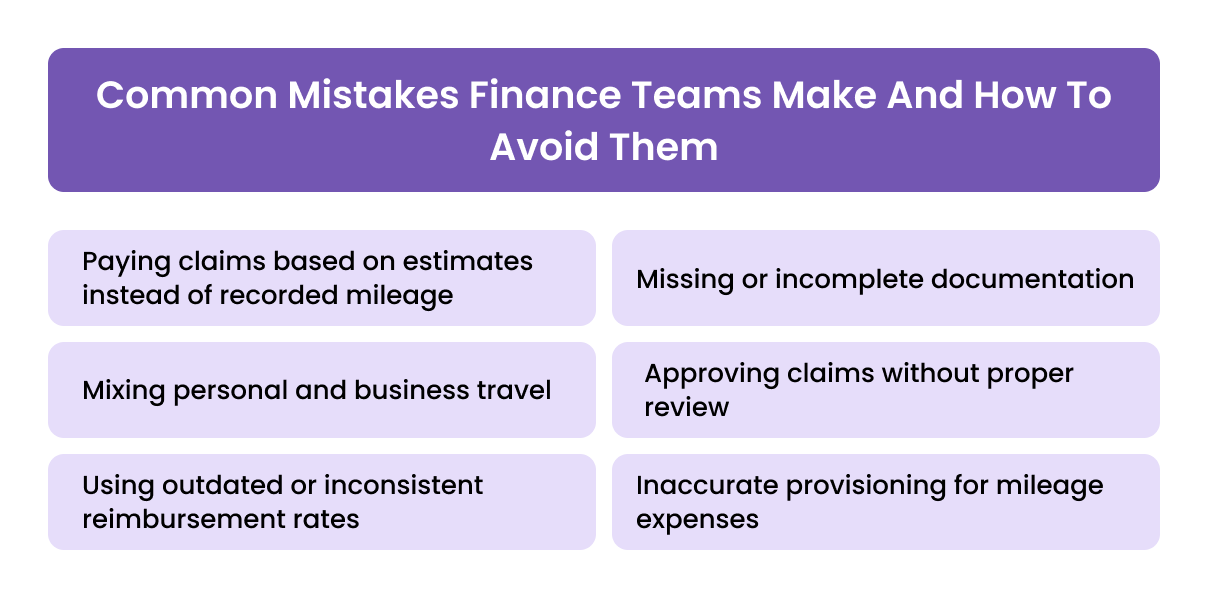
Mileage reimbursement may appear simple, but small errors can accumulate into significant cost leakages over time. Many of the issues arise from inconsistent processes, incomplete documentation or unclear policy rules. Addressing these gaps early helps organisations maintain accuracy and avoid disputes during approvals or audits.
1. Paying claims based on estimates instead of recorded mileage
Employees sometimes estimate kilometres based on routine routes rather than recording actual trips. This leads to reimbursements that do not reflect real business use.
Solution: Require odometer-based logs or digital tracking to ensure claims reflect actual distances travelled.
2. Mixing personal and business travel
When employees combine personal errands with business trips, the mileage submitted may include non-business kilometres.
Solution: Policies should remind employees to submit only the portion of the trip directly attributable to business activity.
3. Using outdated or inconsistent reimbursement rates
If different departments set their own rates or old rates remain in circulation, employees receive inconsistent reimbursements for similar journeys.
Solution: Standardise the organisation’s mileage rate, review it periodically and publish changes formally.
4. Missing or incomplete documentation
Claims submitted without proper logs, odometer readings, or business-purpose notes create verification challenges.
Solution: Finance teams should enforce documentation requirements before approving payments.
5. Approving claims without proper review
Approvers often validate mileage quickly due to time constraints. This can lead to:
- duplicate claims
- inflated distances
- incorrect trip descriptions
- approvals for travel outside business scope
Solution: Introduce a simple checklist for reviewers to confirm the purpose, start and end points and consistency in kilometres.
6. Inaccurate provisioning for mileage expenses
Many organisations rely on employee submissions at the end of the month, which can be incomplete or late. This makes provisions inaccurate and affects monthly financials.
Solution: Require employees to submit mileage claims within a defined reporting cycle.
Related: Understanding Spend Visibility: Business Benefits
How Alaan Helps Streamline Mileage Expense Reimbursement
Mileage reimbursements are manageable only when finance teams have clear records, consistent approval rules and real-time visibility. At Alaan, we help organisations bring structure to mileage-related spending by combining smart corporate cards, automated expense workflows and integrated accounting controls. This reduces manual effort and ensures that mileage expenses remain accurate and compliant.
1. Real-time visibility for mileage-related payments
When employees submit fuel receipts or car-related expenses using Alaan corporate cards, the transaction appears instantly on the platform. Finance teams can review the purpose, supporting documents and cost centre allocation without waiting for month-end.
2. Easy documentation through digital uploads
Employees can upload trip logs, fuel receipts and supporting notes directly through the mobile app or Chrome extension. Alaan Intelligence extracts key information and matches it to the corresponding transaction, reducing validation time for finance teams.
3. Automatic categorisation and policy enforcement
Alaan Intelligence learns from past submissions and applies consistent categorisation to every mileage-related expense. This helps teams maintain uniform coding across departments and ensures that expenses align with internal mileage policies.
4. VAT validation built into the workflow
Where fuel receipts relate to company-owned vehicles or VAT-eligible costs, Alaan checks for compliant invoice fields such as the supplier’s TRN, correct VAT amount and invoice reference. This reduces the risk of rejected VAT claims and strengthens audit readiness.
[cta-6]
5. Smooth month-end processes through accounting integrations
All approved and categorised expenses sync automatically to accounting systems such as Xero, QuickBooks, NetSuite and Microsoft Dynamics. This ensures the timely posting of mileage-related costs and reduces manual reconciliation work.
Also read: Modern Expense Management Systems
Conclusion
Mileage reimbursement is a routine part of business operations, but it requires structure to ensure fairness, accuracy and compliance. When employees record their mileage properly and finance teams apply consistent rates, documentation rules and approval workflows, organisations avoid unnecessary disputes and maintain clearer control over travel-related spending. The right approach also improves audit readiness and strengthens month-end accuracy.
At Alaan we support organisations in applying this discipline through real-time tracking, digital trip logging, policy enforcement and seamless month-end integration. If you are ready to streamline your mileage-expense process and bring tighter cost control to your business travel, book a free demo today and see how our platform can help.
Frequently Asked Questions (FAQs)
1. What counts as business mileage in the UAE?
Business mileage includes travel for work purposes such as client meetings, site visits, office-to-office travel or operational errands. Travel from home to the office is personal and does not qualify for reimbursement unless the organisation has a stated exception.
2. How do companies calculate mileage expenses?
Most organisations calculate mileage using a fixed rate per kilometre multiplied by the distance travelled. Others use actual cost reimbursement through fuel receipts and detailed logs, though this method requires more documentation and verification.
3. What documentation is required for mileage claims?
Employees should submit a trip log with dates, start and end points, business purpose and total kilometres travelled. Odometer readings or digital tracking evidence strengthen the claim and help finance teams validate accuracy.
4. Are mileage reimbursements deductible for UAE corporate tax?
Yes, mileage reimbursements that are exclusively for business activity and properly documented are generally deductible. Claims that include personal travel or lack supporting evidence may not qualify.
5. Should companies set different reimbursement rates for different vehicle types?
Many UAE organisations do so. Sedans, SUVs and hybrid vehicles have different operating costs, and a uniform rate may not fairly reflect actual expenses. The appropriate structure depends on internal budgets and the nature of employee travel.
Gain control over business expenses with Alaan corporate cards
Invygo earned AED 100,000 in cashback using Alaan cards
Personalise approval workflows to align with your business needs with Alaan's Spend Management platform
Discover the power of automated expense tracking and smarter spend control with Alaan
Turn data into actionable insights with Alaan's spend management tools
Stay Tax Compliant with UAE's #1 Corporate Card and Spend Management Platform
Customisable corporate card policy template
Know how much Corporate Tax you have to pay this fiscal year
Easily integrate Alaan with your ERP for accurate, real-time expense tracking
Close books faster with Alaan's AI-powered accounting automation
Reconcile your books in minutes instead of hours, every single month.
Keep petty cash organized with Alaan corporate cards and automated expense management