.avif)


For many UAE businesses, foreign currency exposure is no longer an exception. It shows up in customer receipts, supplier invoices, platform settlements, and regional operating costs. USD revenues sit alongside AED payroll, SAR vendor payments, and EUR software subscriptions. Over time, finance teams accumulate currency balances not because they planned to, but because the business operates across borders by default.
The problem is not access to foreign currencies. It is control.
When conversions happen automatically, FX costs become invisible. When balances build up across currencies, cash positions look healthy on paper but constrained in practice. Finance teams are left explaining why cash exists but cannot be deployed without incurring losses or delays. Month-end reporting becomes harder to interpret, and treasury decisions are made reactively rather than deliberately.
Multiple currency accounts are often introduced as a solution to these issues. But in practice, they only work when finance teams treat them as part of a broader control framework. Used well, they reduce unnecessary conversions and improve payment efficiency. Used casually, they introduce reconciliation friction and obscure true liquidity.
This guide focuses on how experienced finance teams in the UAE use multiple currency accounts intentionally, without losing visibility or discipline.
Key Takeaways
- Multiple currency accounts shift FX from an automatic outcome to a financial decision. The value comes from timing and intent, not simply holding currency.
- Liquidity looks stronger than it is when currencies fragment cash. Usable cash matters more than total balances.
- FX exposure often builds accidentally. Without clear ownership, gains and losses surface late and disrupt reporting.
- Reconciliation is the real constraint at scale. Most failures occur not at setup, but when volume increases.
- Discipline determines outcomes. Systems and access help, but governance is what preserves control.
What Multiple Currency Accounts Actually Change For Finance Teams
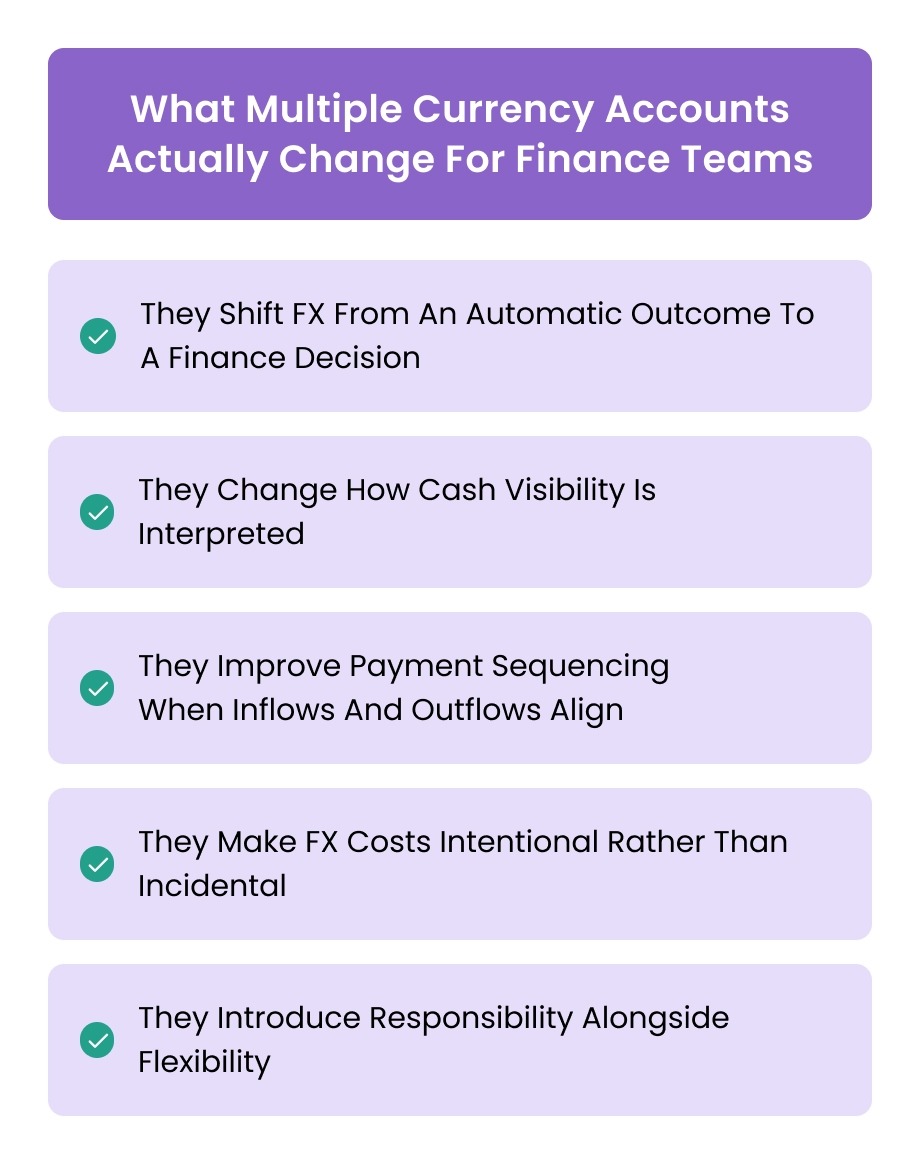
A multiple currency account does not change where money comes from or where it goes. It changes when financial decisions are made and who controls them. That shift has direct implications for visibility, liquidity management, and foreign exchange discipline.
They Shift FX From An Automatic Outcome To A Finance Decision
In a single-currency setup, foreign receipts are converted immediately. The timing, rate, and spread are dictated by the bank. Finance teams see the result after the fact, usually embedded inside a net balance or monthly FX variance.
With multiple currency accounts, conversion is no longer automatic. Funds remain in their original currency until finance decides otherwise. FX stops being a background cost and becomes a controllable variable. This is a structural change, not a feature enhancement.
They Change How Cash Visibility Is Interpreted
Once balances are held across currencies, total cash figures lose relevance on their own. A business may appear liquid overall while still being constrained in the currency needed to meet near-term obligations.
Finance teams are forced to move away from aggregate cash views and think in terms of currency-specific liquidity. This is where better decisions begin, but it is also where poor discipline quickly becomes visible.

They Improve Payment Sequencing When Inflows And Outflows Align
When receivables and payables share the same currency, multiple currency accounts reduce friction. Suppliers can be paid directly from matching balances, avoiding double conversions and unnecessary spread costs.
This is particularly valuable for exporters, logistics companies, marketplaces, and regional operators with predictable currency flows. The benefit is not theoretical; it shows up directly in reduced FX leakage.
They Make FX Costs Intentional Rather Than Incidental
In traditional setups, FX costs accumulate quietly through frequent small conversions. With multiple currency accounts, finance teams can batch conversions, align them with cash requirements, or wait for more favourable rates.
The savings come not from rate speculation, but from fewer conversion events and better timing. This requires clear ownership and predefined thresholds, not ad hoc decisions.
They Introduce Responsibility Alongside Flexibility
Holding currency also means holding exposure. Without clear governance, balances can drift, FX gains or losses can surface late, and month-end explanations become harder.
Multiple currency accounts reward discipline. Teams that treat them casually often end up with more complexity than control. The structure only works when FX timing, liquidity thresholds, and reconciliation ownership are clearly defined.
Also Read: Understanding Spend Visibility And Business Benefits
How Multiple Currency Accounts Work In Day-To-Day Operations
The operational impact of multiple currency accounts is felt most clearly in routine finance workflows. Understanding these mechanics helps teams avoid surprises as transaction volume increases.
Currency Balances And Liquidity Fragmentation
Each currency sits as a separate balance. A USD receipt increases the USD pool, not the AED one. While this preserves value by avoiding forced conversion, it also fragments liquidity. Finance teams must track not just total cash, but usable cash by currency.
This fragmentation becomes visible during payment runs. A business may appear liquid overall but still need to convert currency to meet local obligations. Teams that fail to monitor this proactively often end up converting at unfavourable rates simply to meet timing constraints.
Receipts, Payables, And Settlement Timing
Incoming payments are credited in the original currency. Outgoing payments can be made directly from the matching balance, provided one exists. This is efficient when receivables and payables align, but it requires coordination between sales, procurement, and finance.
Problems arise when currency alignment is accidental rather than planned. For example, receiving USD revenue while paying regional suppliers in AED forces a conversion decision that may not have been anticipated. Over time, these mismatches accumulate and complicate cash planning.
FX Timing And Cost Control
Foreign exchange costs only apply when conversion occurs. This gives finance teams flexibility, but also exposes them to rate movements while funds are held. The longer a balance sits unconverted, the more sensitive it becomes to volatility.
Experienced teams define clear thresholds. Small operational balances may be converted immediately to reduce exposure. Larger balances may be held deliberately to offset upcoming payments or to optimise conversion timing. What matters is that the decision is explicit, not incidental.
Integration With Accounting And Controls
The real test of a multiple currency setup is reconciliation. Each transaction must map cleanly to invoices, ledger entries, and reporting currency rules. Without tight integration between banking, accounting, and approval workflows, finance teams end up explaining discrepancies rather than managing performance.
This is why multiple currency accounts scale well only when supported by strong systems and consistent processes.
Also Read: Top ERP Integration Challenges (and How to Solve Them) in 2025
Why UAE And GCC Businesses Use Multiple Currency Accounts
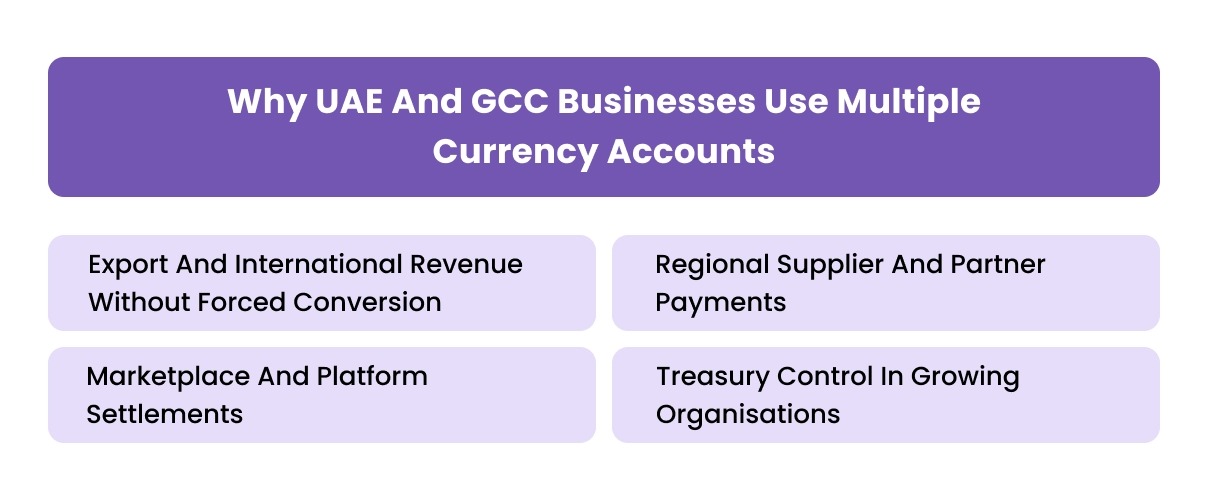
Multiple currency accounts are rarely adopted for theoretical reasons. In the UAE and wider GCC, they emerge as a practical response to how money actually moves across borders. Finance teams turn to them when existing setups start creating friction, cost leakage, or control gaps.
Export And International Revenue Without Forced Conversion
Businesses selling outside the UAE often receive revenue in USD, EUR, or GBP. Converting these receipts immediately into AED introduces two problems. First, FX spreads are incurred regardless of whether the funds are needed locally. Second, timing is dictated by the bank, not by business needs.
Holding foreign currency receipts allows finance teams to decide when conversion makes sense. This is particularly relevant for businesses with predictable overseas supplier payments or international operating costs that can be settled directly from the same currency pool.
Regional Supplier And Partner Payments
Many UAE businesses operate across the GCC, paying suppliers in SAR, OMR, or other regional currencies. Without multiple currency accounts, each payment triggers a conversion, even when the business regularly receives revenue in that same currency.
Over time, this creates unnecessary FX churn. Multiple currency accounts reduce this friction by allowing finance teams to pay regional partners directly from matching balances, improving both cost efficiency and payment turnaround times.
Marketplace And Platform Settlements
Marketplaces, aggregators, and digital platforms often receive settlements in foreign currencies based on customer location. These funds may not be required immediately for local expenses. Holding them in currency avoids premature conversion and allows finance teams to align cash deployment with operational needs.
This use case is increasingly common among e-commerce, travel, and SaaS businesses operating from the UAE with global customer bases.
Treasury Control In Growing Organisations
As transaction volumes increase, FX costs stop being marginal. What appears immaterial at low volumes becomes visible at scale. Multiple currency accounts give finance teams the tools to impose structure on FX decisions rather than absorbing them passively.
For growing organisations, this shift marks the point where treasury considerations move from informal oversight to formal governance.
Also Read: Cash Flow Optimisation Strategies for UAE Businesses in 2025
Where Multiple Currency Accounts Start To Break Down
The benefits of multiple currency accounts are real, but they are not automatic. Most problems surface not at setup, but as usage scales. The same structure that creates flexibility can also introduce blind spots if discipline is missing.
Liquidity Appears Stronger Than It Is
When balances are spread across currencies, headline cash numbers become misleading. A business may appear well funded while still lacking liquidity in the currency required to meet near-term obligations.
This often results in last-minute conversions at unfavourable rates, undermining the cost advantages that prompted the multi-currency setup in the first place.
Reconciliation Effort Increases Quietly
Each currency introduces its own reconciliation trail. AR, AP, bank balances, and FX adjustments must all align. Without daily visibility and consistent mapping, discrepancies surface late, often during the month-end close.
At scale, this creates pressure on finance teams and increases reliance on manual workarounds, which erode confidence in reported numbers.
FX Exposure Becomes Accidental
Holding currency is a position, whether intended or not. When ownership of FX timing is unclear, balances drift, and exposure accumulates. Gains or losses then appear unexpectedly in financial reports, prompting reactive explanations rather than planned outcomes.
This is especially risky in volatile currency environments or during periods of tight cash planning.
Operational Decisions Bypass Finance Oversight
When teams across the business initiate payments or receive funds in different currencies without clear guidelines, finance loses visibility. Payment convenience takes precedence over currency discipline, and exceptions become the norm.
Over time, this weakens governance and makes it harder to enforce consistent policies.
Systems Fail To Keep Pace With Volume
Spreadsheets and manual tracking may work initially, but they do not scale. As transaction counts rise, the absence of integrated systems leads to delays, errors, and incomplete reporting.
This is usually the point at which finance teams realise that access to multiple currencies is not the same as control over them.
Also Read: Importance and Steps in Account Reconciliation
Accounting and Reporting Implications Finance Teams Cannot Ignore
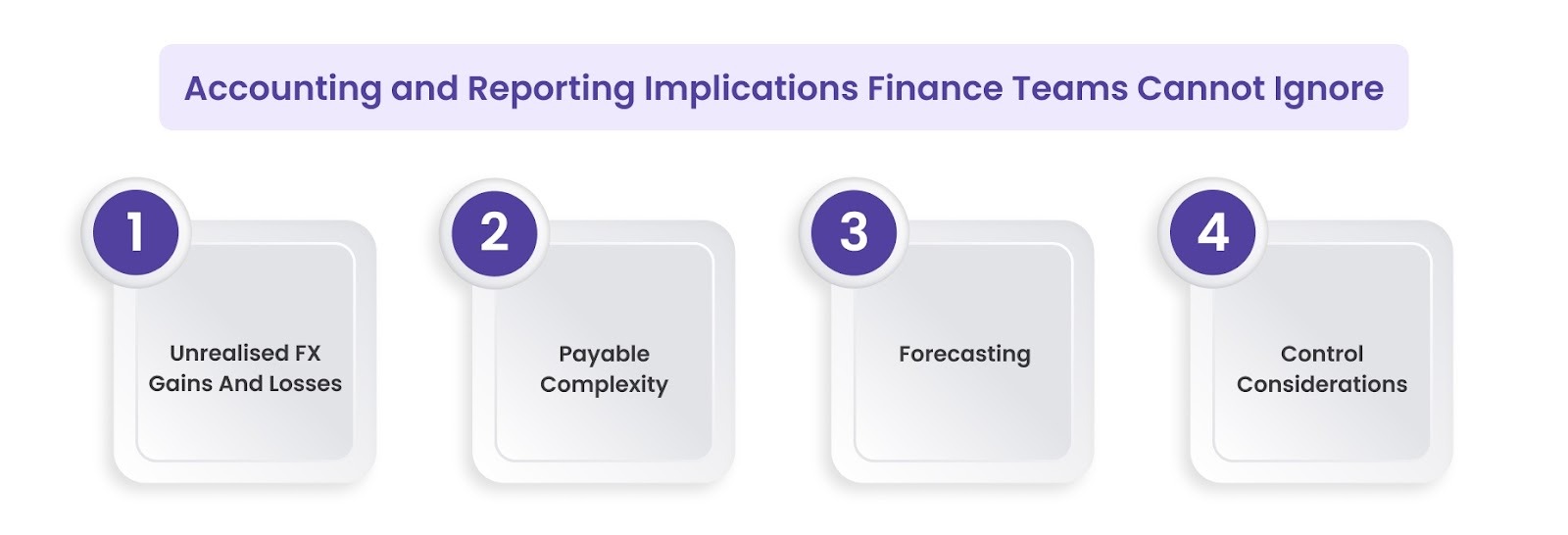
Multiple currency accounts change the shape of accounting work, not just its volume. The complexity does not come from foreign exchange itself, but from how currency movements interact with receivables, payables, and reporting timelines.
Realised And Unrealised FX Gains And Losses
The moment a business holds foreign currency, FX gains and losses become unavoidable. Unrealised gains and losses arise from revaluing currency balances at reporting dates. Realised gains and losses occur when conversion actually happens.
Problems emerge when these two are not clearly distinguished or reviewed regularly. Unrealised movements can distort management reporting if they are not isolated properly. Realised FX impacts, if not tracked transaction by transaction, often surface as unexplained variances at month end.
Well-run finance teams define clear rules for:
- When balances are revalued,
- How FX differences are posted,
- Which accounts absorb volatility.
Without this structure, FX becomes noise rather than insight.
Multi-Currency Accounts Receivable And Payable Complexity
Receivables and payables denominated in foreign currencies must be tracked consistently from invoice to settlement. This includes:
- Issuing invoices in transaction currency,
- Tracking outstanding balances at both transaction and reporting currency levels,
- Recognising FX differences on settlement.
Breakdowns usually occur when invoices, payments, and bank balances are not aligned by currency. Teams end up reconciling totals that technically balance but do not explain movement. This slows close cycles and increases audit effort.
Impact On Management Reporting And Forecasting
Cash flow forecasts become less reliable when currency balances are not monitored actively. A forecast that assumes conversion at a single rate or date rarely reflects reality.
Experienced teams forecast by currency first, then consolidate. This provides a clearer picture of funding gaps, conversion needs, and FX exposure. It also makes discussions with leadership more grounded, particularly when volatility affects short-term liquidity.
Audit And Control Considerations
Auditors look closely at FX treatment when multiple currency accounts are in play. Inconsistent revaluation methods, unclear conversion logic, or weak documentation raise questions quickly.
Strong audit outcomes depend on:
- documented FX policies,
- consistent application across periods,
- and traceable links between bank balances, ledgers, and financial statements.
Multiple currency accounts do not increase audit risk by default, but poor discipline around them does.
Also Read: Understanding the Role of Ledgers in Accounting
Best Practices For Managing Multiple Currency Accounts At Scale
Once transaction volume increases, informal practices stop working. The finance teams that extract real value from multiple currency accounts are those that impose structure early and enforce it consistently.
Define A Clear Base And Reporting Currency
Every organisation needs a reference point. Defining a base currency for reporting and performance evaluation avoids confusion and keeps discussions consistent, even when operational currencies vary.
This does not restrict operational flexibility. It simply ensures that results are interpreted through a single lens.
Assign Ownership Of FX Decisions
FX timing should not be accidental. Whether ownership sits with treasury, finance leadership, or a dedicated role, someone must be accountable for conversion decisions and exposure thresholds.
Clear ownership prevents reactive conversions driven by urgency rather than intent.
Align Receivables And Payables By Currency Where Possible
Where inflows and outflows naturally align, finance teams should preserve that alignment. Paying suppliers from matching currency balances reduces conversions and simplifies reconciliation.
This requires coordination with procurement and sales teams, not just accounting adjustments after the fact.
Reconcile Frequently, Not Just At Month End
Daily or near-daily reconciliation of currency balances prevents issues from compounding. Small discrepancies are easier to resolve early than after weeks of activity.
Teams that wait until month end often spend more time explaining numbers than analysing them.
Automate Once Volume Justifies It
Manual tracking works only up to a point. As transaction counts rise, automation becomes less about efficiency and more about control. Integrated systems reduce dependency on spreadsheets and improve confidence in reported figures.
Automation should support existing discipline, not compensate for its absence.
Also Read: Effective ERP Implementation for Business Improvement
Multiple Currency Accounts In A UAE Regulatory And Tax Context
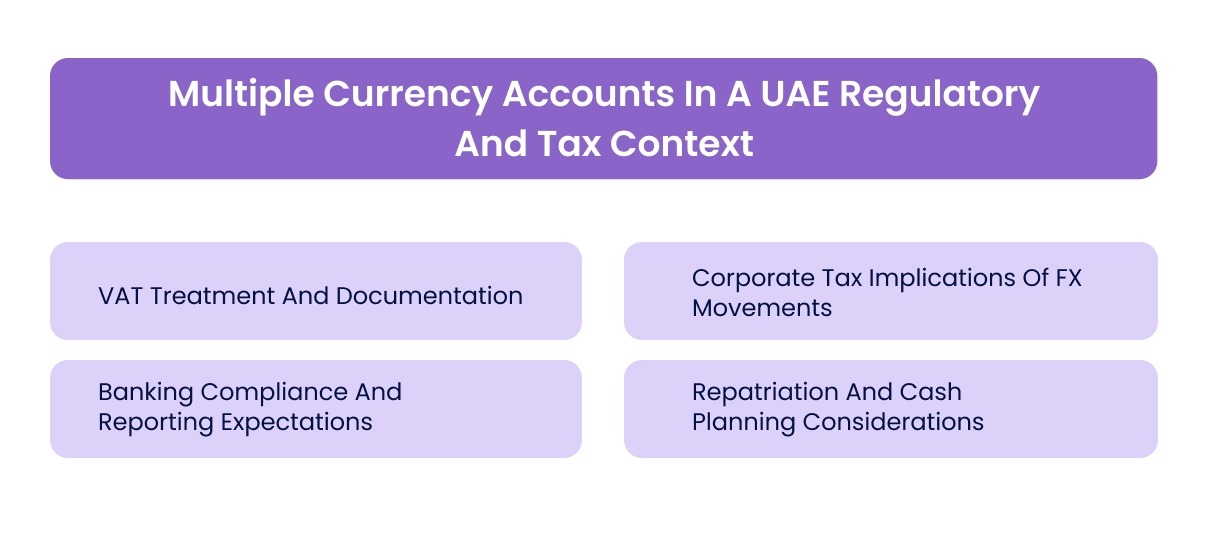
Multiple currency accounts operate within a regulatory and tax framework that finance teams cannot treat as peripheral. In the UAE, the rules may be lighter than in some jurisdictions, but they still shape how currency balances are reported, taxed, and scrutinised.
VAT Treatment And Documentation
Foreign currency transactions do not change VAT obligations on their own, but they complicate documentation. Invoices must clearly state transaction currency, VAT amounts, and the exchange rate used where applicable. Errors here tend to surface during audits rather than day-to-day operations.
For businesses with cross-border activity, inconsistent FX treatment across invoices and receipts creates reconciliation issues that extend beyond VAT into revenue recognition and reporting accuracy.
Corporate Tax Implications Of FX Movements
With corporate tax now in effect in the UAE, FX gains and losses carry greater significance. Realised gains and losses directly affect taxable income. Unrealised movements may also influence reporting depending on accounting treatment.
Finance teams must ensure that FX impacts are:
- classified correctly,
- applied consistently across periods,
- and supported by clear documentation.
Without this, currency volatility can introduce unexpected tax exposure.
Banking Compliance And Reporting Expectations
While the UAE allows foreign currency accounts freely, banks still expect transparency. Large or frequent cross-border movements may trigger additional scrutiny, particularly where the transaction purpose is unclear.
Clear internal records linking currency movements to operational activity reduce friction with banking partners and support smoother compliance reviews.
Repatriation And Cash Planning Considerations
Holding foreign currency does not eliminate the need to repatriate funds. It simply changes the timing. Finance teams must factor in local funding needs, regulatory timelines, and potential FX exposure when planning conversions back to AED.
Treating repatriation as a planned event rather than a reactive one preserves flexibility and avoids last-minute losses.
Also Read: Understanding VAT Late Payment Penalties in UAE
How Alaan Supports Finance Teams Managing Multi-Currency Operations
At Alaan, we see multiple currency accounts as only one part of the equation. Holding funds in different currencies solves conversion friction, but it does not automatically create control once those funds are spent. That control depends on how payments are made, approved, captured, and reconciled.
Our platform is designed to support finance teams at that operational layer, where currency complexity often turns into visibility gaps.
Where Alaan Adds Control In Multi-Currency Environments
- Corporate Cards With Real-Time Spend Visibility
Teams spend directly from company funds rather than personal cards. Transactions appear instantly, regardless of currency, eliminating delayed visibility caused by reimbursements. - Point-Of-Spend Expense Capture
Receipts are uploaded at the time of the transaction. Currency, amount, vendor, and purpose are captured immediately, reducing reconciliation effort later. - Consistent Approval And Policy Enforcement Across Currencies
Spend limits, category controls, and approval workflows apply regardless of transaction currency. This prevents foreign currency spend from bypassing governance. - Reduced Dependency On FX-Heavy Reimbursements
By shifting spend to corporate cards, finance teams avoid reimbursing employees in AED for foreign currency expenses, which often introduces FX noise and reporting distortion. - Clean Accounting Sync With Currency Context Preserved
Expenses sync into accounting systems with currency details intact, supporting accurate posting, FX treatment, and audit trails. - Centralised View Of Cross-Currency Operational Spend
Finance teams see how currency balances are actually used, not just where funds are held. This bridges the gap between treasury decisions and day-to-day operations.
The result is not more complexity, but fewer blind spots as currency flexibility increases.

Also Read: Top Enterprise Spend Management Software Solutions for 2025
Conclusion
Multiple currency accounts are neither a shortcut nor a risk by default. They are a control choice. Used deliberately, they reduce unnecessary FX conversions, improve payment efficiency, and give finance teams more influence over timing and cost. Used casually, they fragment liquidity, complicate reconciliation, and introduce exposure that surfaces late.
For UAE finance teams operating across borders, success with multiple currency accounts depends less on access and more on governance. Clear ownership of FX decisions, disciplined reconciliation, and alignment between operational spend and treasury strategy are what separate control from confusion.
As businesses scale, currency complexity is unavoidable. What remains optional is whether that complexity becomes a source of leakage or a source of advantage.
This is where tools like Alaan play a practical role. While multiple currency accounts address where funds are held, Alaan helps finance teams control how those funds are spent. By providing real-time visibility, policy enforcement, and clean accounting across currencies, Alaan ensures that operational spend does not undermine treasury decisions.
If your business is already managing multiple currencies, the next step is not more accounts, but tighter control at the point of spend. Alaan helps finance teams maintain that control as cross-border operations grow. Book a Free Demo now!
Frequently Asked Questions (FAQs)
1. Why Do UAE Businesses Use Multiple Currency Accounts?
UAE businesses use multiple currency accounts to manage international revenues, pay overseas suppliers, reduce FX conversion costs, and improve cash flow timing. They are especially common among exporters, logistics firms, marketplaces, and regional service providers.
2. Do Multiple Currency Accounts Reduce FX Costs Automatically?
No. They reduce FX costs only when finance teams actively manage conversion timing and avoid unnecessary conversions. Without discipline, FX exposure can increase instead of decrease.
3. What Are The Biggest Risks Of Using Multiple Currency Accounts?
The main risks include fragmented liquidity, reconciliation complexity, unplanned FX exposure, and delayed visibility into true cash positions. These issues typically surface as transaction volume grows.
4. How Do Multiple Currency Accounts Affect Accounting And Reporting?
They introduce realised and unrealised FX gains or losses, require currency-specific AR/AP tracking, and affect cash flow forecasting. Strong ledger mapping and regular revaluation are essential to maintain reporting accuracy.
5. Are Multiple Currency Accounts Allowed In The UAE?
Yes. UAE banks and financial institutions allow businesses to open and operate foreign currency accounts freely. However, transactions must still comply with VAT, corporate tax, and banking documentation requirements.
6. How Can Finance Teams Maintain Control Across Currencies?
Control comes from clear ownership of FX decisions, frequent reconciliation, aligned AR/AP currency flows, and tools that provide real-time visibility into spend and approvals. Multiple currency accounts provide flexibility, but systems and governance provide control.
Gain control over business expenses with Alaan corporate cards
Invygo earned AED 100,000 in cashback using Alaan cards
Personalise approval workflows to align with your business needs with Alaan's Spend Management platform
Discover the power of automated expense tracking and smarter spend control with Alaan
Turn data into actionable insights with Alaan's spend management tools
Stay Tax Compliant with UAE's #1 Corporate Card and Spend Management Platform
Customisable corporate card policy template
Know how much Corporate Tax you have to pay this fiscal year
Easily integrate Alaan with your ERP for accurate, real-time expense tracking
Close books faster with Alaan's AI-powered accounting automation
Reconcile your books in minutes instead of hours, every single month.
Keep petty cash organized with Alaan corporate cards and automated expense management