.avif)

In most companies, financial risk rarely comes from large investments. It comes from everyday supplier payments, when invoices are approved without proper checks, leading to duplicate payments, incorrect billing, or missed discrepancies.
This becomes even more relevant in the UAE, where 82% of businesses are micro-businesses with annual turnover of less than AED 3 million. For these companies, even small errors in accounts payable can directly impact cash flow and margins.
This is why finance teams rely on 3 way matching in accounting. It is a control mechanism that verifies every invoice against the purchase order, goods receipt, and supplier invoice before payment is approved.
In a regulatory environment where VAT documentation and audit readiness matter, this process helps maintain accuracy across financial records. This guide explains how 3 way matching works, how finance teams apply it, and how it supports better control over supplier payments.
Key Takeaways:
- 3 way matching verifies invoices before payment: It compares the purchase order, goods receipt note, and supplier invoice to ensure accuracy in quantity, price, and terms.
- Prevents costly payment errors: This control helps avoid duplicate payments, incorrect billing, and unauthorised purchases, which directly impact cash flow.
- Relies on three connected documents: The PO defines terms, the GRN confirms delivery, and the invoice requests payment; each must align for approval.
- Mismatches are common and must be resolved: Differences in price, quantity, or missing POs are flagged, and invoices are held until corrected.
- Automation improves accuracy and speed: Tools like Alaan centralise invoices, approvals, and payments, helping finance teams apply controls consistently and reduce manual work.
What Is 3 Way Matching in Accounting?
3 way matching in accounting is an accounts payable control process used to verify supplier invoices before payment is approved. It involves cross-checking three key documents to ensure that what was ordered, received, and billed all match in terms of quantity, price, and terms.
The finance team compares:
- Purchase Order (PO): Confirms the agreed order details, including items, quantity, and price
- Goods Receipt Note (GRN): Confirms that the goods or services were actually received
- Supplier Invoice: The bill submitted by the vendor requesting payment
If the details across all three documents align, the invoice is approved. If not, it is flagged for review and held until discrepancies are resolved.
Also Read: How to Track Your Business Spending using Simple Steps
Understanding how each of these documents works together is key to applying 3 way matching effectively.
The Three Documents Used in 3 Way Matching
Each document in the 3 way matching process serves a distinct role in verifying that a supplier transaction is accurate before payment is released. Together, they create a control system that ensures what was ordered, received, and billed aligns across the procurement and finance workflow.
With these roles defined, the next step is to understand how these documents come together in the actual 3 way matching process.
How the 3 Way Matching Process Works?
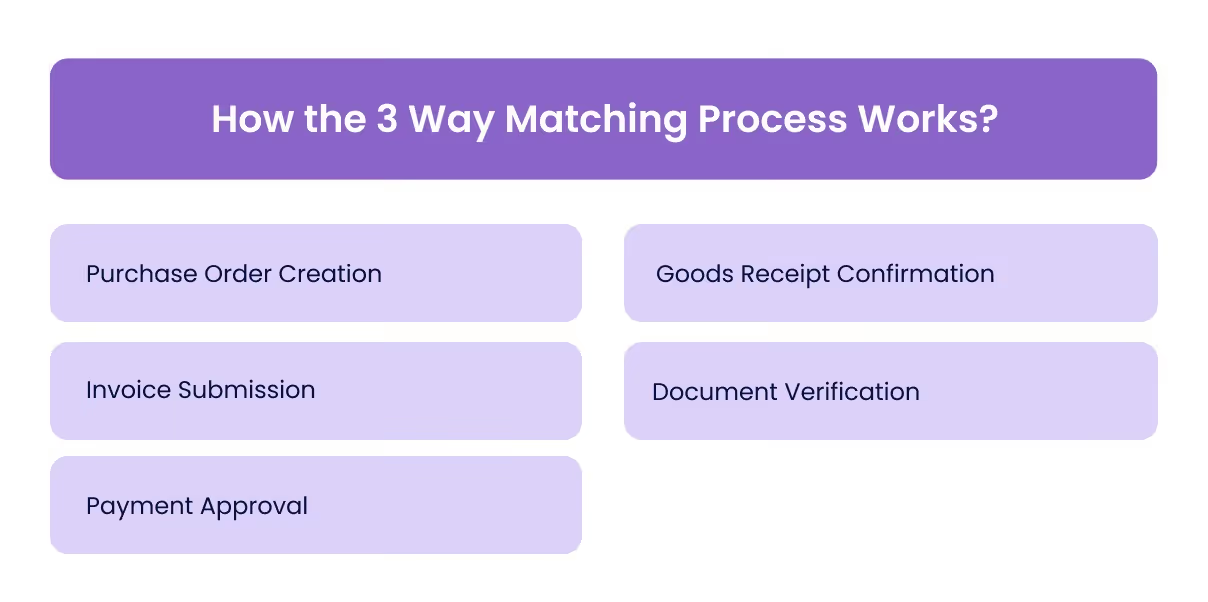
The 3 way matching process follows a structured sequence within the accounts payable workflow to ensure that only valid and accurate invoices are approved for payment. It connects procurement, operations, and finance by verifying that the purchase order, receipt, and invoice all align before funds are released.
Step 1: Purchase Order Creation
The process begins when the procurement team raises a purchase order (PO) with agreed details such as item description, quantity, and pricing. This document sets the baseline for all future verification.
Step 2: Goods Receipt Confirmation
Once goods or services are delivered, the receiving team records them in a goods receipt note (GRN), confirming what was actually received, including quantity and condition.
Step 3: Invoice Submission
The supplier issues an invoice referencing the purchase order and detailing the amount payable for the delivered goods or services.
Step 4: Document Verification
The accounts payable team compares the invoice against the PO and GRN, checking quantities, prices, and terms. Any mismatch is flagged and held for review before payment.
Step 5: Payment Approval
If all three documents match, the invoice is approved and scheduled for payment. If discrepancies exist, the invoice remains on hold until resolved.
To see how this works in practice, it helps to look at a simple example of 3 way matching.
Example of 3 Way Matching
A practical example helps illustrate how 3 way matching works in real transactions and how discrepancies are identified before payment.
In this scenario, all three documents align. The purchase order confirms what was agreed, the goods receipt note confirms the exact quantity delivered, and the supplier invoice reflects the same quantity and price. Since there are no mismatches, the invoice is approved, and payment can be processed.
If any of these values differed, for example, fewer items received or a higher invoice amount, the invoice would be flagged and placed on hold until corrected.
This step is critical because 3 way matching ensures businesses only pay for goods that were both ordered and actually received, preventing overpayments and billing errors.
Also Read: Invoice Number: What It Is and How to Assign It Correctly
While this example shows a clean match, in practice, finance teams often encounter discrepancies during the verification process.
Common Mismatches in 3 Way Matching
In practice, 3 way matching rarely results in a perfect match on the first attempt. Finance teams often encounter discrepancies when comparing purchase orders, receipts, and invoices, which must be reviewed before any payment is approved.
Common mismatches include:
- Price differences: The invoice may reflect a higher or different unit price than what was agreed in the purchase order.
- Quantity mismatches: The number of items billed does not match the quantity received or ordered.
- Missing purchase orders: Invoices are submitted without a valid PO, making it difficult to verify whether the purchase was authorised.
- Duplicate invoices: Vendors may send the same invoice more than once, increasing the risk of duplicate payments.
Also Read: Understanding Expense: Definition, Types, and How They Are Recorded
Managing these mismatches consistently requires systems that bring better visibility, control, and accuracy to the accounts payable process.
How Alaan Helps Finance Teams Manage Accounts Payable
For many finance teams, accounts payable breaks down at the point of execution. Invoices come from multiple vendors, approvals happen over email, and reconciliation is left until the end of the month. This makes it difficult to apply controls like 3 way matching consistently and increases the risk of errors or delayed payments.
Alaan addresses this by bringing spend management, invoice handling, approvals, and payments into one platform, giving finance teams a structured way to manage accounts payable with better visibility and control.
Key Ways Alaan Supports Accounts Payable:
- Centralised Invoice And Payment Management (Super Pay):
With Super Pay, finance teams can manage supplier invoices, approvals, and payments in one place. This includes cross-border transfers with clear FX rates and no hidden fees, reducing fragmentation in vendor payments. - Built-In Approval Workflows:
Every payment follows predefined approval rules, ensuring that invoices are verified before funds are released. This supports processes like 3 way matching by enforcing checks before payment. - Real-Time Visibility Across Payments:
Finance teams can track both card transactions and supplier payments in a single dashboard, with clear status and ownership for each transaction. - AI-Powered Invoice And Receipt Matching:
Alaan Intelligence automatically extracts and matches invoice data with transactions, flagging discrepancies early and reducing manual verification work. - Corporate Cards With Spend Controls:
Custom card limits and vendor restrictions ensure that purchases align with approved budgets and procurement policies, reducing off-process spending. - Faster Reconciliation And Month-End Close:
As transactions, invoices, and approvals are recorded in a single system, finance teams spend less time chasing documents and can close the books faster.
Get a personalised walkthrough of Alaan and see how your team can manage invoices, approvals, and payments without the usual manual work.
Conclusion
Invoice verification is not just a control—it is what protects cash flow in everyday operations. When procurement, operations, and finance stay aligned, payments move faster, errors are reduced, and supplier relationships remain stable.
As transaction volumes grow, maintaining that level of control manually becomes difficult. This is where having the right system in place makes a measurable difference. Alaan brings invoices, approvals, and payments into a single workflow, helping finance teams maintain accuracy without slowing operations.
Get a personalised demo and see how your team can manage accounts payable with better visibility and control.
FAQs
1. What is 3 way matching in accounting?
3 way matching is an accounts payable process that verifies a supplier invoice by comparing it with the purchase order and goods receipt note before payment is approved.
2. What are the three documents used in 3 way matching?
The process involves a purchase order (PO), a goods receipt note (GRN), and a supplier invoice, all of which must match in quantity and price.
3. Why is 3 way matching important for businesses?
It helps prevent duplicate payments, incorrect billing, and procurement fraud by ensuring that only valid and verified invoices are paid.
4. What happens if there is a mismatch in 3 way matching?
The invoice is placed on hold and reviewed until discrepancies in quantity, price, or documentation are resolved.
5. How does automation improve 3 way matching?
Automation reduces manual verification, flags discrepancies in real time, and speeds up invoice approval and payment processes.
Gain control over business expenses with Alaan corporate cards
Invygo earned AED 100,000 in cashback using Alaan cards
Personalise approval workflows to align with your business needs with Alaan's Spend Management platform
Discover the power of automated expense tracking and smarter spend control with Alaan
Turn data into actionable insights with Alaan's spend management tools
Stay Tax Compliant with UAE's #1 Corporate Card and Spend Management Platform
Customisable corporate card policy template
Know how much Corporate Tax you have to pay this fiscal year
Easily integrate Alaan with your ERP for accurate, real-time expense tracking
Close books faster with Alaan's AI-powered accounting automation
Reconcile your books in minutes instead of hours, every single month.
Keep petty cash organized with Alaan corporate cards and automated expense management