.avif)


Non-cash expenses matter because they reduce reported profit without using cash in the period they are recorded. That makes them essential for reading financial statements properly, understanding the gap between earnings and cash flow, and avoiding the very common mistake of treating profit as if it were the same thing as cash generation.
For finance teams, this is not just a reporting technicality. Non-cash expenses affect budgeting, variance analysis, EBITDA discussions, cash flow statements, and how management interprets business performance. If teams do not separate accounting charges from actual cash outflows, performance reviews get noisy very quickly.
This guide explains what non-cash expenses are, how they show up in reporting, and the most common examples businesses need to understand.
TL;DR
- Non-cash expenses reduce accounting profit without reducing cash in the same reporting period.
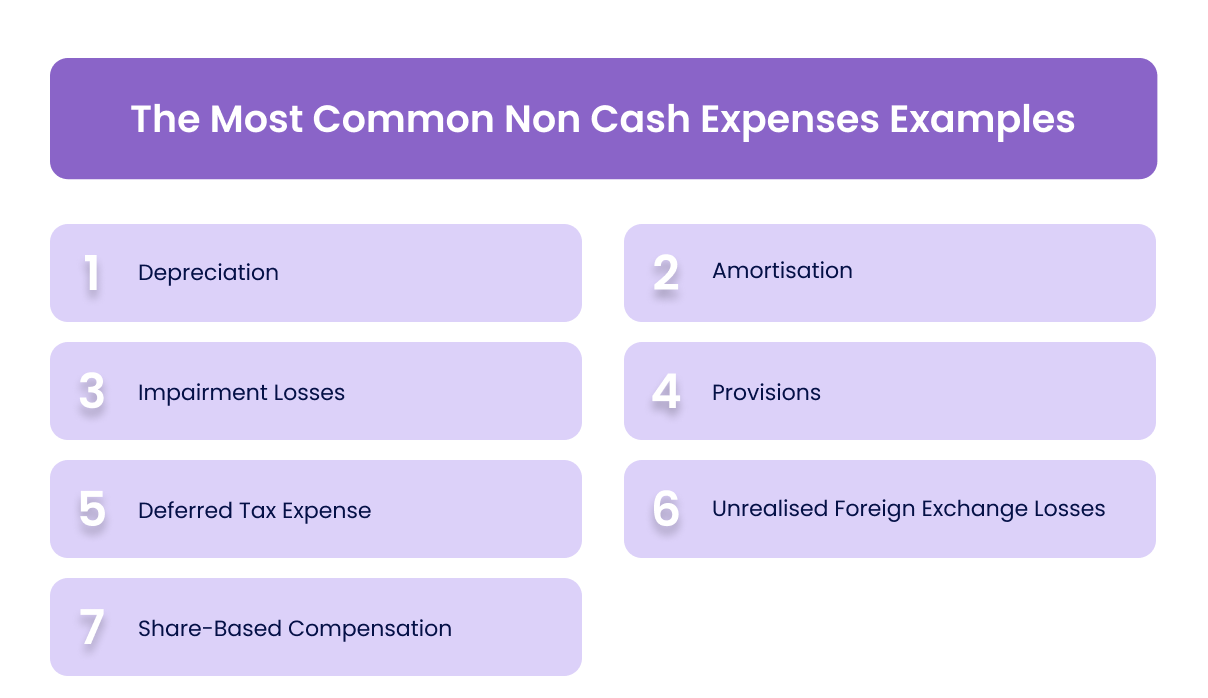
- Common examples include depreciation, amortisation, impairment, provisions, deferred tax, unrealised FX losses, and some share-based compensation.
- These items matter because they affect profit, financial analysis, and the bridge between earnings and operating cash flow.
- Non-cash expenses are not the same as broader non-cash investing or financing transactions.
- Finance teams need to read profit, EBITDA, and cash flow together rather than treating them as interchangeable.
- Alaan helps teams stay closer to actual operating spend so cash movement is easier to distinguish from accounting adjustments.
What Non Cash Expenses Mean
A non-cash expense is an expense recognised in the income statement that does not involve a cash payment in the same reporting period. The business still records the expense because the accounting impact is real, but the cash either moved in a different period or did not move at all at the time of recognition.
What Are Non Cash Expenses
Non cash expenses reduce accounting profit without reducing current-period cash. They usually arise because accounting rules require costs or losses to be recognised over time, or because estimates and remeasurements affect the accounts before any cash changes hands.
A simple way to think about it is this: a business can show an expense in the profit and loss statement today even though no bank payment went out today.
Why Non-Cash Expenses Exist
Non-cash expenses exist because accounting is built on matching and accrual principles, not just bank movements. If a company buys an asset that will be used over several years, it does not usually expense the whole cost on day one. Instead, that cost is allocated over time. The same logic applies to certain estimates, provisions, impairments, and other accounting adjustments.
This is why non-cash expenses are common in businesses with:
- Fixed assets and equipment
- Intangible assets
- Foreign currency exposure
- Deferred tax balances
- Share-based compensation
- Significant judgement in financial reporting
Why They Matter In Financial Analysis
Non-cash expenses matter because they affect:
- Profitability, since they reduce accounting earnings
- Cash flow reporting, because they are often added back under the indirect method
- Performance metrics, especially EBITDA, operating profit, and net income
- Valuation discussions, where analysts try to separate accounting charges from cash generation
They are not “fake” expenses. They are real accounting charges. But they do not always represent cash leaving the business in the same period.
Related: Understanding Recording Business Expenses Efficiency Strategies
The Most Common Non Cash Expenses Examples
The best way to understand non cash expenses is to look at the most common examples. Some are routine and expected, while others are more irregular and often appear during close, review, or impairment testing.
1. Depreciation
Depreciation is one of the most common examples of a non-cash expense. It allocates the cost of a tangible asset over its useful life. The cash outflow usually happened when the asset was purchased, but the expense is recognised gradually across future periods.
For example, if a business buys equipment and uses it for five years, the equipment cost is not usually expensed all at once. Instead, part of that cost is charged each year as depreciation.
2. Amortisation
Amortisation is the equivalent concept for certain intangible assets. If a business holds a finite-life intangible asset, such as some software rights or licences, the cost is spread over its useful life as amortisation expense.
Like depreciation, the key point is that the cash usually moved earlier, but the expense is recognised over time.
3. Impairment Losses
An impairment loss happens when the carrying value of an asset is reduced because it is no longer expected to recover its recorded value. This can happen with receivables, inventory, fixed assets, or intangible assets, depending on the circumstances.
Impairment is often non-cash at the point of recognition because it reflects a write-down in value rather than a fresh payment.
4. Provisions
Certain provisions can create non-cash expenses when a business recognises an obligation before the related cash outflow happens. The expense is recognised now because the obligation has arisen, even though settlement may happen in a future period.
This is where teams need to stay sharp: the accounting charge may be current, but the cash impact may come later or may still be uncertain in timing.
5. Deferred Tax Expense
Deferred tax expense is another example of a non-cash item. It arises from timing differences between accounting treatment and tax treatment. No immediate payment may happen in the period the deferred tax expense is recognised, but the income statement still reflects the tax effect of those timing differences.
6. Unrealised Foreign Exchange Losses
Businesses with foreign currency balances often recognise unrealised FX gains or losses when exchange rates move before settlement. These adjustments affect reported profit or loss, but they do not always involve current-period cash movement.
This is especially relevant for businesses with cross-border suppliers, foreign currency receivables, or overseas bank balances.
7. Share-Based Compensation
When a company recognises the cost of employee equity or option-based compensation, it often books an expense even though there is no immediate cash outflow in that reporting period. This makes share-based compensation another common non-cash expense example.
Also Read: Financial Controller Vs Other Finance Roles
Non-Cash Expenses In The Cash Flow Statement
Non-cash expenses become especially important when reading the cash flow statement. Many finance teams understand them in theory, but the link between the income statement and cash flow statement is where the concept becomes genuinely useful.
Why Non-Cash Expenses Are Added Back
Under the indirect method of presenting operating cash flow, the starting point is usually profit before tax or net profit. From there, non-cash expenses are added back because they reduced profit without reducing operating cash in the period.
That means if depreciation, amortisation, or an unrealised FX loss reduced reported earnings, those amounts are adjusted so the operating cash flow figure reflects cash reality more accurately.
Why Expense Does Not Always Mean Cash Outflow
This is the point many non-finance readers miss. An expense means profit was reduced. It does not always mean cash left the business at the same time. Some expenses reflect allocation, remeasurement, or accrual rather than immediate payment.
That is why two businesses with the same net profit can still have very different operating cash flow.
Why This Matters For Decision-Making
Understanding this distinction helps management avoid weak conclusions. A profit decline driven by a non-cash impairment is not the same as a profit decline driven by higher cash operating costs. Both matter, but they mean different things operationally.
This is also why lenders, investors, and finance leaders pay close attention to the bridge between profit and cash flow, rather than treating the income statement in isolation.
Related: Effective Business Spending Policies
Non-Cash Expenses Compared With Non-Cash Transactions
This distinction matters because finance teams often use the two phrases interchangeably, even though they are not the same thing. A non-cash expense affects profit or loss without using cash in the current period. A non-cash transaction is broader and may involve an investing or financing activity that happens without cash at all, such as acquiring an asset through a lease or converting debt to equity. IAS 7 requires entities to exclude non-cash investing and financing transactions from the cash flow statement and disclose them separately.
Non-Cash Expense
A non-cash expense appears in the income statement. It reduces accounting profit, but does not represent a current-period cash payment. Depreciation, amortisation, deferred tax expense, provisions, and unrealised foreign exchange losses are all classic examples when using the indirect method of cash flow reporting. IAS 7 explicitly refers to these types of items as non-cash adjustments when reconciling profit to operating cash flow.
Non-Cash Investing Or Financing Transaction
A non-cash transaction does not always pass through profit or loss at all. For example, if a business acquires an asset by taking on a lease liability, or converts debt into equity, that event may be economically significant without being a cash outflow in the period. IAS 7 treats these separately because the statement of cash flows is meant to report actual cash movements, not every economically meaningful transaction.
Why The Difference Matters
If teams blur the line between non-cash expenses and non-cash transactions, the result is messy reporting. You can end up adjusting EBITDA correctly but presenting the cash flow narrative badly, or vice versa. Clean analysis needs both distinctions: what affected profit, and what affected cash.

Related: Enterprise Spend Management Software Solutions
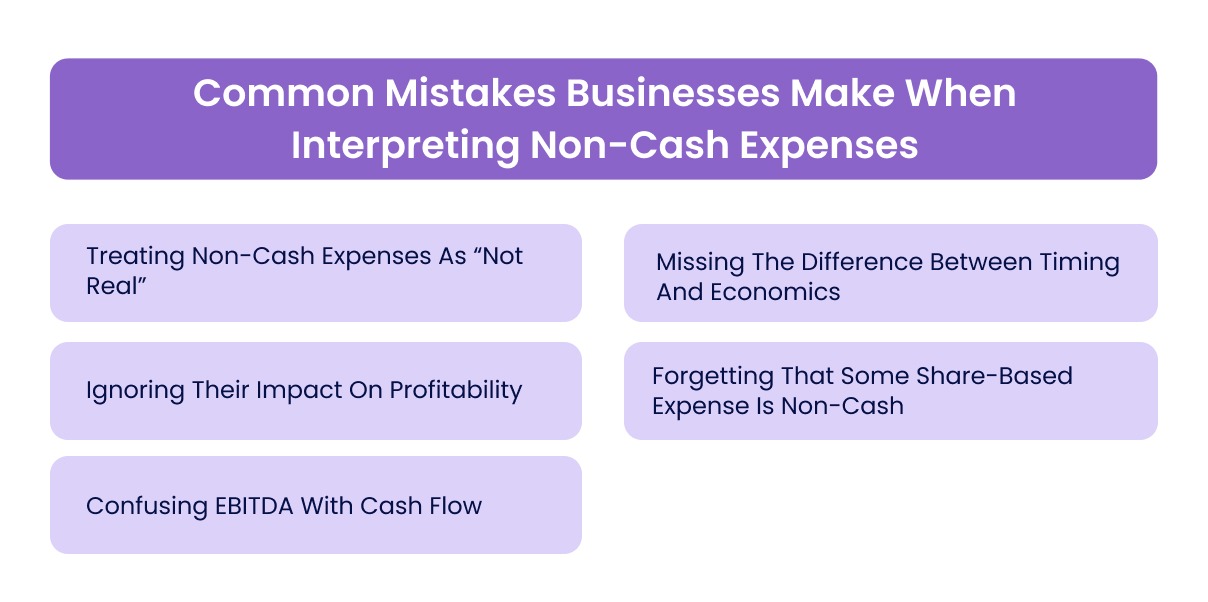
Common Mistakes Businesses Make When Interpreting Non-Cash Expenses
Most mistakes happen when non-cash expenses are treated as either meaningless or equivalent to cash. Neither is true. They matter a great deal for reporting, but they need to be interpreted in the right framework.
1. Treating Non-Cash Expenses As “Not Real”
This is the classic finance gremlin. A depreciation charge may not be a current cash outflow, but it reflects the consumption of an asset that did require cash at some point. An impairment loss may not use cash now, but it signals that the asset is worth less than previously expected. These are not fake numbers. They are real accounting charges with real analytical value.
2. Ignoring Their Impact On Profitability
Because non-cash expenses do not hit the bank account immediately, some operators mentally strip them out too early. That can lead to inflated views of profitability. Profit, EBITDA, and operating cash flow are all useful, but they are not interchangeable. A business can have strong EBITDA and weak cash conversion, or weak net income but stable cash generation, depending on the mix of non-cash charges and working-capital movement. IAS 7’s indirect method exists precisely because profit and cash are different animals.
3. Confusing EBITDA With Cash Flow
EBITDA excludes depreciation and amortisation, which is one reason it is popular. But EBITDA is not operating cash flow. It ignores working-capital changes, taxes paid, interest paid, and other cash realities. This is where analysis can go full circus if teams start using EBITDA as a shortcut for “cash earnings.”
4. Missing The Difference Between Timing And Economics
Some non-cash expenses are timing allocations, such as depreciation and amortisation. Others are valuation or estimate-based, such as impairments, provisions, and unrealised FX movements. Those are not the same category economically. Treating them as one undifferentiated block makes it harder to understand what actually changed in the business.
5. Forgetting That Some Share-Based Expense Is Non-Cash
Under IFRS 2, an entity recognises the goods or services received in a share-based payment transaction, with a corresponding increase in equity for equity-settled awards or a liability for cash-settled awards. That means share-based compensation can create a genuine expense in profit or loss without a standard payroll-style cash payment in the same period.
Related: Modern Expense Management Guide
How Alaan Helps Finance Teams Stay Close To Real Spending
Non-cash expenses matter in reporting, but finance teams still need a clear view of actual cash spend during the month. That is where Alaan is relevant. It helps teams manage real operating spend through corporate cards, spend controls, approval workflows, receipt capture, AI verification, and accounting integrations, so it becomes easier to separate true cash outflows from accounting adjustments later in the reporting cycle.
- Real-Time Visibility Into Cash Spend
Alaan gives finance teams live visibility into company spend by employee, team, vendor, and category. That makes it easier to see what has actually consumed cash in the period, instead of mixing real operating spend with non-cash accounting charges during review. - Corporate Cards With Spend Controls
Alaan lets businesses issue corporate cards with spending limits and vendor restrictions. That helps finance teams control cash spend at the point of purchase and reduces the risk of uncontrolled expenses showing up later in reporting. - Approval Workflows Before Spend Is Finalised
Alaan supports custom approval workflows, so expenses can be reviewed according to policy before they become part of the month’s spend. That gives teams better control over actual cash outflows and cleaner internal governance. - Receipt Capture And Supporting Documents
Employees can upload receipts and invoices through the mobile app, Chrome extension, or email, so supporting documents stay attached to transactions. That makes it easier to review cash expenses properly and reduces manual chasing during close. - AI Verification And Duplicate Detection
Alaan extracts receipt data, matches it to transactions, and flags errors or duplicates. That helps finance teams clean up actual spend records faster and reduces noise when reviewing operating cash movement. - Accounting Sync For Faster Reconciliation
Alaan integrates with Xero, QuickBooks, NetSuite, and Microsoft Dynamics, helping teams sync expense data in real time and reduce manual re-entry. That makes it easier to reconcile real spend and focus analysis on the difference between cash costs and non-cash charges.

In practice, that gives finance teams a cleaner view of what is actually left in the business in cash and what only affects accounting profit.
Conclusion
Non-cash expenses are important because they explain part of the gap between reported profit and actual cash generation. Depreciation, amortisation, impairment, provisions, deferred tax, unrealised FX losses, and similar items all affect the income statement, but they do not always represent current-period cash outflows.
That is why finance teams need to read profit, EBITDA, and cash flow together rather than treating them as interchangeable. Understanding non-cash expenses makes performance analysis more accurate and helps teams avoid weak conclusions based on incomplete reporting views.
Alaan helps finance teams stay closer to the cash side of that picture. With real-time spend visibility, corporate cards, approval workflows, receipt capture, AI verification, and accounting integrations, teams can track actual operating spend more clearly and review results with better context. Book a Demo Today!
FAQs
1. Is Depreciation Always A Non-Cash Expense
In the period, it is recognised, yes. Depreciation reduces profit but does not require a new cash payment in that same period. The cash outflow usually happened when the asset was acquired.
2. Are Provisions Always Non-Cash
Not always in the long run, but usually at the point of recognition. A provision often starts as a non-cash expense because the liability is recognised before cash is paid. The settlement may happen later.
3. Is EBITDA The Same As Operating Cash Flow
No. EBITDA removes some non-cash expenses, mainly depreciation and amortisation, but it does not capture working-capital changes, taxes paid, interest paid, or other cash effects. Operating cash flow is a different measure.
4. Can A Non-Cash Expense Still Matter For Tax
Yes. Some non-cash expenses can still affect taxable income depending on the jurisdiction and tax rules, although the tax treatment does not always follow the accounting treatment exactly. The accounting label “non-cash” does not automatically mean “irrelevant for tax.”
5. What Is The Difference Between Amortisation And Depreciation
Both are non-cash allocation expenses, but depreciation applies to tangible assets and amortisation usually applies to finite-life intangible assets. Under IFRS, finite-life intangible assets are amortised under IAS 38.
Gain control over business expenses with Alaan corporate cards
Invygo earned AED 100,000 in cashback using Alaan cards
Personalise approval workflows to align with your business needs with Alaan's Spend Management platform
Discover the power of automated expense tracking and smarter spend control with Alaan
Turn data into actionable insights with Alaan's spend management tools
Stay Tax Compliant with UAE's #1 Corporate Card and Spend Management Platform
Customisable corporate card policy template
Know how much Corporate Tax you have to pay this fiscal year
Easily integrate Alaan with your ERP for accurate, real-time expense tracking
Close books faster with Alaan's AI-powered accounting automation
Reconcile your books in minutes instead of hours, every single month.
Keep petty cash organized with Alaan corporate cards and automated expense management