.avif)

Vendors often struggle to get clarity on payment timelines, not because the payment is not approved, but because they do not know who to follow up with. At the same time, finance teams deal with scattered emails, repeated queries, and confusion around invoice status, slowing down the entire accounts payable process.
This is not a small issue. In the UAE, nearly 58% of B2B invoices are overdue, with average delays exceeding agreed payment terms. These delays are not always driven by cash flow constraints; they are often the result of fragmented communication and unclear ownership within the payment process.
This is where the accounts payable contact becomes critical. Acting as the central point of communication between vendors and the finance team, this role ensures that invoices, queries, and payment updates are handled clearly and efficiently.
What Is an Accounts Payable Contact?
An accounts payable contact is the designated person or team responsible for handling vendor invoices, payment queries, and all payables-related communication within an organisation. This role sits within the finance or accounts payable function and acts as the primary point of contact for suppliers.
In practice, this means managing supplier-facing communication while ensuring invoices are received, verified, approved, and processed correctly. Accounts payable teams are responsible for processing invoices, managing vendor payments, and ensuring they are paid accurately and on time. This is critical for maintaining financial control and vendor relationships.
To understand how this role operates day-to-day, it is important to look at the specific responsibilities involved.
Key Responsibilities of an Accounts Payable Contact
The accounts payable contact acts as the bridge between vendors and internal finance teams, ensuring that invoices, payments, and communication flow without delays. This role is central to maintaining accuracy, resolving issues quickly, and keeping vendor relationships stable.
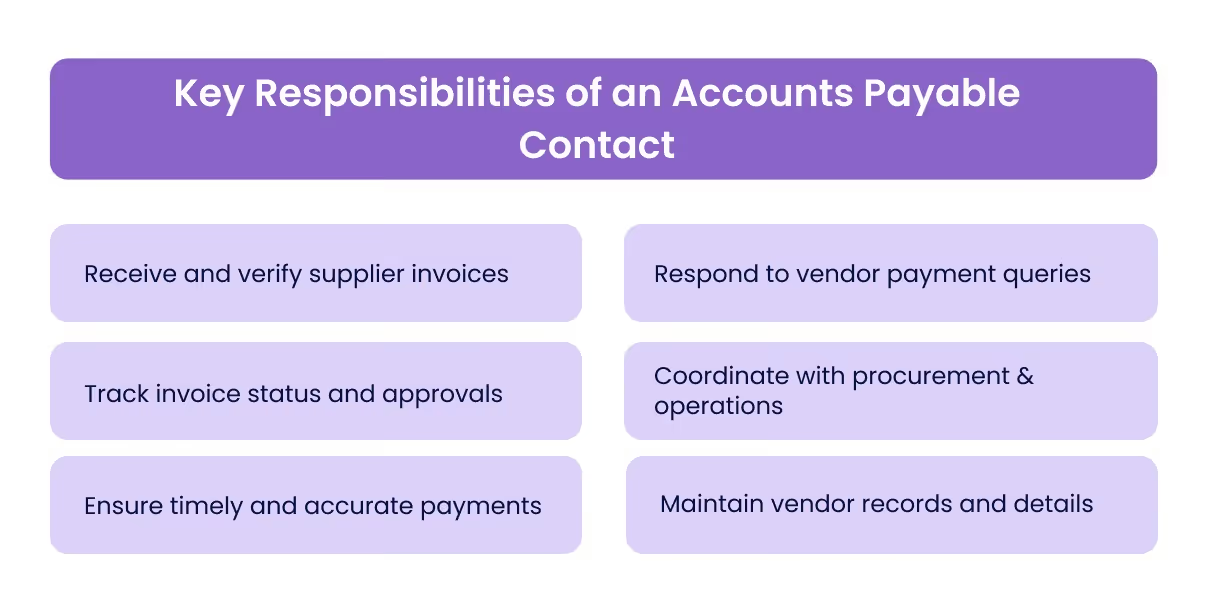
Responsibilities include:
- Receive and verify supplier invoices:
Check invoices for accuracy, completeness, and proper authorisation before processing. - Respond to vendor payment queries:
Act as the primary contact for suppliers, resolving invoice and payment-related issues promptly. - Track invoice status and approvals:
Monitor invoices through receipt, validation, approval, and payment stages to avoid delays. - Coordinate with procurement and operations:
Work with internal teams to validate purchase orders, delivery details, and resolve mismatches. - Ensure timely and accurate payments:
Process vendor payments on schedule to maintain cash flow control and supplier trust. - Maintain vendor records and details:
Keep supplier data, documentation, and transaction records up to date for audits and reporting.

Also Read: Step-by-Step Automated Invoice Processing and its Benefits
To see how these responsibilities come together, it helps to understand where the accounts payable contact fits within the overall invoice-to-payment process.
Where the Accounts Payable Contact Fits in the Process
The accounts payable contact is involved throughout the accounts payable workflow, ensuring invoices move smoothly from receipt to payment. This role sits at the centre of the process, coordinating between vendors, procurement, and internal approvers to maintain accuracy and timelines.
Below is the typical accounts payable process flow:
- Invoice received from vendor:
The process begins when the supplier submits an invoice to the company for goods or services delivered. - Invoice verified (PO/GRN matching):
The AP contact ensures the invoice matches the purchase order and delivery records to confirm accuracy before approval. - Internal approvals:
The invoice is routed to the relevant stakeholders for authorisation in accordance with company policies. - Payment scheduling:
Once approved, the invoice is scheduled for payment in accordance with agreed-upon terms and cash-flow priorities. - Vendor communication:
Throughout the process, the AP contact updates vendors on invoice status, resolves queries, and ensures clarity around payment timelines.
Example of How the Process Works in Practice
A company hires a vendor to supply office furniture.
- The vendor sends an invoice for AED 15,000 after delivery
- The accounts payable contact checks the purchase order to confirm the agreed pricing and quantity
- The goods receipt is verified to ensure that all items were delivered correctly
- The invoice is then sent for internal approval to the admin or operations head
- Once approved, the AP contact schedules the payment as per agreed terms (e.g., 30 days)
- The vendor is updated on payment status to avoid follow-ups

Also Read: Faster Invoice Processing: How UAE Finance Teams Can Cut Days Off Their AP Cycle
If any mismatch is found, such as fewer items delivered or incorrect pricing, the invoice is held until the issue is resolved.
Common Challenges Faced by AP Contacts
Even with defined workflows, accounts payable contacts operate in a highly complex environment where manual processes, fragmented communication, and limited visibility can slow down payments and increase risk.
Most challenges are not isolated; they are structural issues within the AP process that directly impact efficiency, vendor relationships, and financial control.
Below are the most common challenges faced by AP contacts and practical ways to address them:
These challenges highlight a clear pattern; most inefficiencies in accounts payable are not caused by a lack of effort but by disconnected systems, manual workflows, and limited visibility across the process.

Also Read: 7 Business Bill Payment Solutions & Workflows Explained
To address this, finance teams are increasingly turning to automation and integrated platforms that bring control, clarity, and speed to the entire AP function.
How Alaan Helps Finance Teams Manage Accounts Payable
Many of the challenges in accounts payable stem from fragmentation, multiple tools for invoices, approvals, payments, and accounting, with little visibility across them. As a result, AP contacts spend more time coordinating between systems than actually managing the process.
Alaan addresses this by bringing the entire accounts payable workflow into a single, connected system, allowing finance teams to handle invoices, approvals, and payments without switching platforms.
Here is how that translates in practice:
- Invoice capture without manual entry:
Invoices can be uploaded or forwarded, with key data automatically extracted. This reduces dependency on manual input and lowers the risk of errors at the first stage of the process. - Structured approval workflows:
Instead of chasing approvals over email, invoices follow predefined workflows aligned with company policies, making approvals more predictable and traceable. - SuperPay for integrated payments:
Once invoices are approved, payments can be executed within the same system. This removes the disconnect between approval and payment stages, especially for cross-border transactions where external banking platforms are typically required. - Visibility across the entire lifecycle:
From invoice receipt to final payment, every stage is trackable in one place. This allows AP contacts to respond to vendor queries with clarity instead of relying on multiple systems or manual checks. - Centralised vendor management:
Supplier details, transaction history, and payment records are maintained in a single database, reducing errors caused by outdated or scattered information. - Built-in controls for accuracy:
Automated checks help identify duplicates, mismatches, or missing data early in the process, reducing rework and preventing incorrect payments. - Accounting integration for reconciliation:
Invoice and payment data flow directly into accounting systems, reducing the manual effort required during reconciliation and month-end closing. - Unified view of spend:
By combining payables with corporate card expenses, finance teams get a more complete picture of outgoing cash, improving control and decision-making.
For teams dealing with fragmented AP workflows, seeing how a unified system like Alaan operates can offer a useful reference point.
Conclusion
An effective accounts payable process is about creating clarity across every stage, from invoice receipt to final settlement. The role of the accounts payable contact becomes significantly easier when processes are structured, communication is centralised, and visibility is consistent.
As businesses grow, relying on manual coordination and disconnected systems often leads to delays, errors, and unnecessary back-and-forth. This is where a more integrated approach can make a meaningful difference.
Platforms like Alaan bring together invoice management, approvals, and payments into a single workflow, helping finance teams operate with greater control and fewer dependencies. For teams looking to move towards a more streamlined and transparent accounts payable function, it may be useful to explore how such systems work in practice.
If you’d like to see how this could fit your current workflow, you can schedule a personalised demo with Alaan.
FAQs
1. What is an accounts payable contact?
An accounts payable contact is the person or team responsible for managing vendor invoices, handling payment-related queries, and ensuring that suppliers are paid accurately and on time within an organisation.
2. What does an accounts payable contact do?
An accounts payable contact receives and verifies invoices, coordinates approvals, schedules payments, maintains vendor records, and serves as the primary point of contact for suppliers.
3. Why is an accounts payable contact important?
This role ensures smooth communication between vendors and finance teams, reduces payment delays, prevents errors, and helps maintain strong supplier relationships and financial control.
4. What challenges do accounts payable contacts face?
Common challenges include manual data entry errors, delayed approvals, invoice mismatches, high volumes of vendor queries, and limited visibility into invoice status.
5. How can accounts payable processes be improved?
Accounts payable processes can be improved by automating invoice capture, setting structured approval workflows, centralising communication, and using integrated platforms to manage invoices and payments efficiently.
Gain control over business expenses with Alaan corporate cards
Invygo earned AED 100,000 in cashback using Alaan cards
Personalise approval workflows to align with your business needs with Alaan's Spend Management platform
Discover the power of automated expense tracking and smarter spend control with Alaan
Turn data into actionable insights with Alaan's spend management tools
Stay Tax Compliant with UAE's #1 Corporate Card and Spend Management Platform
Customisable corporate card policy template
Know how much Corporate Tax you have to pay this fiscal year
Easily integrate Alaan with your ERP for accurate, real-time expense tracking
Close books faster with Alaan's AI-powered accounting automation
Reconcile your books in minutes instead of hours, every single month.
Keep petty cash organized with Alaan corporate cards and automated expense management