.avif)


Amortisation is a common finance term, but it is often used to describe two different things. In one context, it describes how a loan is repaid over time through scheduled instalments. In another, it refers to how the cost of a finite-life intangible asset is allocated across reporting periods. Same word, different job.
For UAE businesses, both meanings matter, but not in the same way. Loan amortisation is usually the more operational concern because it affects cash flow planning, financing decisions, and repayment visibility. Intangible asset amortisation matters more in accounting, reporting, and corporate tax analysis, especially where licences, acquired rights, or other identifiable intangibles are involved.
This guide explains both clearly, shows where businesses tend to confuse them, and focuses on what actually matters in practice for UAE finance teams.
Key Takeaways
- Amortisation Has Two Distinct Meanings In Business Finance. It can refer to loan repayment over time or to the allocation of the cost of a finite-life intangible asset over its useful life.
- Loan Amortisation Is Usually More Relevant Operationally. It helps businesses understand repayment structure, financing cost, and cash commitments over time.
- Intangible Asset Amortisation Is An Accounting Treatment. It applies to intangible assets with finite useful lives under IAS 38.
- Not All Intangible Assets Are Amortised. Intangible assets with indefinite useful lives are not amortised, and goodwill is not amortised under IFRS.
- Amortisation Is Not A VAT Strategy. In the UAE, VAT treatment depends on the underlying transaction, not on the fact that an item is amortised in the accounts.
What Amortisation Means In Business Finance
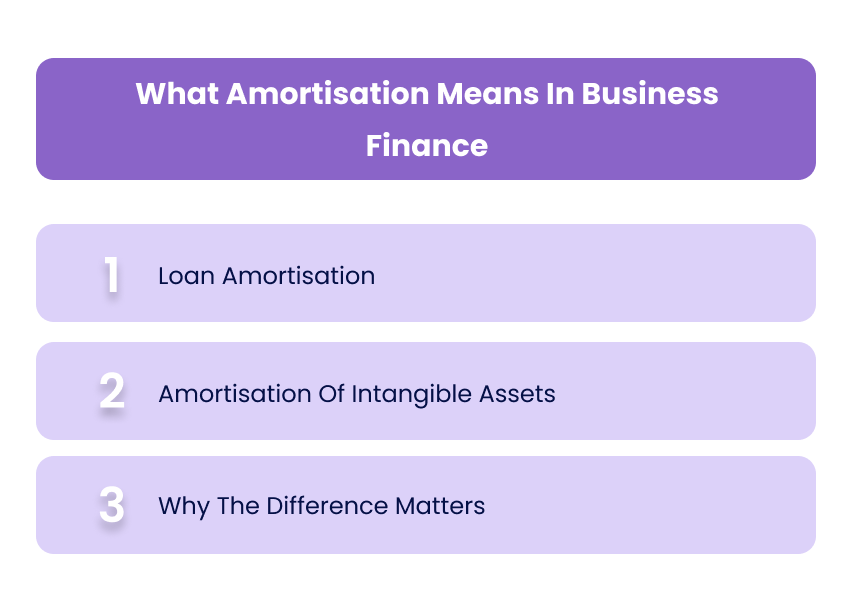
Amortisation is used in two separate business contexts. It is important to define them clearly before going deeper.
Loan Amortisation
Loan amortisation refers to the gradual repayment of borrowed money through scheduled payments over an agreed term. Each payment usually includes:
- An Interest Portion
- A Principal Portion
As the loan balance declines, the interest element typically falls and the principal element increases. This is the meaning most businesses encounter when reviewing a term loan, equipment loan, or other financing facility.
Amortisation Of Intangible Assets
Amortisation also refers to the systematic allocation of the cost of an intangible asset over its useful life. Under IAS 38, this applies to intangible assets with a finite useful life. If an intangible asset has an indefinite useful life, it is not amortised and is instead tested for impairment.
Examples may include certain:
- Licences
- Patents
- Copyrights
- Franchise Rights
- Acquired Customer-Related Intangibles
This meaning belongs to accounting and financial reporting, not debt repayment.
Why The Difference Matters
The distinction matters because the two uses of amortisation answer different questions.
- Loan Amortisation helps a business understand how debt is repaid over time.
- Intangible Asset Amortisation helps a business allocate the cost of an asset across the periods that benefit from it.
Also Read: What Is Direct Cost? How It Differs from Other Expenses in Your Business
How Loan Amortisation Works
When a business takes out an amortising loan, the lender sets a repayment schedule over a fixed period. Each instalment usually includes both interest and principal, but the split between them changes over time.
In the earlier part of the loan term, a larger share of each payment often goes towards interest because the outstanding balance is still high. As the balance falls, the interest portion decreases, and more of the payment goes towards reducing principal. This is the core pattern described in standard amortisation explainers and amortisation schedules.
For finance teams, the practical value is not just that the debt gets repaid. It is that the repayment profile becomes visible and predictable. That helps businesses assess how financing commitments will affect liquidity and planning over time.
What Businesses Can Use Loan Amortisation For
A clear view of loan amortisation helps with:
- Cash Flow Planning
- Budgeting
- Assessing Financing Cost Over Time
- Comparing Different Loan Structures
- Understanding How Quickly Debt Is Actually Reducing
That is why reviewing the amortisation schedule matters far more than glancing at a headline interest rate and declaring victory.
What An Amortisation Schedule Shows
An amortisation schedule is a table that breaks down each payment across the life of a loan. It shows how the debt changes from one period to the next and gives finance teams a much clearer view of repayment mechanics.
A typical amortisation schedule includes:
- Payment Date Or Number
- Total Payment Amount
- Interest Portion
- Principal Portion
- Remaining Balance After Payment
This is useful because it turns a generic borrowing figure into something operational. A finance team can see how much of future debt servicing is financing cost, how quickly the principal balance is declining, and what the cash commitment looks like across future periods.
For UAE businesses managing working capital, capex financing, or structured repayment facilities, that visibility improves planning discipline and makes it easier to explain borrowing costs internally.
Why Loan Amortisation Matters For UAE Businesses
Loan amortisation is the more operationally relevant side of this topic for most businesses because it affects day-to-day finance visibility more directly than the accounting treatment of intangible assets.
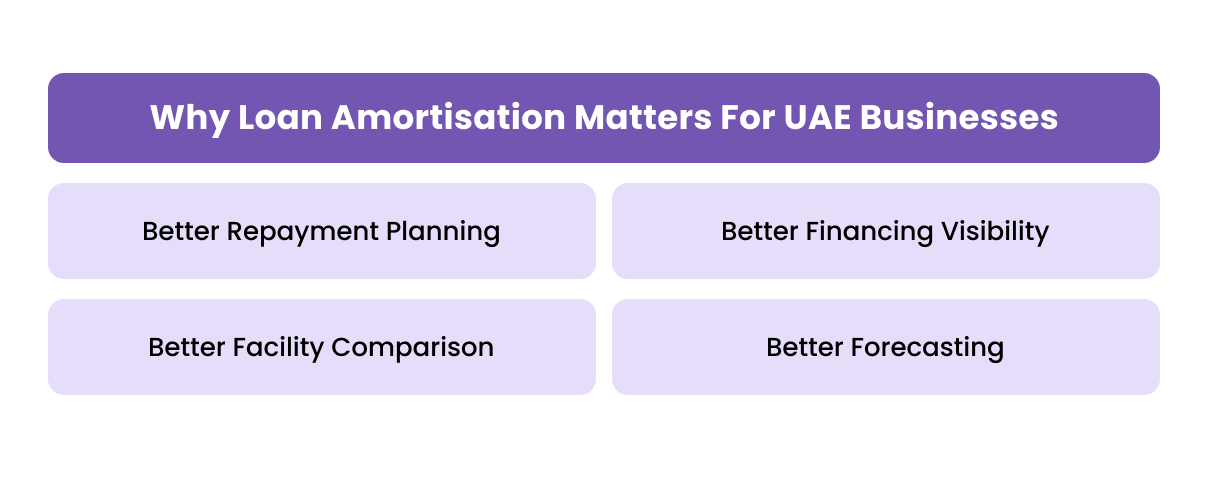
1. Better Repayment Planning
A structured repayment schedule helps finance teams map future cash obligations with more confidence. That is especially useful when borrowing needs to be considered alongside payroll, supplier payments, and operating expenses.
2. Better Financing Visibility
Amortisation shows how much of each instalment is actually reducing debt and how much is being paid as borrowing cost. That makes loan evaluation more grounded and less dependent on headline terms alone.
3. Better Facility Comparison
Two financing facilities can look similar at first glance but create very different repayment profiles. Looking at amortisation helps businesses compare the real cash impact of different terms, tenors, and structures.
4. Better Forecasting And Internal Reporting
Because an amortisation schedule shows future repayment patterns clearly, it supports budgeting, internal reporting, and broader financial planning. It gives finance leaders a cleaner basis for discussing obligations with management instead of relying on fragmented spreadsheets and manual repayment tracking.
Also Read: Cash Flow Forecasting: Best Practices and Key Methods
How Intangible Asset Amortisation Works
In accounting, amortisation is used to allocate the cost of an intangible asset over the period in which the business expects to benefit from it. This applies to intangible assets with a finite useful life. Under IAS 38, the depreciable amount of such an asset is allocated on a systematic basis over its useful life.
Instead of recognising the full cost as an expense immediately, the business records the expense over multiple reporting periods. This gives a more accurate view of performance by matching the cost of the asset to the periods that benefit from it.
Common Examples
Examples of intangible assets that may be amortised include:
- Patents
- Licences
- Copyrights
- Franchise Rights
- Certain Acquired Customer-Related Intangibles
- Certain Acquired Software Rights
The key issue is not whether the asset is digital or non-physical. The real test is whether it is an identifiable intangible asset with a finite useful life.
A Simple Example
If a business acquires a licence for AED 120,000 and determines that its useful life is 6 years, the annual amortisation expense under a straight-line approach would typically be:
AED 120,000 ÷ 6 = AED 20,000 per year
That annual expense is then recognised over the useful life of the licence rather than all at once.
Why It Matters
For finance teams, intangible asset amortisation affects:
- Reported Profit
- Asset Carrying Value
- Period-By-Period Cost Allocation
- Management Reporting
- Forecasting Accuracy
This is what makes it relevant in practice. It is not just an accounting label. It changes how costs appear across reporting periods.

Which Assets Are Not Amortised
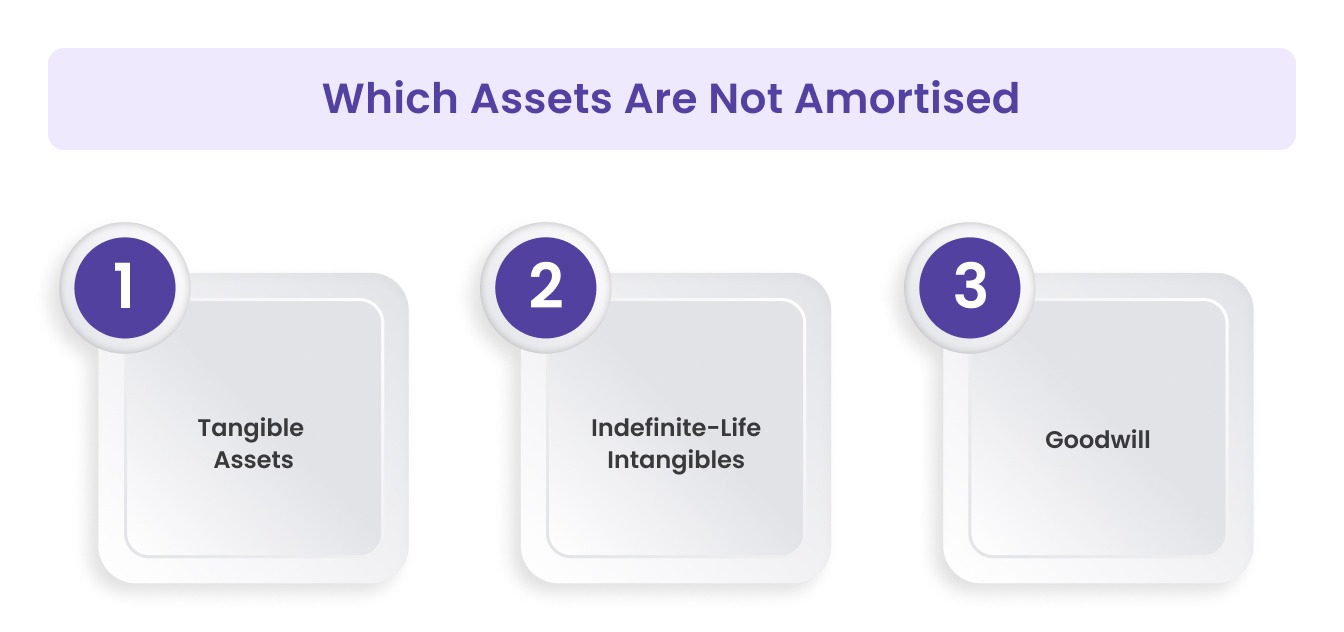
Not every asset is amortised, and not every intangible asset should be treated in the same way.
1. Tangible Assets
Physical assets such as machinery, vehicles, office equipment, and buildings are generally depreciated, not amortised. Depreciation is the cost-allocation method used for tangible assets.
2. Intangible Assets With Indefinite Useful Lives
Under IAS 38, an intangible asset with an indefinite useful life is not amortised. Instead, it is tested for impairment.
3. Goodwill
Under IFRS, goodwill is not amortised and is tested for impairment instead.
This distinction matters because businesses should not assume that every non-physical asset automatically falls into amortisation.
Amortisation Vs Depreciation
Amortisation and depreciation are both methods of allocating cost over time, but they apply to different types of assets.
Amortisation
Amortisation generally applies to intangible assets with finite useful lives. It reflects the gradual recognition of the asset’s cost over the periods expected to benefit from it.
Depreciation
Depreciation applies to tangible assets such as equipment, vehicles, machinery, and buildings. It reflects the reduction in value of a physical asset over time due to use, wear and tear, or obsolescence.
Why The Difference Matters
For businesses, the distinction affects:
- Expense Recognition
- Balance Sheet Treatment
- Financial Reporting
- Management Reporting
- Tax Analysis
Misclassifying an asset can lead to incorrect accounting treatment and weaker reporting accuracy.
Also Read: Introduction to GAAP (Generally Accepted Accounting Principles)
How Amortisation Relates To UAE Corporate Tax
For UAE businesses, the safest way to think about amortisation and Corporate Tax is this: accounting treatment matters, but tax treatment does not always follow accounting treatment in exactly the same way.
The UAE Corporate Tax framework starts from the accounting income shown in the financial statements, subject to the adjustments required under the law. The FTA’s accounting standards guidance also notes that capital expenditure is generally not deductible when incurred, while related depreciation, amortisation, or similar changes may be recognised depending on the relevant treatment and rules.
What Businesses Should Keep In Mind
- Amortisation Can Affect Accounting Profit
Amortisation changes the expense recognised in the income statement, which affects the accounting profit that forms the starting point for Corporate Tax analysis. - Capital Expenditure Is Not Usually Deducted Immediately
Paying for an asset upfront does not usually mean the full amount is deducted in the same period. - Tax Treatment Depends On The Facts
The final tax treatment depends on the nature of the asset, the accounting treatment applied, and the relevant Corporate Tax rules.
The practical point is simple: businesses should not assume that every amortisation charge automatically produces the same tax result.
Does Amortisation Affect VAT In The UAE
Not directly. Amortisation is an accounting and financing concept. VAT applies based on the underlying supply and the relevant VAT rules. In the UAE’s Financial Services VAT Guide, the treatment depends on the nature of the transaction. Certain financial services may be exempt where consideration is implicit, while explicitly charged fees may be standard-rated.
Why This Matters
- Amortisation Is Not A VAT Method
Recording an item through amortisation does not by itself determine VAT treatment. - The Underlying Transaction Still Matters
The VAT analysis depends on what the business is actually paying for and how that transaction is treated under UAE VAT rules. - Finance Teams Should Avoid Shortcut Logic
Amortisation should not be presented as a general VAT optimisation concept. That would be inaccurate.
Also Read: Guide to Preparing Financial Statements Efficiently
Simple Business Examples Of Amortisation
1. Example Of A Business Loan
Assume a business takes a loan of AED 500,000 over 5 years at a fixed interest rate. Each instalment includes:
- An Interest Portion
- A Principal Portion
At the start of the loan term, a larger share of each payment will usually go towards interest. As the outstanding balance declines, more of each payment goes towards principal. Reviewing the amortisation schedule helps the business understand the repayment profile over time.
2. Example Of A Finite-Life Intangible Asset
Assume a business acquires software rights for AED 90,000 and determines that the useful life is 3 years. Under a straight-line approach, the annual amortisation expense would typically be:
AED 90,000 ÷ 3 = AED 30,000 per year
This reflects the allocation of the software rights cost across the periods expected to benefit from their use.
Also Read: Understanding Deductible and Non-Deductible Expenses in UAE Corporate Tax
Common Mistakes Businesses Make
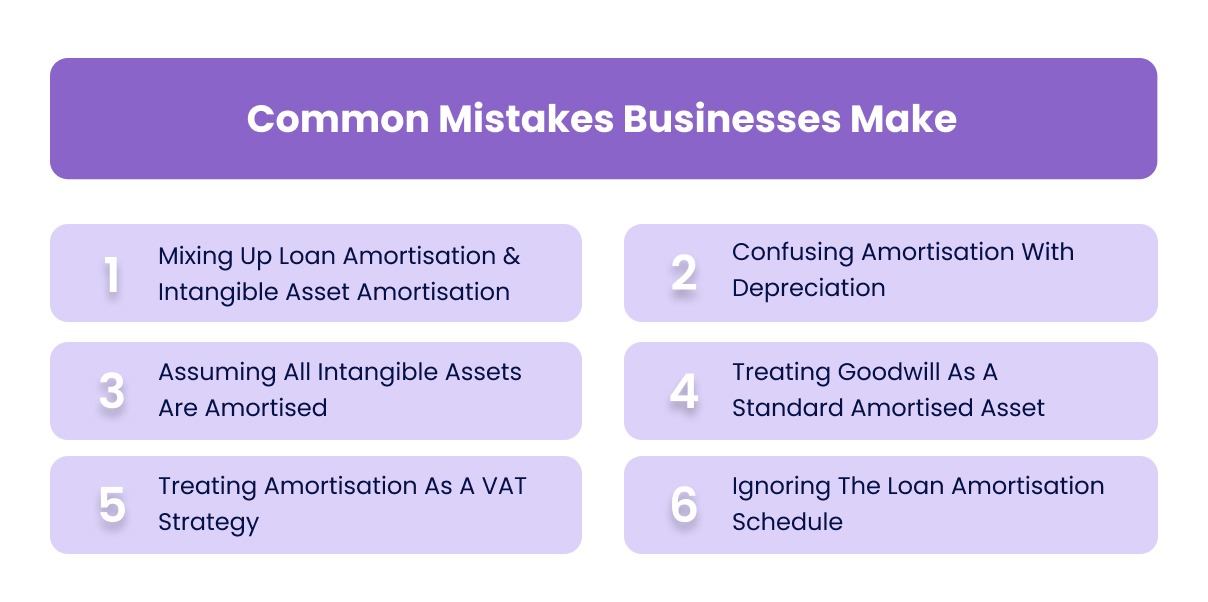
1. Mixing Up Loan Amortisation And Intangible Asset Amortisation
Loan amortisation relates to debt repayment. Intangible asset amortisation relates to accounting cost allocation. They are different applications of the same term.
2. Confusing Amortisation With Depreciation
Amortisation generally applies to finite-life intangible assets, while depreciation applies to tangible assets.
3. Assuming All Intangible Assets Are Amortised
They are not. Under IAS 38, intangible assets with indefinite useful lives are not amortised and are tested for impairment instead.
4. Treating Goodwill As A Standard Amortised Asset
That is not correct under IFRS. Goodwill is not amortised and is tested for impairment.
5. Treating Amortisation As A VAT Strategy
Amortisation itself does not determine VAT treatment. VAT depends on the underlying transaction and the applicable VAT rules.
6. Ignoring The Loan Amortisation Schedule
A headline borrowing cost does not show how repayments are structured over time. The schedule provides the more useful view for planning and review.
Also Read: Importance and Steps in Account Reconciliation
How Alaan Helps Finance Teams Stay In Control
Amortisation is not just an accounting concept. In practice, it affects repayment planning, cost visibility, budgeting, and period-end reporting. That is why finance teams need clean spend data, stronger controls, and up-to-date records around the rest of the cash cycle. Alaan helps support that broader finance workflow.
- Better Visibility Into Business Spend
Finance teams need a clear view of operating spend if they want to assess repayment capacity properly. Alaan gives teams real-time visibility into company expenses, which makes it easier to monitor cash outflows alongside other fixed commitments such as loan repayments. - Stronger Spend Controls
When businesses are managing debt obligations or financing costs, uncontrolled spend creates avoidable pressure on cash flow. With spend limits, vendor controls, and approval workflows, Alaan helps teams keep day-to-day spending more disciplined. - Cleaner Records For Period Reviews
Loan repayment planning and accounting analysis both become harder when transaction records are messy. Alaan helps keep receipts, approvals, and expense records organised, which reduces manual effort during reviews and improves reporting quality. - Faster Accounting Sync
Alaan integrates with accounting systems and helps keep expense data up to date. That makes it easier for finance teams to review actual spend, monitor trends, and work with cleaner numbers during planning and close. - Better Budget Monitoring Throughout The Year
Amortisation schedules show fixed repayment obligations over time. Alaan helps finance teams monitor the rest of the spend base around those obligations, so budgets can be reviewed more accurately and issues can be spotted earlier.
In practice, that means finance teams get a clearer view of the operating reality around amortisation, not just the accounting definition on paper.
Conclusion
Amortisation matters because it affects how finance teams understand cost over time. In lending, it shows how debt is repaid and how borrowing costs change across the life of a facility. In accounting, it shows how the cost of a finite-life intangible asset is allocated across the periods that benefit from it. The word is the same, but the business use is not.
For UAE businesses, the practical value lies in using the right meaning in the right context. Loan amortisation supports repayment planning, cash flow visibility, and financing analysis. Intangible asset amortisation supports cleaner reporting, more accurate profit measurement, and better tax analysis.
Alaan helps finance teams strengthen the operational side of that work. With better spend visibility, stronger controls, cleaner records, and smoother accounting sync, teams can plan with more confidence and keep the numbers behind reporting and budgeting easier to manage. Book a Demo Today!
FAQs
1. Does Early Repayment Change A Loan Amortisation Schedule?
Yes. If a business repays part of a loan early, the lender may either reduce the remaining tenor or reduce the future instalment amount, depending on the facility terms. That changes the amortisation profile and can also affect the total interest paid over the life of the loan.
2. Is A Higher Monthly Instalment Always Worse For A Business?
Not necessarily. A higher instalment increases short-term cash pressure, but it may reduce total financing cost if the debt is repaid faster. The right structure depends on liquidity, forecast cash flow, and how much repayment flexibility the business needs.
3. Can Software Ever Be Amortised Instead Of Expensed Immediately?
Yes, in some cases. If software meets the criteria to be recognised as an intangible asset and has a finite useful life, its cost may be amortised over that life rather than expensed immediately. The treatment depends on the facts, including what was acquired and how it is expected to generate future economic benefit.
4. What Happens If An Intangible Asset Becomes Less Useful Earlier Than Expected?
The business may need to reassess the asset’s useful life or test it for impairment, depending on the circumstances. Amortisation is based on estimates, so if those estimates change materially, the accounting treatment may need to change as well.
5. Are Loan Arrangement Fees Part Of Amortisation?
They can be, in effect. In practice, certain borrowing-related fees are often spread over the life of the loan under the effective interest method rather than recognised all at once. That is different from the informal way people use the word “amortisation,” but the economic logic is similar: the cost is allocated over the period the financing is used.
6. Should Small Businesses Care About Intangible Asset Amortisation?
Yes, but mainly when the amounts are meaningful. If a business acquires licences, rights, or other identifiable intangible assets with a finite useful life, amortisation affects reported profit and asset values. For many smaller businesses, loan amortisation is the more immediate operational issue, but intangible asset amortisation still matters when those assets become material.
Gain control over business expenses with Alaan corporate cards
Invygo earned AED 100,000 in cashback using Alaan cards
Personalise approval workflows to align with your business needs with Alaan's Spend Management platform
Discover the power of automated expense tracking and smarter spend control with Alaan
Turn data into actionable insights with Alaan's spend management tools
Stay Tax Compliant with UAE's #1 Corporate Card and Spend Management Platform
Customisable corporate card policy template
Know how much Corporate Tax you have to pay this fiscal year
Easily integrate Alaan with your ERP for accurate, real-time expense tracking
Close books faster with Alaan's AI-powered accounting automation
Reconcile your books in minutes instead of hours, every single month.
Keep petty cash organized with Alaan corporate cards and automated expense management