.avif)
%20In%20The%20UAE.avif)

A company can look commercially ready long before it is legally structured well. The trade name may be reserved, the activity may be decided, and banking or vendor discussions may already be underway. But in the UAE, one of the documents that often determines whether the business is properly constituted is the Memorandum of Association, or MoA. Official UAE guidance states that, depending on the legal form, a memorandum of association may need to be prepared and signed, and it is specifically required for partnerships, limited partnerships, limited liability companies, private joint stock companies, and public joint stock companies.
For founders, business owners, and finance leaders, the MoA is not just a setup document. It defines the company’s legal identity, its object, its ownership structure, and, crucially, who is authorised to act and sign on behalf of the business. UAE company law also provides that a company’s MoA and any amendment to it must be entered in the Commercial Register to be valid, and companies must notify the authority and registrar within 15 working days of amendments to registered particulars such as name, address, share capital, number of shareholders, or legal form.
In this blog, you will learn what a Memorandum of Association (MoA) is in the UAE, what it contains, when it needs to be updated, and why it plays a critical role in business governance and financial control.
TL;DR / Key Takeaways
- The Memorandum of Association defines the company’s legal structure, ownership, and signing authority, making it central to both setup and ongoing governance.
- MoA relevance increases as a business scales, especially when ownership, capital, or management structures evolve.
- Many operational risks arise when day-to-day approvals and spending workflows do not align with the authority defined in the MoA.
- Timely updates to the MoA are critical, as outdated records can create compliance gaps and control issues.
- Alaan helps ensure that the authority defined at a legal level is reflected in actual spending, approvals, and financial workflows across the business.
What A Memorandum Of Association Means In The UAE
In the UAE company-formation context, the Memorandum of Association is the founding legal document that records the core terms on which the company is established. It is the document that sets out what the company is, what it is formed to do, who owns it, and how authority is allocated at a high level.
Under the UAE Commercial Companies Law, a company’s memorandum of association and every amendment to it must be made in Arabic and authenticated by the competent authority, although a foreign-language text may be attached provided the Arabic version prevails in case of discrepancy. That alone shows that the MoA is not a lightweight administrative form. It is part of the company’s legal constitution.
For business leaders, the practical point is simple: the MoA does not just help form the company. It continues to shape how the company can operate, who can bind it, and how changes in ownership or management should be documented.
When A Memorandum Of Association Is Required In The UAE
The need for an MoA depends on the legal form of the entity. Official UAE guidance states that a memorandum of association is required for several common company forms, including partnerships, limited partnerships, limited liability companies, private joint stock companies, and public joint stock companies. The same business-establishment guidance also lists a duly certified MoA among the documents required for licence issuance for applicable legal forms.
In practice, the more useful question is not only what the MoA means, but whether the chosen legal form requires one and what the document needs to cover before the company can move cleanly into licensing, banking, contracting, and operational setup.
What A Memorandum Of Association Usually Contains In The UAE
The exact drafting of an MoA depends on the legal form and the company’s structure, but UAE company law makes clear the type of information the document is expected to cover. Across the law’s provisions and official templates, the MoA is tied to matters such as company identity, address, business object, capital, partner or shareholder details, management method, authorised signatories, powers, fiscal year, and profit and loss allocation.
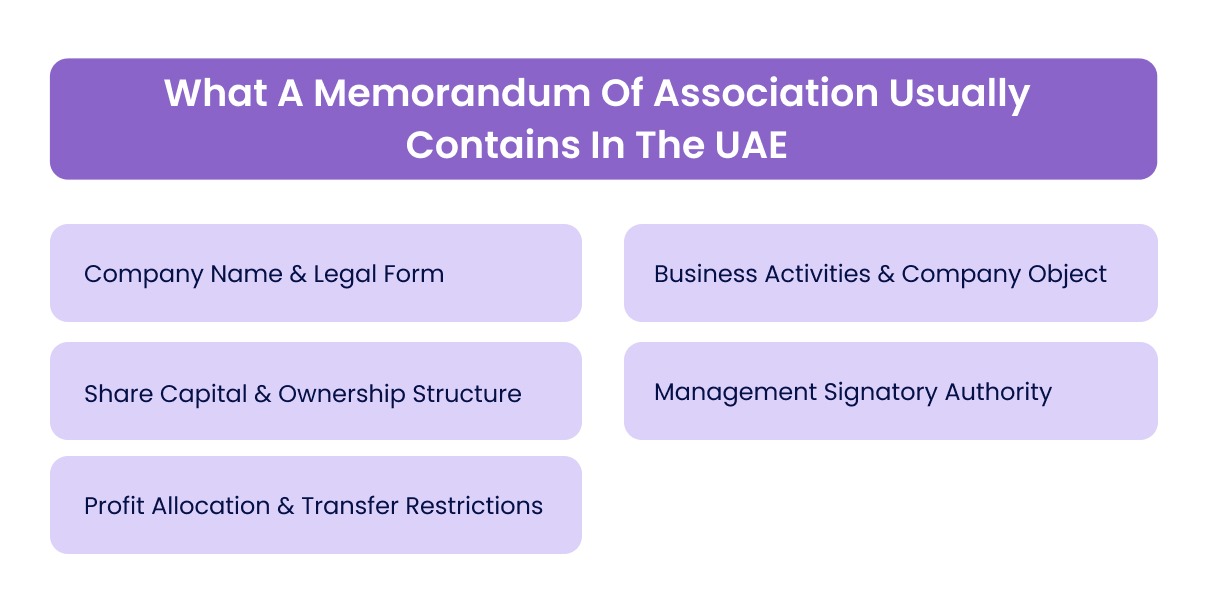
1. Company Name And Legal Form
The MoA records the company’s legal identity, including its name and form. This matters because the legal form determines the corporate framework the business will operate under and affects licensing, governance, and liability treatment.
2. Business Activities And Company Object
The MoA sets out the object of the company, meaning the business activities or purpose for which it is established. This section matters more than many founders expect. If the drafting is too narrow, future activity expansion may require amendments and re-approvals.
3. Share Capital And Ownership Structure
The MoA typically states the company’s capital and the ownership interest of each partner or shareholder. This is one of the most commercially sensitive parts of the document because it affects control, economics, dilution, and future transfers.
4. Management Structure And Signatory Authority
The document may also define how the company is managed, who is authorised to sign on its behalf, and the extent of those powers. For finance leaders, this is one of the most operationally important parts of the MoA because it has direct implications for approvals, vendor commitments, and payment authority.
5. Profit Allocation And Transfer Restrictions
Depending on the structure, the MoA may also cover the company’s financial year, profit and loss distribution, and the conditions for transferring ownership interests. These clauses become especially important in restructuring, partner exits, or investor entry scenarios.
Also Read: Financial Controller Role Duties Skills
Why The Memorandum Of Association Matters After Incorporation
One of the most common mistakes is treating the MoA as a setup document that loses relevance once the trade licence is issued. In reality, the MoA remains important because the company’s actual operating model must continue to match its legal foundation.
That affects areas such as:
1. Banking And Signatory Mandates
2. Vendor And Contract Approval Authority
3. Ownership Change Documentation
4. Capital And Governance Changes
5. Audit And Compliance Readiness
When the legal document says one thing but the business operates another way, control risk starts to build. That is why the MoA matters not only to legal teams, but also to finance leaders responsible for approvals, authority matrices, and financial governance.

What The Difference Is Between The Memorandum Of Association And The Articles Of Association In The UAE
The Memorandum of Association and the Articles of Association are often mentioned together, but they do not serve the same role. In practical terms, the MoA defines the company’s foundational legal and commercial framework, while the Articles of Association deal more with internal governance rules and operating mechanics. This distinction is commonly reflected in UAE company-formation practice and in legal drafting guidance used across the market.
For founders and finance leaders, the practical split is straightforward:
1. The Memorandum Of Association Defines The Company’s Core Structure
It captures what the company is, what it is formed to do, who owns it, and who can legally act for it. That is why the MoA is central during incorporation, ownership changes, and signatory reviews.
2. The Articles Of Association Govern Internal Operating Rules
The Articles typically go deeper into how governance works on an ongoing basis, including internal procedures, decision-making rules, and other operational mechanics. In practice, the MoA is usually the first document reviewed when external parties need to understand the company’s legal framework.
This distinction matters because many businesses treat all constitutional documents as interchangeable. They are not. The MoA usually carries the first-order governance points that affect authority, ownership, and external validity.
When A Memorandum Of Association Needs To Be Amended In The UAE
The MoA should not be treated as a one-time incorporation form. UAE company law requires companies to notify the competent authority and the registrar in writing within 15 working days of amendments to registered particulars, including the company’s name, address, share capital, number of shareholders, or legal form. The law also states that if the MoA is not registered as required, it is not enforceable against third parties to that extent.
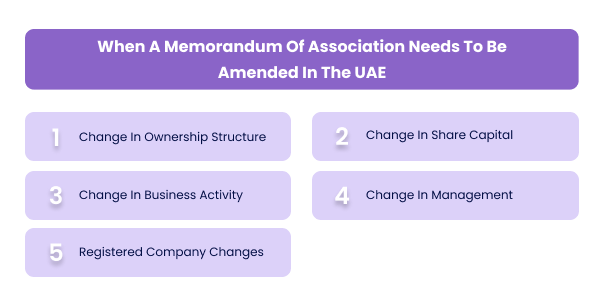
In practice, MoA amendments are commonly needed in the following situations:
1. Change In Ownership Structure
This includes the entry of a new shareholder, the exit of an existing one, or the transfer of ownership interests between parties.
2. Change In Share Capital
Capital increases, reductions, or broader restructuring can require corresponding updates to the MoA so the legal record matches the actual capital structure.
3. Change In Business Activity Or Company Object
If the company expands into new activities or materially revises its stated purpose, the MoA may need to be updated to reflect that scope accurately.
4. Change In Management Or Signatory Authority
A revised authority matrix, new manager appointment, or changes to authorised signatories can have direct implications for the company’s legal and financial operations.
5. Change In Registered Company Particulars
Updates to the company name, registered address, legal form, or related details should be reflected promptly in the registered documents.
Also Read: Account Reconciliation Importance Steps
Common Mistakes Businesses Make With The Memorandum Of Association In The UAE
MoA problems usually do not appear at the drafting stage. They appear later, when the business tries to raise capital, change ownership, revise signing authority, or scale operations while the legal document no longer reflects reality.
1. Treating The MoA As A One-Time Setup Document
Many businesses stop looking at the MoA once the licence is issued. That creates friction later when management authority, ownership, or business activity changes but the legal document remains static.
2. Using Generic Templates Without Reviewing Operational Impact
A generic MoA may appear sufficient at incorporation, but vague drafting around object clauses, signatory powers, or transfer restrictions can create avoidable amendment work later.
3. Letting Approval Workflows Drift Away From Legal Authority
This is one of the most important finance-control issues. The MoA may define who is authorised to bind the company, while day-to-day spend and approvals drift into informal practices that do not reflect that legal structure.
4. Delaying Amendments After Business Changes
When shareholding, capital, signatory authority, or registered particulars change, delayed updates weaken control and can create legal or compliance exposure. UAE law’s notification and registration requirements make this more than an administrative housekeeping issue.
5. Ignoring The Finance Impact Of Signatory Clauses
Signatory power in the MoA affects banking mandates, contract execution, vendor commitments, and payment approvals. Treating it as a purely legal matter can create downstream operational risk.
Related: Effective Business Spending Policies
Why Finance Leaders Should Review The Memorandum Of Association Before Scaling Operations
As a business grows, the MoA becomes more relevant, not less. It affects who can legally approve commitments, how ownership changes are recorded, whether signatory power is clear, and whether the company’s registered structure still matches its operating reality.
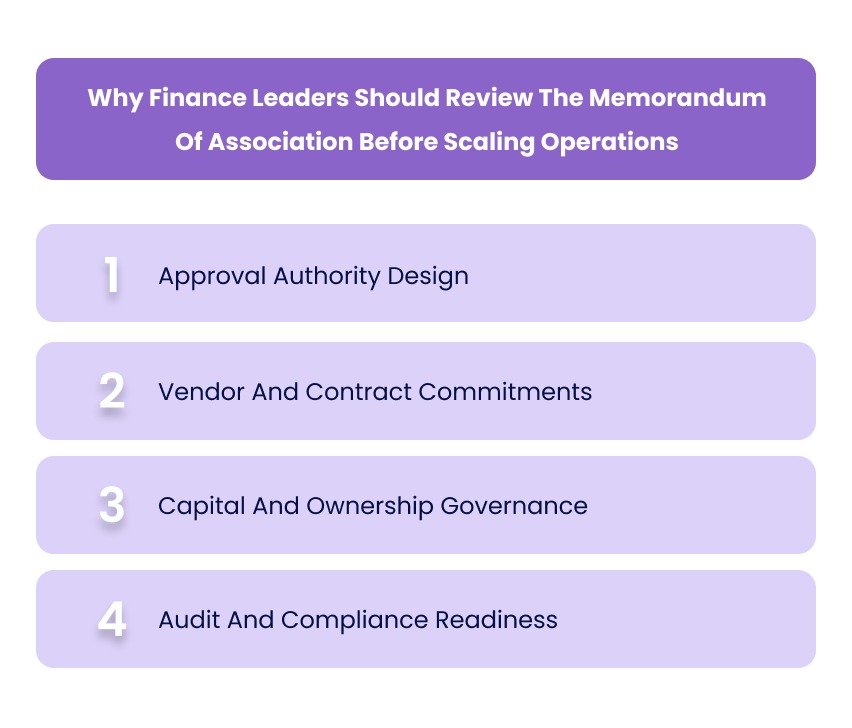
For finance leaders, this matters in several specific areas:
1. Approval Authority Design
Finance workflows should align with actual authorised signatory rules rather than relying on informal delegation.
2. Vendor And Contract Commitments
A company should know who can legally commit it before procurement, treasury, or major vendor relationships scale.
3. Capital And Ownership Governance
Funding rounds, ownership transfers, and restructuring events all become cleaner when the MoA remains current and aligned with company records.
4. Audit And Compliance Readiness
A business with clean constitutional records, matching authority structures, and documented amendments is easier to govern and easier to review.
Also Read: Understanding Spend Visibility Business Benefits
How Alaan Helps Finance Teams Enforce Controls After Legal Authority Is Defined
The MoA defines the company’s legal structure and signatory framework. But once the business starts operating, control risk shifts to execution. If spend happens through fragmented cards, weak approvals, or incomplete documentation, the governance written into the legal documents starts breaking down in practice.
Alaan operates at that execution layer, helping finance teams turn approved policy into controlled day-to-day spend.
- Corporate Cards With Spend Controls
Alaan provides corporate cards with built-in spend controls, including limits and policy-aligned controls that help businesses keep spending within approved boundaries. - Approval Workflows Before Spend Happens
Alaan supports approval workflows and custom controls before transactions become reconciliation issues, which helps companies reflect internal authority structures in real payment execution. - Real-Time Visibility Across Company Spend
Alaan’s platform is built around real-time spend visibility, giving finance teams clearer oversight into where money is going across cards, teams, and categories. - Centralised Receipt And Invoice Documentation
Alaan supports receipt capture and automated expense documentation, reducing fragmented records and making verification easier for finance teams. - Accounting Sync And Reconciliation Support
Alaan integrates with systems including Xero, QuickBooks, NetSuite, and Microsoft Dynamics, helping transaction data move into accounting workflows with less manual effort. - Better Audit Readiness Across Transactions
When approvals, spend controls, receipts, and accounting sync sit in one workflow, finance teams get a stronger trail from policy to payment to booked transaction. That improves control after incorporation, when governance has to be enforced operationally rather than only documented legally.

In practice, this means the legal authority defined in the MoA is easier to uphold once the business starts spending at scale.
Conclusion
The Memorandum of Association is one of the core legal documents behind company formation in the UAE. It defines the company’s identity, object, ownership structure, capital, management model, and signatory framework. It also remains commercially important after incorporation because amendments to key company particulars must be registered and kept current to remain legally effective.
For founders, operators, and finance leaders, understanding the MoA is not just a legal exercise. It is part of maintaining clean approvals, stronger governance, and better control as the business grows.
And once that governance framework is in place, Alaan helps finance teams keep company spending aligned with policy through controlled cards, structured approvals, real-time visibility, and cleaner accounting workflows. Book A Demo Today
FAQs
1. Is A Memorandum Of Association Mandatory For All Businesses In The UAE?
No, the requirement depends on the legal form of the entity. Certain company types, such as LLCs and joint stock companies, require an MoA, while other structures may follow different documentation requirements.
2. Can A Company Operate If The MoA Is Not Updated After Changes?
A company may continue operating, but failing to update the MoA after changes in ownership, capital, or structure can create legal, compliance, and governance risks, especially in audits or disputes.
3. Who Should Review The MoA Within A Company?
While legal teams often draft or review the MoA, finance leaders and founders should also review it, as it directly affects authority, approvals, and financial decision-making.
4. Does The MoA Affect Banking And Payment Authority?
Yes. The MoA can define who is authorised to sign and act on behalf of the company, which often influences banking mandates, contract execution, and payment approvals.
5. How Often Should The MoA Be Reviewed?
There is no fixed frequency, but it should be reviewed whenever there are material changes in ownership, capital, management, or business activity, and periodically as part of governance reviews.
6. What Happens If The MoA Conflicts With Actual Business Practices?
If actual operations do not align with what is defined in the MoA, it can create internal control gaps, legal inconsistencies, and potential disputes, especially when authority or ownership is questioned.
Gain control over business expenses with Alaan corporate cards
Invygo earned AED 100,000 in cashback using Alaan cards
Personalise approval workflows to align with your business needs with Alaan's Spend Management platform
Discover the power of automated expense tracking and smarter spend control with Alaan
Turn data into actionable insights with Alaan's spend management tools
Stay Tax Compliant with UAE's #1 Corporate Card and Spend Management Platform
Customisable corporate card policy template
Know how much Corporate Tax you have to pay this fiscal year
Easily integrate Alaan with your ERP for accurate, real-time expense tracking
Close books faster with Alaan's AI-powered accounting automation
Reconcile your books in minutes instead of hours, every single month.
Keep petty cash organized with Alaan corporate cards and automated expense management